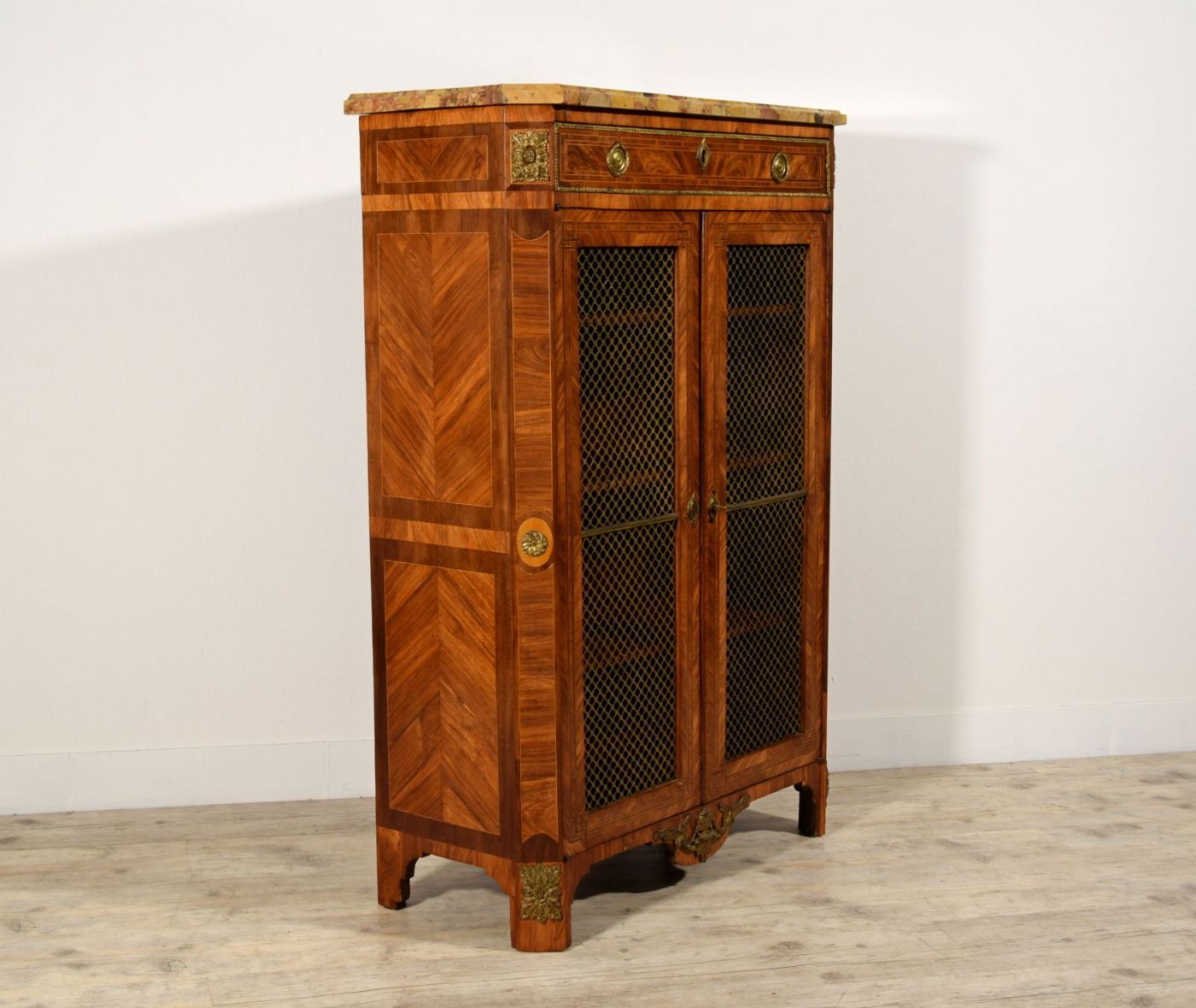
Small veneered wood cabinet, France, 18th century
Stamped C. Mauter
Measurements: H cm 134 x W 90 x D 38; marble top cm W 94.5 x D 42 x thickness cm 2.5
Price: private negotiation
Object accompanied by a certificate of authenticity
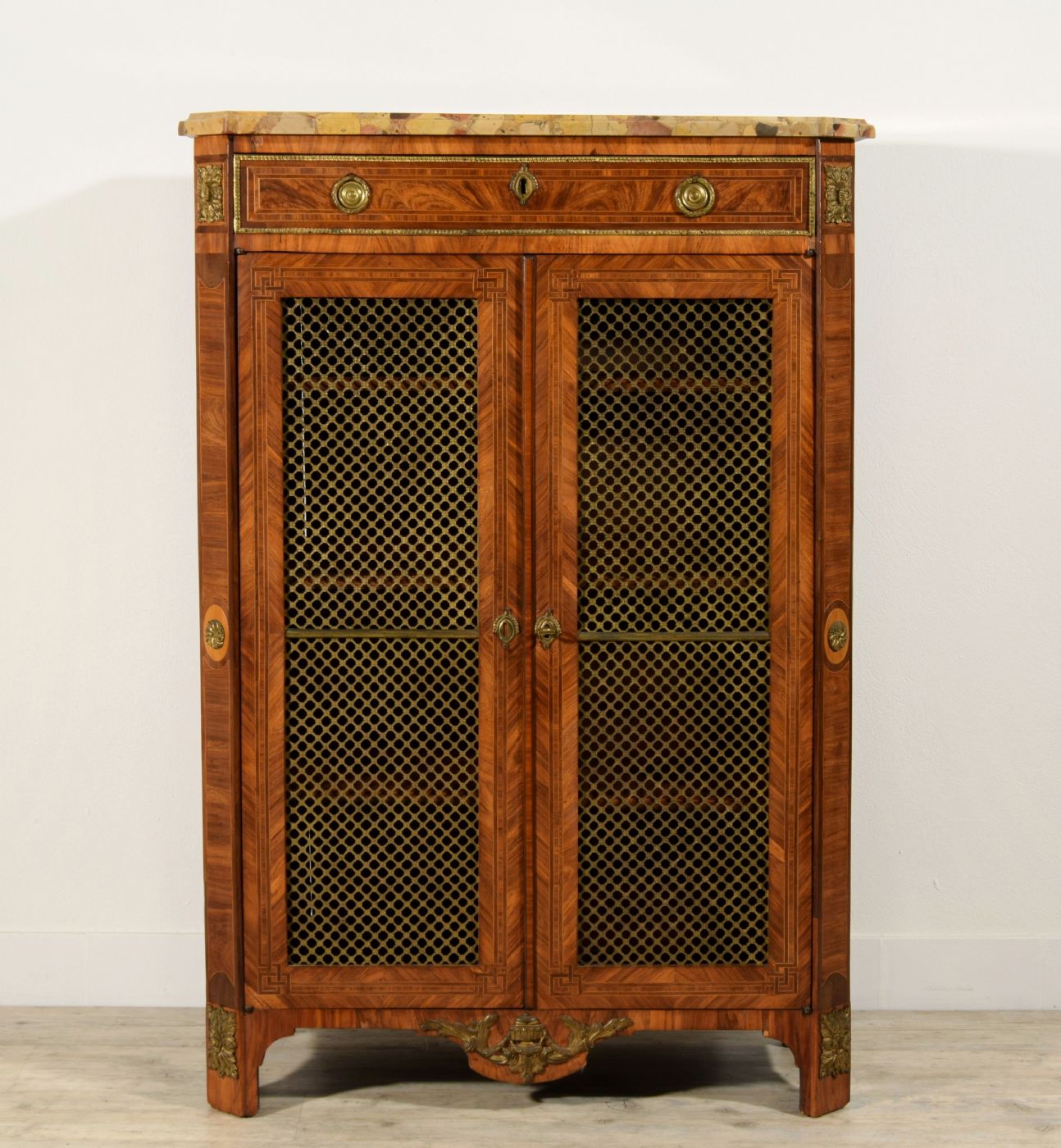
This cabinet, which can also be used as a bookcase, was made in France in the 18th century.
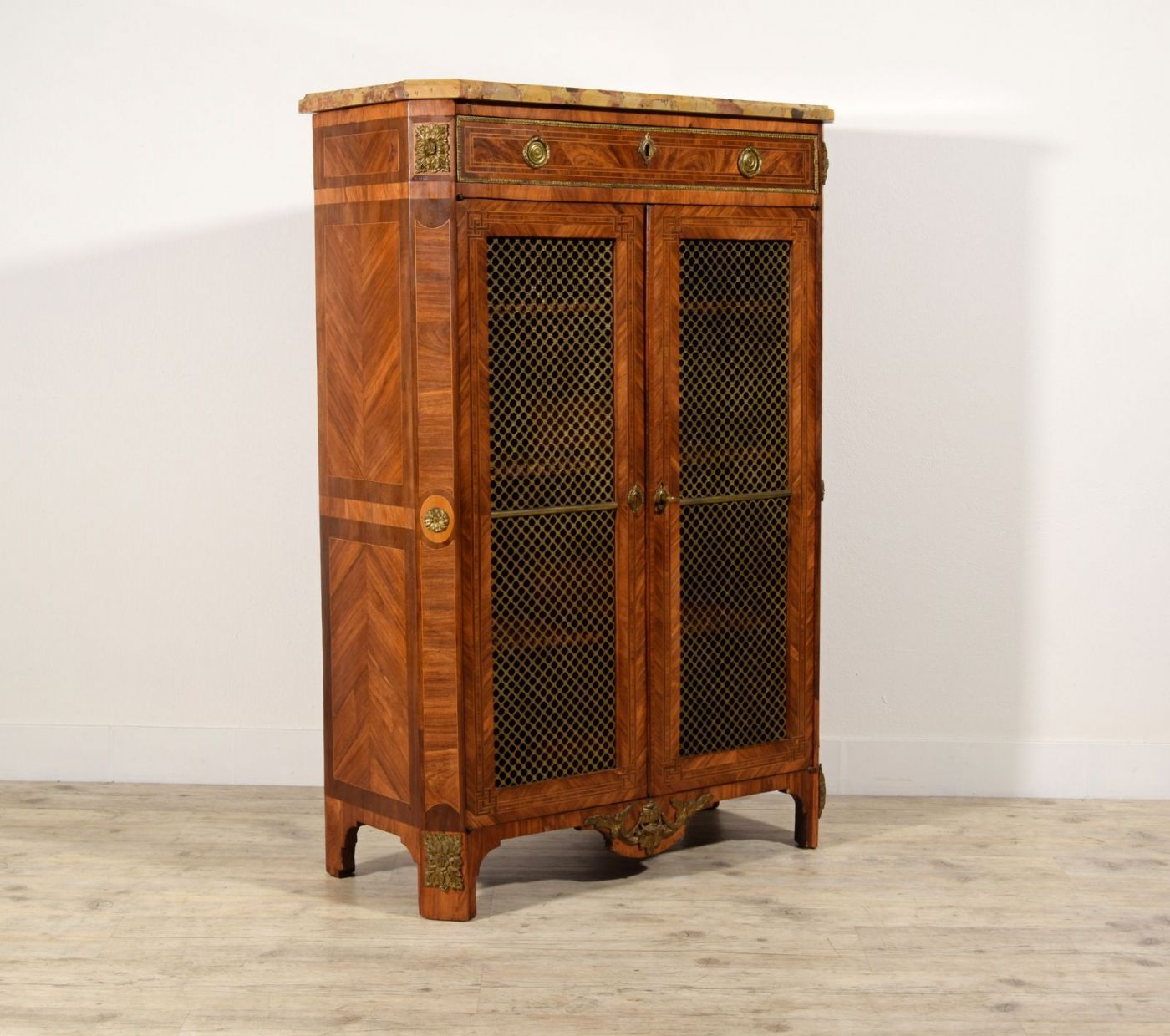
Its structure is veneered in precious bois de rose and rosewood and decorated with inlaid threads. It is embellished with a contemporary marble top. The band under the top has a drawer with a lock and circular handles in chiselled and gilded bronze contemporary with the piece, as are the other bronzes present. The front corners are at 45 degrees, enriched with gilded and chiselled bronzes with foliate motifs. The front of the cabinet has two doors closed by perforated mesh with circular bronze motifs. Inside there are several shelves for storing objects or books. The lower, mixtilinear band is decorated in the centre with a gilded bronze application with phytomorphic motifs and garlands. The four feet are quadrangular and moulded. The skilful use of different woods in colour and characteristic grain has allowed the cabinetmaker to create very refined and decorative chromatic games and contrasts.
The stamp bears the name of cabinetmaker Conrad Mauter (1742 - 1810), master cabinetmaker of the Count d'Artois, the future Charles X, King of France.
This piece of furniture is small in size, suitable for use as a cabinet or bookcase and easily placed in any furnishing context. It can be placed in an entrance hall or study, in a living room or bathroom, as well as in a bedroom, being particularly adaptable to any need.
Conrad Mauter was born in 1742 in Germany and emigrated to Paris around 1765, where he died on 14 May 1810. On 16 April 1787 he married Charlotte Félicité Foureau, daughter of Louis Foureau, a master cabinetmaker who worked at Faubourg Saint-Denis. He began working on his own in rue du Faubourg Saint-Antoine from 1768 and obtained the title of master on 10 September 1777. His fame grew rapidly. In 1782 he became the ordinary supplier of the Count d'Artois, brother of the king and future Charles X. Thus, until the French Revolution, he would deliver his furniture to the Temple Palace, the Château de Bagatelle, the Château de Saint-Germain-en-Laye, the Château de Maisons and even commodes to the Château de Saint-Cloud in 1791. He was one of the most prolific furniture makers of the late 18th century. Despite this, many of his works in these castles were destroyed or disappeared during the French Revolution. Under the Directory, Mauter continued his production, also making Louis XVI style furniture. At his death his business was still particularly prosperous: he had eight cabinetmakers on the payroll and his warehouse was very substantial (estimated at over 22,000 francs). On his death, his company was bought by Nicolas-Louis Sandrin. Mauter left a large number of Louis XVI furniture, almost all in mahogany, characterised by classic lines. His production is divided into two parts: very simple service furniture with few bronzes, and more elaborate luxury furniture. Specialising in living room tables, guéridons and games tables, he also left chests of drawers, secretaries, desks, bonheurs-du-jour and bookcases.


.JPG)
.JPG)
.JPG)
.JPG)
.JPG)
.JPG)
.JPG)