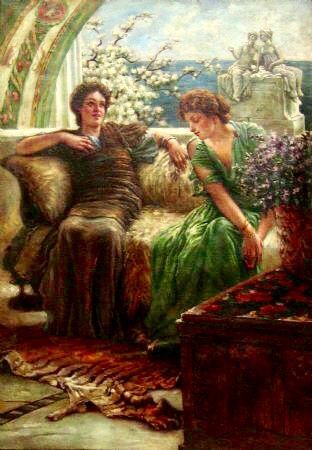
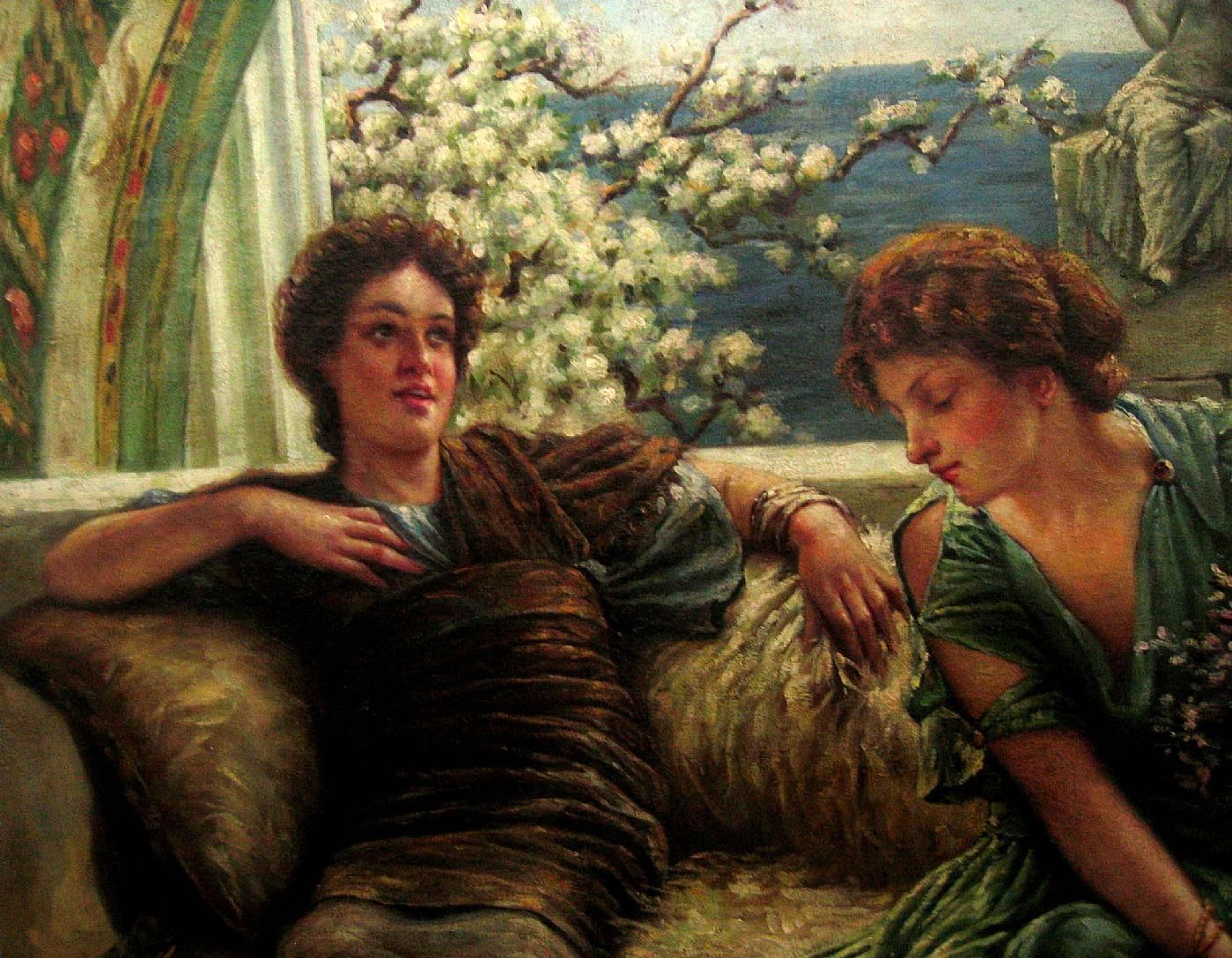
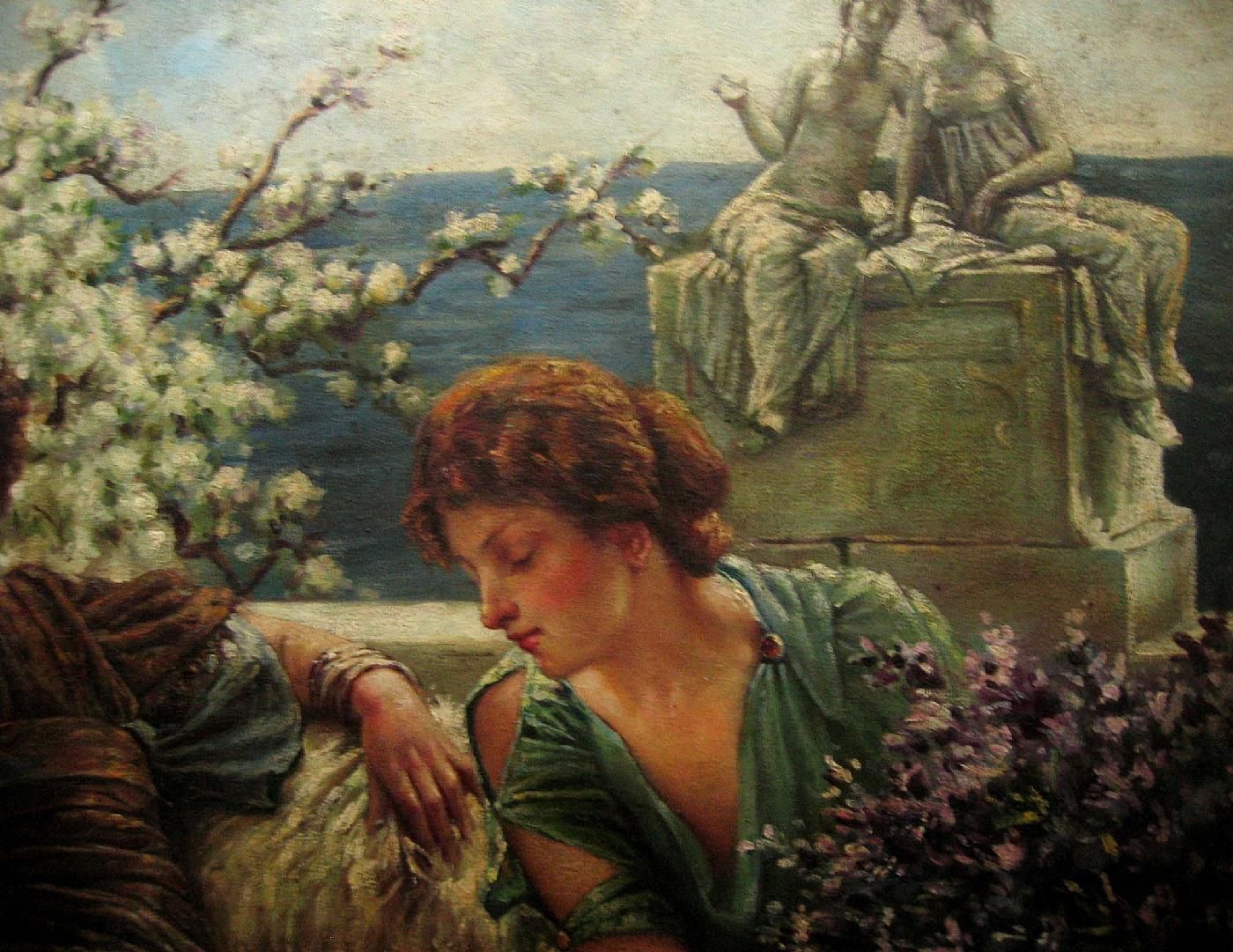
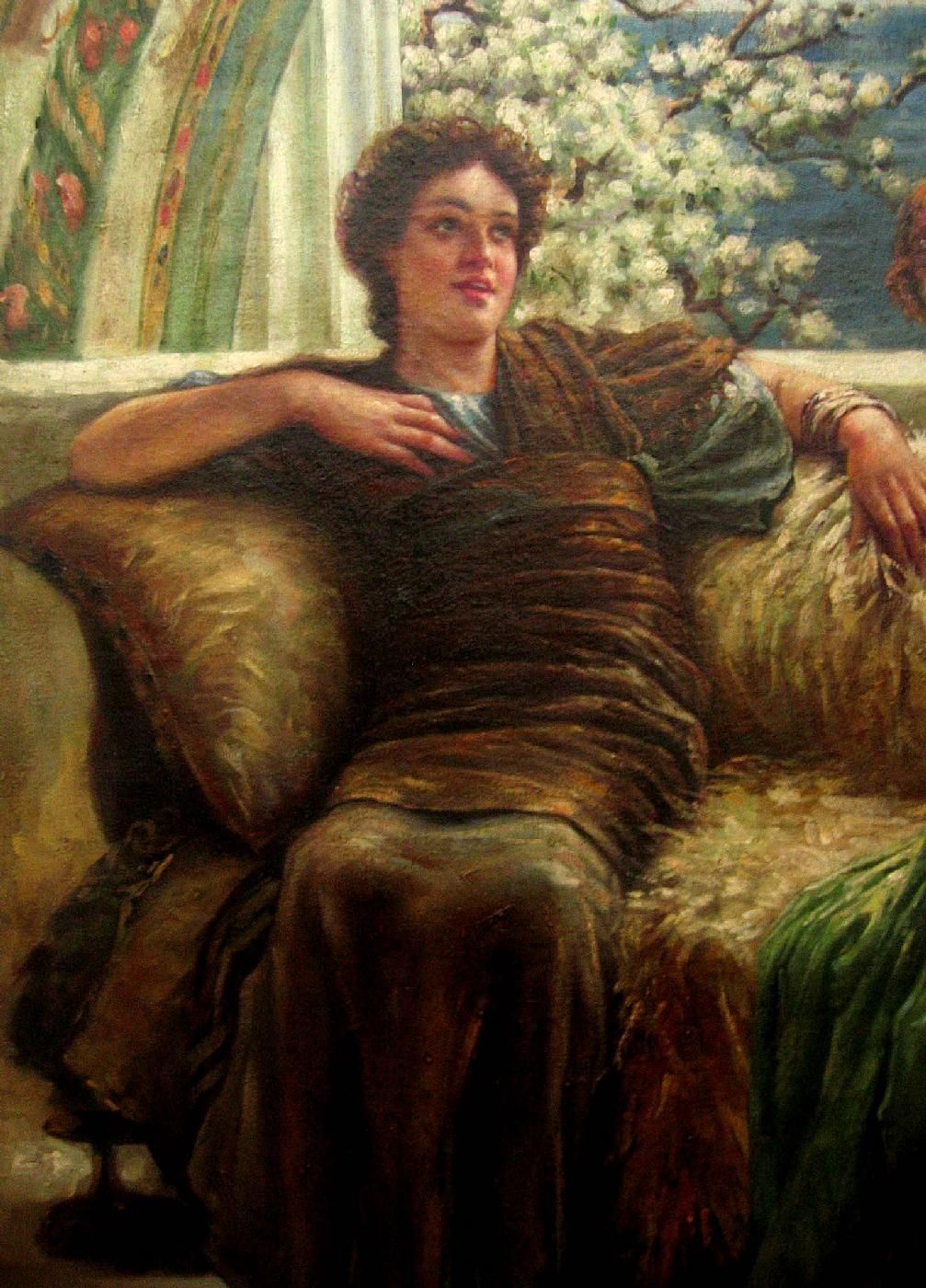
Refined painting that refers to Sir Alma Tadema's painting depicting a meeting between friends inside an elegant Pompeian patio overlooking the sea. The two young women are dressed in "Roman-style peplums", at their feet a tiger skin emphasizes the youthful and disheveled atmosphere of the scene. Behind the two protagonists is a beautiful sculptural group, also female, portraying two women intent on confiding in each other.
Oil on canvas.
Italy - 1920 (approx.)
Measurements : Height cm. 101 Width cm 69
Sir Lawrence Alma-Tadema, born Lourens Alma Tadema, Dutch painter. Born in Dronrijp on January 8, 1836 and died in Wiesbaden on June 25, 1912. His body rests in a crypt in St. Paul's Cathedral in London.
Trained in Belgium at the Royal Academy of Fine Arts in Antwerp (Koninklijke Academie voor Schone Kunsten van Antwerpen), from 1870 until his death he settled in England. The mid-nineteenth century, thanks to archaeological missions, brought back the taste for ancient civilizations: the Greeks and Egyptians (already before with Winckelmann and Napoleon's campaigns), Rome and the Pompeian world with the discoveries in Herculaneum and surroundings. Alma-Tadema could not fail to notice this antiquity that was coming back to light. He became, in fact, one of the most famous painters of the late nineteenth century in Great Britain and considered one of the most influential Victorian painters.
He married Marie-Pauline Gressin in the town hall of Antwerp. Nothing is known of their meeting. They spent their honeymoon in Florence, Rome, Naples and Pompeii. This, his first visit to Italy, developed his interest in representing the life of ancient Greece and Rome, especially the latter since he found new inspiration in the ruins of Pompeii, which fascinated him and inspired much of his work in the coming decades. Widowed with two daughters to raise, Alma-Tadema in 1871 married an English noblewoman, Laura Epps, who lent her features to various paintings.
Two years later he became a British citizen in all respects, in 1876 he entered the Royal Academy, in 1899 he was knighted and in 1907 he had the honor of the Order of Merit. Moreover, knowledge of the Pre-Raphaelites influenced his painting where he brought sensitive modifications to his pictorial palette, also to the consistency of the brushstrokes. With his second wife they made a trip to the Continent that lasted five and a half months and took them through Brussels, Germany and Italy. In Italy he returned to visit the antiquities of Rome and Pompeii and this time acquired several photographs, mostly of the ruins, starting his immense collection of sheets sufficient for a large documentation used for the completion of future paintings. In January 1876, he rented a studio in Rome. The family returned to London in April, visiting the Parisian salon on the way back. For over sixty years he gave his audience exactly what it wanted: distinctive and elaborate paintings of beautiful people in classic settings. His incredibly detailed reconstructions of ancient Rome, with languid men and women posed against white marble in dazzling sunlight, famous for his depictions of the luxury and decadence of the Roman Empire, with languid figures set in fabulous marble interiors or against a backdrop of dazzling blue Mediterranean sea and sky seen from the houses of Pompeii
Already at the time critics defined his paintings as a kind of museums, a gallery of perfectly delineated archaeological objects, in line with the antiquarian and collecting culture of the time, expressed in private homes and artists' studios, full of originals, copies of masterpieces and decorative minutiae of all kinds and genres. The great ability and originality of Alma-Tadema is revealed with vigor in the rendering of materials: precious and refined objects, refined fabrics of which he manages to render the consistency and quality with surprising virtuosity.
Amazing sets of shining marbles form the background to his creations, a sort of spectacular and ideal setting in which the precious visions of the artist come to life.
Sensuality and pleasantness animate Alma-Tadema's painting, which shuns the representation of violent images, even if handed down from antiquity. With ancient clothes he dresses and ennobles Victorian society, with all the splendor of the mansions, the refined elegance of women's clothes, the allusive enigmaticity of seemingly normal family ménages.