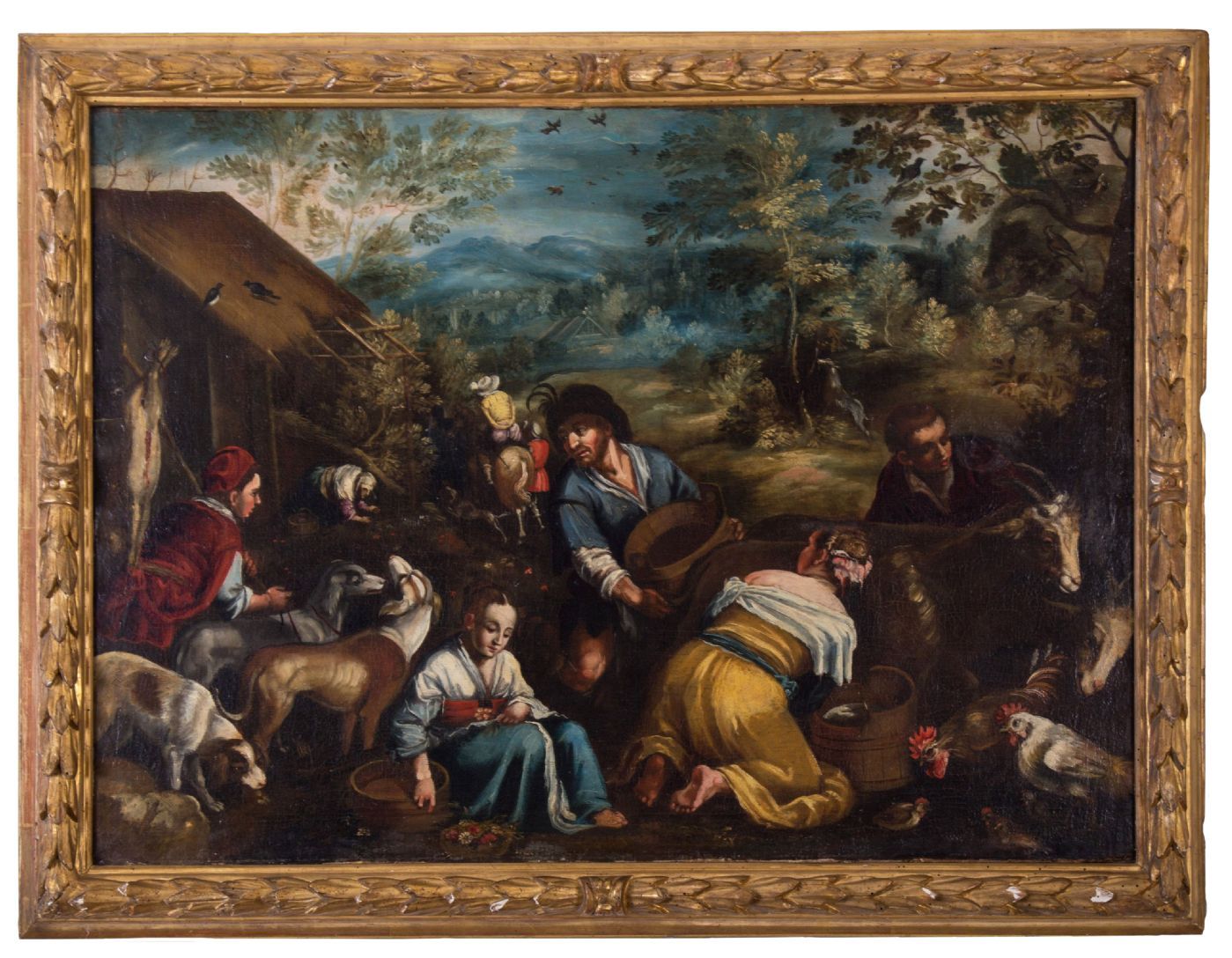
He was born in Bassano around 1515 from the painter Francesco dal Ponte, later called the Elder, and his first wife Lucia Pizzardini. He initially trained with his father, a modest artist originally from Gallio and the founder of the family. According to Ridolfi's account, he then moved to Venice to learn the secrets of the trade in the workshop of Bonifacio de' Pitati.
Returning to his homeland, he joined the family business, gradually assuming a leading role. In 1535 he created three large canvases for the public palace of Bassano, depicting Christ and the Adulteress, The Three Children in the Fiery Furnace and Susanna and the Elders, in which the influence of the master is combined with a careful rendering of the naturalistic data and influences of Titian and Lorenzo Lotto emerge.
Between 1535 and 1540 he approached the plasticity of Pordenone. From this period are Samson and the Philistines, now in Dresden, and the Adoration of the Magi, now in Burghley House.
The lack of traces of movements has led to the assumption that he spent almost his entire life in Bassano. In 1541 the city council granted him exemption from taxes, and from this it appears that he was the head of the family and that therefore his father Francesco had died.
From the forties he approached Mannerist painting, especially that of Francesco Salviati; between 1540 and 1550 he executed the Martyrdom of Saint Catherine of Alexandria now in the Civic Museum of Bassano, the Decapitation of the Baptist of Copenhagen, with slender and tapered figures inserted in a rarefied scene, the Ascent to Calvary, where the landscape is taken from German engravings, the Nativity of Hampton Court and the Rest during the Flight into Egypt of Milan.
In 1546 he married Elisabetta Merzari (+ 5 September 1601) by whom he had eight children: Francesco Alessandro (3 January 1547 - March 1547), Francesco Giambattista (7 January 1549 - 2 July 1592), Giustina (27 December 1551 - 22 July 1558), Giovanni Battista (4 March 1553 - 1613), Benedetta Marina (21 March 1555), Leandro (10 June 1557 - 15 April 1622), Silvia Giustina (17 April 1560) and Girolamo (3 June 1566 - 8 November 1621). All the male children became painters, as well as the nephew Jacopo Apollonio, son of Marina and Apollonio Apolloni.
Between 1550 and 1560 he created the Last Supper of the Borghese Gallery in Rome, in which he takes up the luministic style of Tintoretto.
He produced paintings in the family workshop, together with his sons, until his death
Provenance: Bassano del Grappa, Veneto
Dimensions:
with frame:
W: 115 cm
H: 87.5 cm
Without frame:
73X105 cm