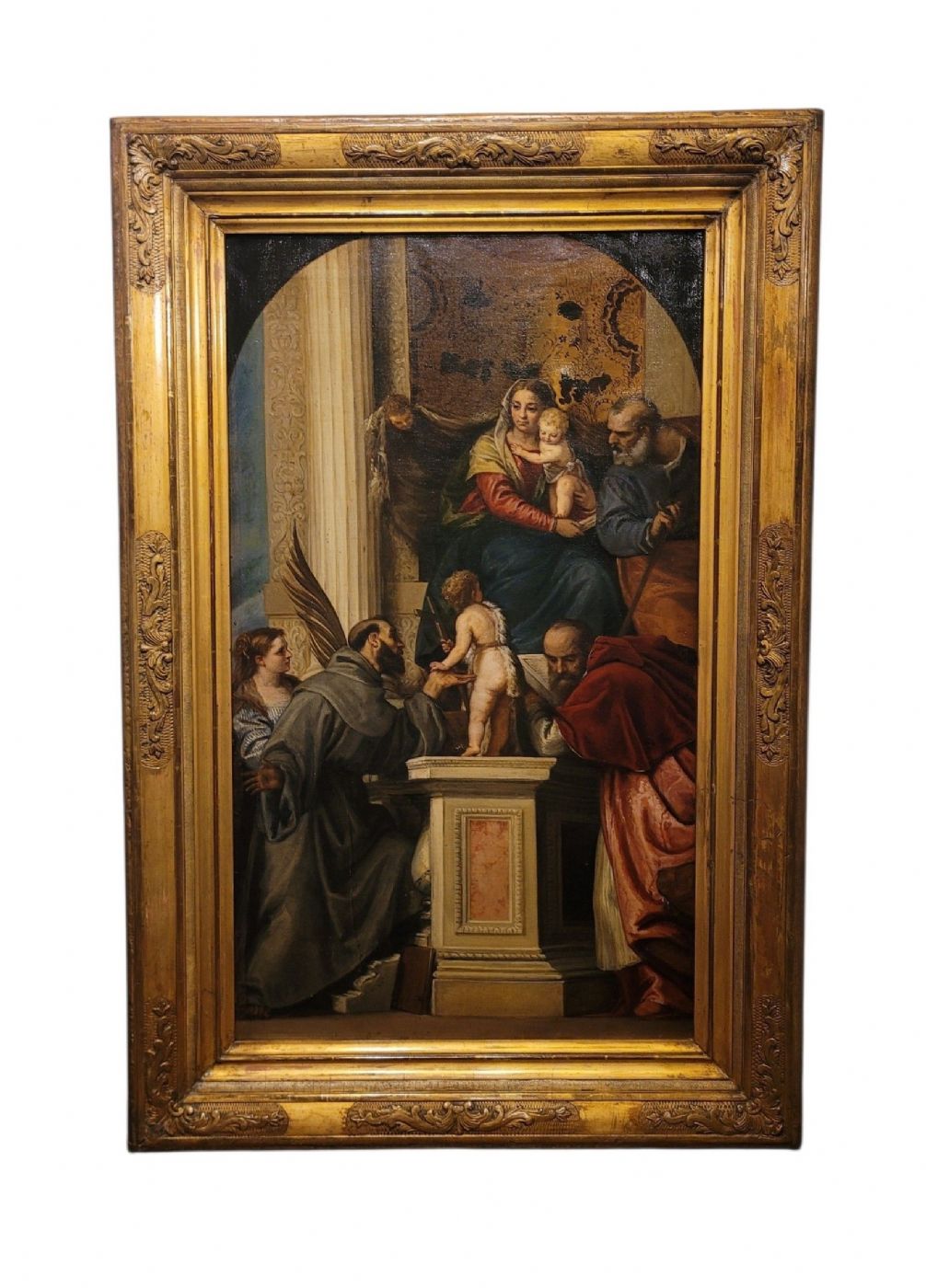
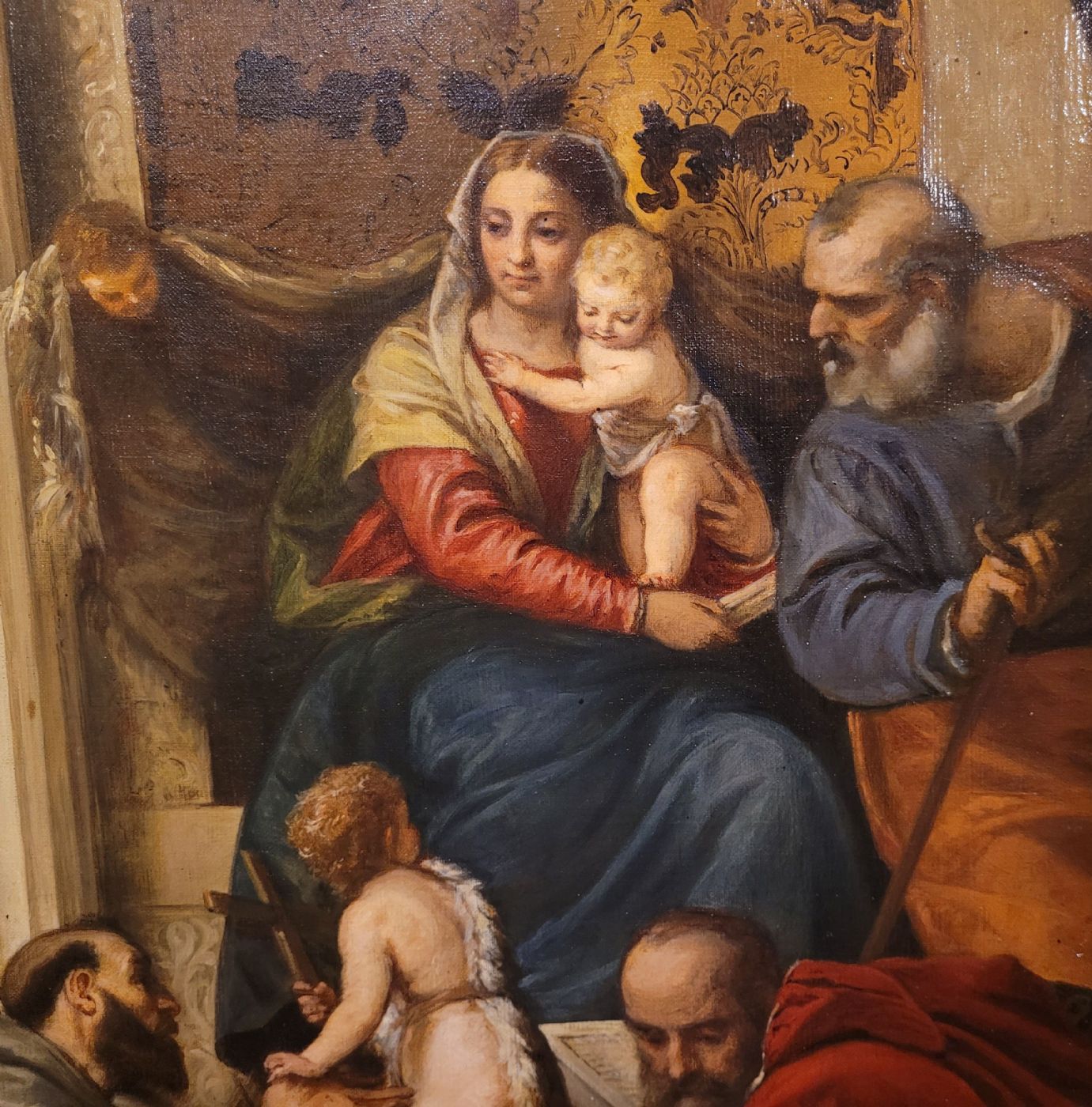
Follower of Paolo Veronese (1528–1588) “Madonna and Child with Saints” from a detail of the Pala di San Zaccaria
Description:
Follower of Paolo Veronese (1528–1588)
“Madonna and Child with Saints”
from a detail of the Pala di San Zaccaria
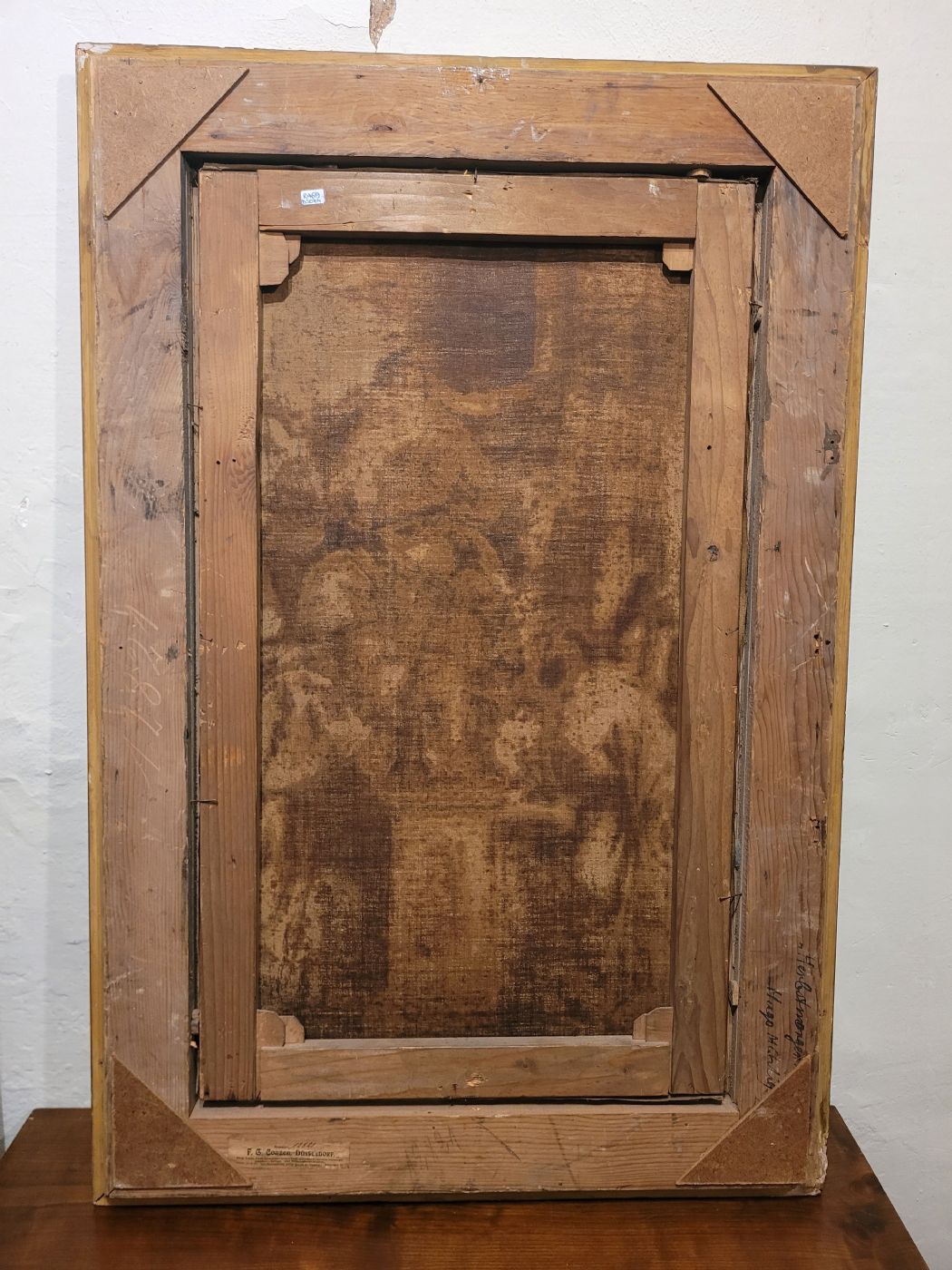
Technique: Oil on canvas, first canvas from the 19th century
Canvas: 85.5x49.5 cm
Frame: 107x71 cm, contemporary
Condition: Very good
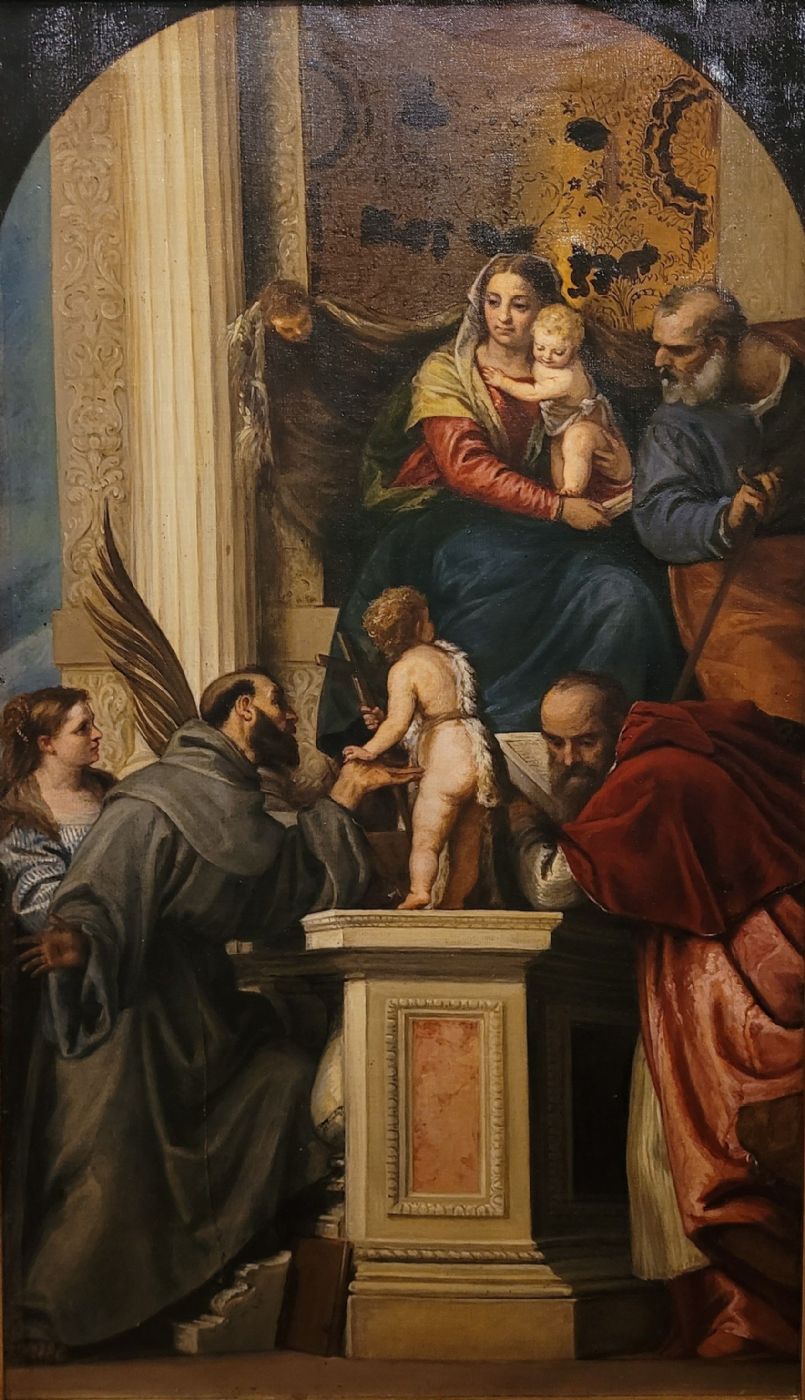
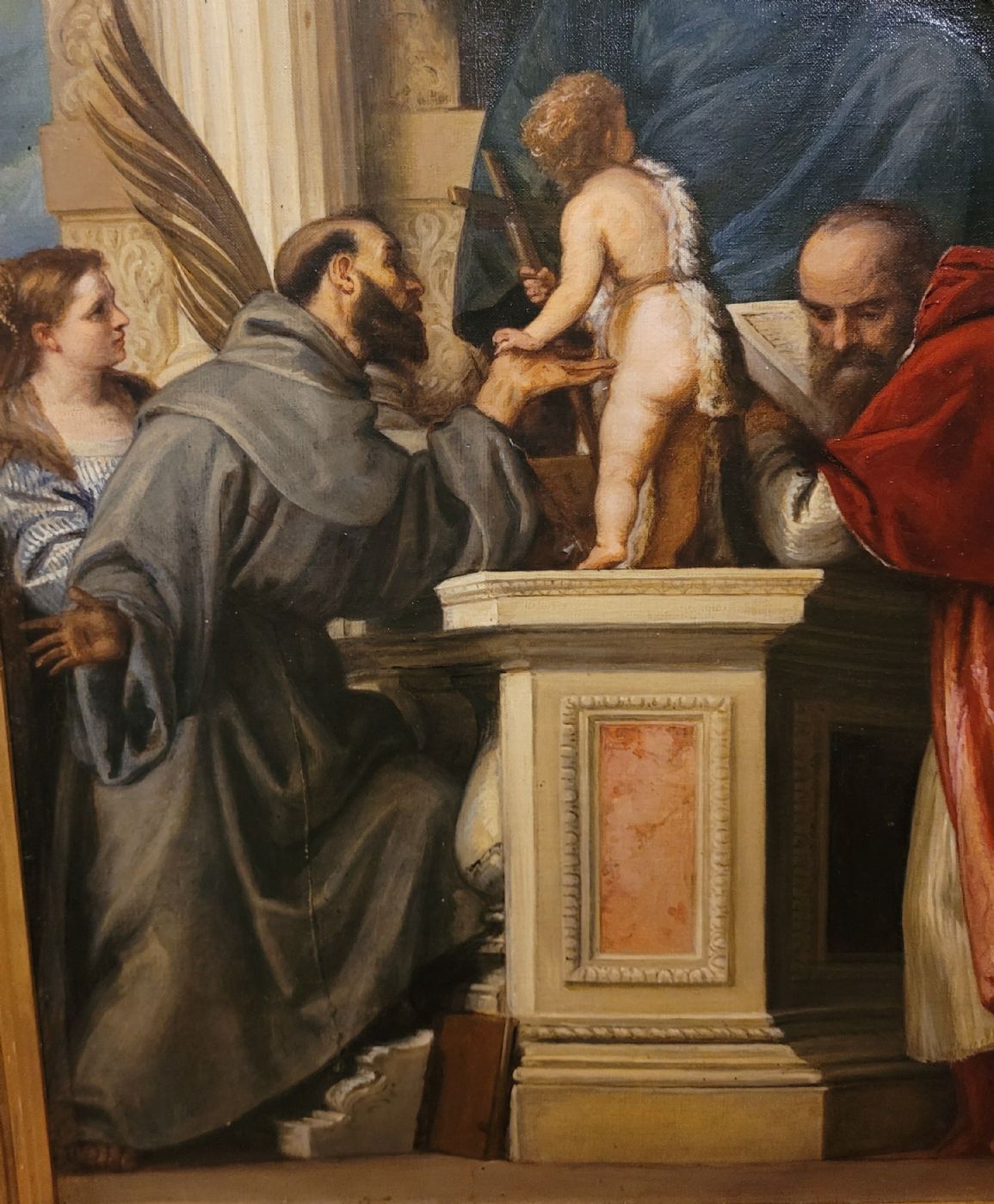
A refined sacred composition depicting the Virgin enthroned with the Child, flanked by Saint Joseph and surrounded by saints, including Saint Francis of Assisi receiving the infant Saint John the Baptist, following one of the most famous compositional schemes developed by Paolo Veronese.
The work derives directly from the monumental Pala di San Zaccaria, a masterpiece created by the Veronese master for the Venetian church of San Zaccaria and now housed at the Gallerie dell'Accademia in Venice, faithfully reproducing the central group of the composition.
The monumental layout is underscored by the presence of the large classical column and the Virgin's throne, adorned with a rich damask drape, while the arrangement of the figures maintains the rigorous spatial balance typical of Veronese's painting. The color palette, dominated by intense reds, deep blues, and muted greens, effectively echoes the tradition of the great Venetian school of the 16th century.
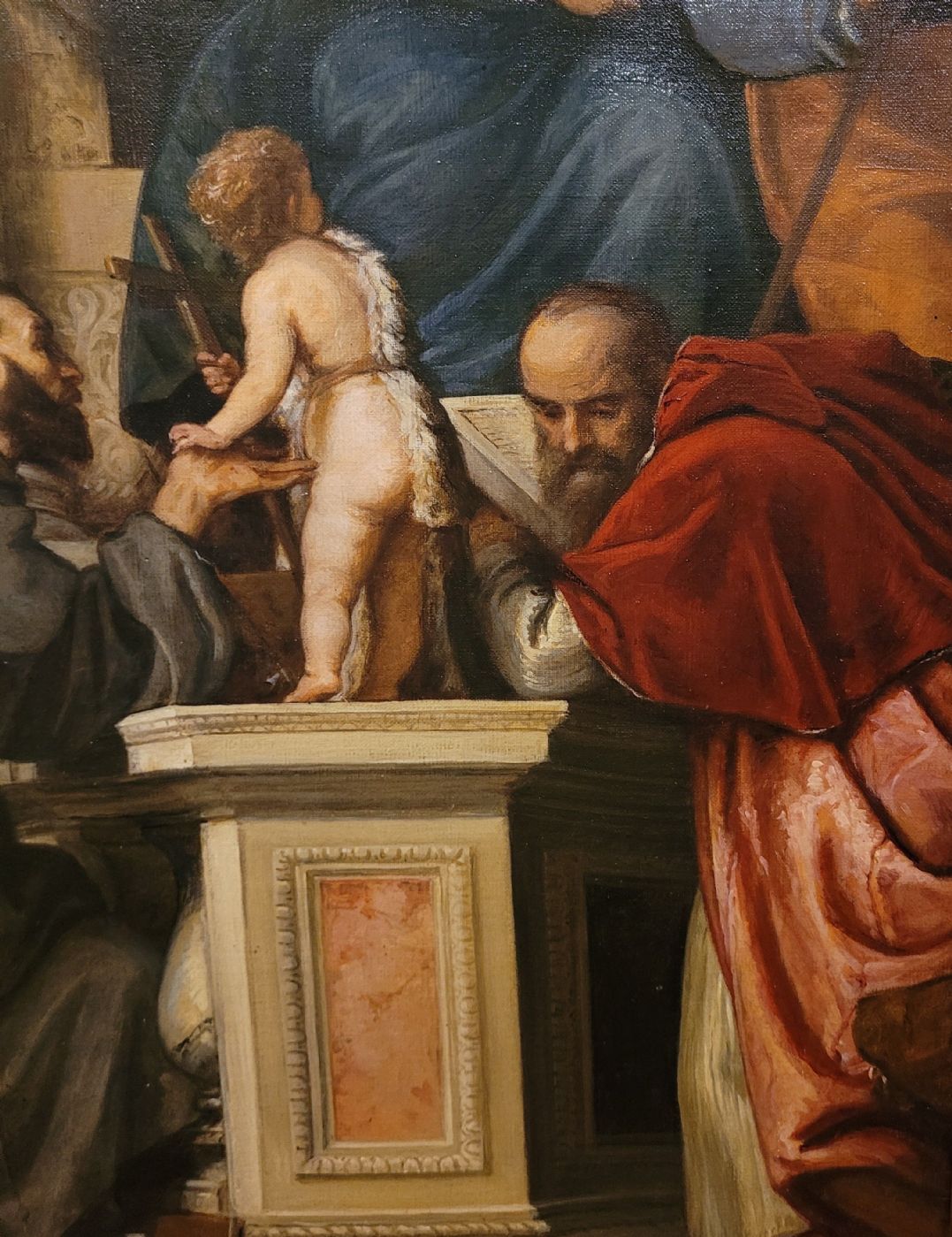
While clearly and faithfully inspired by the famous prototype, the painting exhibits an execution sensibility attributable to 19th-century pictorial culture, evident in the more compact application of color, the greater definition of the faces, and the pursuit of an accurate finish.
Due to these characteristics, the work can be attributed to a 19th-century Venetian painter, a follower of Paolo Veronese, active during the period of rediscovery of great Renaissance Venetian painting, which experienced extraordinary fortune among European collectors in the 19th century. The diffusion of Venetian public collections and the Grand Tour facilitated the creation of numerous replicas, reinterpretations, and copies drawn from the master's great decorative cycles.
It is within this context that the present painting fits, taking one of the most famous sections of the Pala di San Zaccaria and reinterpreting it in a fully 19th-century taste, aiming to preserve the monumental layout of the original while adopting a smoother technique and a more compact pictorial substance.
The work constitutes a significant testimony to the critical and collecting fortune of Paolo Veronese in the 19th century and the persistent vitality of the Venetian pictorial tradition.