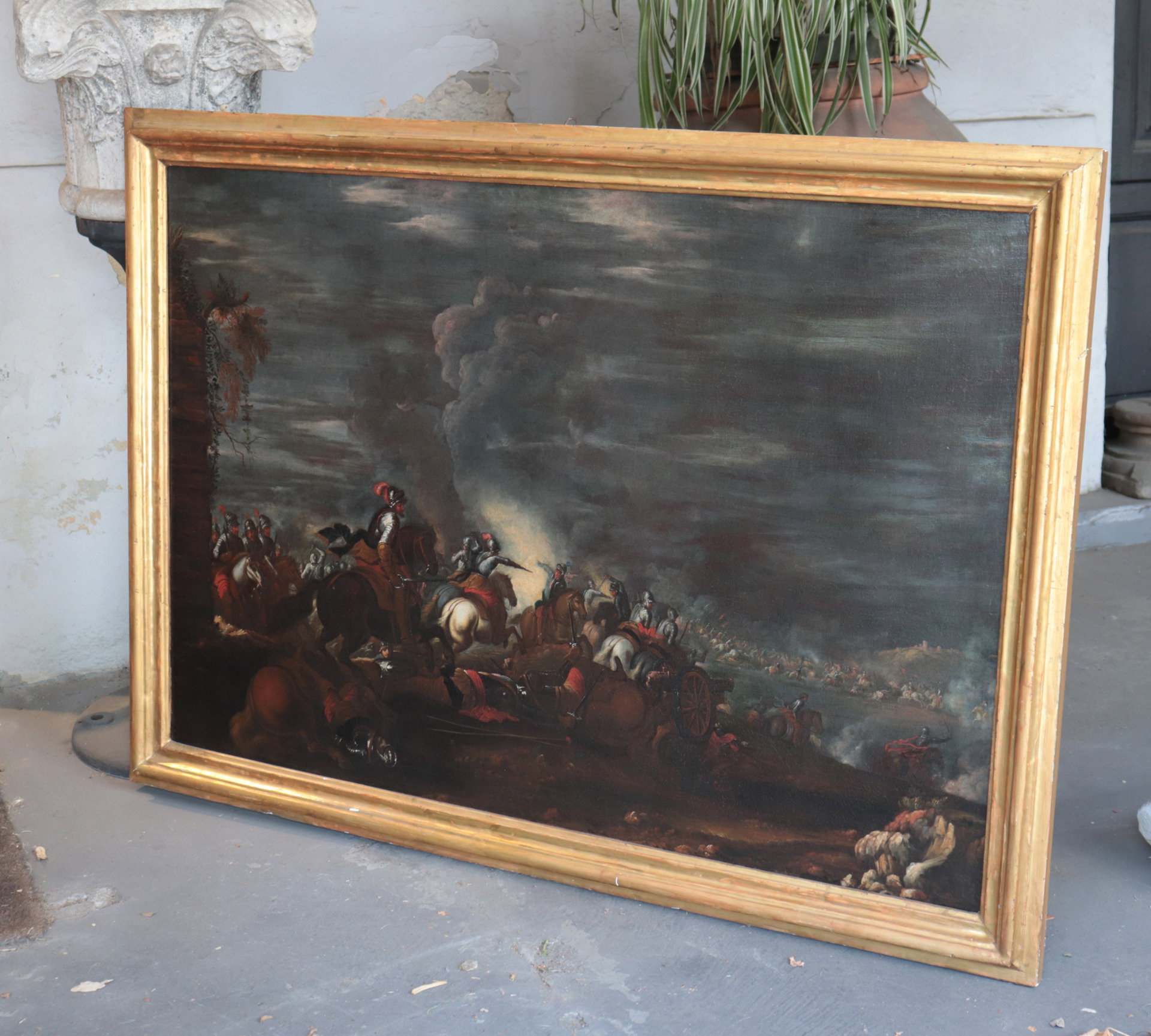
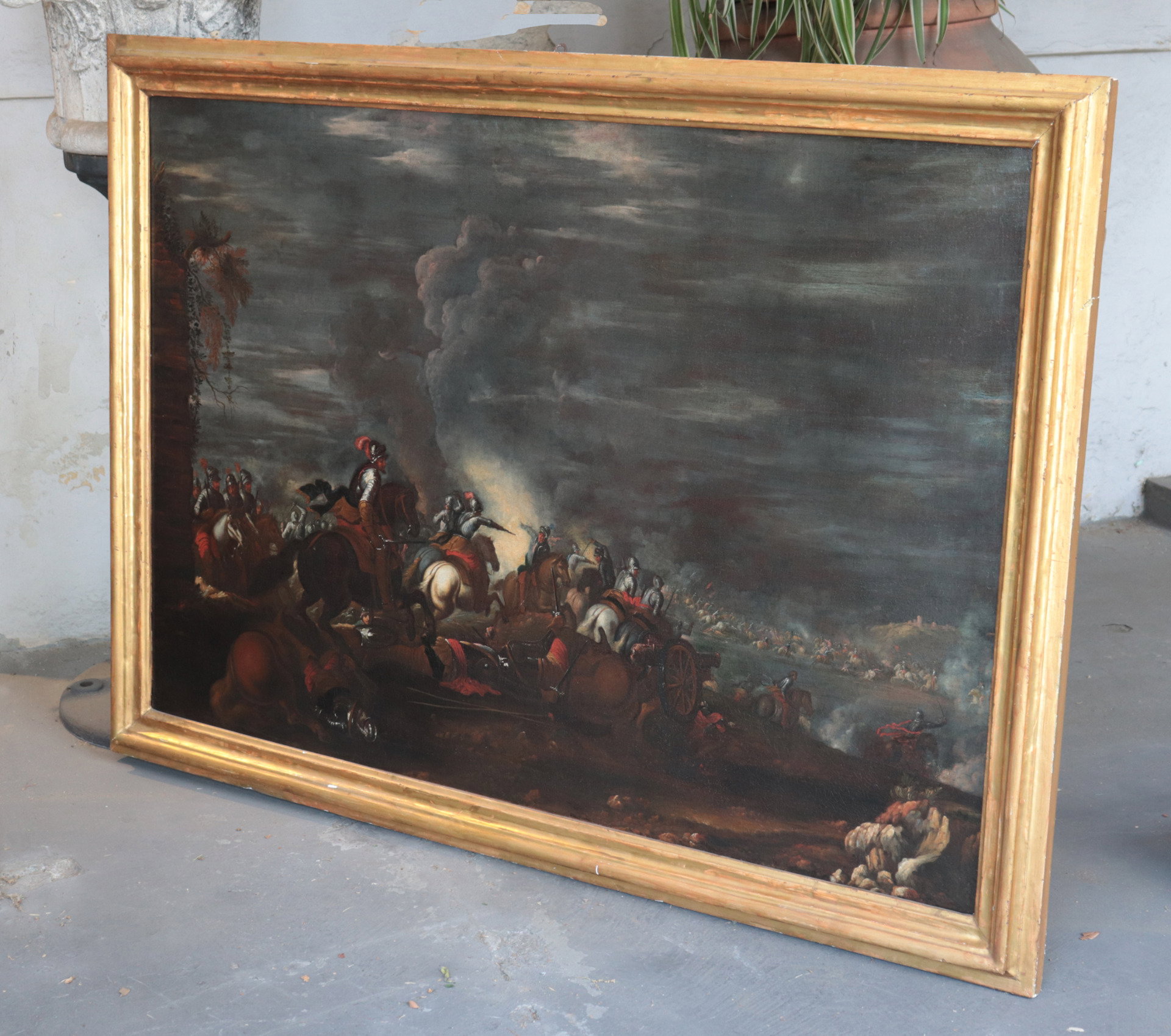
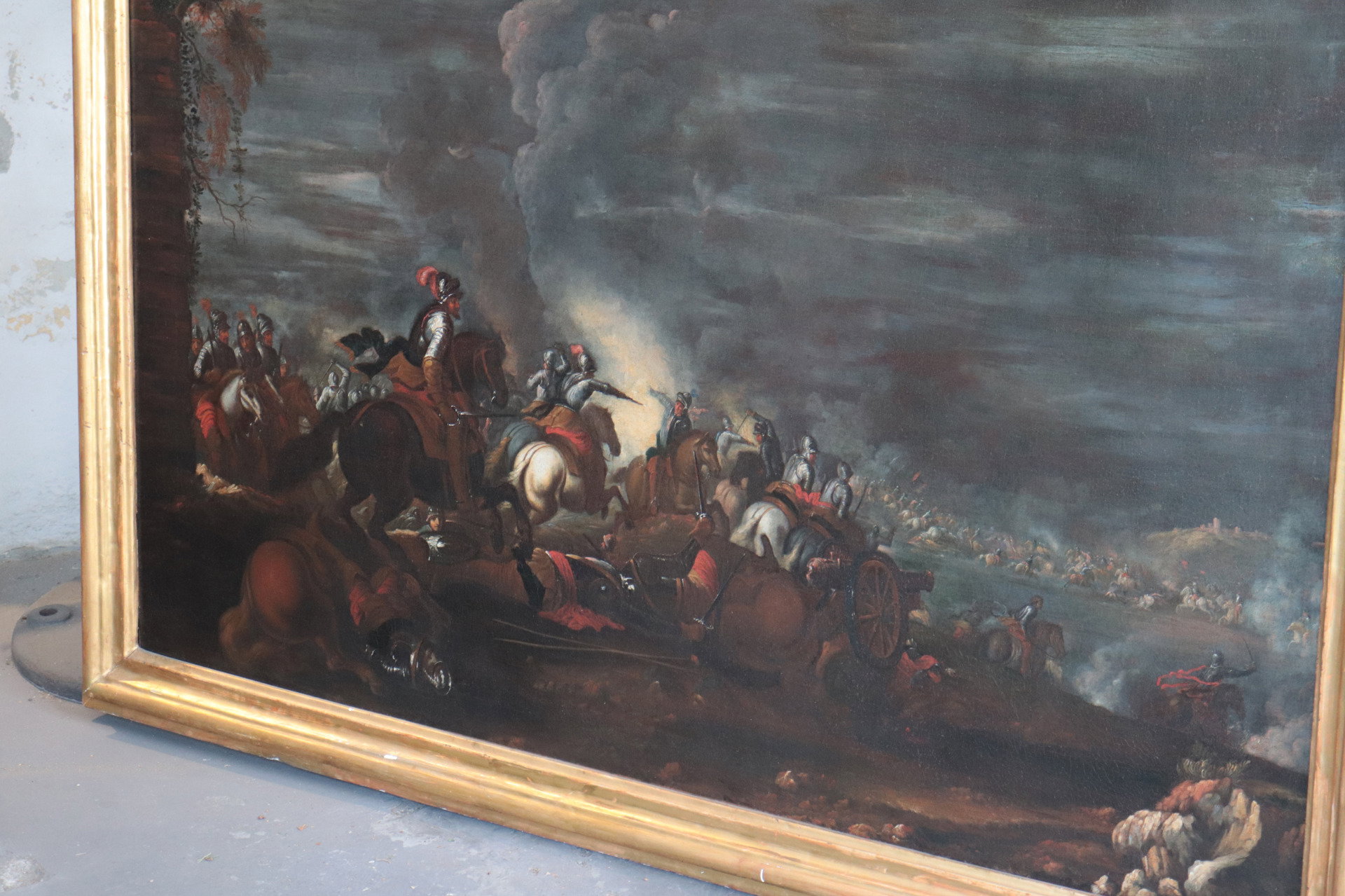
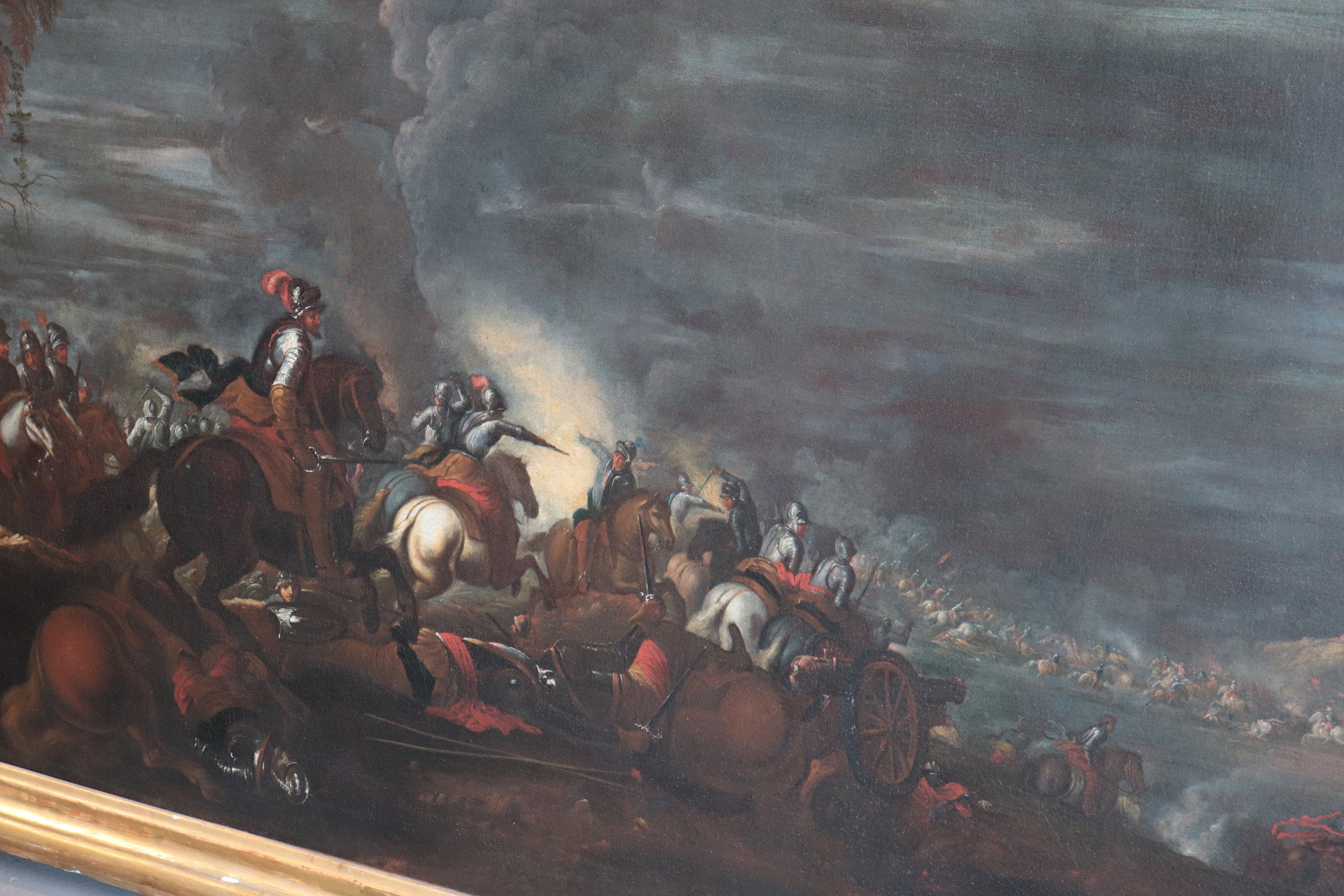
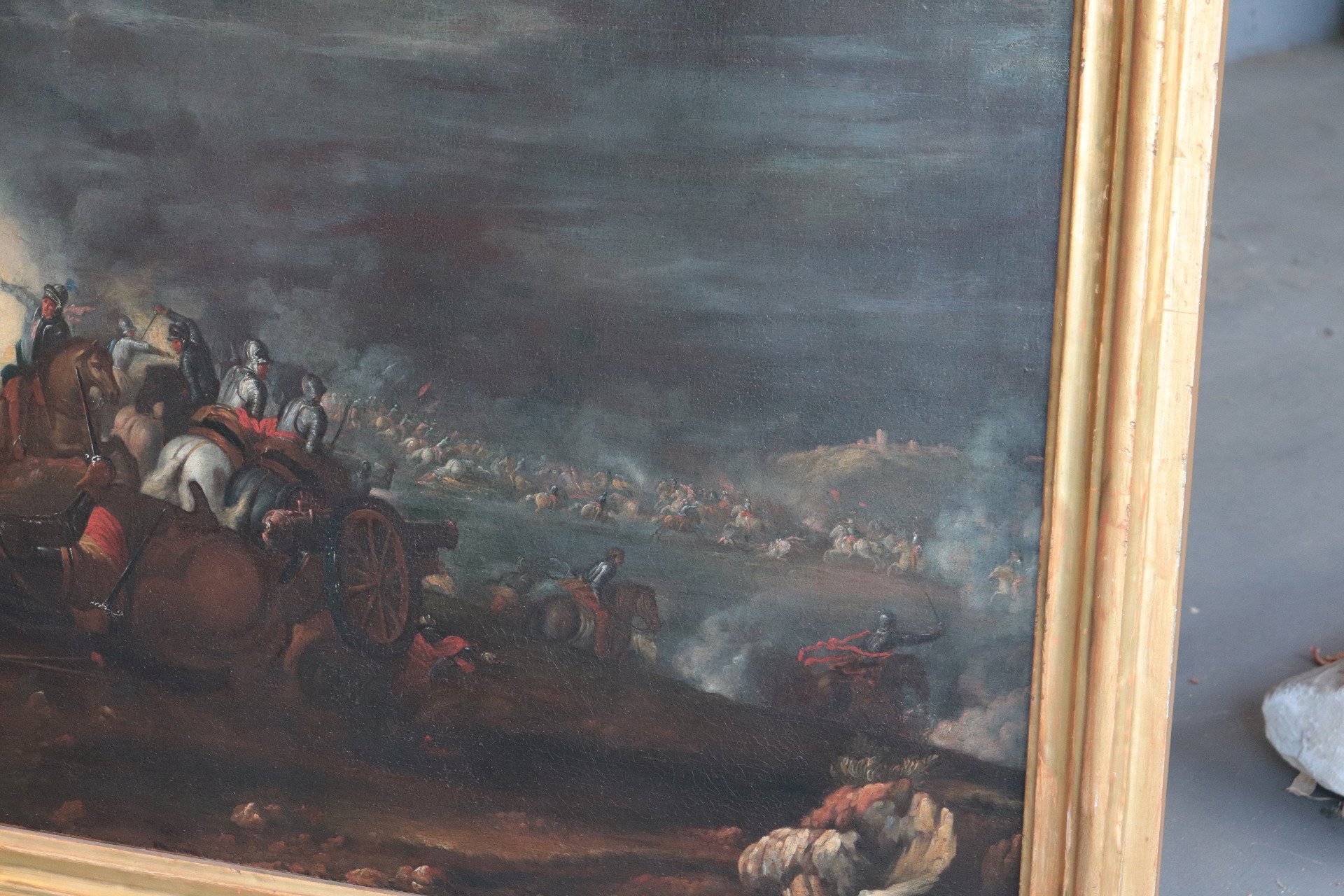
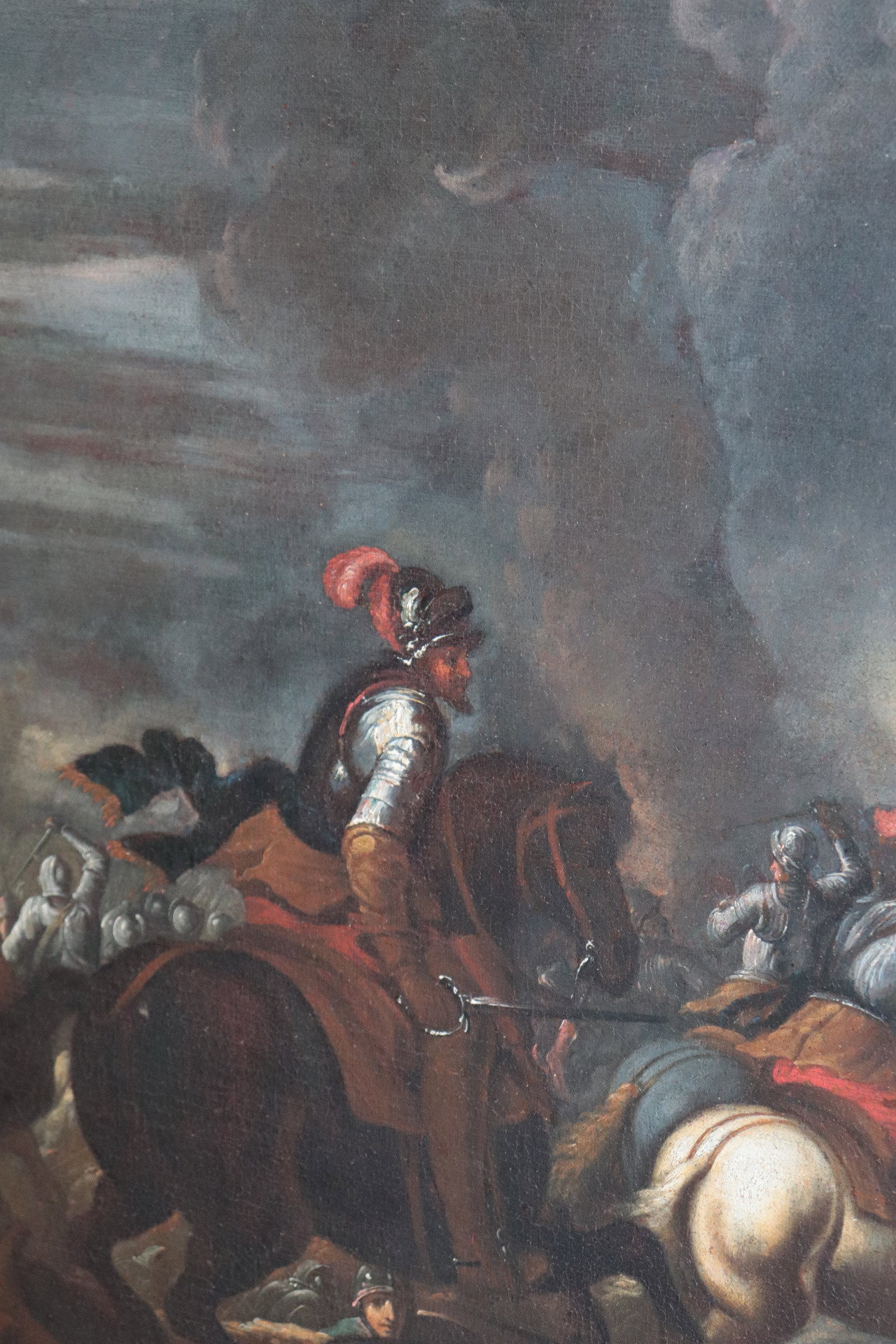
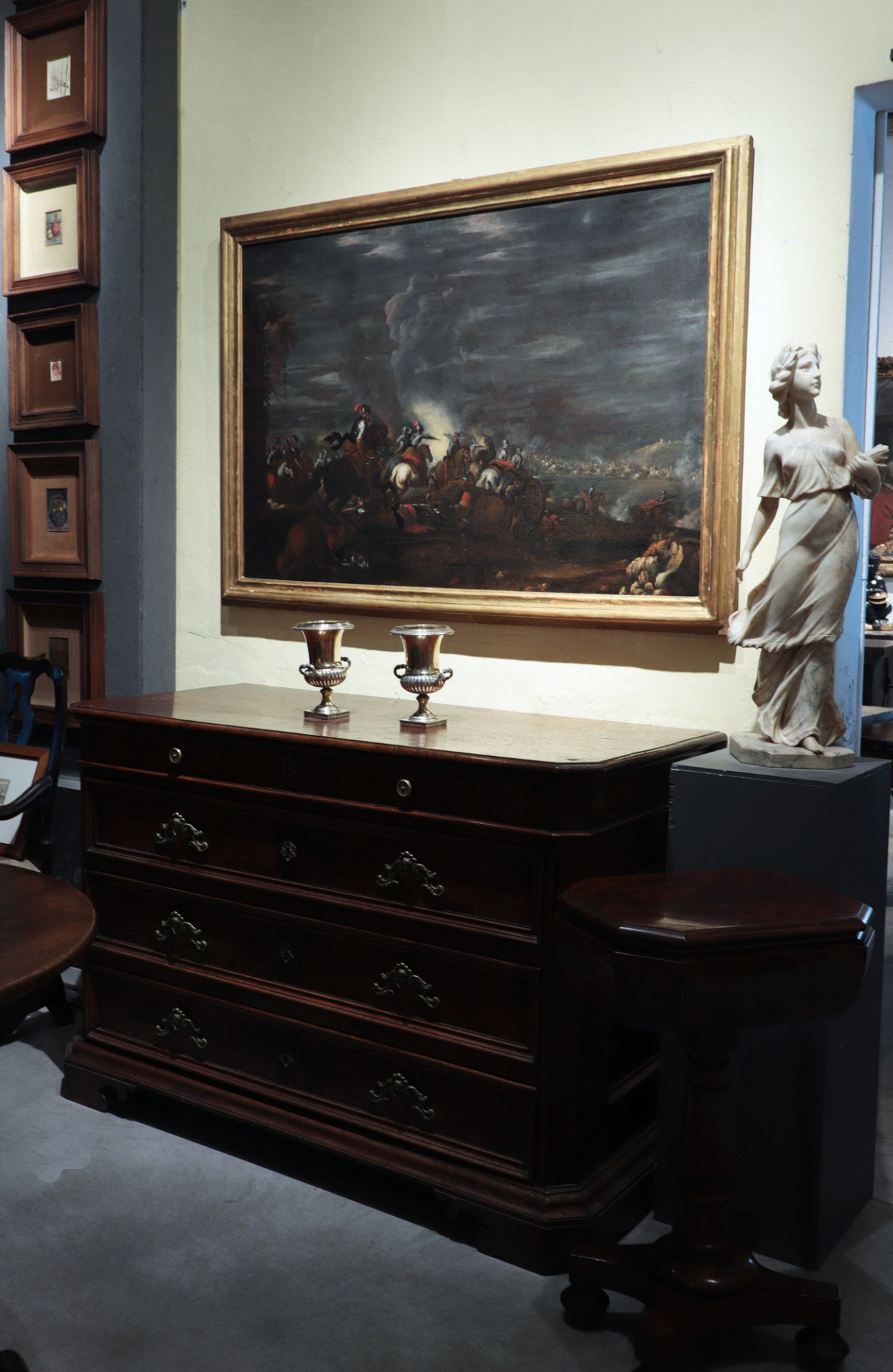
Ilario Mercanti "Lo Spolverini" (1657-1734) - Battle Scene
Description:
Ilario Mercanti known as "Lo Spolverini" (Parma, 1657-1734) - Night Battle Scene
Oil painting on canvas
Expert appraisal: Prof. Giancarlo Sestieri
Dimensions: 147x103cm FRAME
130x87cm CANVAS
MERCANTI, Ilario Giacinto, known as lo Spolverini. – He was born in Parma on January 13, 1657, in the parish of S. Gervaso, according to his birth certificate. He may have chosen to call himself Lo Spolverini to conceal his Jewish origins, adopting a name that would refer to his role as a workshop apprentice responsible for the "spolvero" (pouncing) preparatory to fresco, as he is said to have worked in this capacity in the decoration of the Certosa di Parma at a young age (Silingardi Salvini; Arisi Riccardi). The painter's training took place in the workshop of F. Monti, known as Brescianino delle Battaglie, after an unconfirmed, though probable, apprenticeship with his father (active in Parma in 1660, according to the only documentary evidence concerning him, in the pictorial decoration of two triumphal arches); however, the date of the start of his apprenticeship remains uncertain.
In reconstructing the origins of Mercanti's formal language, criticism, even recent criticism, considers plausible (although not supported by any documentary reference) the hypothesis of a trip to Florence in his youth, where Mercanti would have gone to observe the works of J. Courtois il Borgognone. On that occasion, he may have come into contact with P. Reschi and assimilated formal and compositional elements derived from the style of J. Callot and S. Della Bella (Ceschi Lavagetto). A Venetian trip that Mercanti allegedly took with Monti to illustrate the campaigns of Doge Francesco Morosini against the Turks also remains unproven: none of the works produced on that occasion (originally located in Palazzo Morosini in Campo S. Stefano, now partly in the Correr Museum in Venice) can be convincingly attributed to Mercanti's style. Nevertheless, according to an unanimous and consolidated critical tradition, Mercanti's stylistic evolution, in his choice of chromatic values of a more pronounced tonal influence and in the adoption of characteristic "macchiette" as a distinctive feature of his painting style, is linked to the influences of this presumed trip to Venice between 1690 and 1695. Echoes and suggestions from S. Mazzoni, F. Maffei, and S. Rosa would also find space within the framework of this formal paradigm.
However, sources attest to Mercanti's high degree of integration into the Farnese cultural circuit in Parma during the same years: in 1692 he was granted a patent of familiarity by Duke Ranuccio II and subsequently appointed court painter. It was clearly in this context that Mercanti specialized in celebratory genre painting and historical-encomiastic narrative, focusing a specific area of expertise in battle painting.