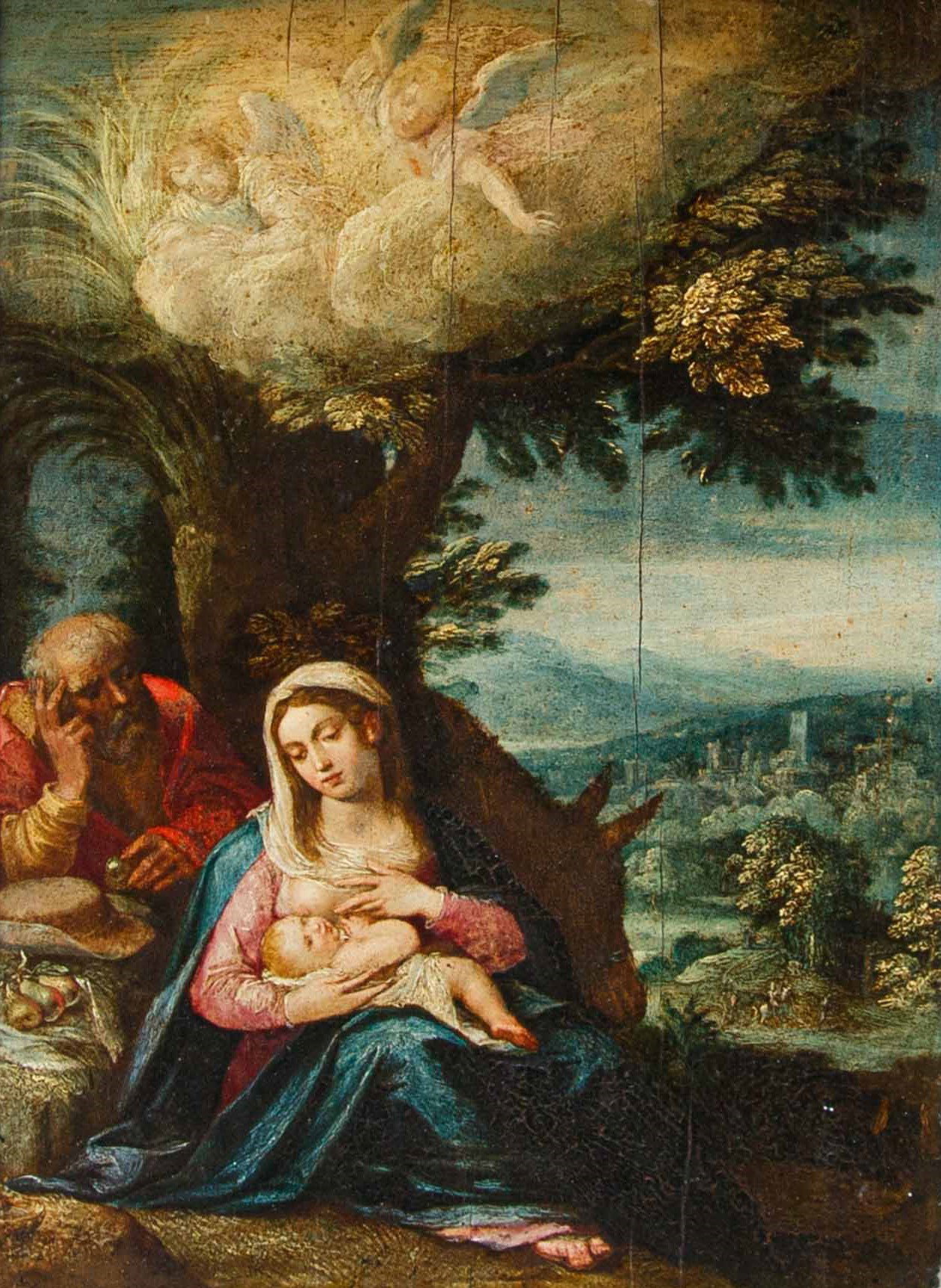
Christoph Schwarz (Ingolstadt, 1548 – Munich, 1592), Rest on the Flight into Egypt
Description:
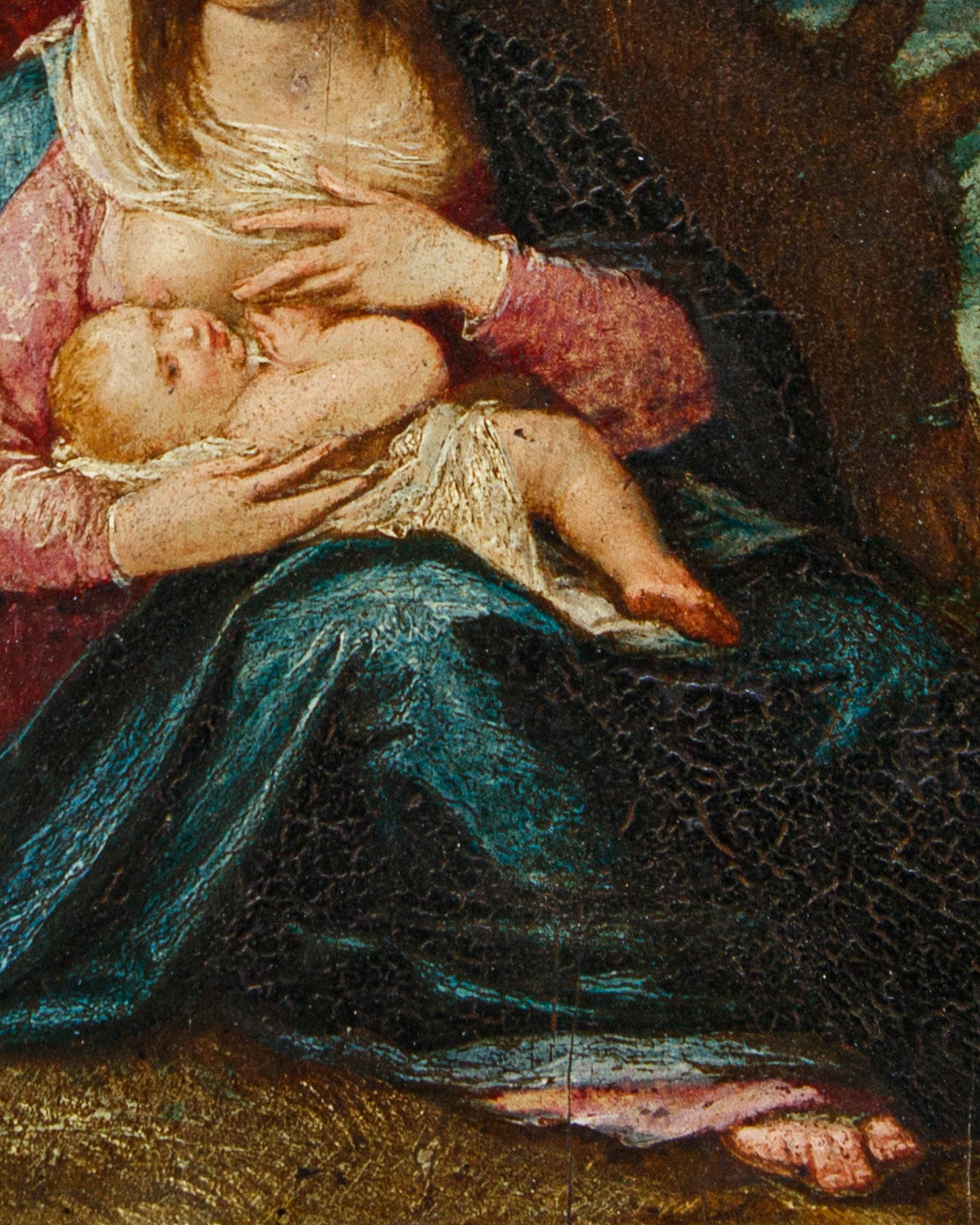
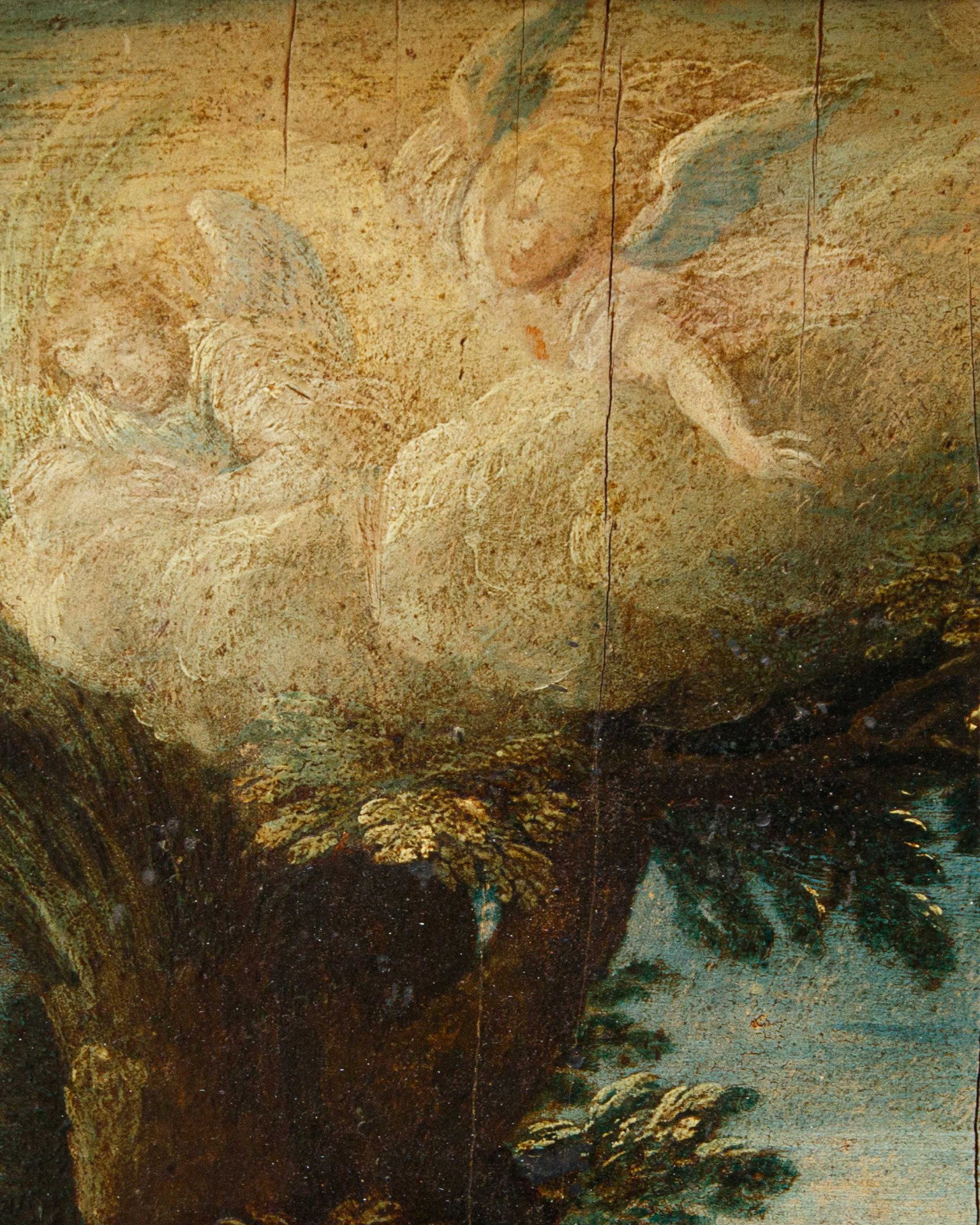
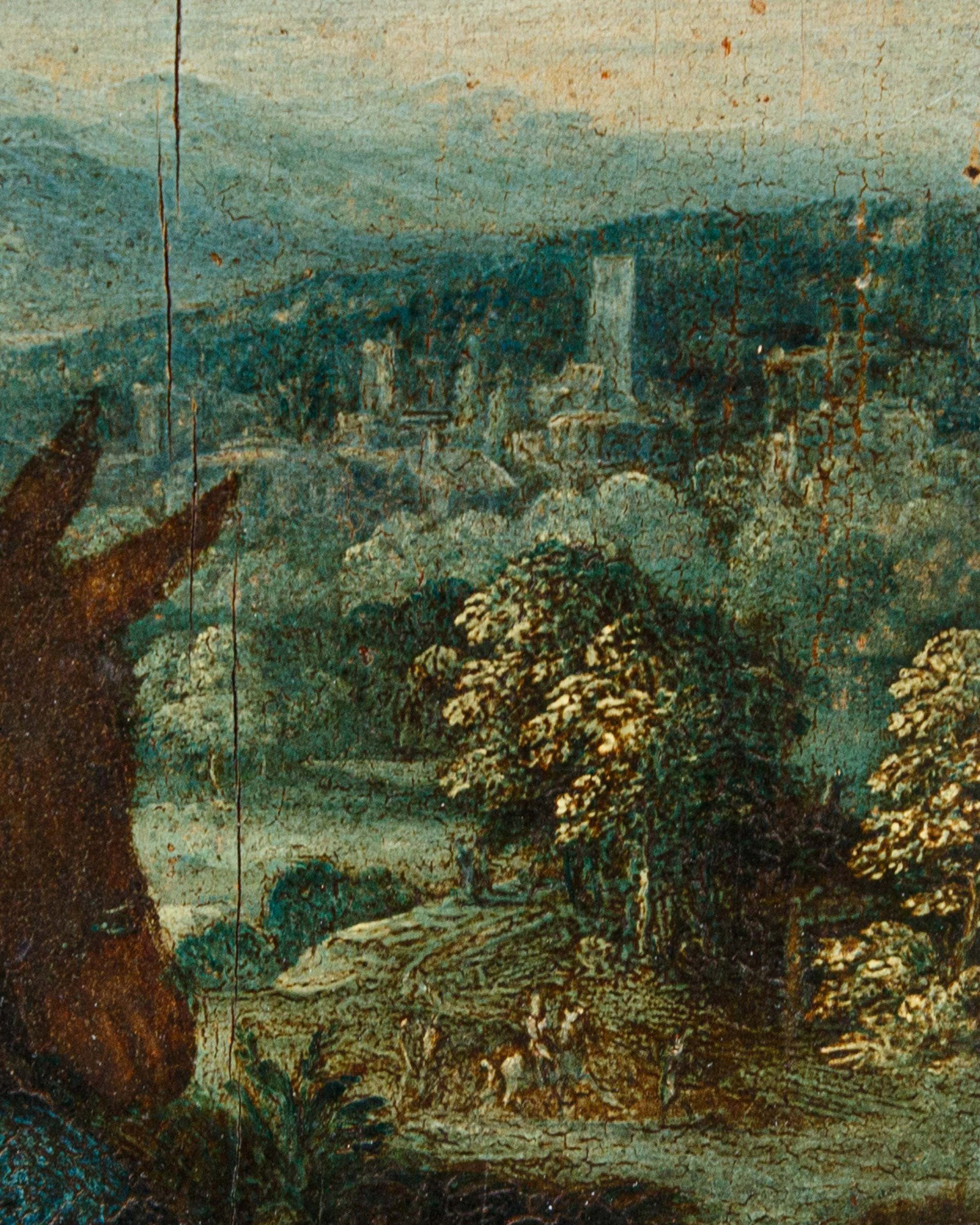
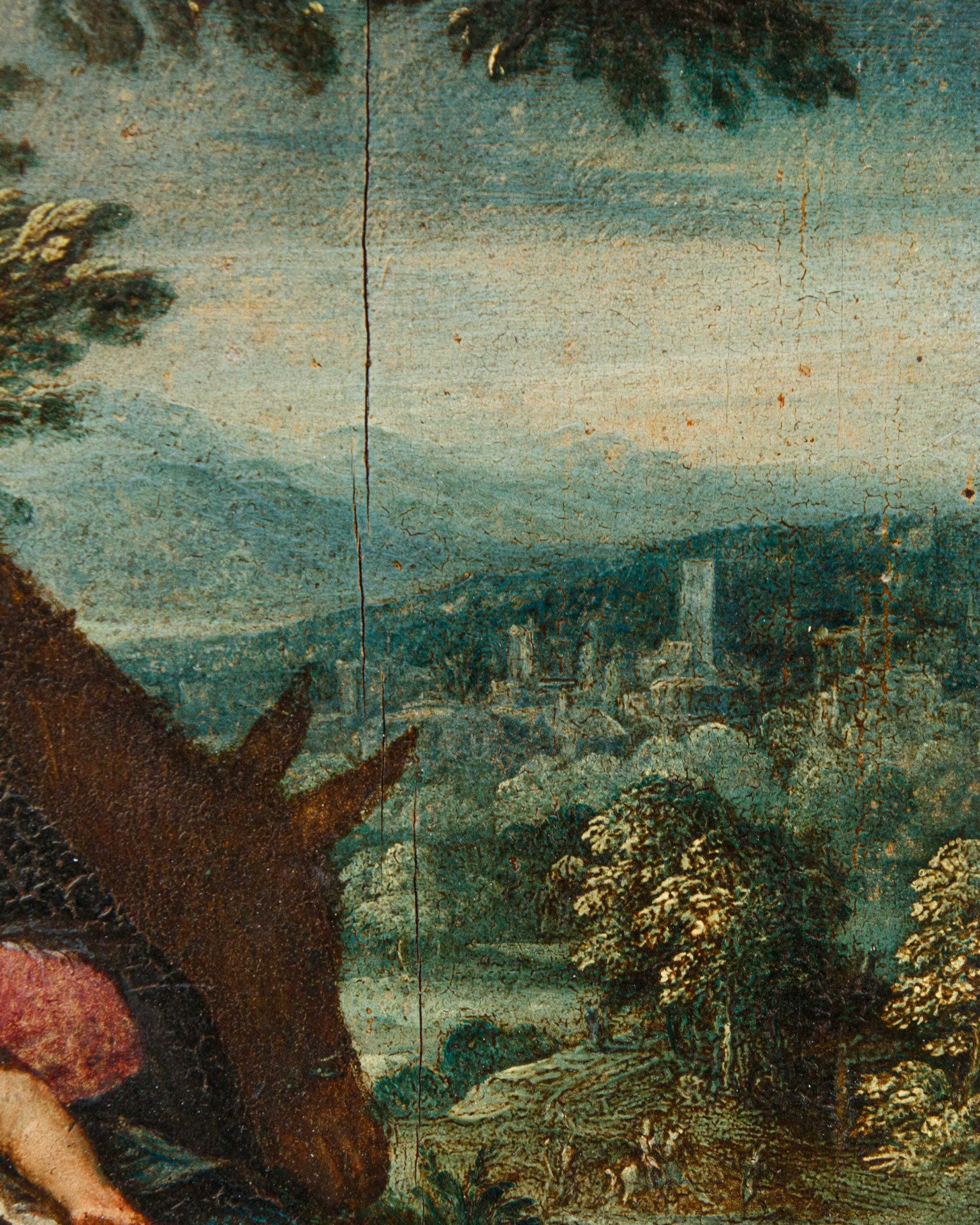
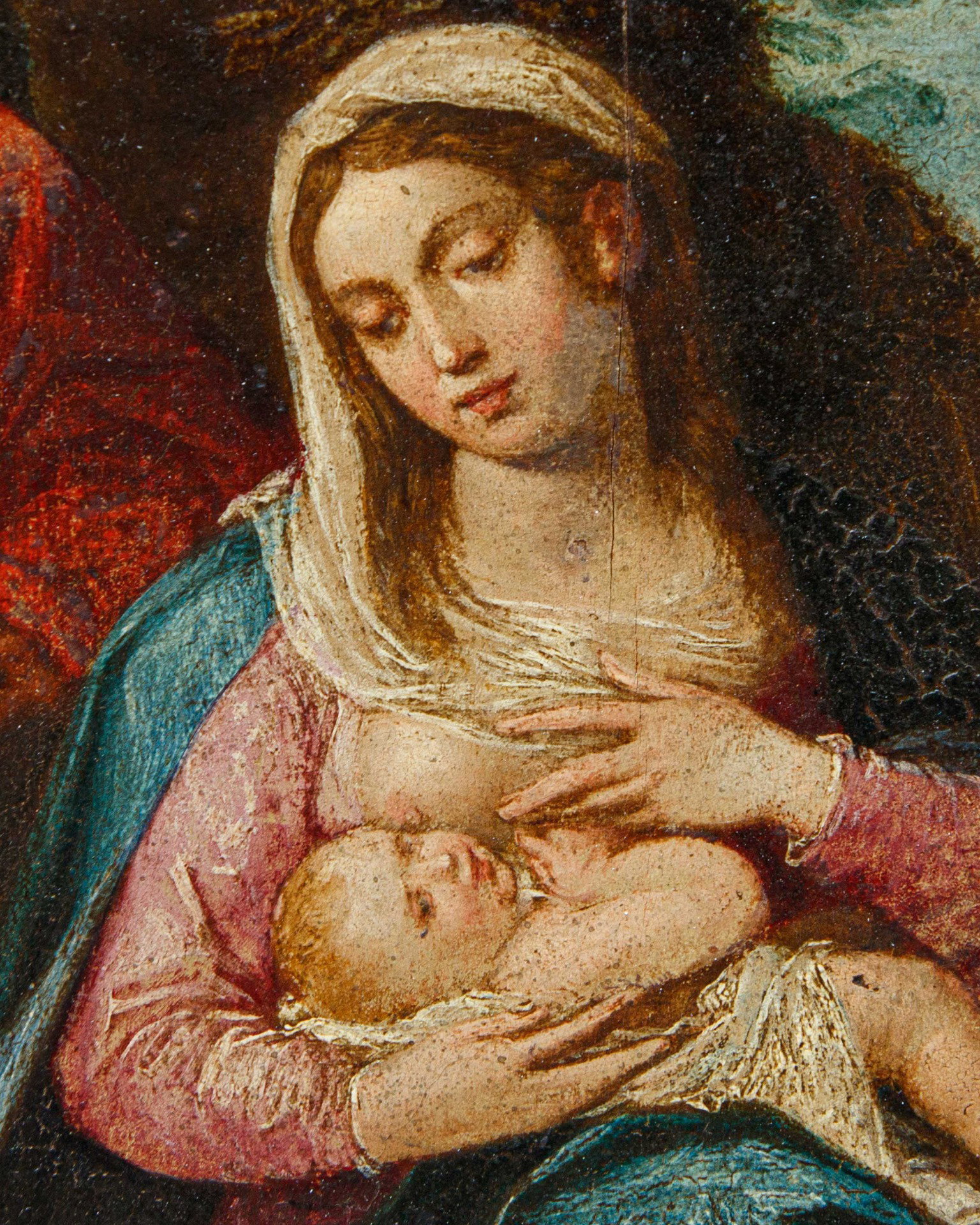
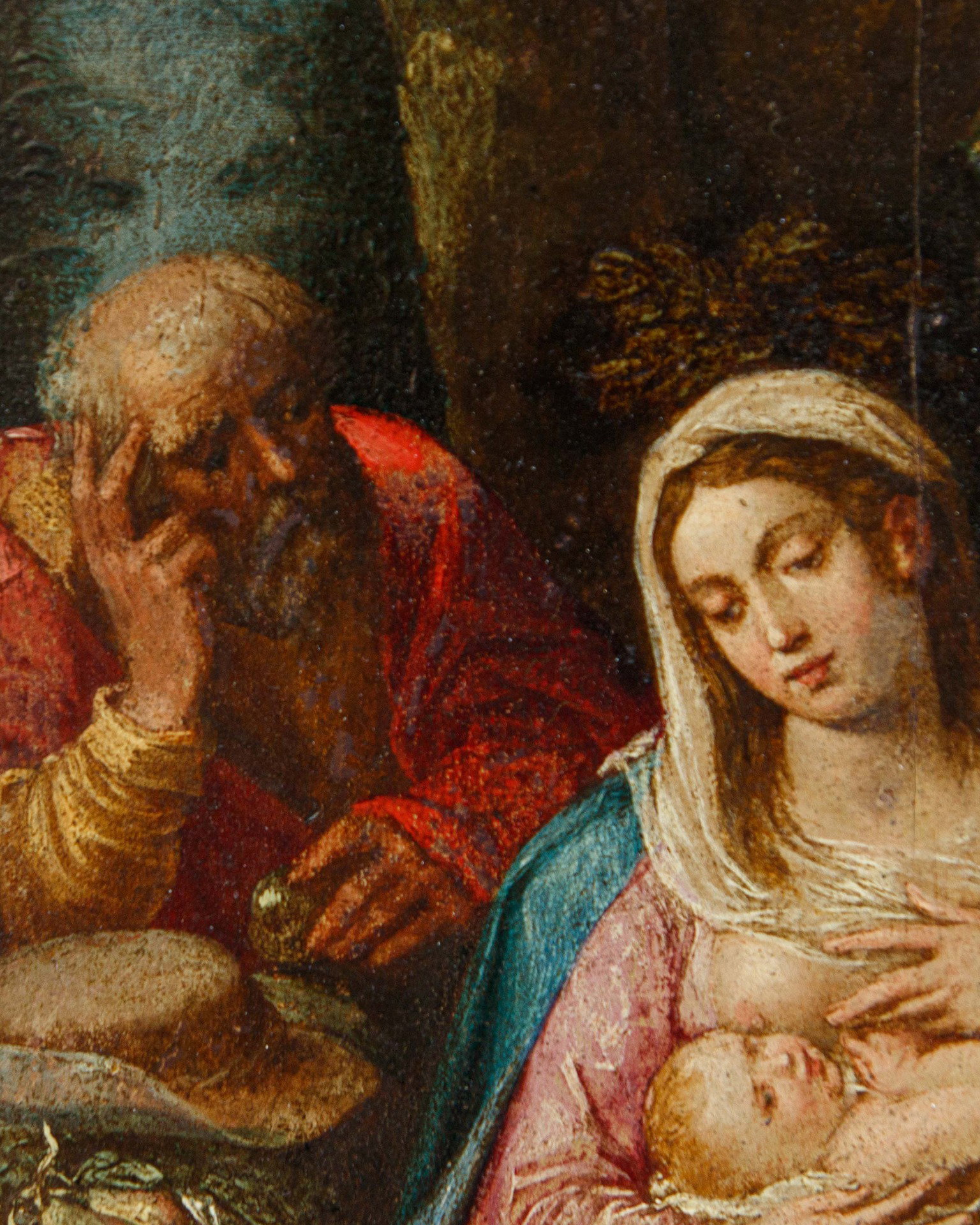
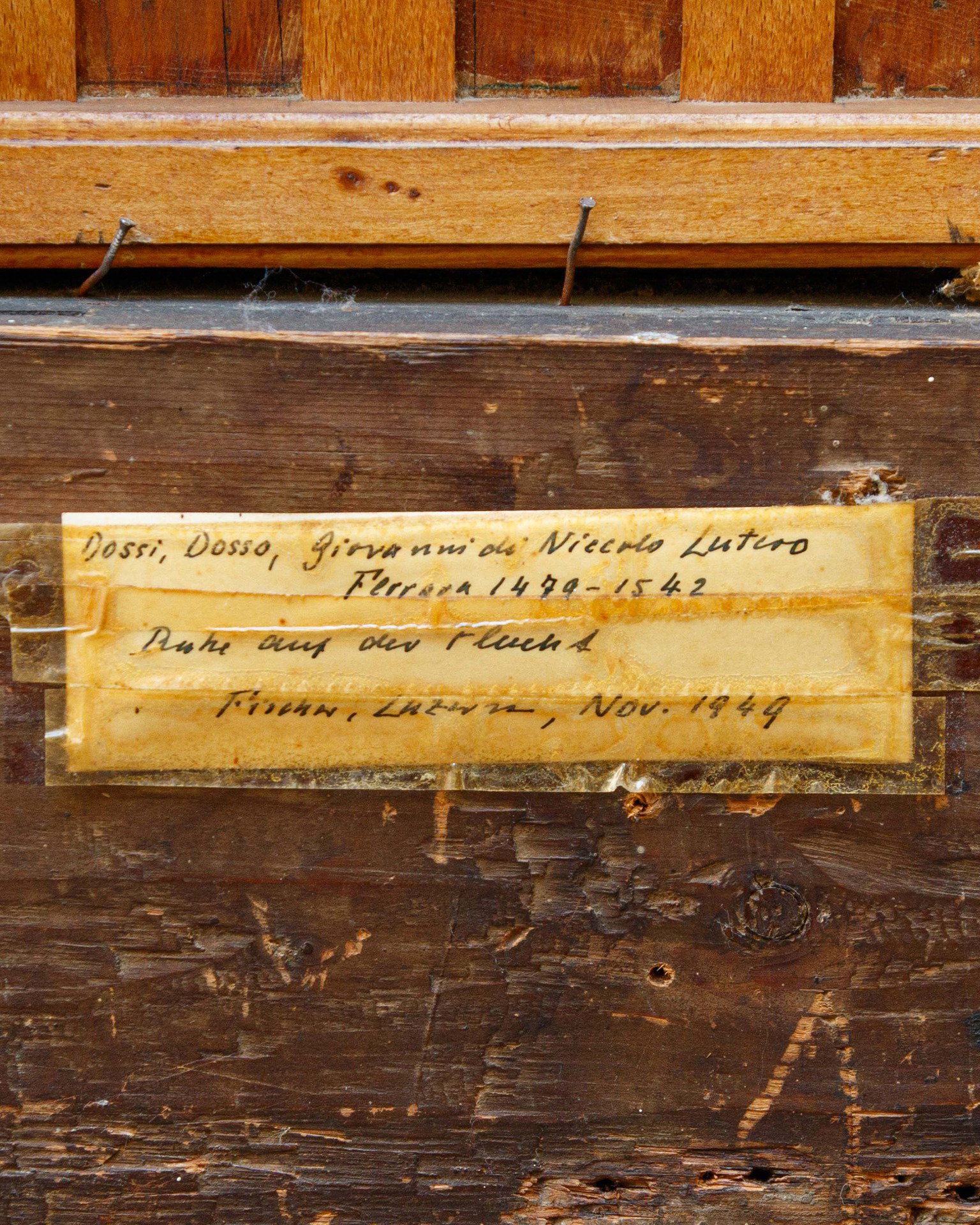
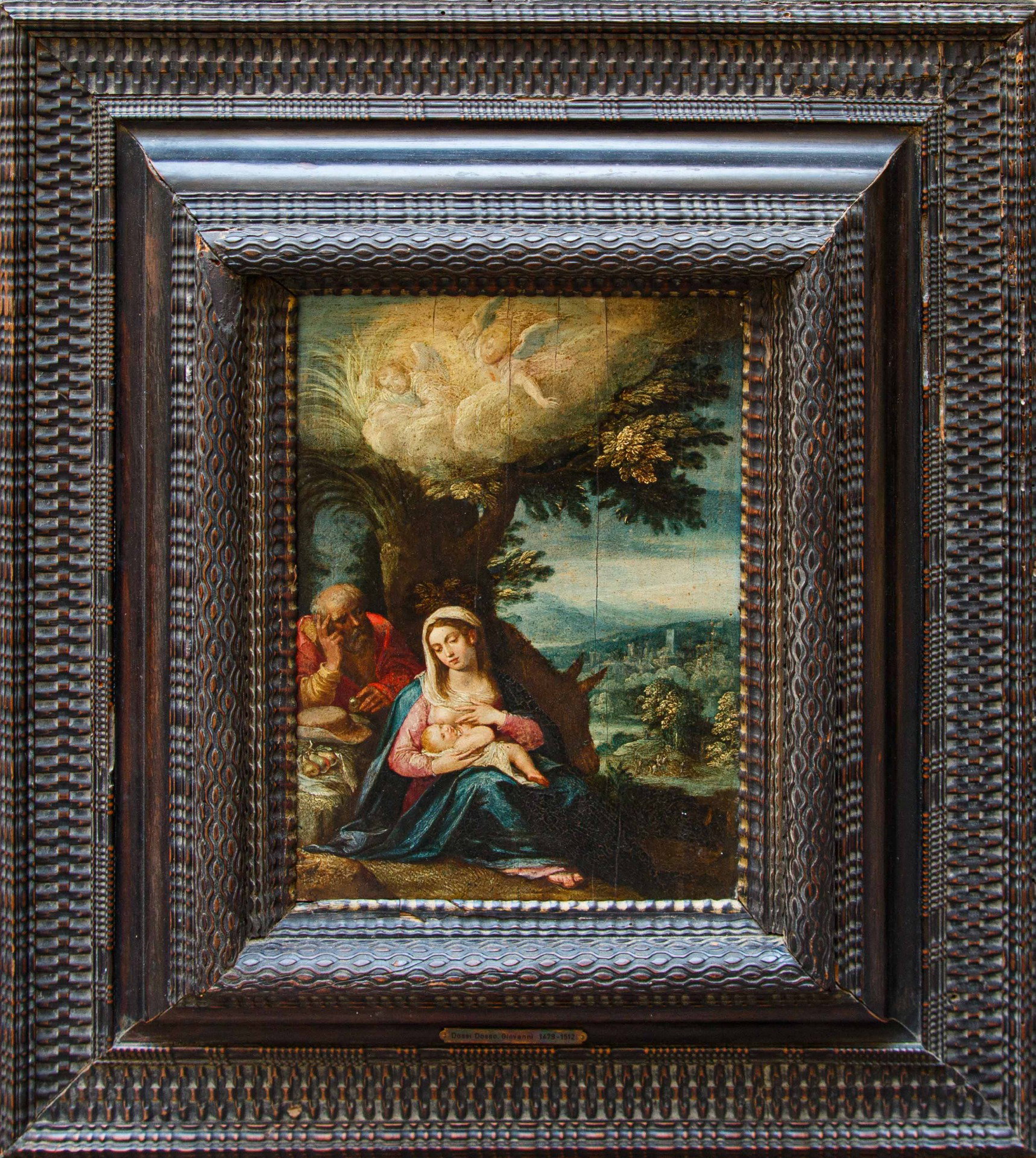
Christoph Schwarz (Ingolstadt, 1548 – Munich, 1592) Rest on the Flight into Egypt Oil on panel, 32 × 23.5 cm With frame, 63.5 × 56.5 cm Christoph Schwarz's oil painting on panel depicts one of the most beloved subjects in late Renaissance devotional painting: the Rest on the Flight into Egypt. The Virgin occupies the center of the composition, seated on the ground with her blue mantle enveloping her legs and a pink dress, while tenderly nursing the Christ Child with a protective gesture. Behind her, Saint Joseph is captured in a meditative pose, his face resting on his hand, wrapped in a vibrant red cloak. To the right, a bright, hilly landscape opens up, featuring a fortified city, a sloping forest, and a distant valley animated by small figures. In the sky, among cloudy, vaporous golden clouds, two angels glide towards the earthly scene. The composition achieved extraordinary circulation throughout Counter-Reformation Europe thanks to the engraving made from it by Johannes Sadeler, known as Jan the Elder, the first exponent of the renowned dynasty of engravers originally from Aalst, Belgium. The Sadelers were among the most prolific and influential engravers of the late 16th century, active in Flanders, Germany, and Italy, and their ability to disseminate images across Europe ensured that compositions conceived for private or devotional contexts became continental reference models. Jan Sadeler's engraving gave Schwarz's original a circulation that no painted panel could have guaranteed alone, fixing in the visual memory of the time the formula of the Virgin nursing the Child in the foreground, with the landscape behind and angels in glory. As evidence of this composition's genesis, the Art Institute of Chicago houses an autograph drawing by Schwarz documenting an early compositional idea: in that sketch, the Holy Family is placed on the left, before a landscape in a wooded valley stretching towards the background. Christoph Schwarz was born around 1548 in Ingolstadt, the son of Conrad, who was a goldsmith by trade. From 1560 to 1566, his father apprenticed him to the workshop of Melchior Bocksberger, a prominent painter and fresco artist, from whom he learned the basics of the craft. In 1566, he moved to Augsburg for his first independent fresco works, and then returned to Munich in 1569. The following year, he undertook a decisive journey for his training: he went to Venice, where he stayed for about three years. The Venetian sojourn profoundly marked his style, imparting a fluidity in the treatment of light, a chromatic richness, and a softness of flesh that distinctly set him apart from his Bavarian contemporaries. Returning to Munich in 1573, he was appointed court painter the following year, succeeding Hans Mielich, with whom he had collaborated and who was probably among his teachers. He worked for the most important patrons of the time, such as the Fugger banking family. Comparison with other works by the artist illuminates the coherence of his pictorial language. In the Altarpiece with Saint Sebastian and Saint Nicholas of Tolentino, preserved in the Bavarian public collections, two angels appear at the top, entirely similar to those in the Rest on the Flight into Egypt, immersed in golden shafts of light among putti and swollen clouds, confirming a typological angelic representation that Schwarz had codified as a recurring element of his devotional rhetoric. The panel depicting the Entombment of Christ at the Kunsthistorisches Museum in Vienna shows the same spatial structure: the religious scene unfolds compactly and dramatically in the foreground, while in the background, a landscape opens up, developing in depth with the same luminous and distant atmospheric quality. The identical compositional logic governs the panel with the Baptism of Christ at the Prado Museum in Madrid, where the background landscape dialogues with the sacred figures with the same economy of means and the same veiled luminosity. The panel with the Raising of the Cross at the National Museum of Warsaw, while sharing the same conception of the background landscape, is distinguished by a much higher density of figures, transforming the scene into a choral fresco, demonstrating Schwarz's versatility in modulating the same formal framework according to different narrative needs.