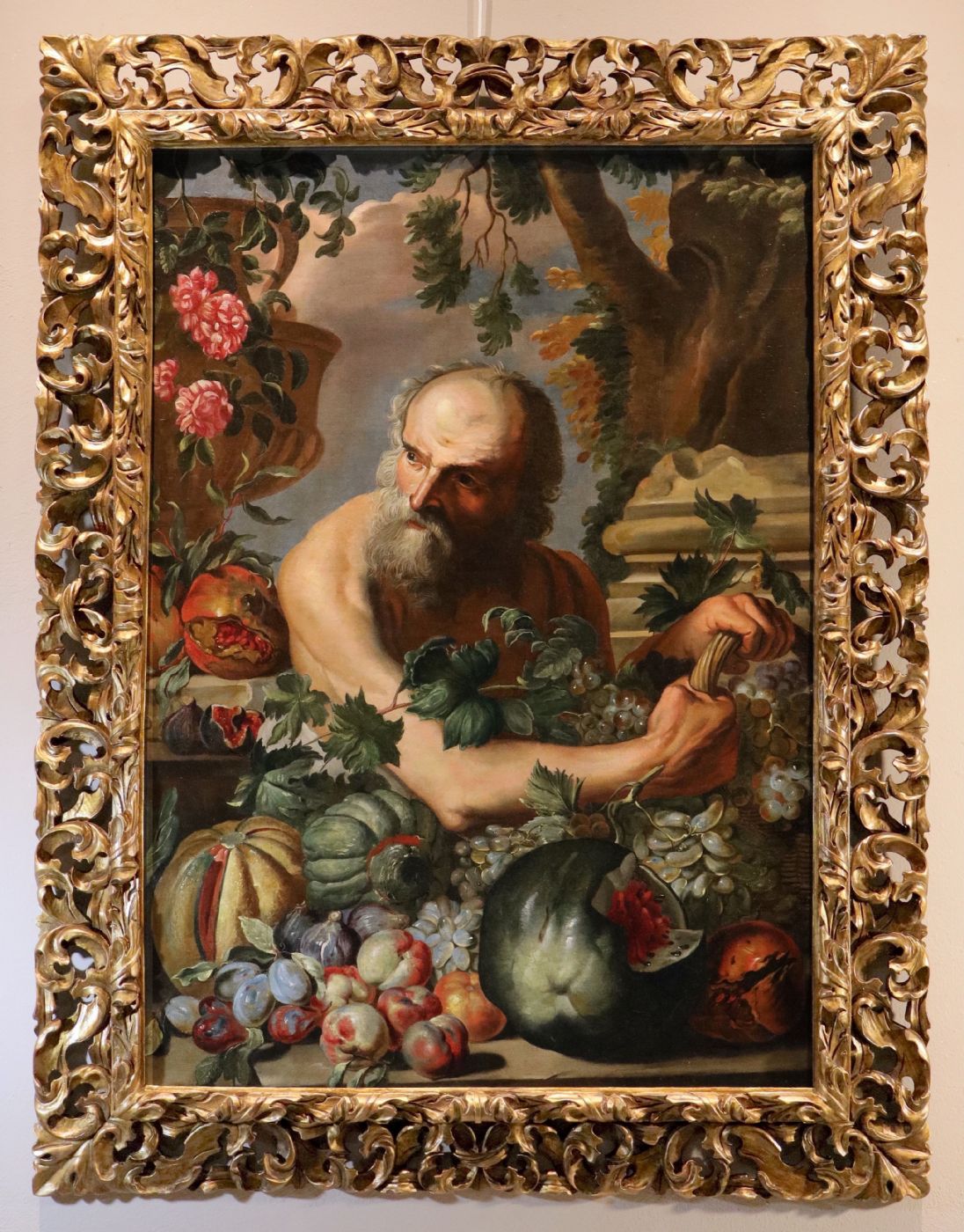
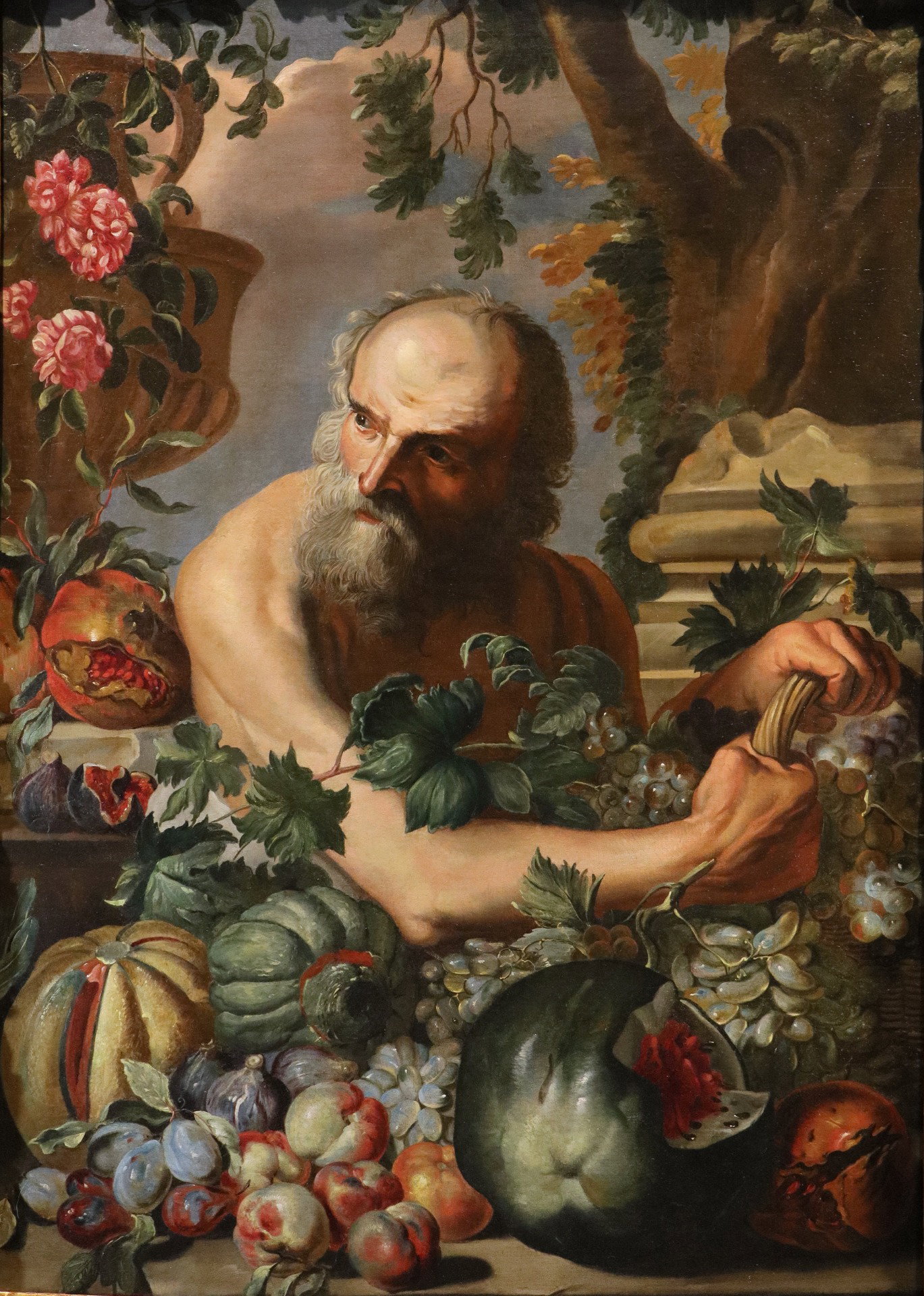
Portrait of the Greek philosopher Diogenes with a fruit composition, workshop of Abraham Brueghel (Antwerp 1631 - Naples 1690)
Description:
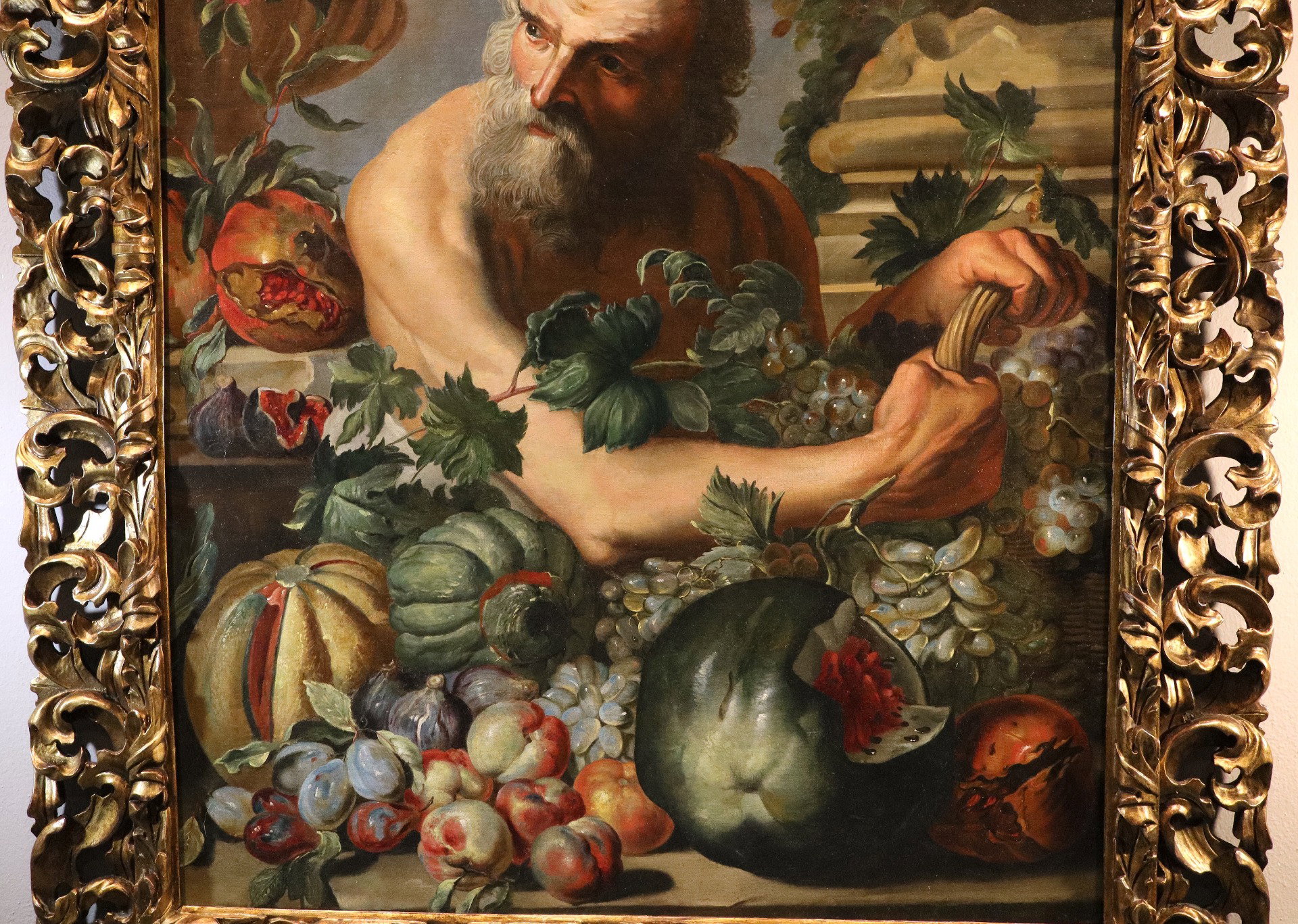
Portrait of the Greek philosopher Diogenes with a composition of fruit and flowers
Workshop of Abraham Brueghel (Antwerp 1631 - Naples 1690)
Oil on canvas (130 x 94 cm - Framed 153 x 118 cm.)
Reference bibliography: Alberto Cottino, Abraham Brueghel 1631-1697. A master of still life between Antwerp, Rome and Naples, Etgraphiae, Rome 2022
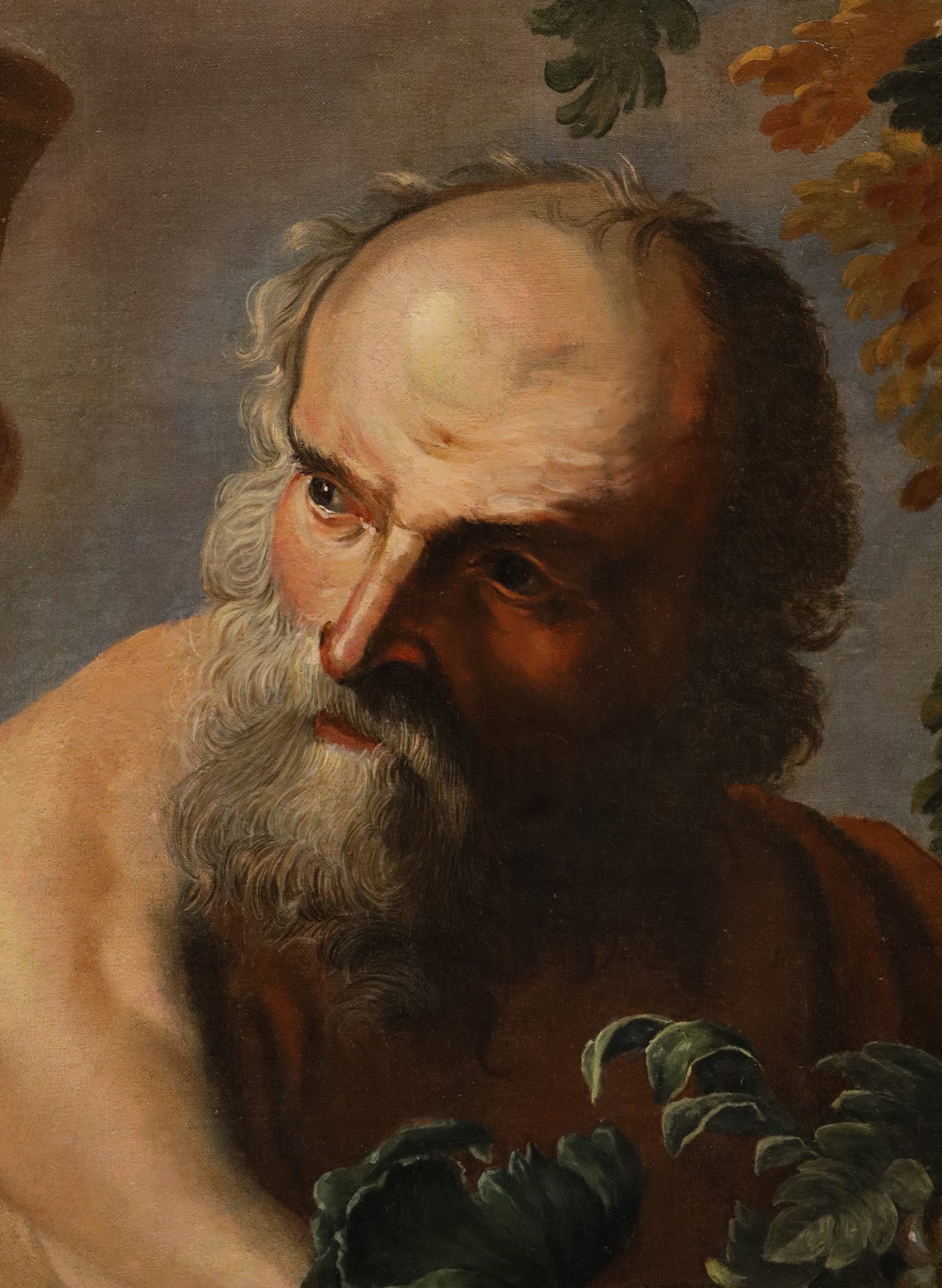
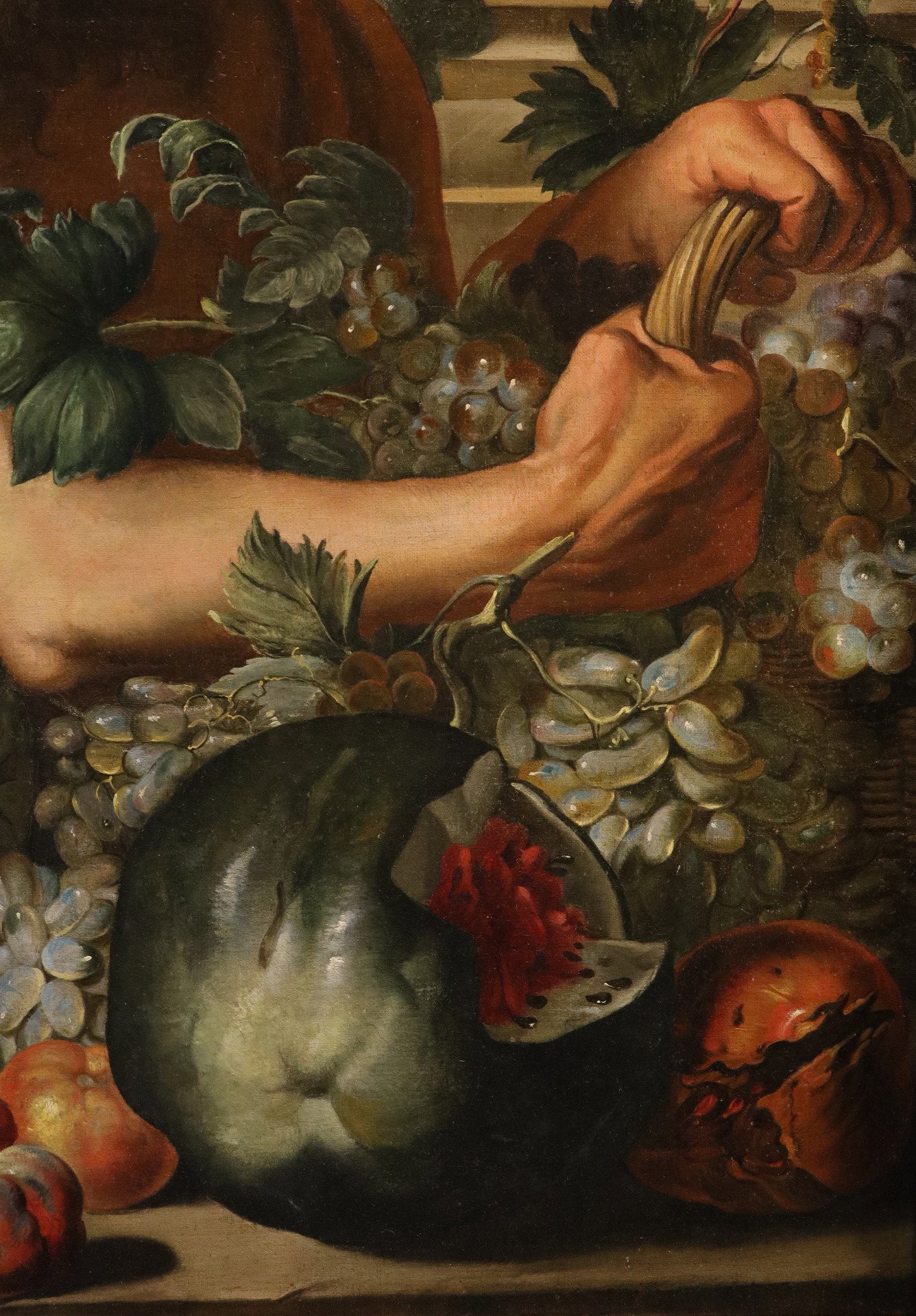
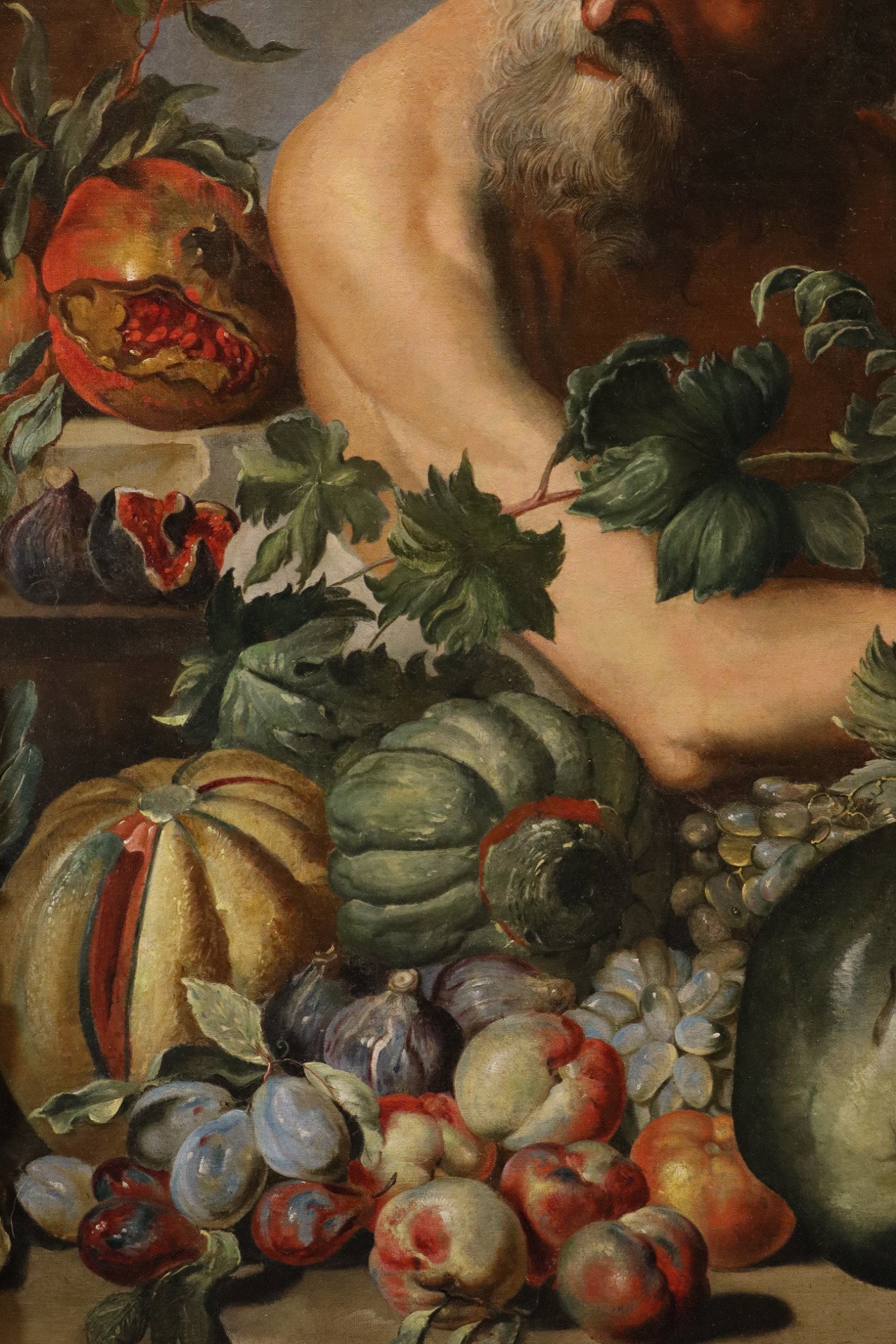
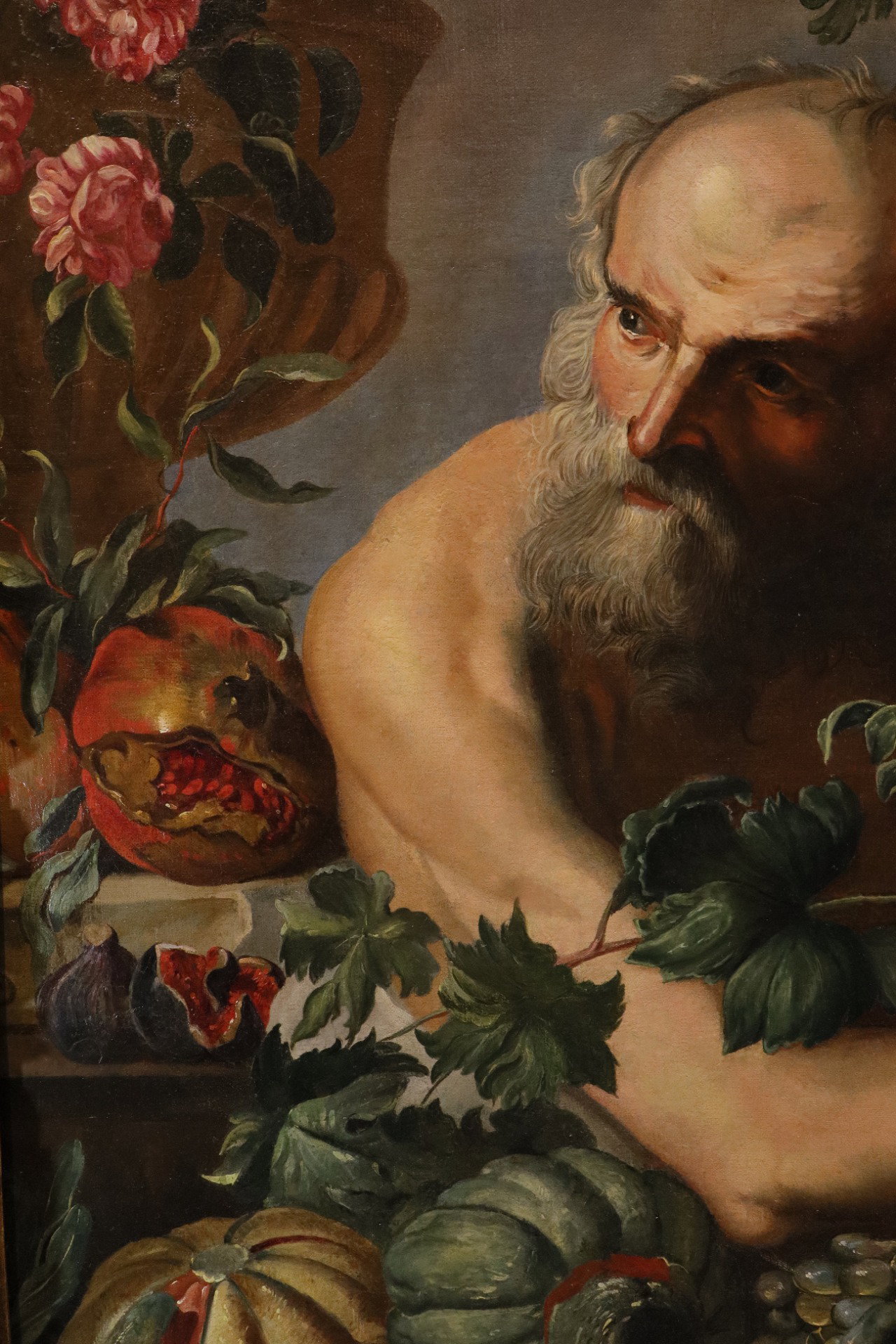
The painting in question, of excellent qualitative and artistic level, depicts an elderly man with a thick gray beard, portrayed in three-quarters view with an intense and concentrated gaze, looking to the left. With his muscular and tensed arms, he is intent on grasping the handle of a large woven basket overflowing with grapes, surrounded by an opulent and festive composition of fruits alongside floral and architectural elements.
It is the portrait of the Greek philosopher Diogenes of Sinope (called the Cynic), as it perfectly reflects the ancient portraits and marble busts dedicated to the great thinker that have come down to us: classical iconography depicts him precisely as a man with an unkempt beard, pronounced baldness, unclothed, and a vigorous physique marked by age.
Even the context in which he is placed perfectly reflects his philosophical thought, which preached self-sufficiency and a return to the state of nature, despising material goods and social conventions: for these reasons, his figure in the painting is semi-nude and immersed directly among the fruits of the earth, recalling the philosopher's austere lifestyle.
From the mid-seventeenth century onwards, the fashion for these cultured representations quickly spread throughout Italy, but especially in Rome, where the figures portrayed were enveloped in settings adorned with flowers or fruits, making these works highly decorative and appreciated by the bourgeois clientele of the time.
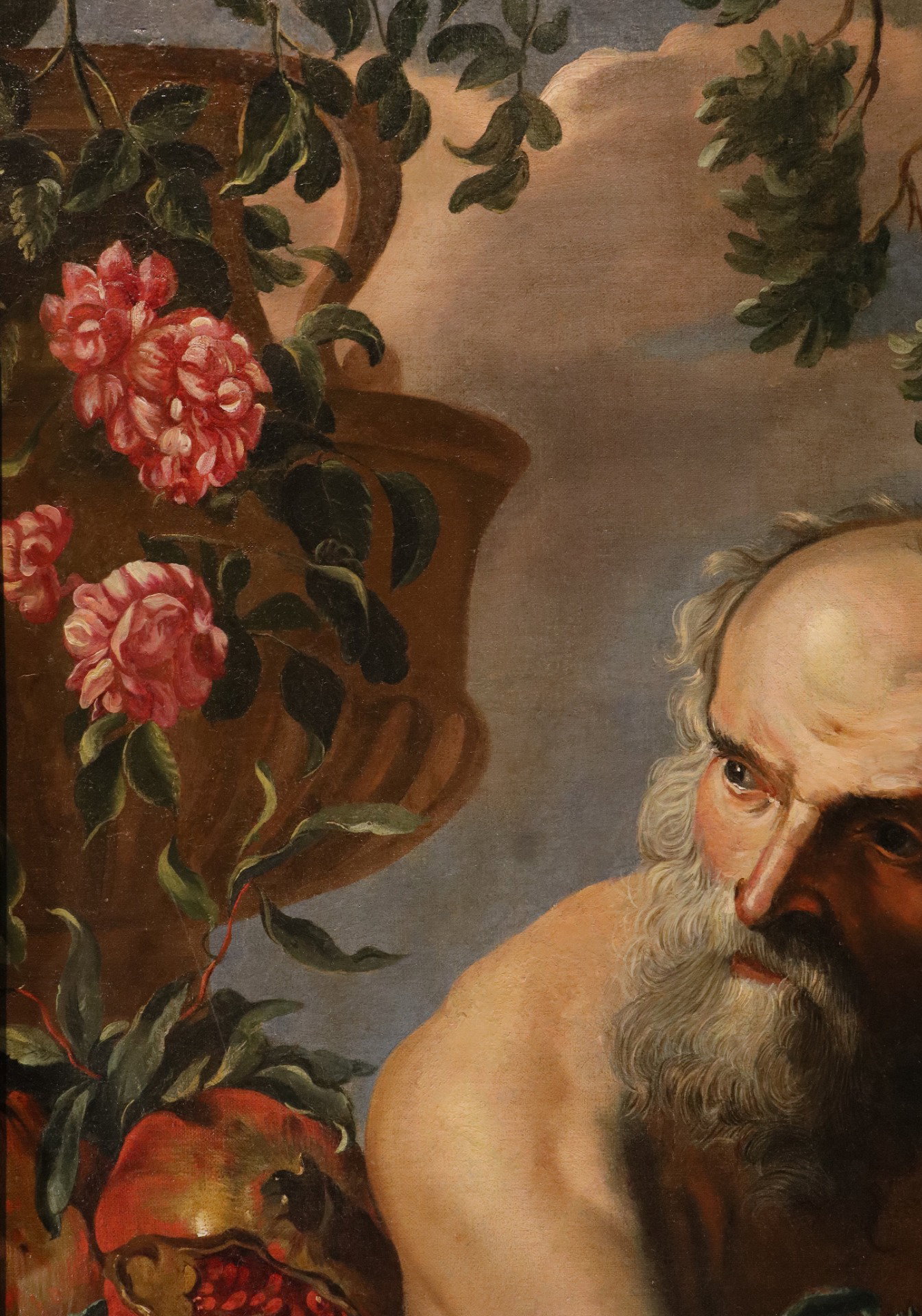
The work is indeed distinguished by its spectacular scenography from which emerge, in all their opulence, various types of fruit: from the giant dark watermelon cut open, showing its red pulp and seeds, to the striped melon, the figs opened with red hearts, the purplish plums and the velvety peaches, up to the two large ripe and split pomegranates resting near a monumental decorated vase, from which lush dark pink roses cascade.
This is a painting of immediate beauty, capable of combining considerable pictorial finesse with a scenic construction that can satisfy even the most demanding gaze: a strong chiaroscuro contrast illuminates the man's skin and the vibrant colors of the fruit, creating a sense of abundance typical of the Baroque.
The style of the work, with its soft brushwork and brilliant coloration, combines the typical naturalism of Northern European origin with the classicism typical of the Roman environment of the second half of the seventeenth century, to which the paternity can easily be traced.
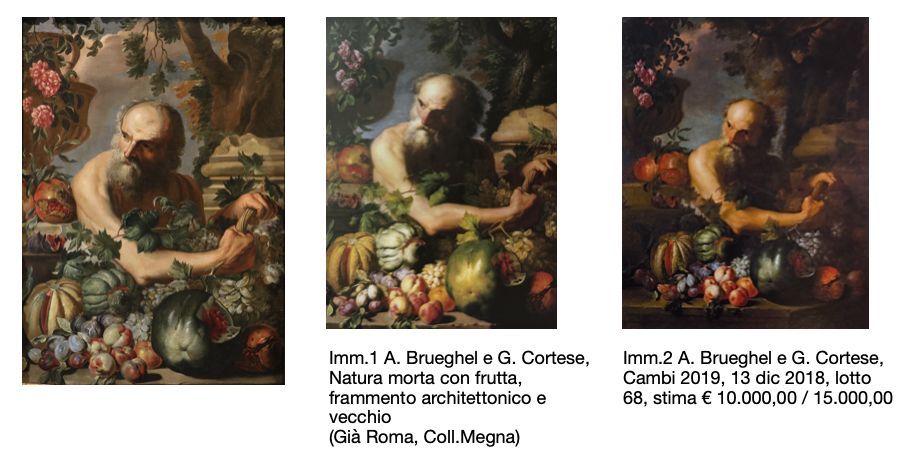
In the volume edited by Prof. Alberto Cottino, we can find a work analogous to ours published (which differs by minor variations), generically defined as 'Still life with fruit, architectural fragment and old man' and attributed to the hand of Abraham Brueghel (Antwerp 1631 - Naples 1697) with the collaboration of Guillaume Cortese (formerly Rome, Megna collection, imm.1).
In the volume, we find a further version published (oil on canvas, 147 x 117 cm.) that passed through Cambi auction house in Genoa (December 13, 2019, lot 68), also in this case attributed to the partnership between Abraham Brueghel and Cortese (imm.2 - https://www.cambiaste.com/it/asta-0377/abraham-brueghel-anversa-1631-1697-e-guillaume-187994 ).
Collaborations like this one, between painters specializing in still life and other figure specialists, were very frequent in the Roman context of the seventeenth century, and Brueghel benefited from them with great frequency in his production: it is sufficient here to mention Maratti, Baciccio, Brandi, and indeed Guillaume Courtois, known as Guglielmo Cortese (Saint Hippolyte, 1628 – Rome, 1679), with whom he established a happy and prolonged partnership, from which emerged authentic masterpieces of Roman Baroque painting.
Furthermore, it was customary in seventeenth-century painters' workshops to repeat subjects of the most successful paintings multiple times, and Brueghel is certainly no exception.
In our case, given the quality of the painting, the paternity must undoubtedly be sought in the hand of a skilled student from the prolific 'Brueghel workshop', without entirely excluding his participation or, in any case, his direct supervision.
The theme of still lifes of flowers and fruits with male figures is very well represented in Abraham Brueghel's catalog, and in particular, we can mention, for comparative purposes, a composition of a similar subject but in horizontal format, 'Still life with fruit and bearded man' (Bologna, Private Collection), which also features the hand of Guglielmo Cortese as co-author for the male figure. And again, the painting 'Allegory of Autumn' (Private Collection). Both works can be found published in the aforementioned Cottino volume dedicated to Abraham Brueghel, on pages 82 and 104, respectively).
ADDITIONAL INFORMATION:
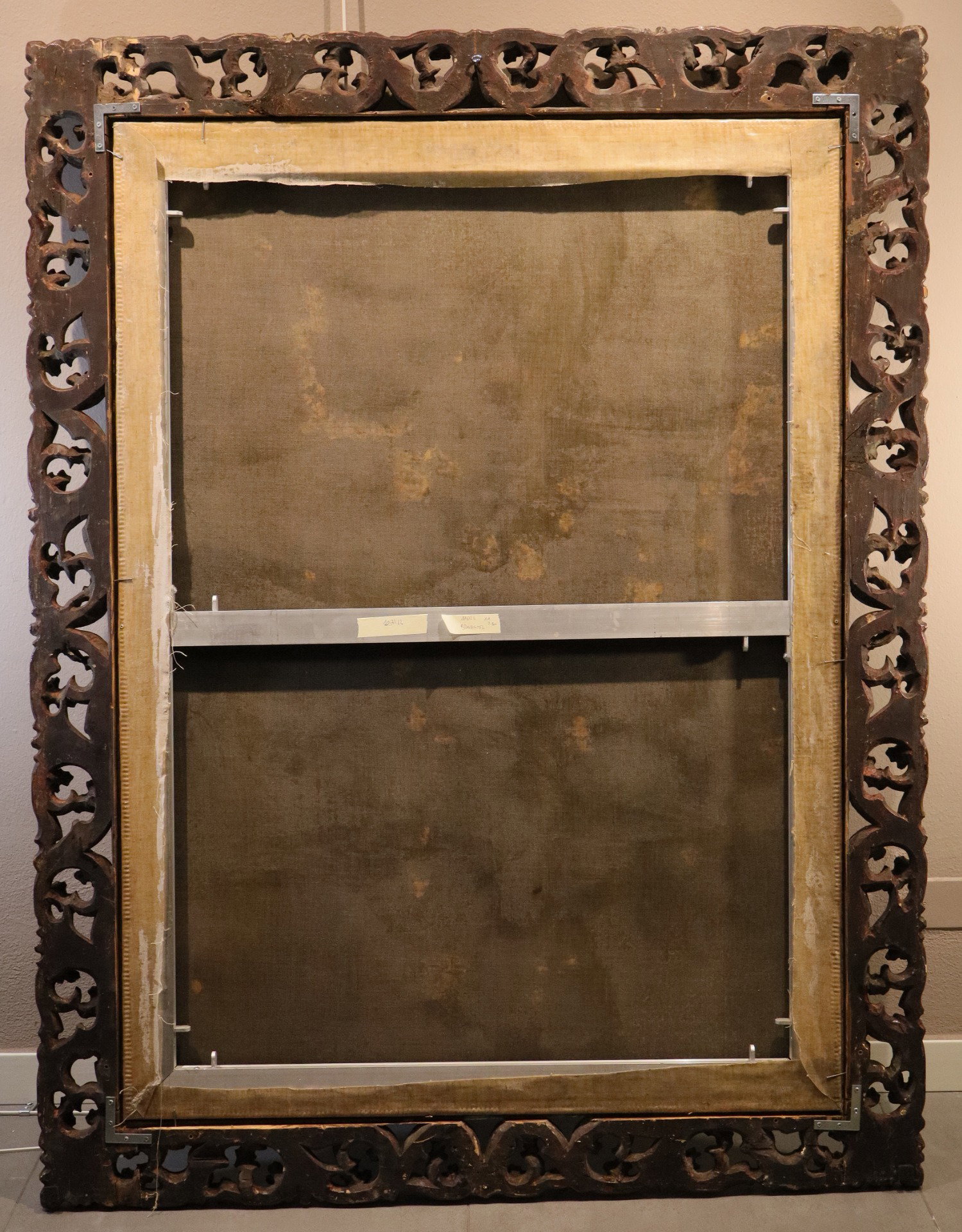
The painting comes complete with a pleasant antique frame and is accompanied by a certificate of authenticity and a descriptive iconographic sheet.
We handle and organize the transport of purchased works, both within Italy and abroad, through professional and insured carriers.
Should you wish to view this or other works in person, we will be pleased to welcome you to our new gallery in Riva del Garda, at Viale Giuseppe Canella 18. We await you!
Contact us for any information or to arrange a visit, we will be happy to respond.
Follow us also on:
https://www.instagram.com/galleriacastelbarco/?hl=it
https://www.facebook.com/galleriacastelbarco/