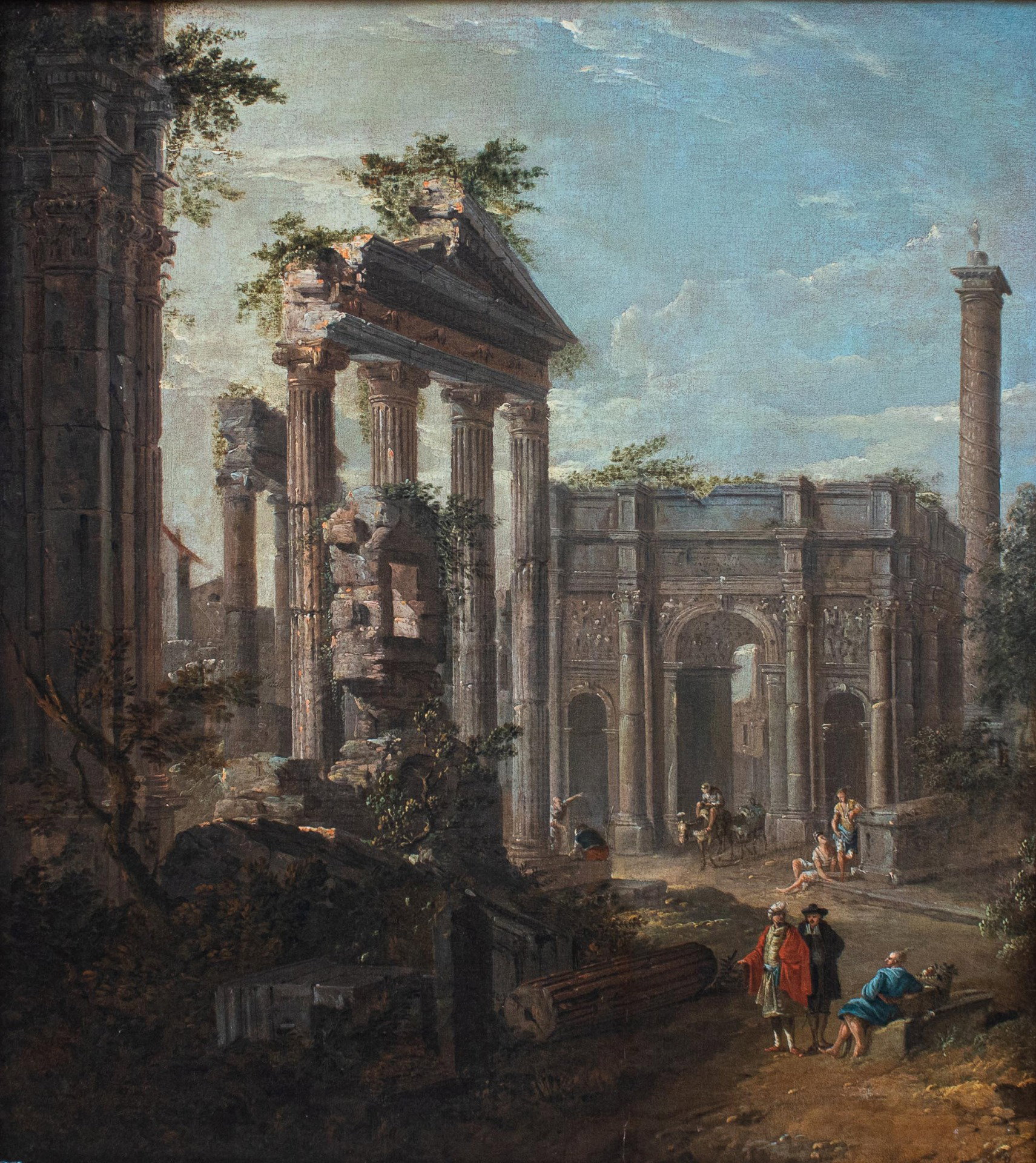
Antonio Joli (Modena, circa 1700 – Naples, 1777), Architectural Capriccio
Description:
Antonio Joli (Modena, c. 1700 – Naples, 1777)
Architectural Capriccio
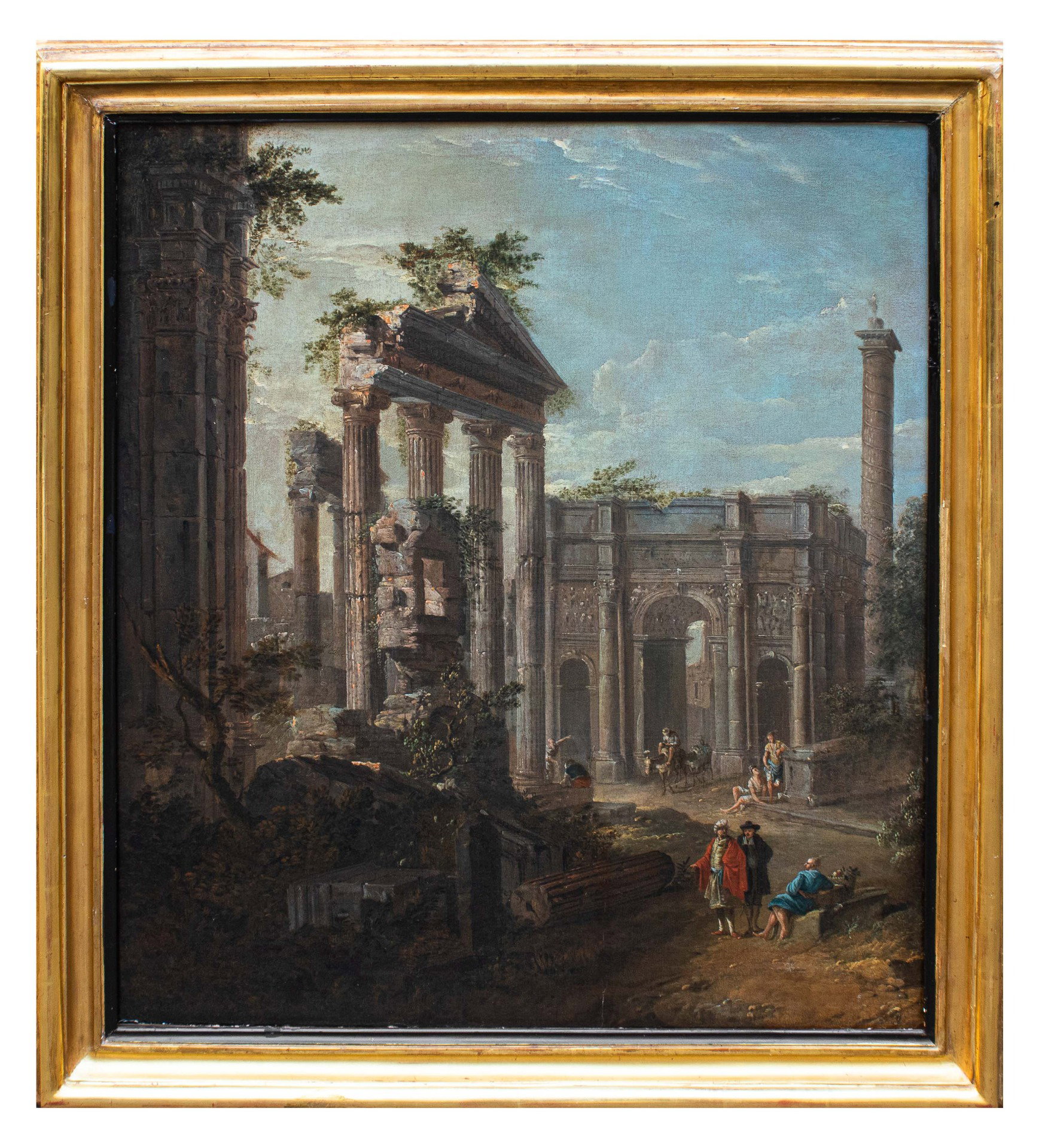
Oil on canvas, 84 x 72 cm
Bichrome frame, 98.5 x 86 cm
Critical Essay by Prof. Giancarlo Sestieri
This Architectural Capriccio, of superb pictorial quality, is a work by Antonio Joli, as confirmed by a written communication from Roberto Middione, author of the 1995 monograph on the painter, and by an expert appraisal by Giancarlo Sestieri in 2005.
Of Modenese origin, Joli studied in his hometown with Raffaello Rinaldi, known as Il Menia, a painter of perspectives and architecture enlightened by the teachings of Codazzi. A particular predisposition for vedutismo led him to the styles of Paltronieri and Bigari, who enriched his Emilian training. Around 1720 he moved to Rome, coming into contact with Giovanni Paolo Panini, a "natural consequence" of his training that allowed him to deepen the foundations of the veduta, perspective, and classical ruins; while documents attesting to his attendance with the Piacenza master are lacking, a pair of paintings now housed at the Civic Museum of Modena, formerly from the Campori collection and previously gracing the Franciosi antiquarian group in Carpi, represents a perfect synthesis of his studies on Panini's contemporary works. During the five years spent in Rome, Joli's original inclination for ruins and theatrical settings, derived from the Bibiena style, was enriched by more scientific approaches to the genre of objective and rational veduta. As Middione comments, his Roman experiences were, in short, "permeated as none other by the modes of theatrical scenography," thus early grafted onto his initial Emilian figurative sedimentation.
By 1732, the artist had moved to Venice, where he remained for ten years (except for excursions to other cities like Rome, where in 1740 he stood as godfather to Paolo Anesi's son), coming into contact with Canaletto's vedute. In the lagoon city, he continued to work primarily as a set designer. He then traveled extensively throughout Europe, first reaching Germany and then London, where he lived between 1744 and 1748; from 1750 to 1754 he resided in Madrid, a city where he received numerous accolades. A protagonist of his time, he moved again to Venice, Rome, and Naples, where he was sought after as a vedutista, set designer for the Teatro San Carlo, and organizer of official celebrations, an activity he began early in his career. He died in Naples in 1777 after achieving extraordinary fame and fulfilling impeccable commissions for the nobility undertaking the Grand Tour. The historical judgment of Lanzi is illuminating in this regard: "(...) rooted in architectural theories, he moved to Rome, and in Panini's school, he formed one of the most celebrated painters of architecture and ornate decoration."
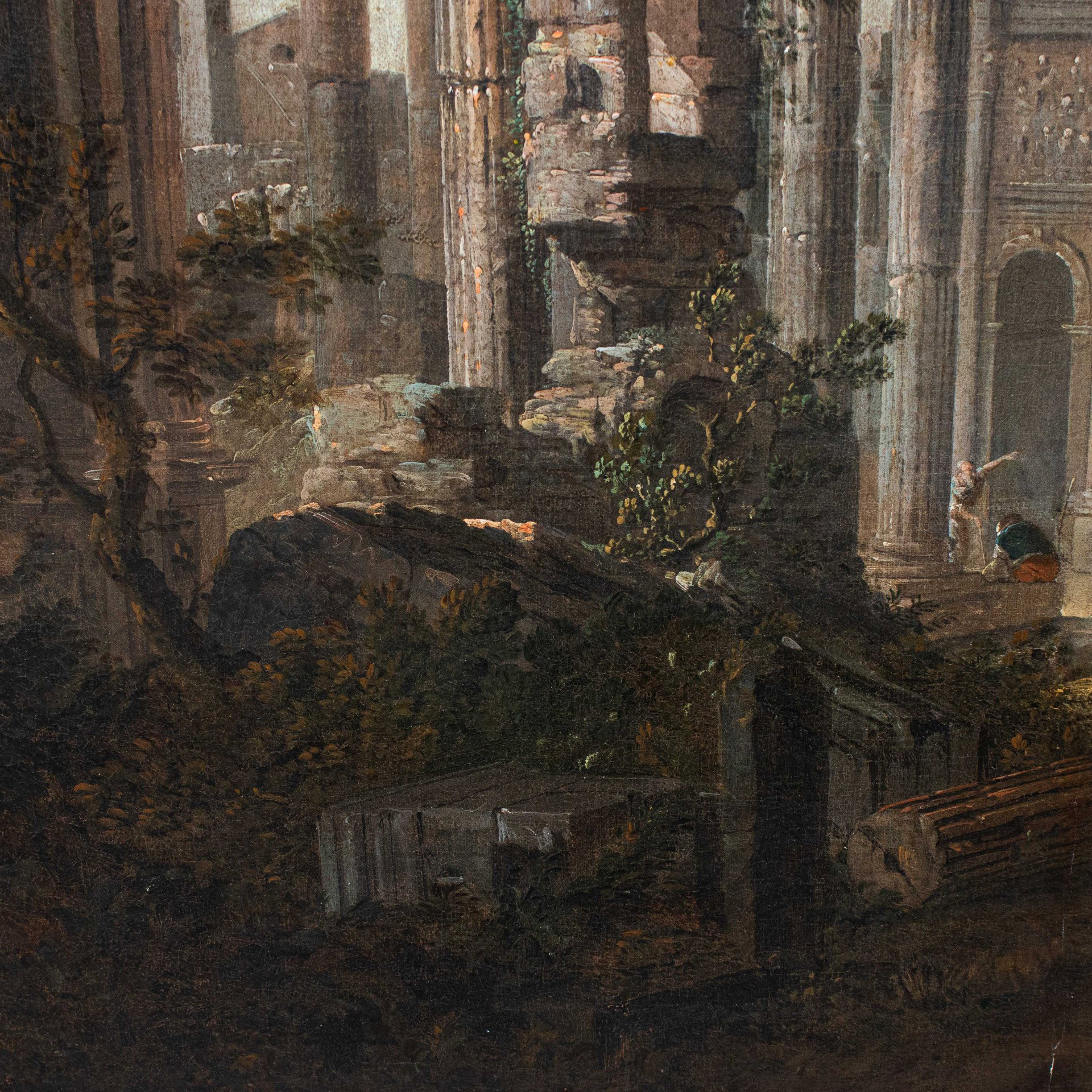
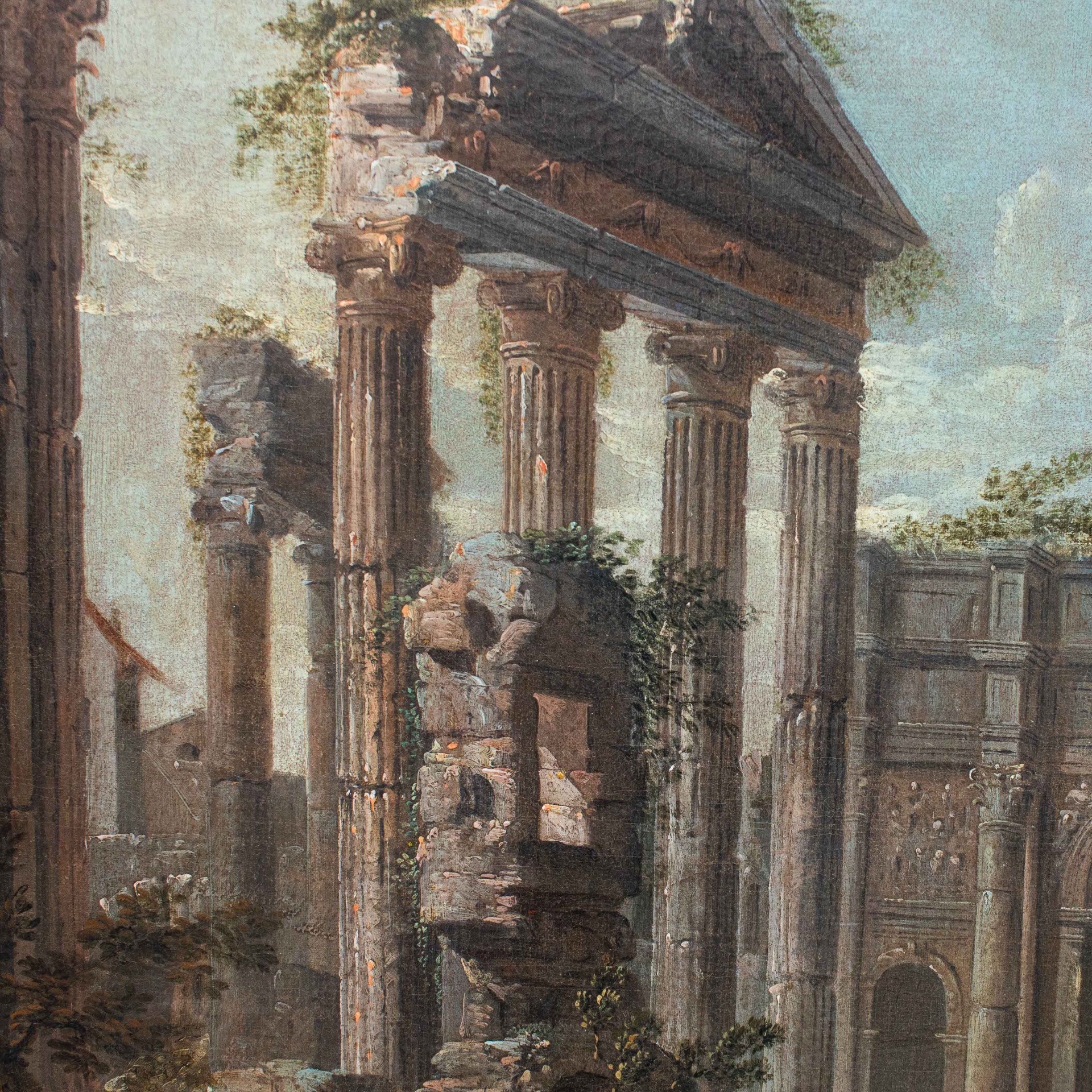
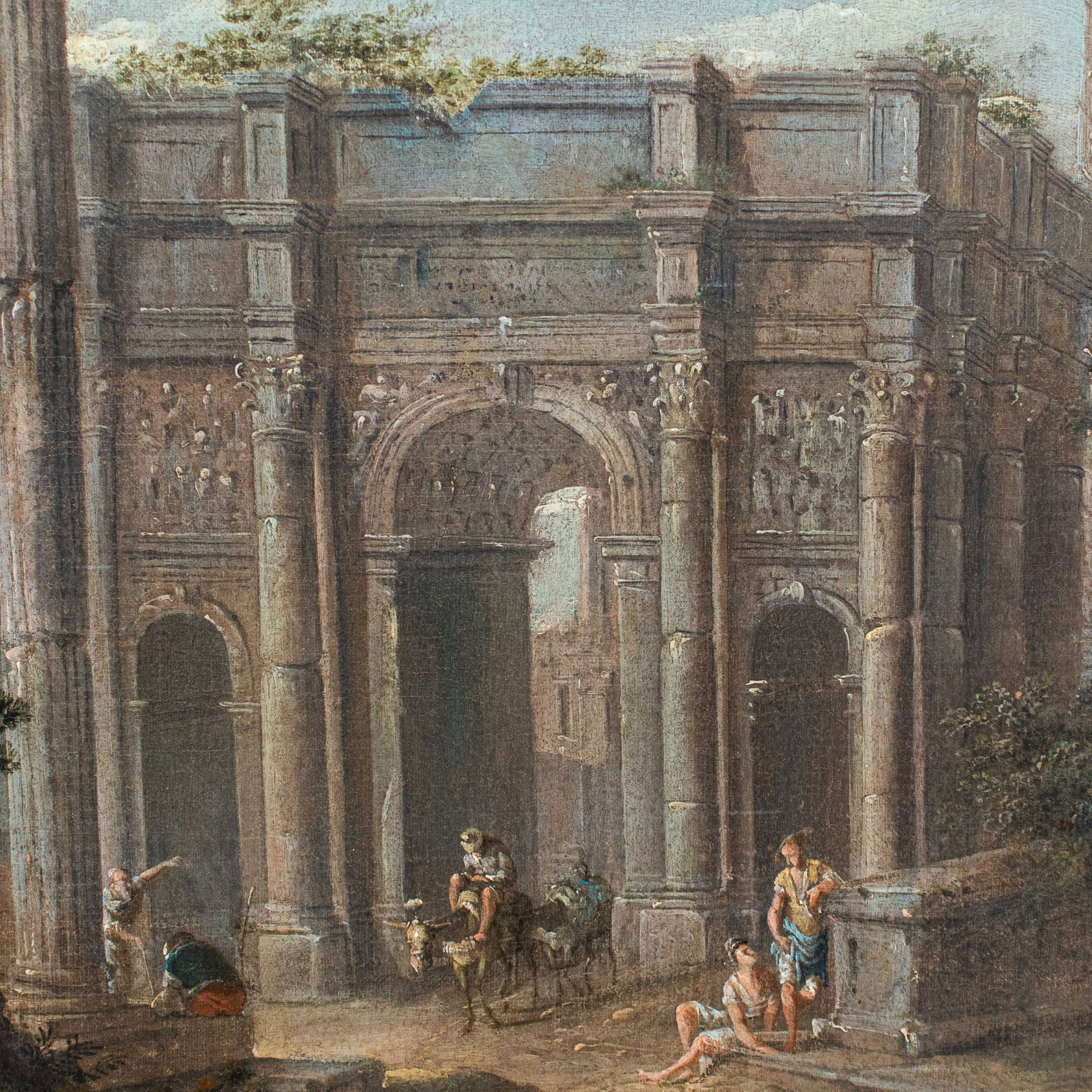
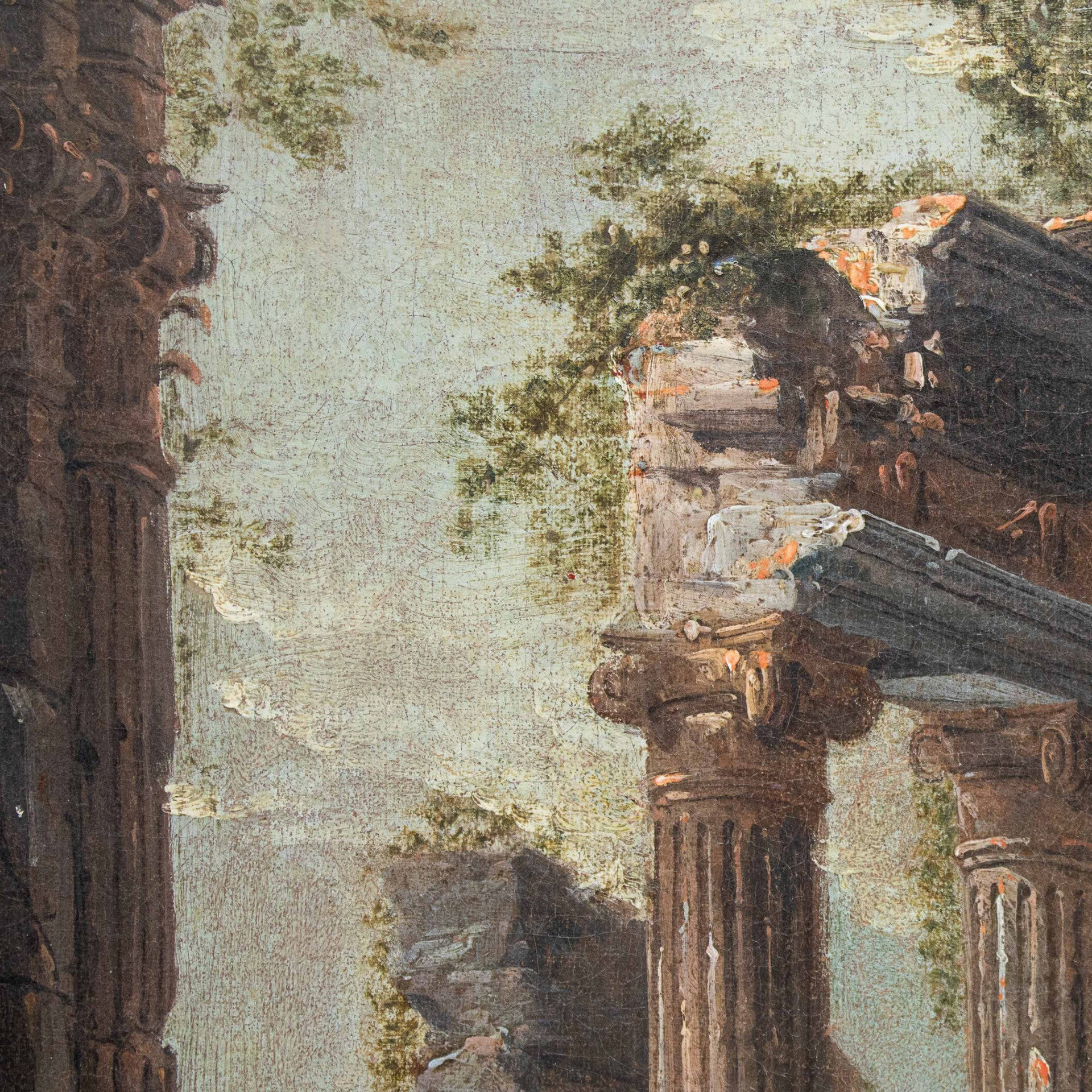
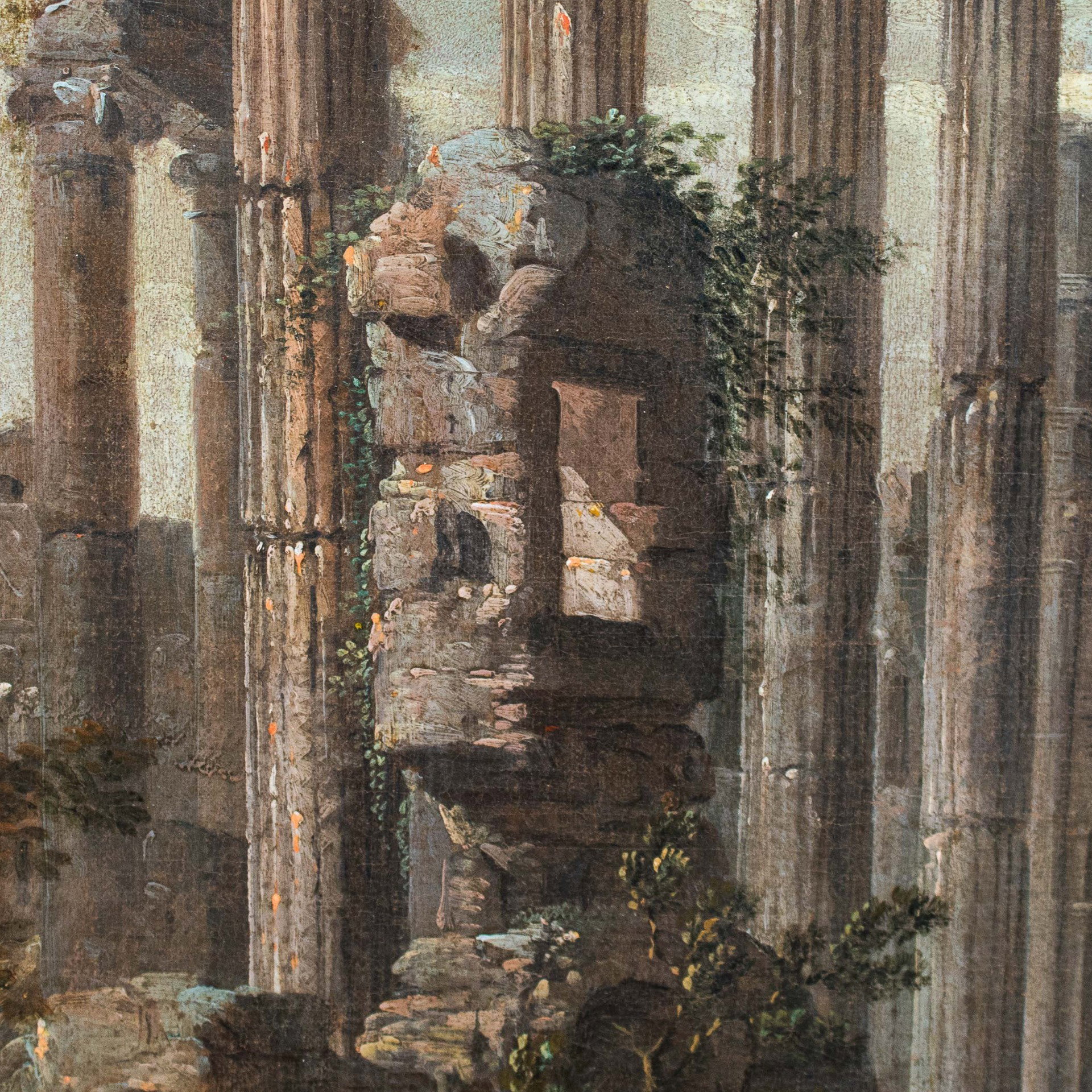
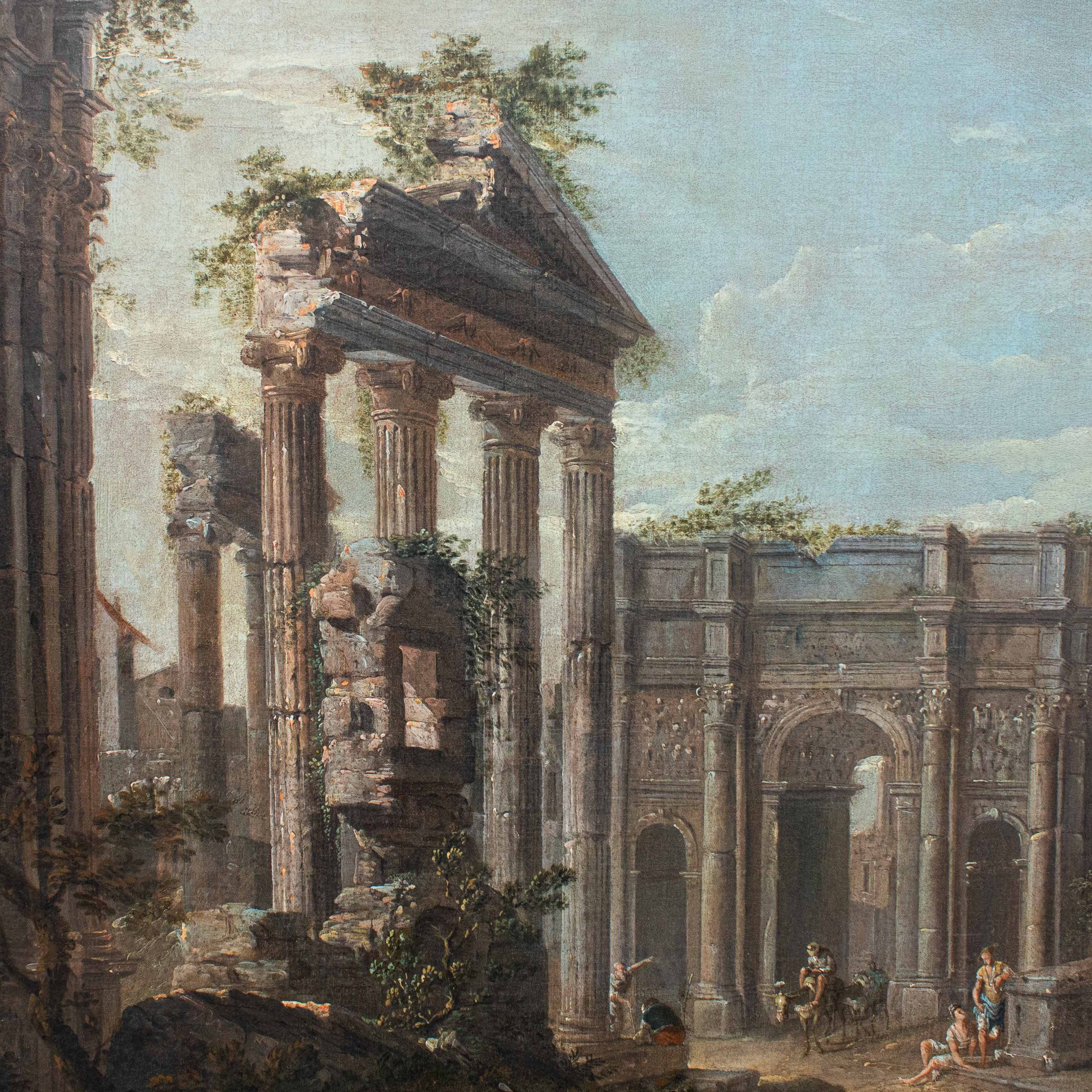
The Capriccio is centered on a fanciful mixture of Roman monuments, some of which are easily recognizable, such as the Arch of Septimius Severus and Trajan's Column on the right. The two famous vestiges of the imperial past are placed slightly behind, on the right, while in the foreground one can see a ruined tempietto with a group of archaeological fragments, behind which are four fluted columns with remains of an entablature and pediment, and further back, three more, freely inspired by those of the temples of Saturn and of Castor and Pollux. According to a typology common to the genre, trees, bushes, and weeds appear among the monuments.
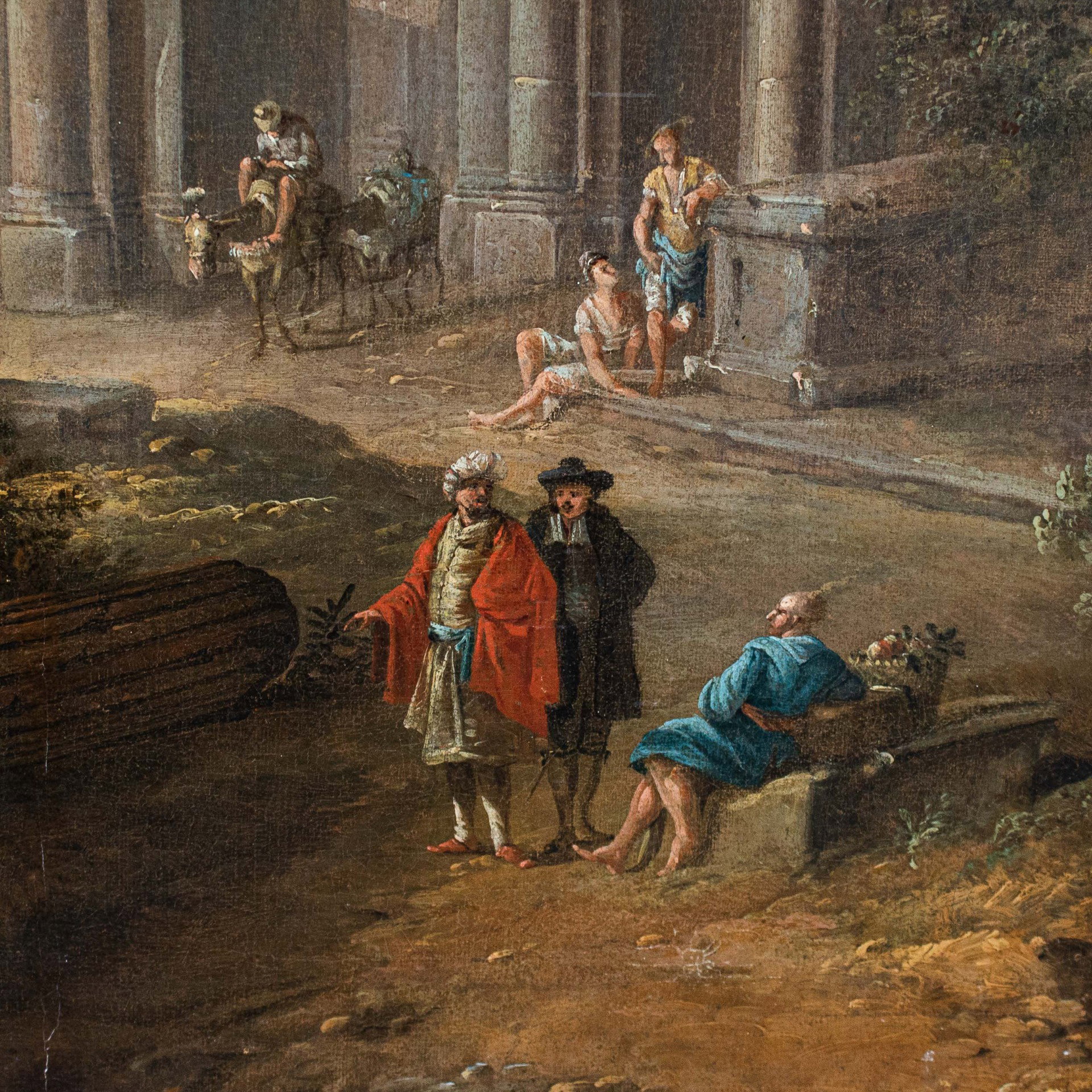
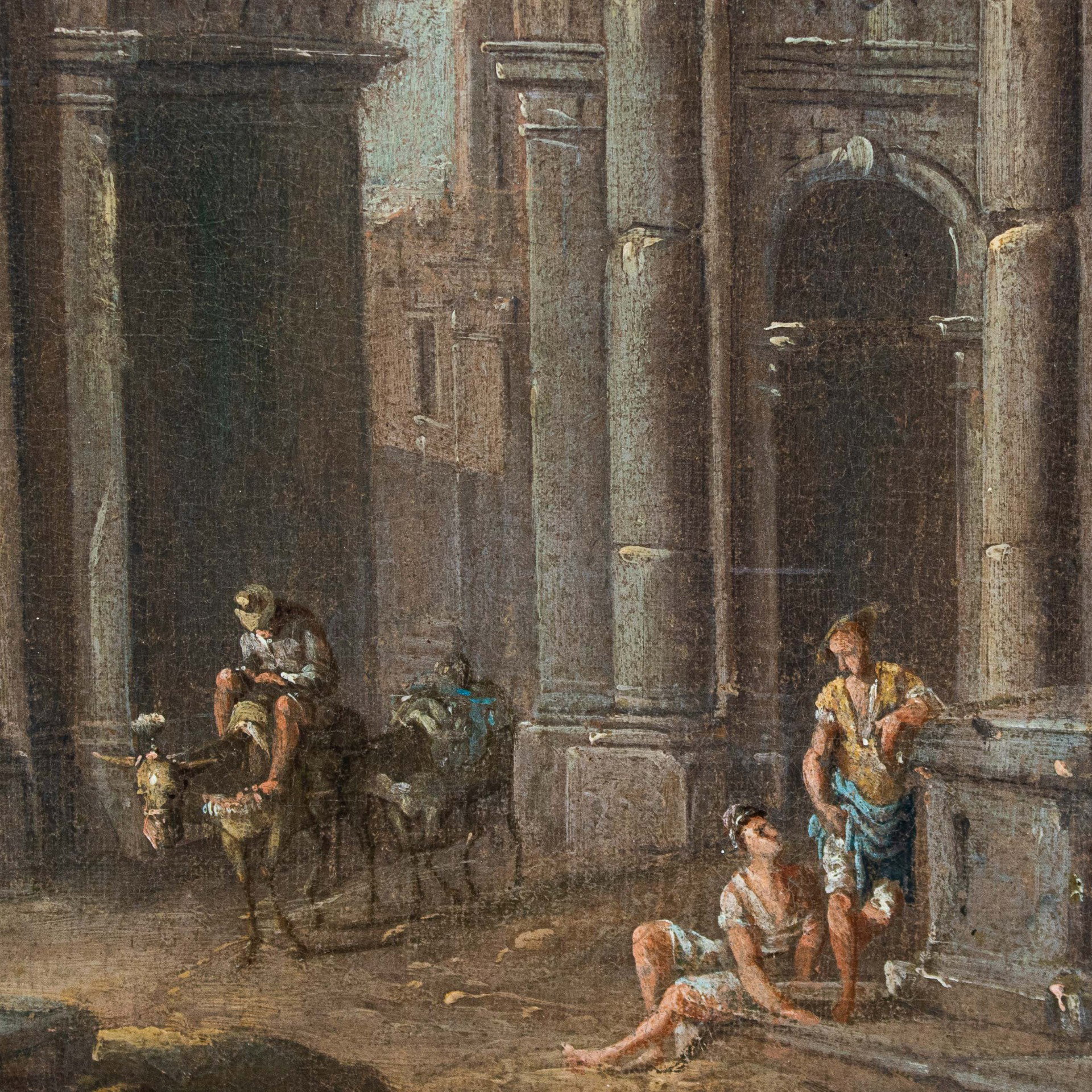
The painting is populated by several figures: in the foreground, two men in contemporary dress are engaged in conversation, while a third, dressed in blue, is languidly reclining on an archaeological fragment, perhaps a sarcophagus, with a basket of flowers beside him. The other figures are in the background, in front of the Arch of Septimius Severus: among them, one can see a man on horseback with a mule, followed by a second animal.
The pictorial rendering is softly blended in delicate hues with pastel-like effects.
As emphasized by Sestieri, this painting is intimately linked more to the world of theatrical capriccio than to vedutismo, in relation to the set designer training of the Modenese painter, who freely mixes realistic elements from Roman ruins as if they were a theatrical backdrop. In other words, it is an early example of capriccio datable to his first Roman sojourn (1720-1725), an expression of his initial contact with Panini, who had not yet reached a level of completeness in the early 1720s. To confirm the chronology around the mid-1720s, one can compare this work with "The Fire of Troy" and its pendant "Samson Pulling Down the Temple of the Philistines," created immediately after his five years in Rome and both housed at the Galleria Campori in Modena.
Written communication from Prof. Roberto Middione, October 17, 2005
Expert appraisal by Prof. Giancarlo Sestieri, November 8, 2005
Published: SESTIERI G., 2015, Il Capriccio architettonico in Italia tra XVII e XVIII secolo, Rome, p. 251 (fig. 25)