Michele Gordigiani (Florence 1835-1909), Young Pompeian Maiden, 1886
Description:
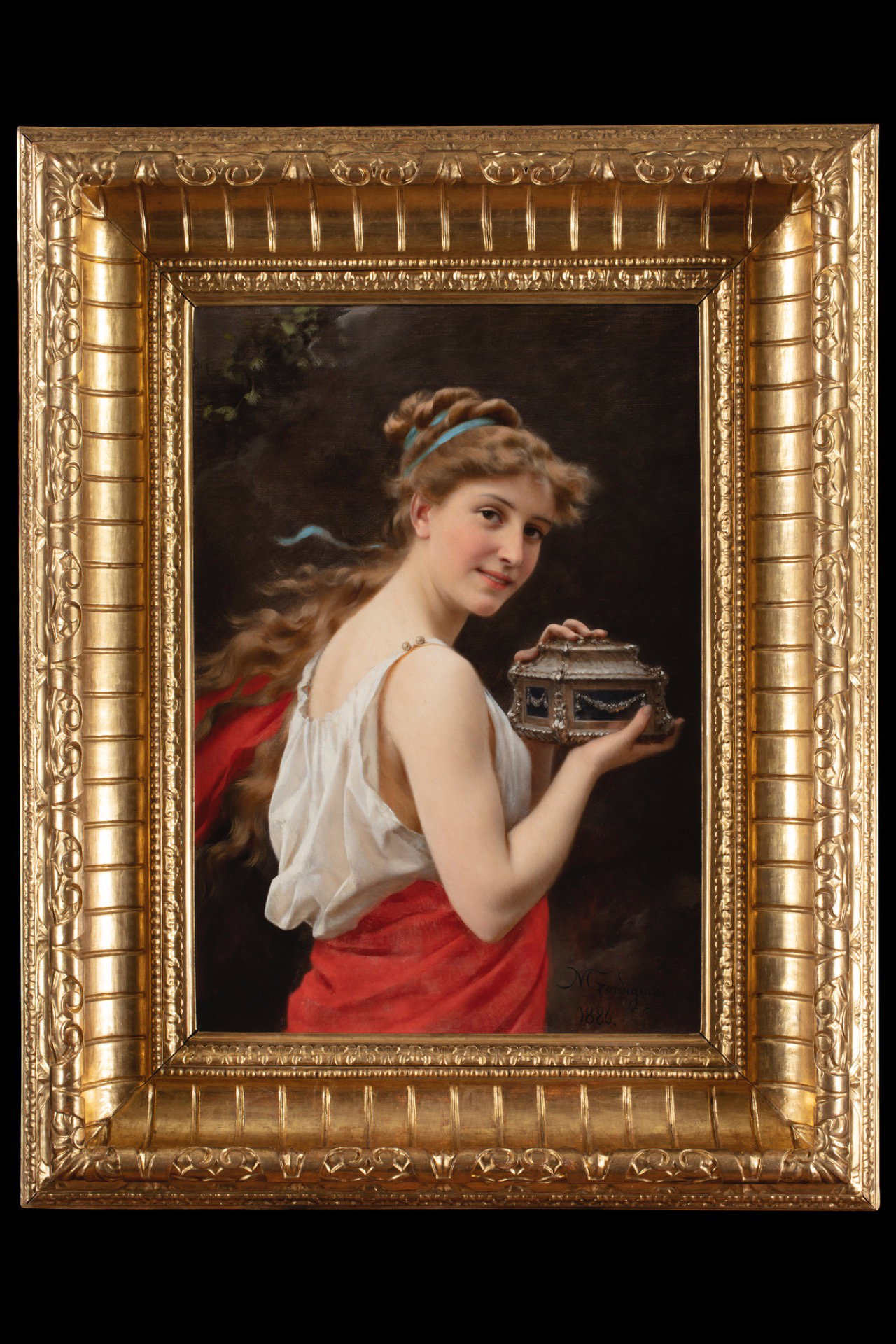
Michele Gordigiani (Florence 1835-1909), Young Pompeian Maiden, 1886.
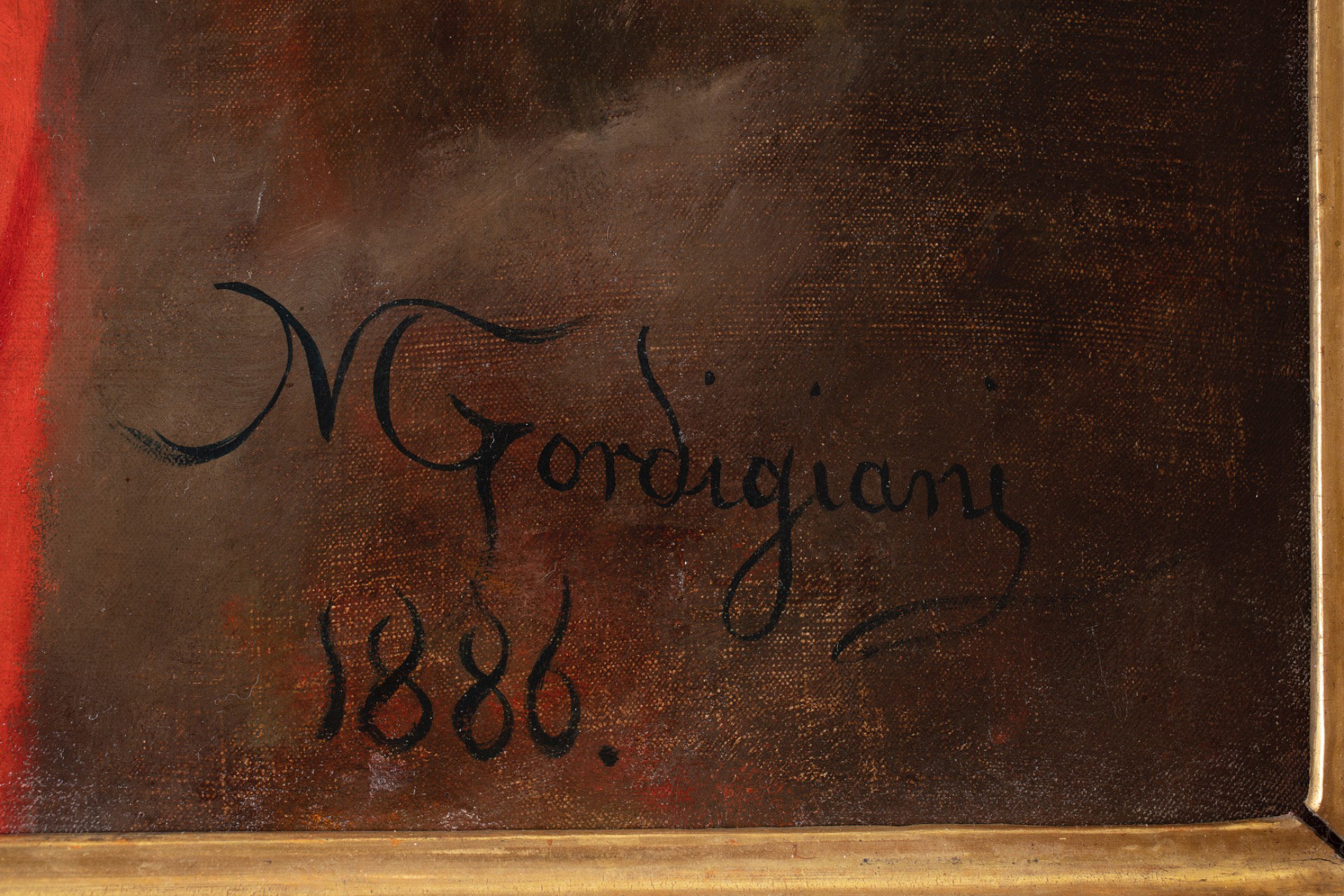
Oil on canvas, 82x86 cm, signed lower right "M. Gordigiani/1886".
Dimensions with frame: 122x126 cm.
The painting depicts a portrait of a young woman in ancient clothing. The Roman tunic that covers the maiden and the ribbon that gathers her hair, so frequently used in this type of historical painting, are distinctive elements of Neo-Pompeian painting, which was very popular in the second half of the 19th century.
The maiden holds an elegant bronze casket, displayed with satisfaction, as if it contained something very special.
Gordigiani, a highly skilled and much-appreciated portraitist, renders a female figure with delicate features and timeless grace.
The painting is enhanced by a refined, richly decorated gilded wooden frame.
BIOGRAPHY
Born in Florence on May 29, 1835, to the musician Luigi and Anna Giuliani, daughter of the renowned guitarist and composer Mauro. At a very young age, he learned the rudiments of sculpture in the studio of L. Bartolini, who lived in the same building in Borgo Tinti. Around 1845, he became a student of L. Mussini at the school the painter had founded in Florence with his friend A. Sturler, where he studied alongside S. Lega.
Determined to dedicate himself entirely to painting, Gordigiani enrolled in the Academy of Fine Arts, attending the courses of G. Bezzuoli. During these formative years, he practiced extensively by copying the great masters of the past and began to develop excellent portraitist skills.
His entry into the Caffè Michelangelo dates back to 1855, where he formed friendships with the Macchiaioli group, partially sharing their artistic explorations.
However, his inclination for portraiture soon became almost exclusive, and his refined skills in this genre quickly earned him widespread acclaim. The year 1856 saw the creation of his Self-Portrait at the Uffizi, where he depicts himself with a subtly bold air and a cigar in his mouth, and the portrait of Ludovico Raymond (Turin, Civic Gallery of Modern Art); the two famous portraits of the English poets Robert Browning and his wife Elizabeth Barrett (London, National Portrait Gallery) date from 1858.
In 1860, he traveled to Paris, where he was introduced to artistic and social circles by Virginia Oldoini, Countess of Castiglione, his close friend and whom he portrayed several times over the years. Upon his return, he painted the portrait of Count Camillo Benso of Cavour and in 1861, despite having only glimpsed the model at a party, that of King Vittorio Emanuele II (Turin, National Museum of the Risorgimento), commissioned by his cousin Eugenio Emanuele of Savoy, Prince of Carignano.
Both canvases were presented, earning unanimous praise, at the first Italian Exhibition held in Florence in 1861; on this occasion, Gordigiani refused the prize awarded to him, joining the protests of his Macchiaioli friends against the jury, whom they deemed incompetent. The favorable reception of the portrait of Vittorio Emanuele, however, led Gordigiani to become the official portraitist of the House of Savoy, whose members posed for him multiple times, especially during the years when Florence was the capital.
Subsequently, other royal courts utilized his talent, starting with the Portuguese court (many portraits of the Savoy family are preserved at the Palacio Nacional de Ajuda in Lisbon, commissioned by Queen Maria Pia, daughter of Vittorio Emanuele) to the English court, where he traveled to paint the effigy of Queen Victoria. For thirty years, the artist received increasingly frequent and prestigious commissions from the nobility and the wealthy bourgeoisie, although he never failed to capture on canvas the faces of his own family and dearest friends, such as the artists G. Duprè, L. Mussini, T. Conti, and the writers R. Fucini, E. De Amicis, A. Maffei. The remarkable ability to faithfully reproduce likenesses, increasingly using photographic models, and adherence to the aristocratic style of the best interpreters of the genre active in France and England (C. Duran and J.S. Sargent above all) are the main reasons for the success of Gordigiani's portraits, not only among the high-society clientele but also among the public, who had the opportunity to admire them in major Italian and international exhibitions.
Among the numerous trips made by Gordigiani, most frequently to London or Paris, his 1893-94 journey to New York is noteworthy; his son Eduardo had settled there, and Gordigiani was able to paint numerous portraits in the span of a few months.
Upon returning to Italy, he continued to produce at his usual pace until shortly before his death, which occurred on October 7, 1909, in Florence. In April of the following year, a large portion of the paintings and sketches in his studio in Piazzale Donatello, along with numerous furnishings and his own art collection, were put up for auction as per his testamentary dispositions.
In addition to portraits, Gordigiani also ventured, albeit more rarely, into other types of compositions, from landscapes to historical and genre painting, the latter often featuring subjects that were easily accessible and assured of public appeal. Using family members as models, he occasionally indulged in costume portraits. Constantly faithful to his own style, Gordigiani remained virtually impervious to new trends, accentuating his solid academic approach as he aged and his fame grew.
Works by Gordigiani can be found not only in the aforementioned museums and in numerous Italian and foreign private collections but also in the Museo Nazionale di Capodimonte in Naples, the Pinacoteca Nazionale di Bologna, the Galleria Nazionale d'Arte Moderna e Contemporanea in Rome, and the Galleria Nazionale d'Arte Moderna in Palazzo Pitti, Florence, which houses about thirty of the artist's canvases.