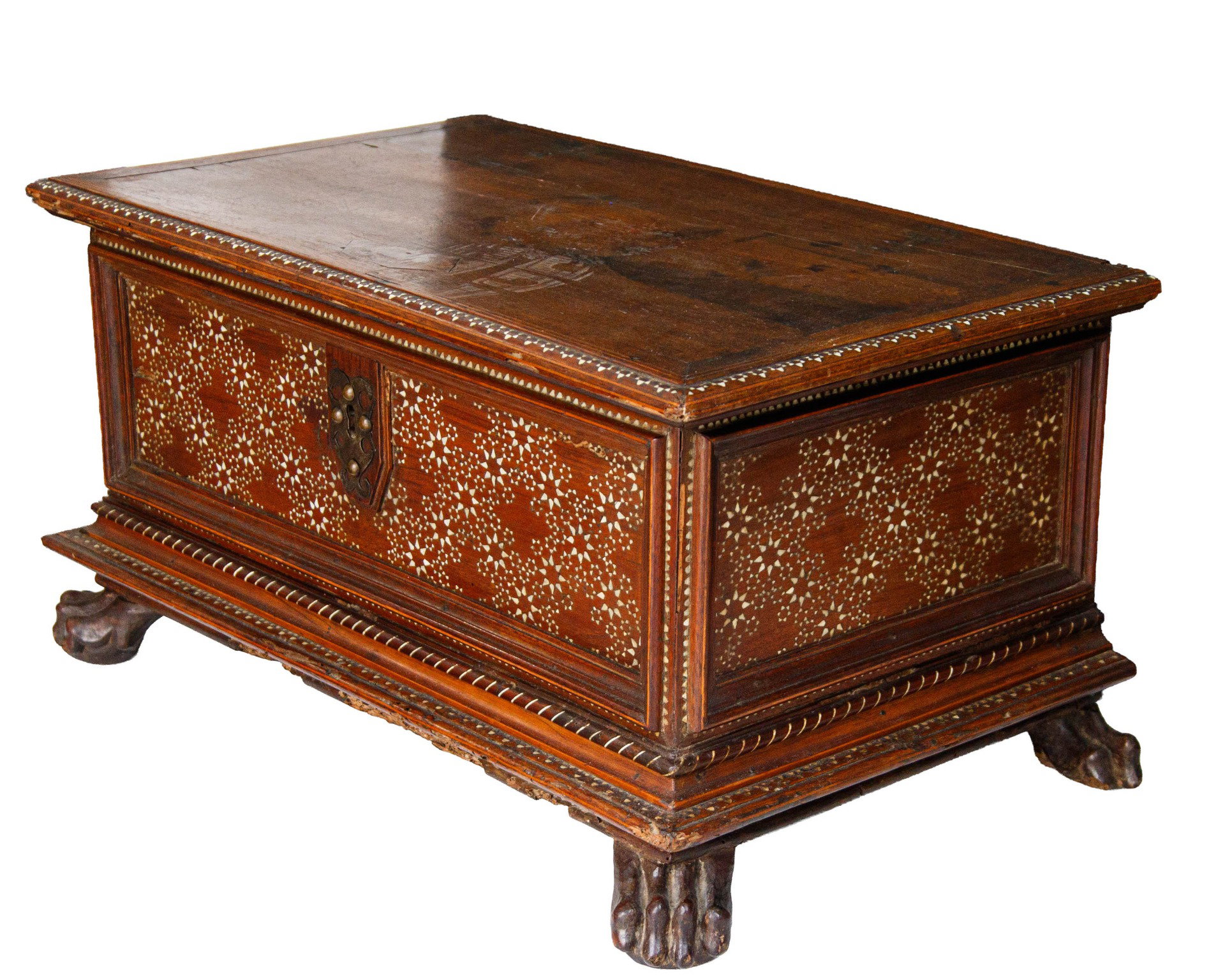
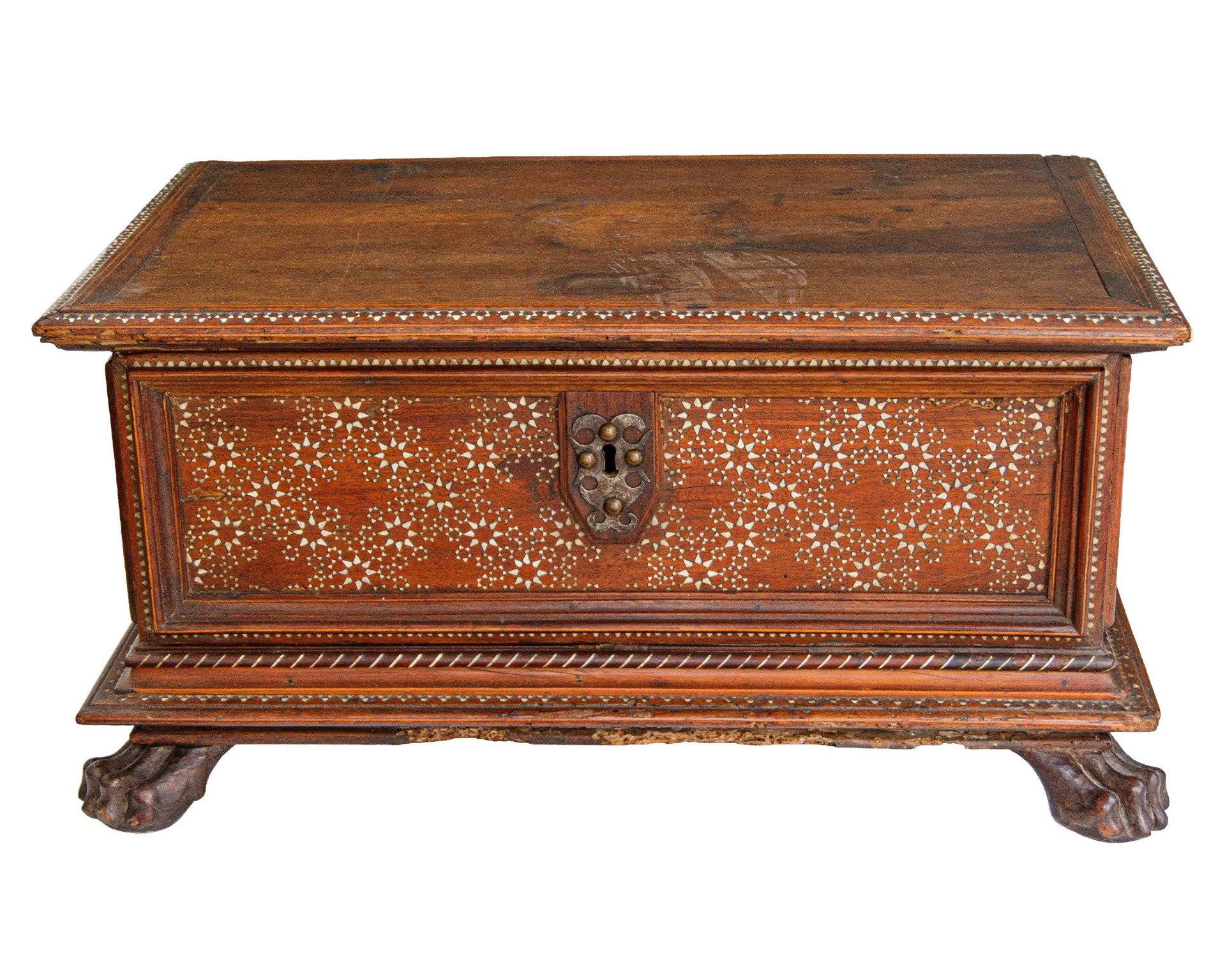
Bottega di Santa Maria della Scala (mid-16th century), Casket
Description:
Bottega di Santa Maria della Scala (mid-16th century)
Casket
Walnut wood with bone inlay, 41 x 68 x 34 cm
This small walnut wood chest, dating from the mid-16th century, is a precious example of the refined Lombard cabinetmaking tradition that found one of its most fertile centers in 16th-century Milan. The parallelepiped structure, with its compact proportions, rests on four elegant, finely carved lion's paw feet. The entire perimeter surface is covered by a dense star motif achieved through minute inlays of bone fragments set into the warm brown of the walnut: the chromatic contrast between the two materials creates a decorative effect of great refinement, enlivening the wood with a regular geometric rhythm. The upper border, marked by a series of small bone dots, frames the main panel and gives the object a sense of formal completeness. In the center of the front is a small metal lock, the only visible functional element, which attests to the original purpose of the piece: to safeguard precious objects, jewelry, or confidential documents.
This chest is most likely attributable to the same workshop active at the church of Santa Maria della Scala, the famous Milanese parish church demolished in 1776 to make way for the La Scala Theatre designed by Giuseppe Piermarini. That workshop, operating in the first half of the 16th century, left as its most imposing testament the complex of nineteen walnut choir stalls, now preserved in the church of San Fedele where it was transferred at the time of the demolition. The choir, completed around 1560 and stylistically attributed to Anselmo de' Conti, reveals the same technical mastery found in the chest: geometric motifs, friezes in bone and mother-of-pearl, inlays that in the upper panels depict views of an ideal and ancient Milan, with arches, pyramids, streams, and architecture of classical and medieval inspiration. The small chest shares with the choir the same decorative language — the star as a repeated module, the minute bone fragment as an element of light in the dark wood — testifying to the continuity of a high-level artisanal language.