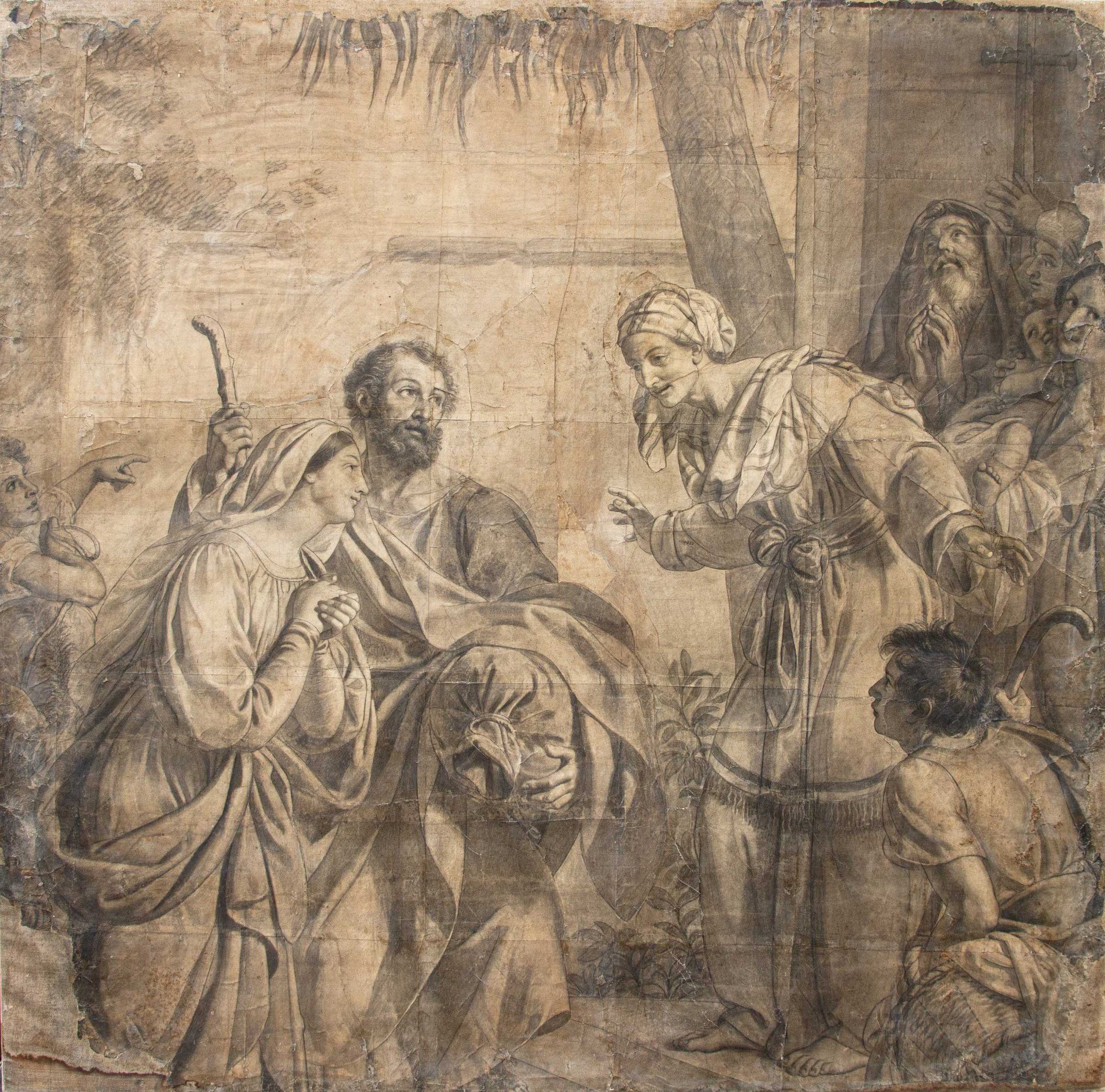
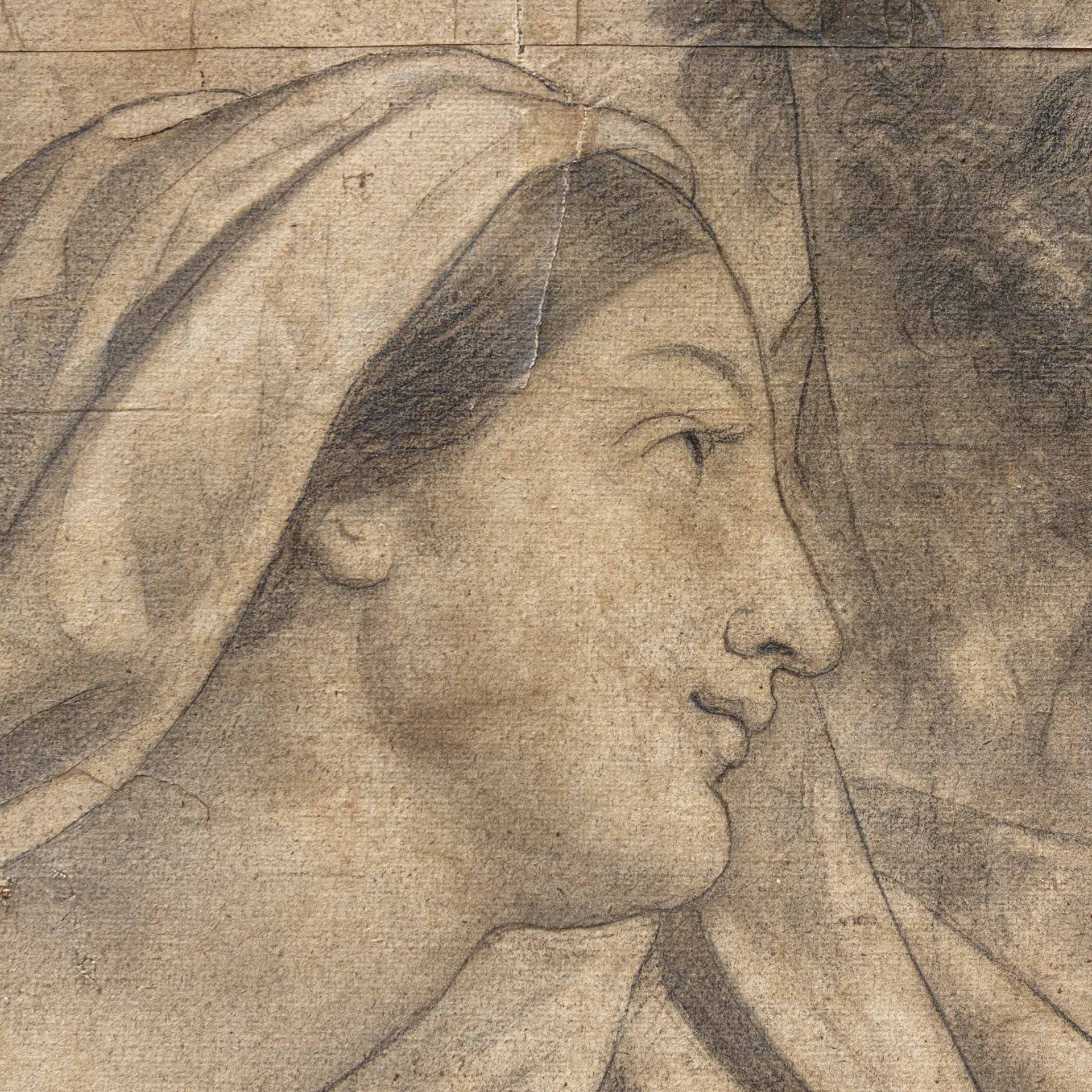
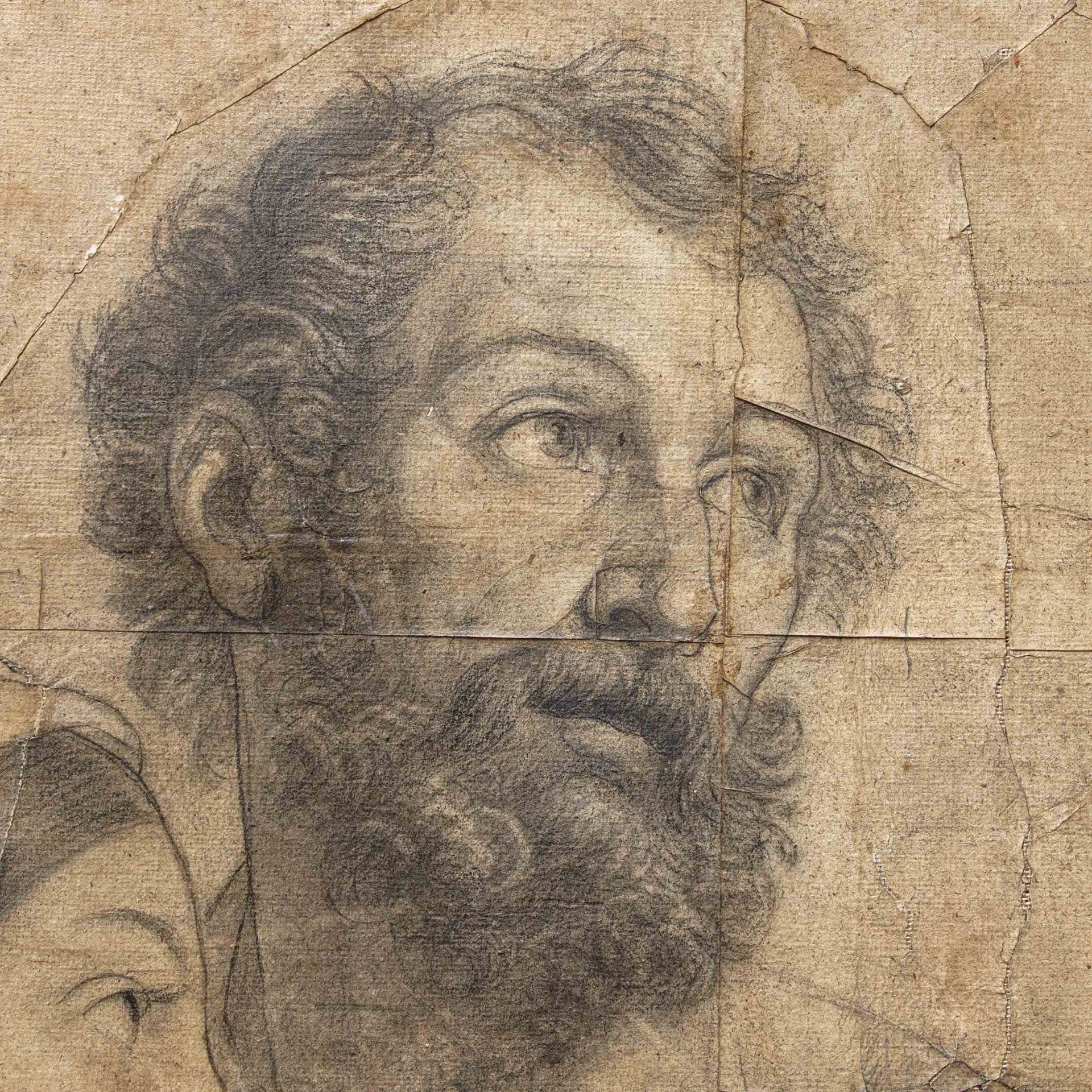
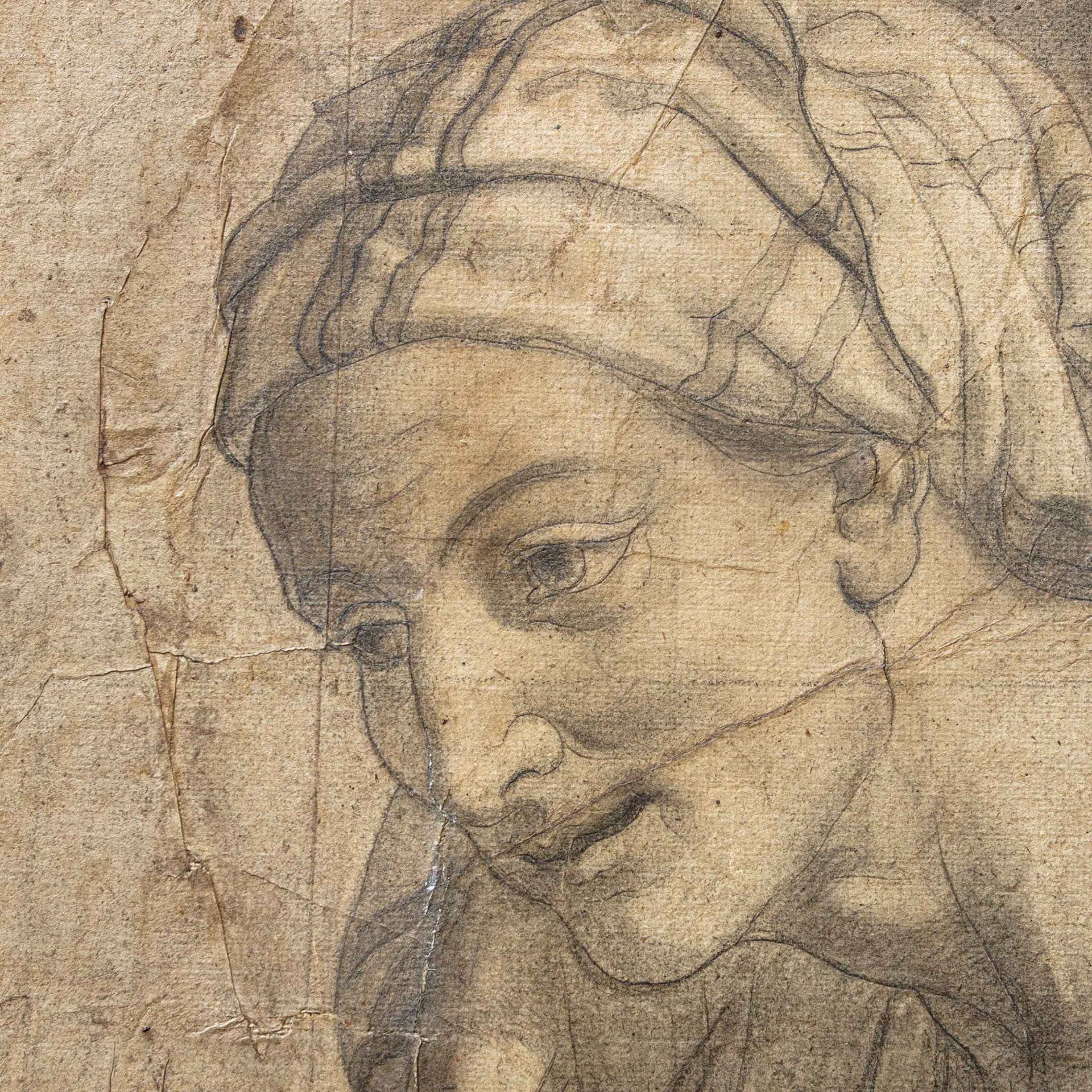
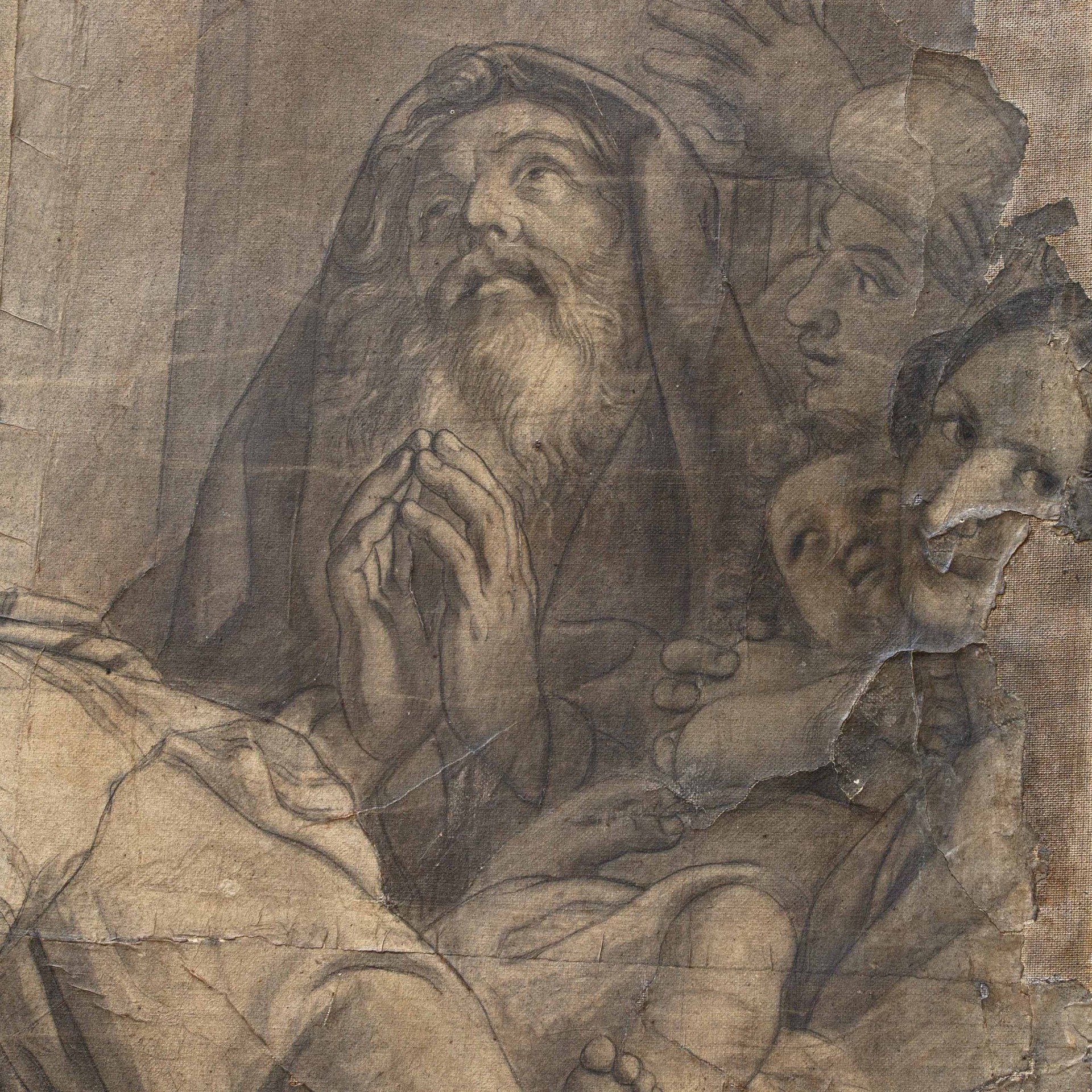
Enrico Scuri (Bergamo, 1806 – 1884), The Visitation of Mary to Saint Elizabeth
Description:
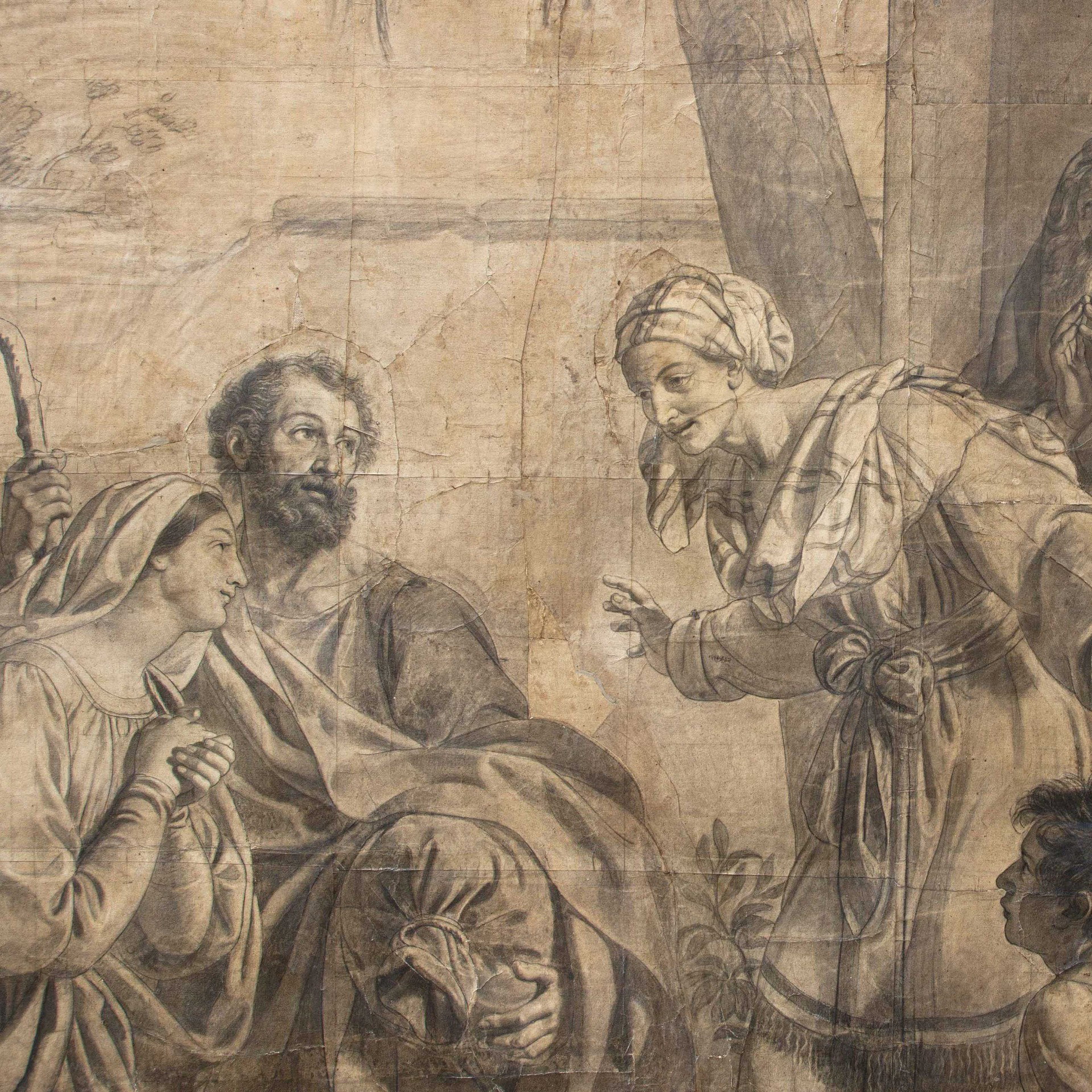
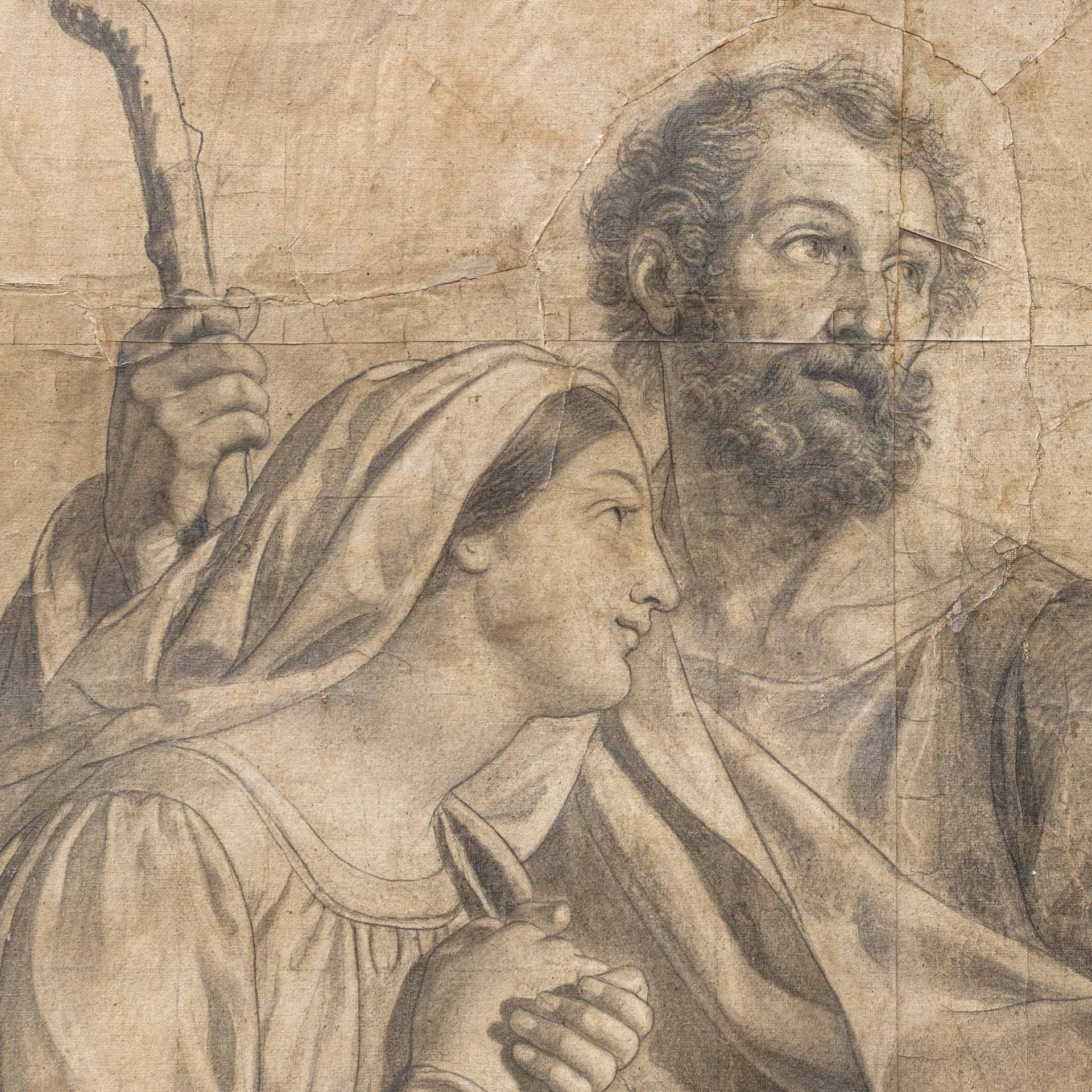
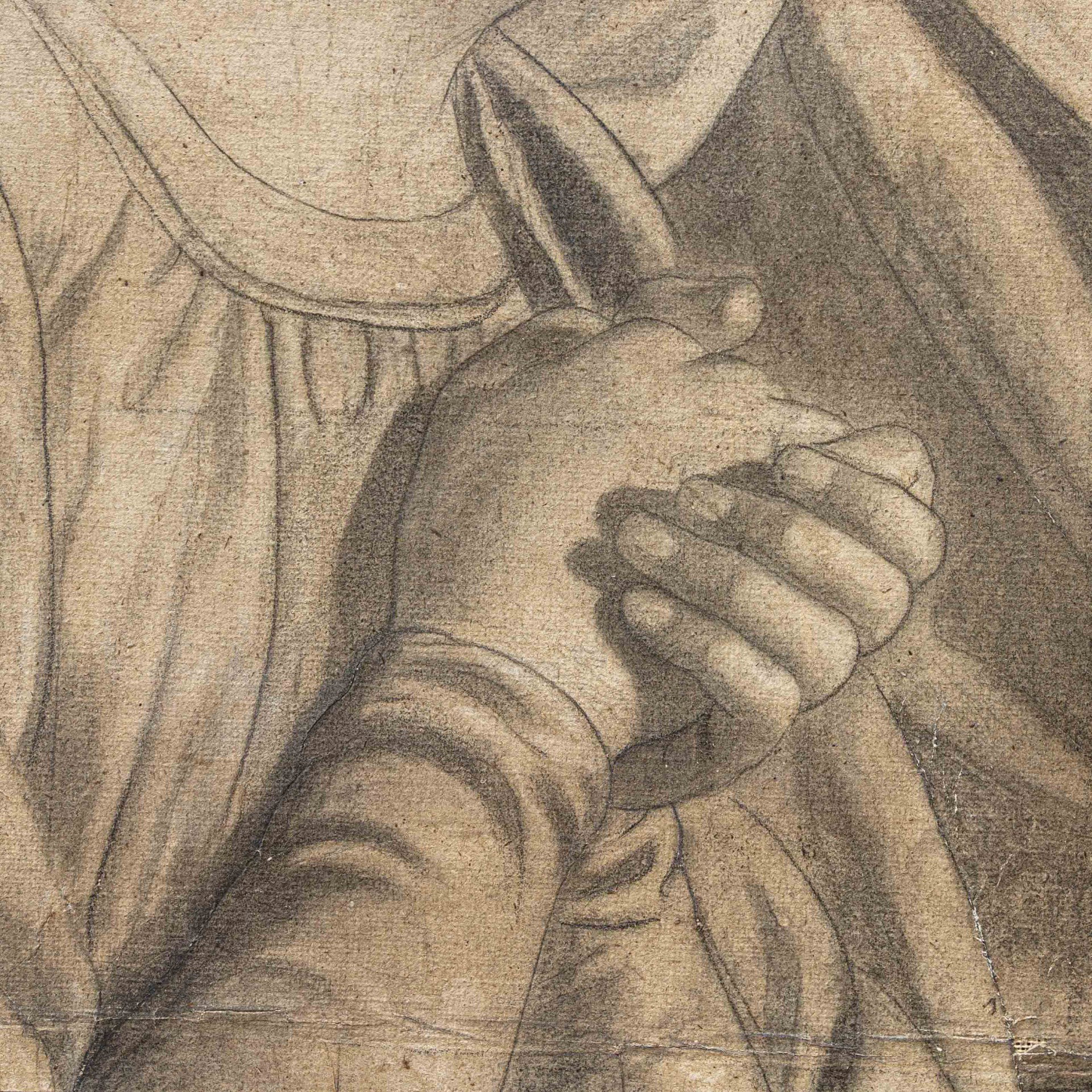
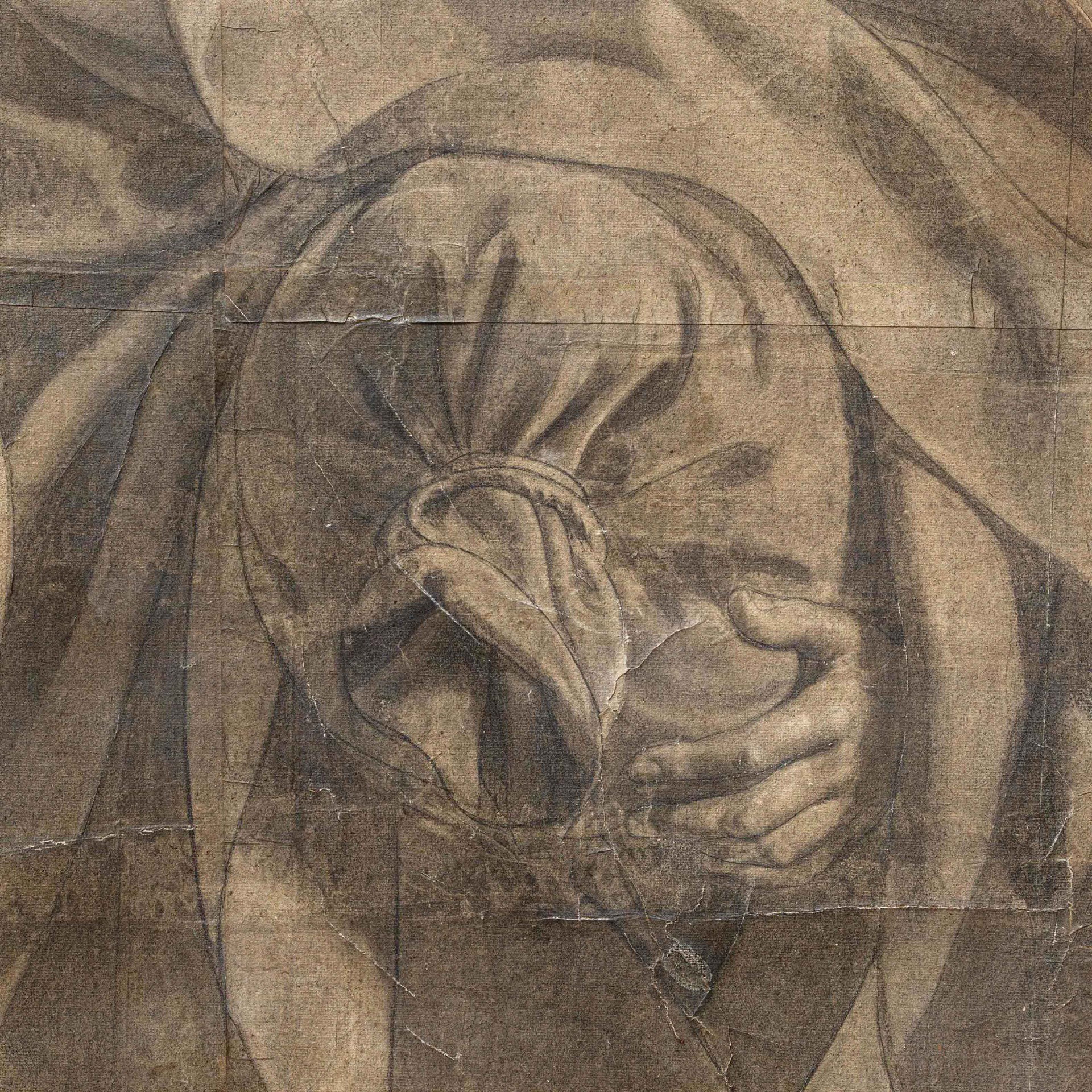
Enrico Scuri (Bergamo, 1806 – 1884) The Visitation of Mary to Saint Elizabeth Pencil and charcoal on paper applied to canvas, 222 x 224 cm The preparatory cartoon for the fresco in the parish church of Santa Maria Nascente in Rudiano, in the Brescian area, is presented as a large sheet of pencil on paper applied to canvas. The subject depicted is the Visitation of Mary to Saint Elizabeth, an evangelical episode known as the Visitation: at the center of the scene, the two female figures are recognizable, Mary, engrossed in a gesture of supplication with clasped hands, and Elizabeth, who turns to her with an open smile and a hand gesture expressing wonder and welcome. Next to Mary stands the male figure of Joseph, recognizable by his beard and the staff he holds raised. In the background, on the right, a group of secondary figures reacts to the encounter with animated expressions, their gazes turned upwards in a movement of devout astonishment. The pencil grid visible on the sheet confirms the preparatory function of the drawing, intended to be transferred to the fresco surface through the traditional proportional grid system. Ercole Scuri was born in Bergamo in the very early years of the 19th century to Cristoforo and Francesca Maver, originally from Serina. In 1819 he enrolled at the Accademia Carrara, where he trained under the guidance of Giuseppe Diotti, and in 1823 he won two first prizes at the annual competition. In 1841, he succeeded his master as director of the Accademia Carrara, a position he held for forty-three years until handing over to his student Ponziano Loverini. In 1932 Scuri created his first painting for the parish church of Rudiano, in the province of Brescia (The Healing of a Sick Woman, operated with the presence of the True Cross brought to her by Saint Macarius and Saint Helena), which made it clear that he was Diotti's best student. Also in 1932, he created the fresco with the Entombment of the Virgin Mary, also for the parish church of Rudiano, which was becoming the main testing ground for the Painting School of the Accademia Carrara: the preparatory cartoon for this fresco has also survived, now at the Civic Museum of Cremona, like the one for the work examined here. These are the years in which Scuri defined his artistic personality, linked above all to ecclesiastical commissions but supported, in its formal development, by the Milanese environment. Among his major works are King Starno shows the dead daughter to Fingal, now at the Belvedere in Vienna, the Expulsion from Eden, Orpheus and Eurydice at the Civic Museums of Pavia, and The Angel Announces the Resurrection to the Holy Women at the Accademia Carrara. Stylistically, the drawing fits coherently into Scuri's artistic journey, which managed to mediate between the formal solidity of neoclassicism and a romantic opening in themes and expressive intensity. The most immediate comparison is with the Visitation of Mary to Saint Elizabeth intended for the same church in Rudiano, of which the sheet is the direct study: the coherence between the graphic and pictorial phases reveals a rigorous method, in which drawing is a tool for compositional definition and not a simple sketch. The mastery of the human body, evident in the young man sitting in the lower right, recalls the academic figure studies that Scuri transmitted to his students, convinced that drawing was the foundation of all pictorial practice.