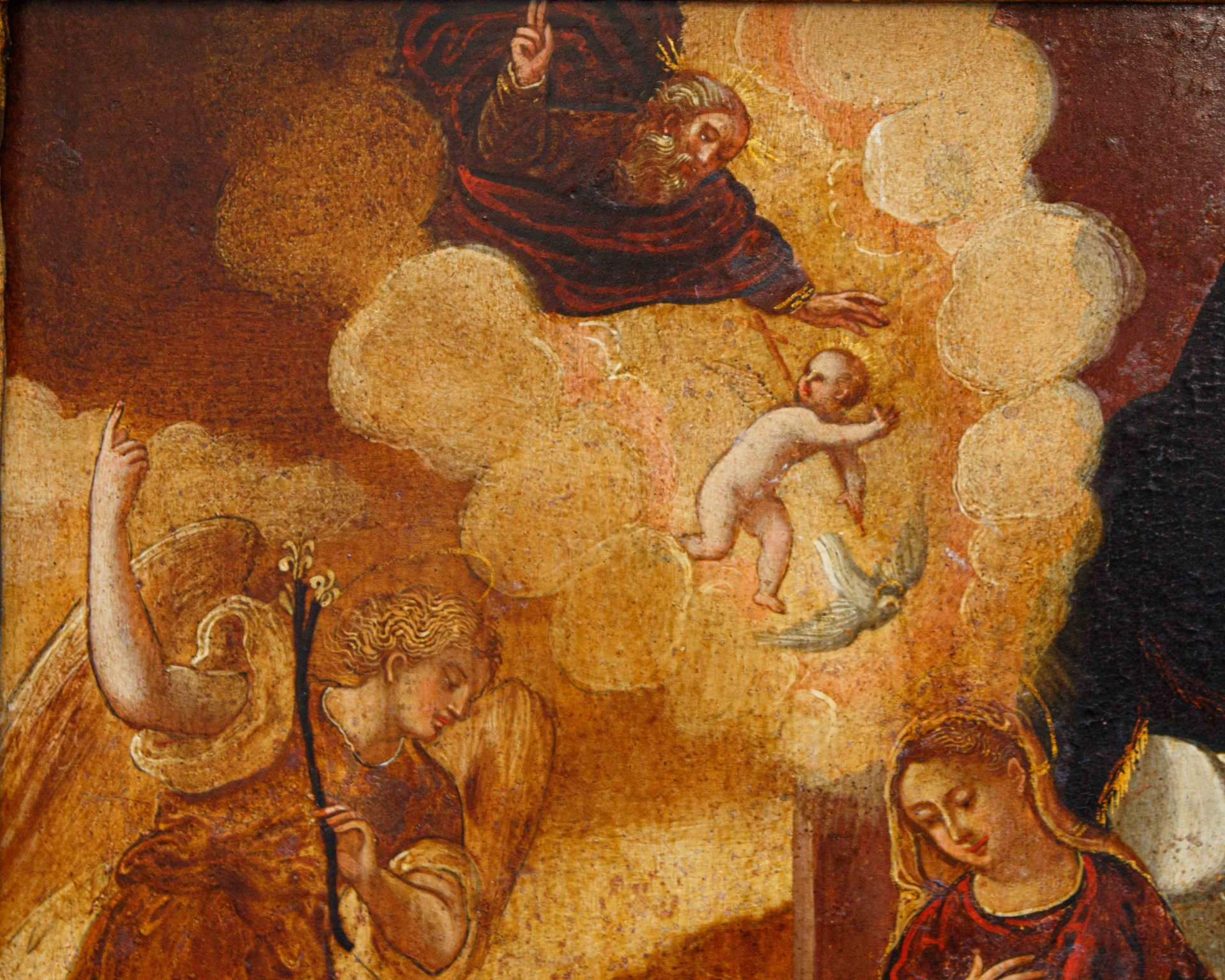
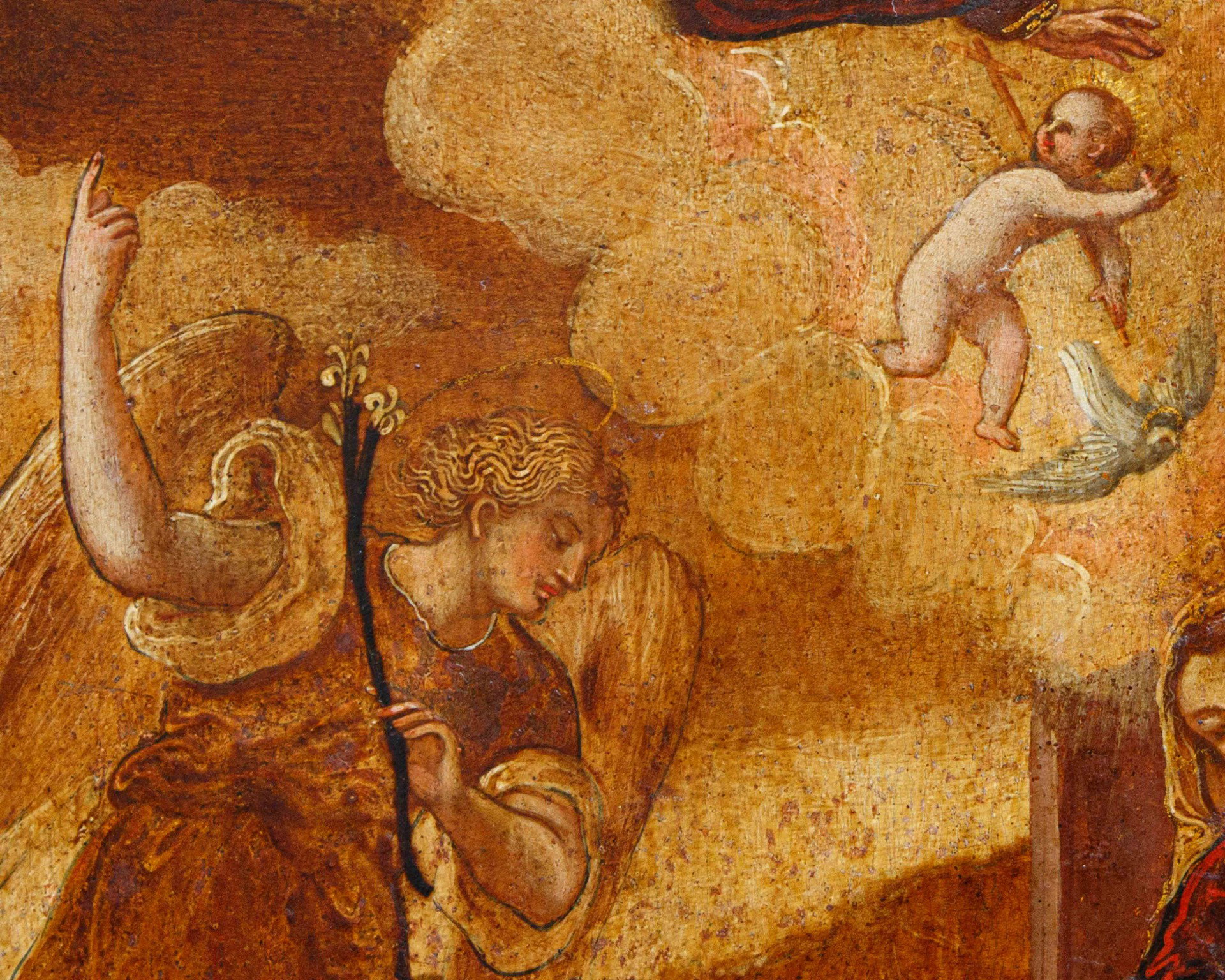
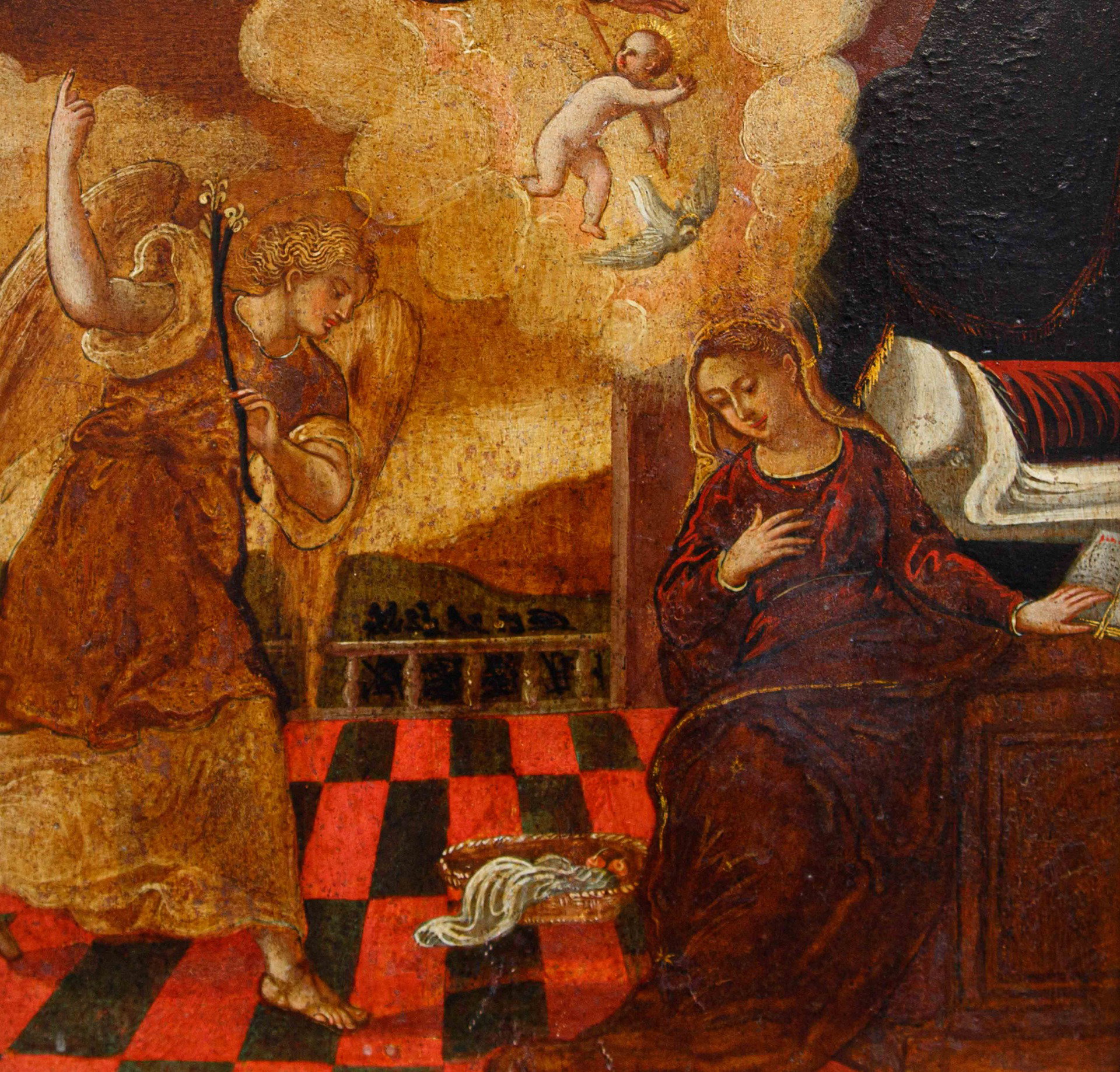
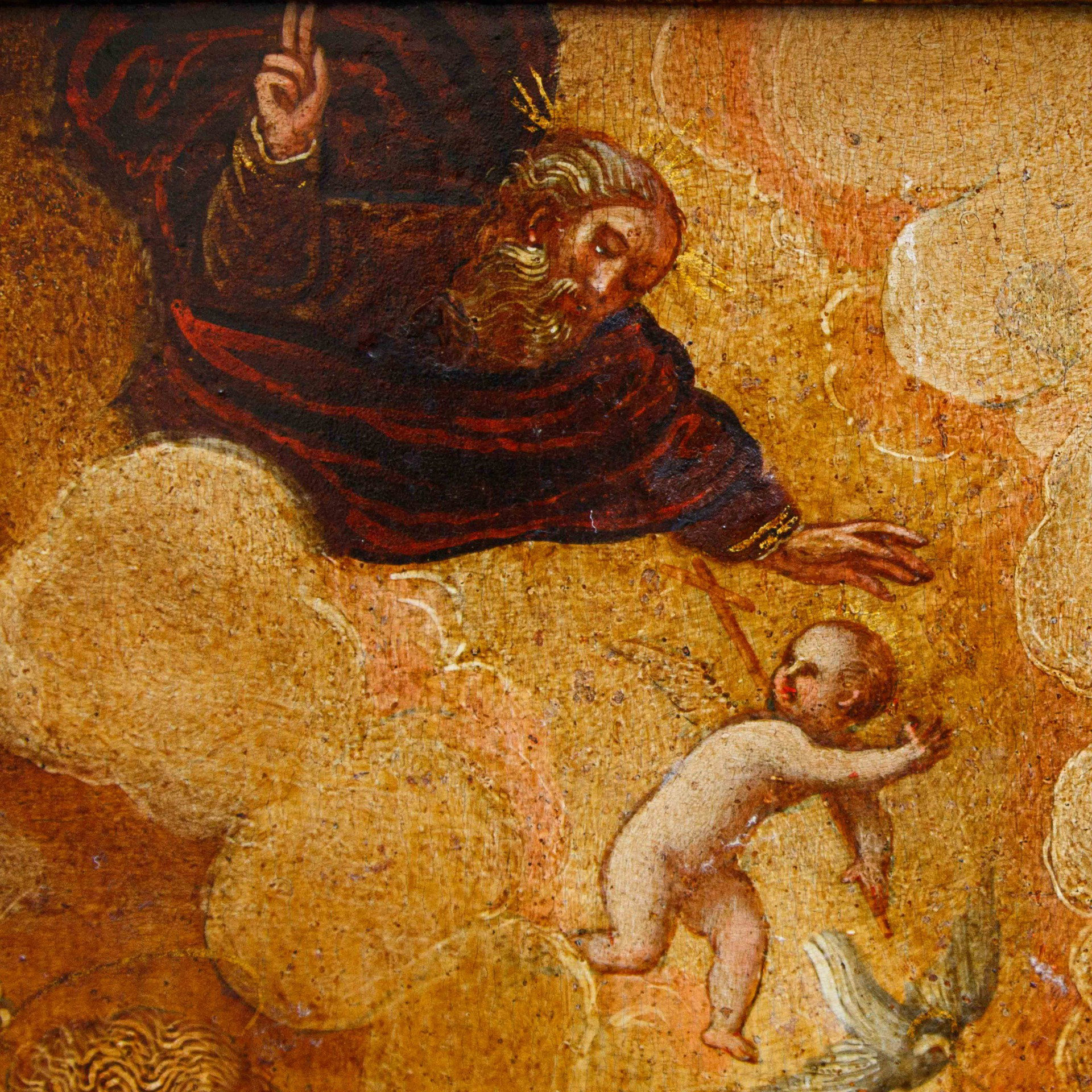
Dalmatian School, 17th century, Annunciation
Description:
Dalmatian School, 17th century
Annunciation
Oil on panel, 37 x 32 cm
With frame, 49 x 45 cm
The panel in question highlights the peculiar characteristics of the pictorial current known as Venetian Cretan, which spread from Venice to the coasts of Dalmatia and the Greek islands, from the 13th to the 17th century. The term Venetian Cretan refers to a geographically and culturally situated area between Venice, which politically controlled this vast Mediterranean area, and ancient Byzantium, the historical hinge between Europe and Asia, where Orientalizing characteristics prevailed at the time. The most brilliant example of this cultural and artistic fusion is undoubtedly Domenico Theotokopulos (1514-1614), known as El Greco, who, despite the future developments of his art, maintained strong technical and figurative links with the stylistic elements of this school, as is evident in the various Annunciations he created throughout his career.
The Byzantine-inspired tradition, characterized by golden preciousness and the dominance of line over volume, is combined in this work with the Renaissance Venetian innovations: the deliberate use of perspective, highlighted by the floor tiles and the vanishing point of the landscape background, the narrative sense of the story, the gestural liveliness of the figures, the green drapery, typically Venetian, to the right of Mary, and the very arrangement of the figures within the Annunciation scene.
Although the warm colors of the panel show a predominance of Byzantine gold in the background and clouds, where the figures of God the Father, the Holy Spirit, and the Child Jesus can be seen, typically recurring in the iconography of the Annunciation in this school, forming a descending diagonal towards the Virgin's face, we also note their materiality, a result of Venetian tonalism, which redefines the contours, no longer as linear as in the Oriental tradition, and capable of conferring volume, especially to the drapery. We thus observe a coexistence of the two traditions, both from a chromatic and spatial point of view, where perspective and two-dimensionality coexist between a background that fades into the distance and figures compressed in the foreground, but also of expressiveness, with the attempt to reconcile the hieratic nature of sacred figures with a more marked and naturalistic characterization in poses and faces.