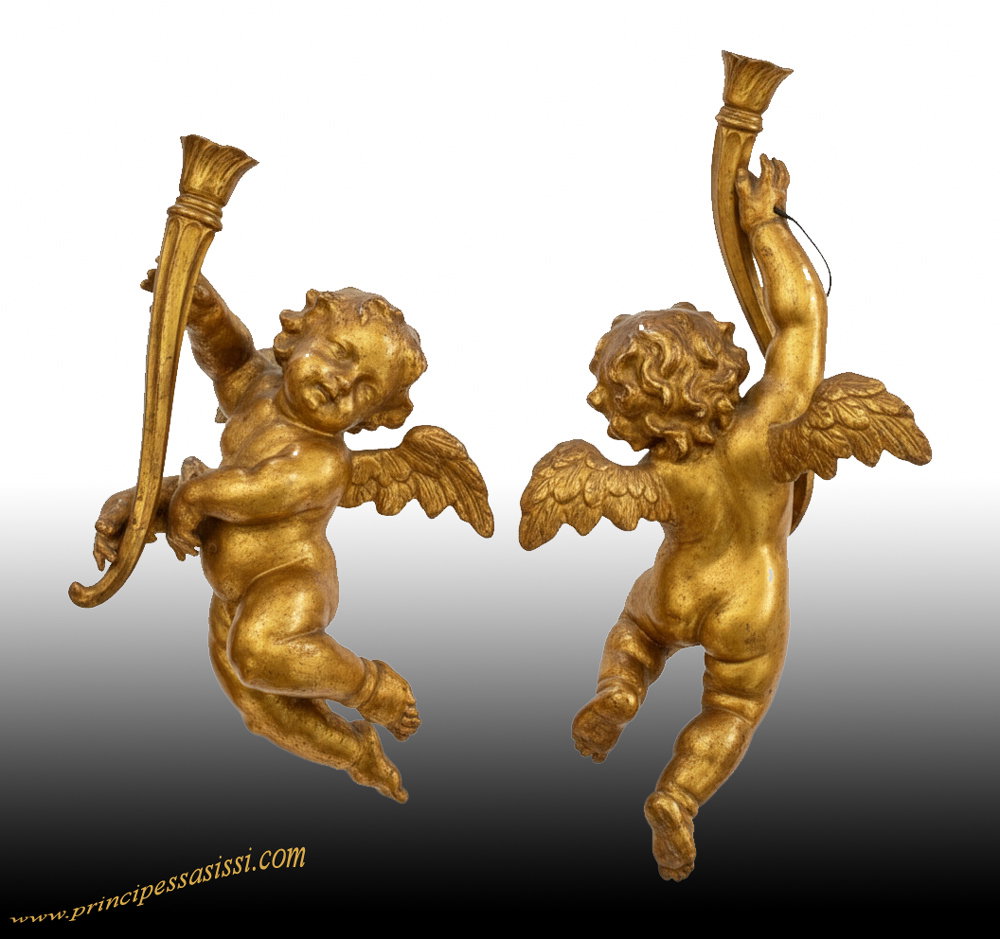
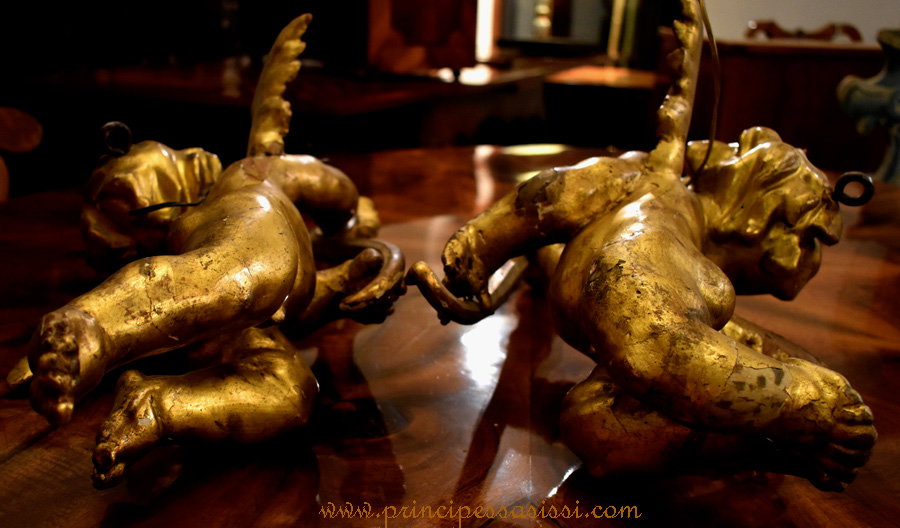
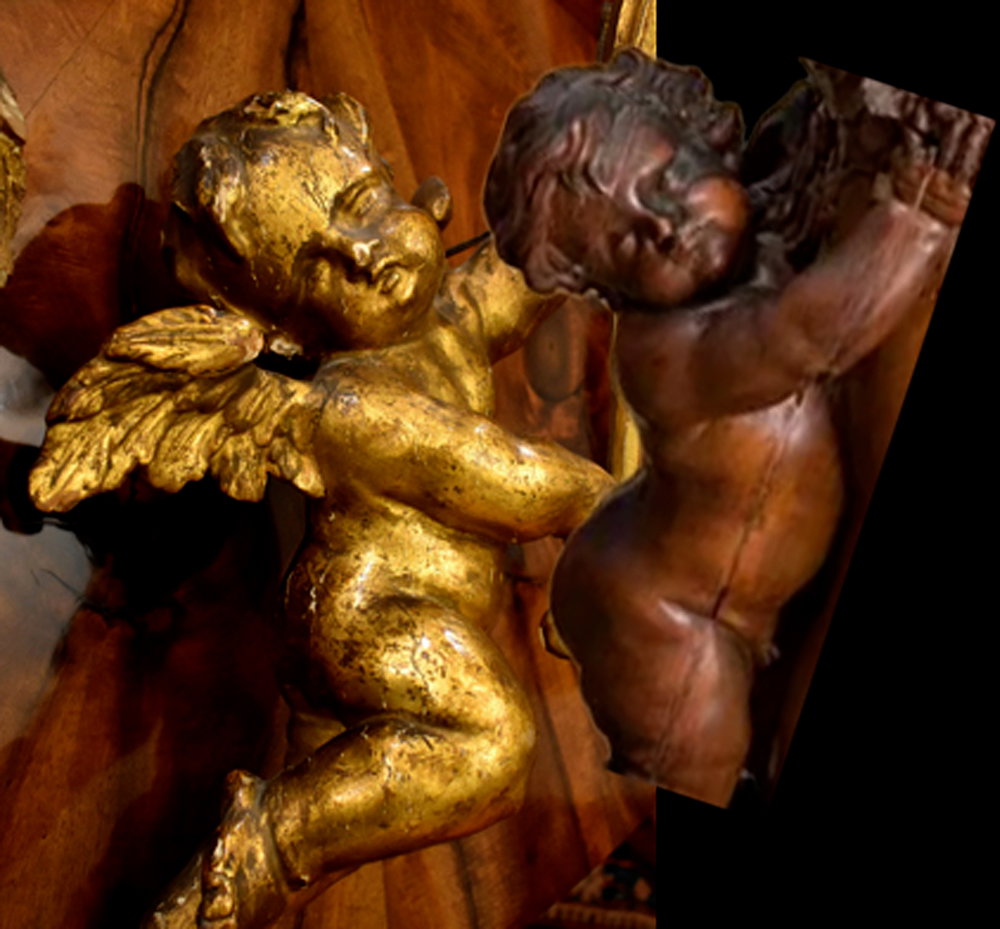
Andrea Brustolon. Venice or Belluno, circa 1700. Rare and decorative pair of torchieres / putti, finely sculpted and leaf-gilded.
Description:
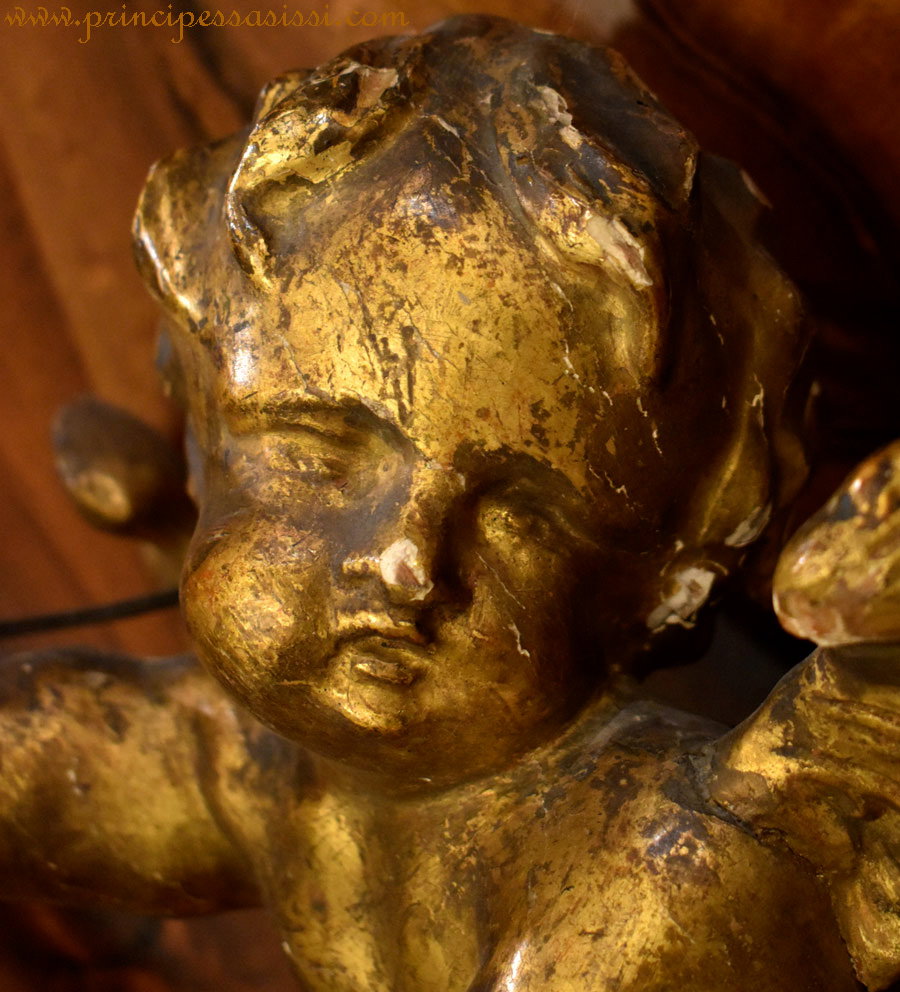
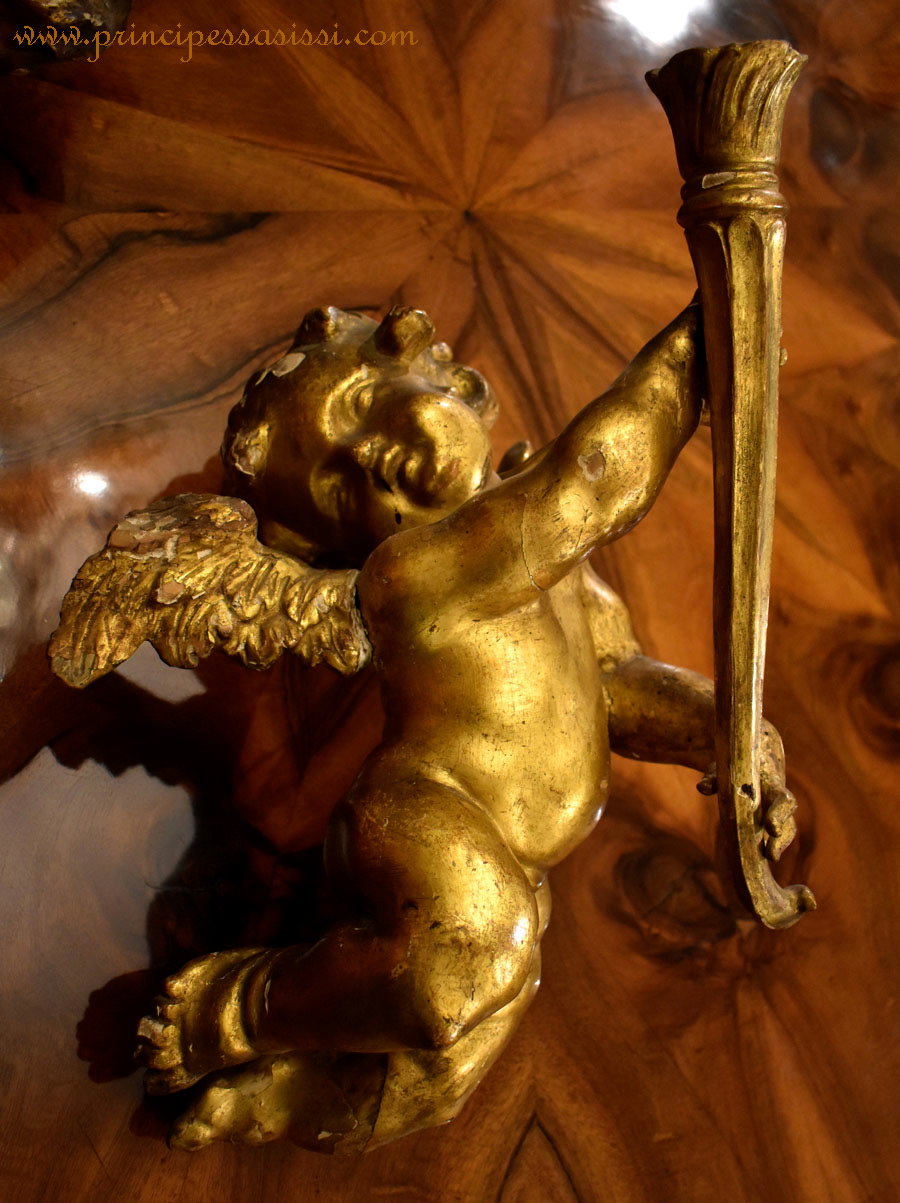
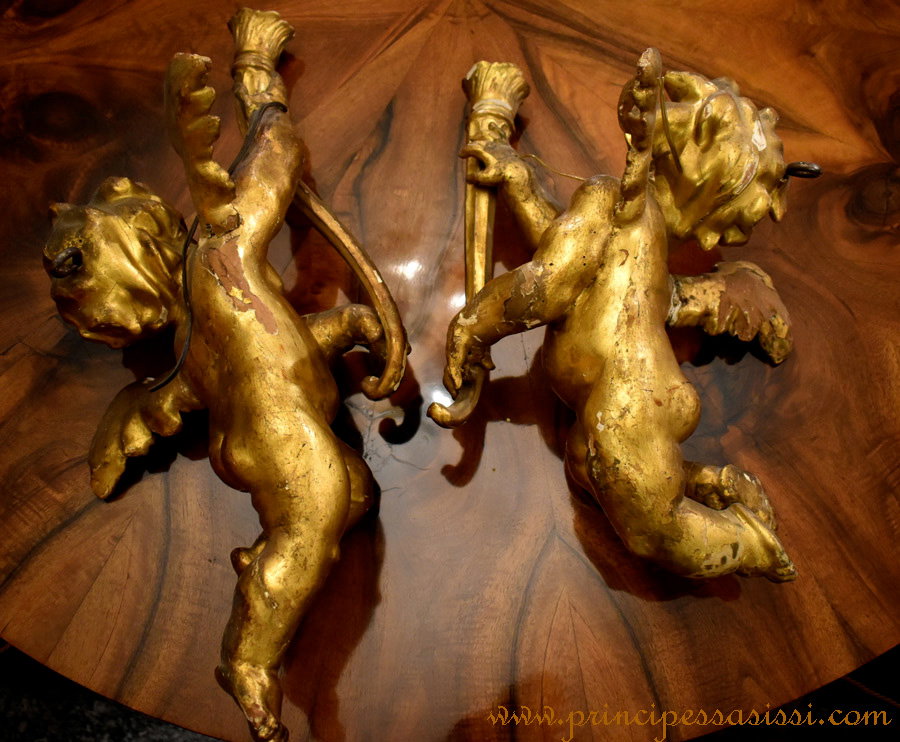
Andrea Brustolon. Venice or Belluno, circa 1700. Rare and important pair of torchieres / putti, finely sculpted and leaf-gilded, attributed to him. Carved with great mastery, in original condition and without restoration. Patina, slight imperfections, and signs of use consistent with the period.
Electrified in the early 1900s. Restoration can be commissioned if desired, although their current state with a desirable original patina makes them fascinating in their current desirable and virtually unaltered condition. Dimensions cm. 58 high and 25 wide approximately for the first - the second is cm. 45 long, and 27 wide approximately.
It is evident that these two putti are sculpted with great skill. The gentleness of the faces, the plasticity of the bodies, the vibrant modeling, the dynamism and the proportions of the sculptures, besides recalling the poetics of Bernini, highlight the likely hand of the master, with his personal and original interpretation.
Provenance, high bourgeois private collection, Udine.
Andrea Brustolon was born in Belluno in 1662. His father is Jacopo, a carver and sculptor and his first master; later he moved to the school of the painter Agostino Ridolfi. Belluno does not allow the young Andrea to receive high-level sculptural artistic notions; he then went to Venice to his friend from Belluno, Antonio Buzzati, who entrusted him to the workshop of the sculptor Filippo Parodi. In 1679 Brustolon moved to Rome where he was fascinated by the figure of the great Gian Lorenzo Bernini. In Rome he left the famous Sala del Brustolon at the Palazzo del Quirinale. In 1682 he returned to Venice where he remained for some years dedicated to the production of wooden furniture: numerous were his noble clients, for example the Correr and the Pisani; but his great patrons were in particular the Venier family, for whom he created vases, armchairs and various furnishings now kept at the Museum of the 18th Century Venetian Cà Rezzonico. In 1695 he settled permanently in Belluno where he began his large and exceptional production of altarpieces, statues, tabernacles and wooden works of all kinds. Brustolon is certainly an artist who inserts himself, with all his skill, into the reality of the time in which he operates and can be considered among the most representative figures of Italian Baroque sculpture. He was nicknamed the "Michelangelo of Wood". Literature "Andrea Brustolon 1662 - 1732, the Michelangelo of wood" Skira editore; "Andrea Brustolon, restored works - Wooden sculpture in the Baroque age", Spiazzi - Mazza.
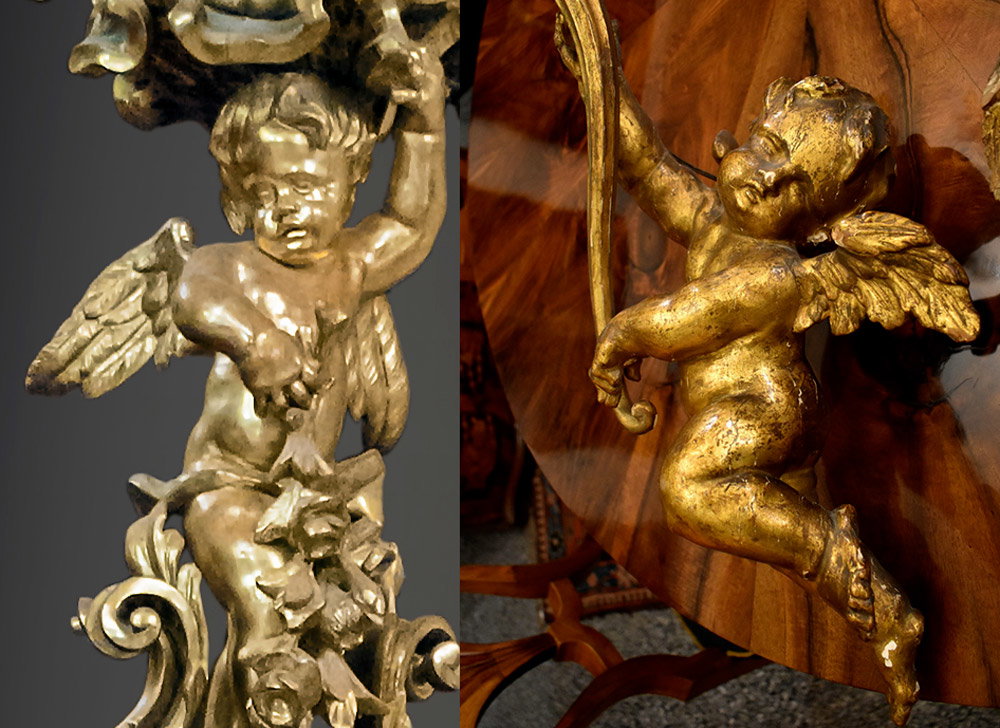
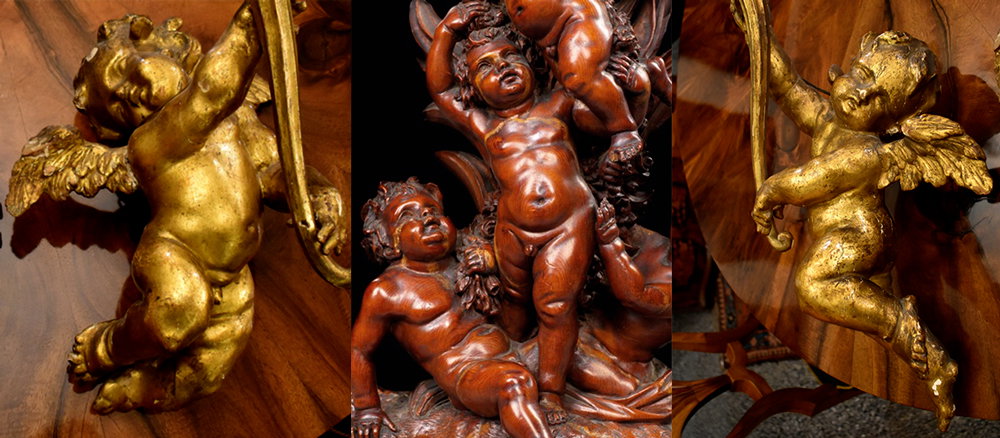
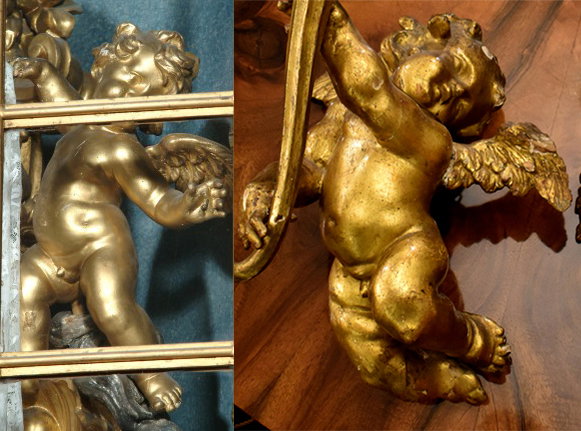
Other works certainly by Brustolon compared with ours (attribution studies - see last photos of this card):
A) Detail of a candelabrum by Andrea Brustolon, San Trovaso, Venice. circa 1700
B) Andrea Brustolon, representation of sculpted putti and sea dragons (detail, France, private collection)
C) Putto attributed to Andrea Brustolon owned by the Archdiocese of Padua (see link at the bottom of the page). There is great affinity with our works even though the quality of that of the archdiocese (on the left) appears slightly inferior in the representation of details (workshop?)
D) Comparison with detail of sculpture by Andrea Brustolon, Diocesan Museum of Feltre (Belluno)
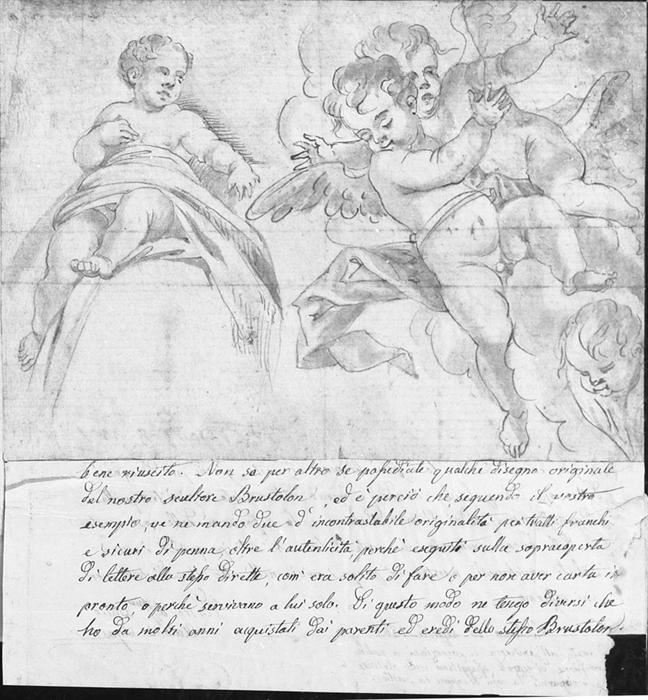
E) Comparison with details of design drawings for original putti by Andrea Brustolon circa 1700
The comparisons show evident and very marked affinities:
Face treatment: the physiognomies are extremely similar, in particular the cut of the eyes, the roundness of the cheeks and the conformation of the mouth.
Dynamic posture and Baroque dynamism: The postures, the sense of flight or action, the torsions of the bodies in the cherubs, express the theatrical and fluid movement typical of Brustolon. Brustolon's putti are never static. There is muscle tension and a rotary movement (typical of Venetian Baroque from the early 1700s) which is found in the torsion of the busts and in the position of the legs of our sculptures.
Hair: the thick and well-modeled curls are almost identical, with a very recognizable plastic workmanship.
Material treatment: although materials change (gilding, burnished wood, etc.), the way of modeling surfaces, in particular the skin and features, is surprisingly consistent.
Other considerations:
Treatment of the Flesh: Despite being in gilded wood, the shapes are "soft" but defined, with those characteristic folds of the skin (on the ankles and wrists) that Brustolon cared for with almost anatomical precision.
Hair and Details: The deeply carved curls and the very structured plumage of the wings recall the virtuoso technique of the Belluno carver. In comparison with the piece from Treviso, it can be noted how the locks are worked with the same "depth". They are not just scratched on the surface, but carved to create sharp shadows.
The abdomen and pelvis: It can be noted that in our putti and in the work of Treviso the belly is pronounced in an identical way, with that slight "fold" above the pubis which gives realism and softness.
The musculature of the legs: The rendering of the shapely thighs and the way in which the knee connects to the calf are superimposable. It is a "heroic" anatomy but applied to an infantile body, typical of Brustolon.
The inclination of the face: The head tilted back with half-closed eyes that are visible in the work kept in France compared is almost specular to our putti. This stylistic choice served to give dramatic emphasis and to capture the light from above.
The Dynamic Structure Our sculptures are not simple "figures", but real engines of movement. In the works of Brustolon, the arms that support the cornucopia are not rigid, but follow the torsion of the whole body.
Conclusion: The comparisons are well founded. The stylistic affinities between the gilded cherubs and the compared works clearly indicate that these are works by the same author or, in any case, but less probably, from the same workshop.
In compliance with the provisions of the New Code of Cultural Heritage, the selling company provides, at the time of sale, a detailed photographic written guarantee of originality and provenance of the works sold. The data with which the works are described and then contained in the written guarantees are expressed determinations resulting from accurate and documented technical/historical/artistic investigations, even of expert importance.