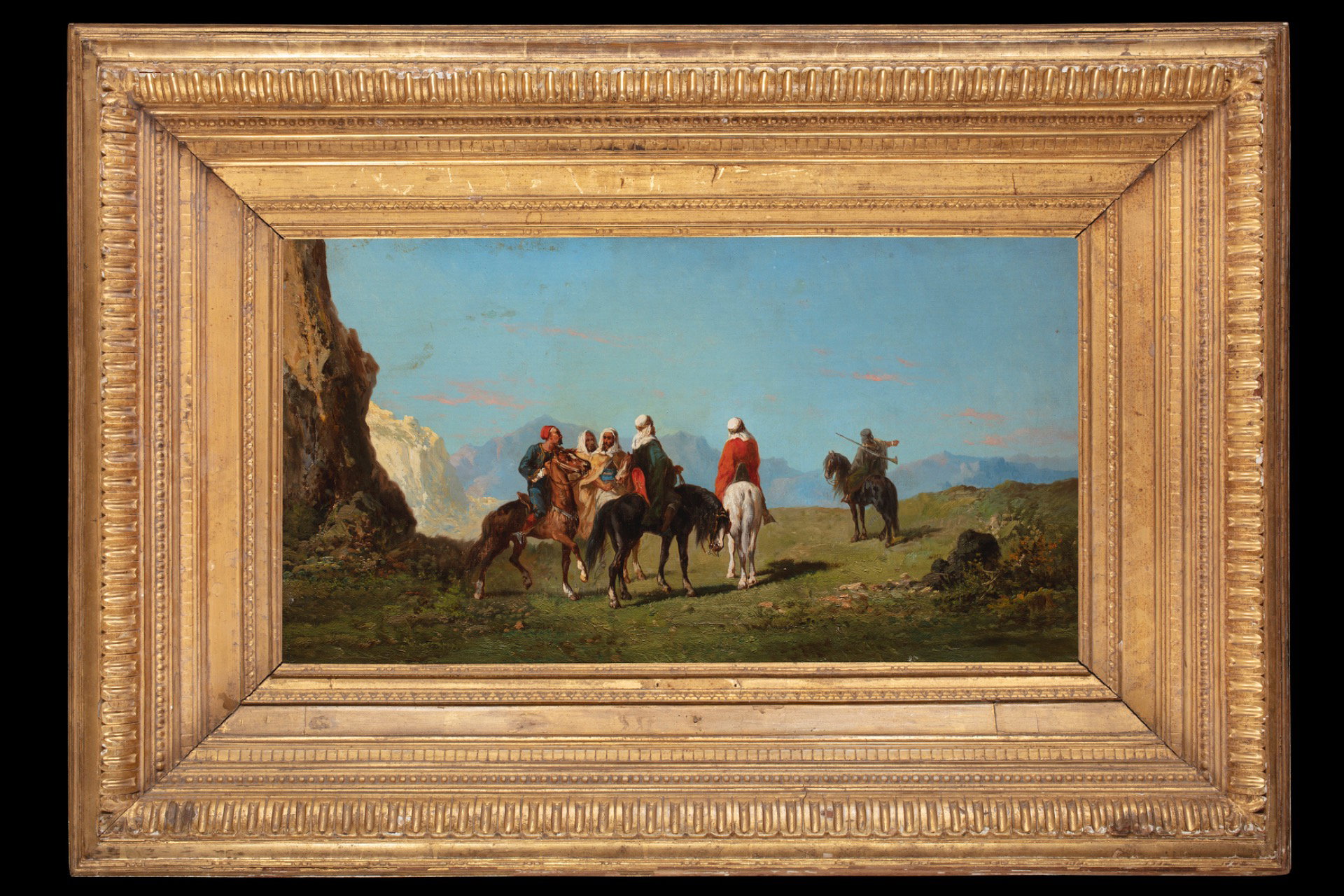
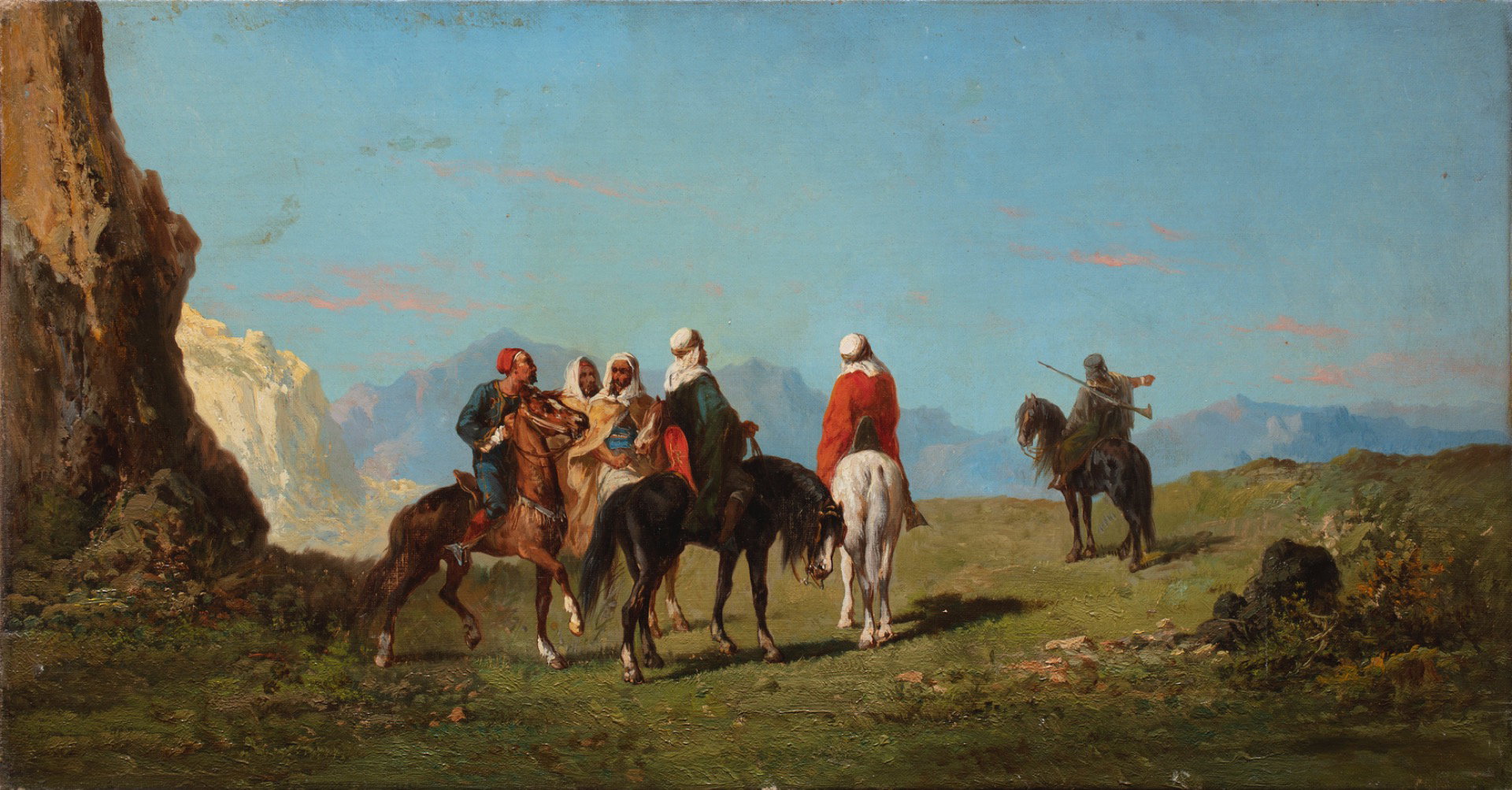
Eugène Fromentin (La Rochelle 1820 – 1876), “Berber Warriors”, circa 1860.
Oil on canvas, 30 x 60 cm within a frame, 70 x 100 cm including frame.
Signed “E. F” lower right.
The canvas depicts a group of Arab men on horseback; in the background is an arid landscape reminiscent of the vast territories of North Africa, visited by the artist during numerous trips to Algeria. The Berber men are portrayed in traditional clothes and weapons; Fromentin's attention seems almost documentary, a precociously ethnographic approach uncommon in artists of the time: the Orientalists, in fact, used to sacrifice historical veracity in exchange for aesthetic beauty, sought after by European buyers fascinated by exoticism. The picturesque compositions here give way to a respectful and composed vision, which ennobles the figure of the Berber horseman. The light in the work is intense, almost dazzling; in terms of color, a warm palette prevails, composed of shades of earth, ochre and browns, which contribute to evoking the heat of the desert.
BIOGRAPHY
Eugène Fromentin was born in La Rochelle in 1820, the son of a wealthy family. His father, Pierre Fromentin-Dupeux, was a doctor and amateur painter, and from his father's passion he learned the first rudiments of art.
After brilliant studies in his hometown, Fromentin moved to Paris, where he graduated in law in 1834; however, his very strong artistic vocation led him to abandon the profession of lawyer to enter the studio of the landscape painter Jean-Charles Rémond (1795 – 1875). He later became an apprentice to another French artist, Louis Nicolas Cabat (1812-1893). In 1846, secretly from his family, he left for Algeria, where he was fascinated by the desert landscapes and the local population, adhering to the Orientalist current that had exploded at the Salon a few years earlier. The following year he participated in the annual exhibition of the Parisian institution with landscapes inspired by the sketches on his travel notebooks, such as Mosque near Algiers and The Gorges of Chiffa. In 1849 he presented some paintings at the Salon including Women of Algiers, for which he received an award. Three years later he returned to Algeria with his new bride, making the second of his three trips to the region, with an archaeological expedition that allowed him to study closely the customs, habits and landscapes of the place.
His works reflect a meticulous, almost ethnological research, as demonstrated by the writing of the various travel journals subsequently published in some magazines, such as Un été dans le Sahara (1854) and Une année dans le Sahel (1857). While continuing with his painting career, Fromentin had a brief literary excursus, with the publication of the autobiographical novel Dominique in 1863. In 1876 he applied for a position at the Académie française, but lost in the Commission's voting against the engraver and art critic Charles Blanc. In the same year he published a work of art criticism dedicated to the old masters of the 17th century Flemish masters such as Rubens and Rembrandt, the volume Les maîtres d'autrefois (1876). He died after a short illness. Specializing in Orientalist subjects, his works are kept in the main French museums, including the Louvre, the Musée d'Orsay and the Musée des Beaux-Arts in Reims.