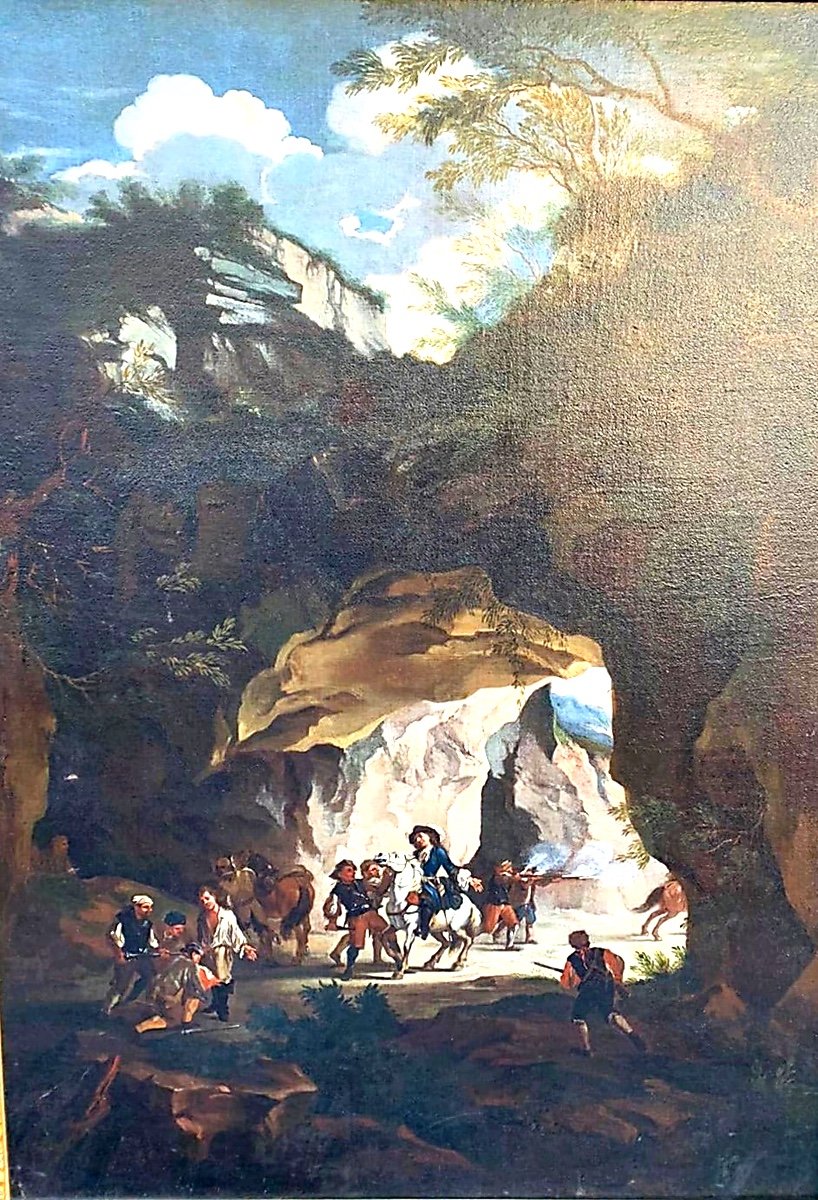
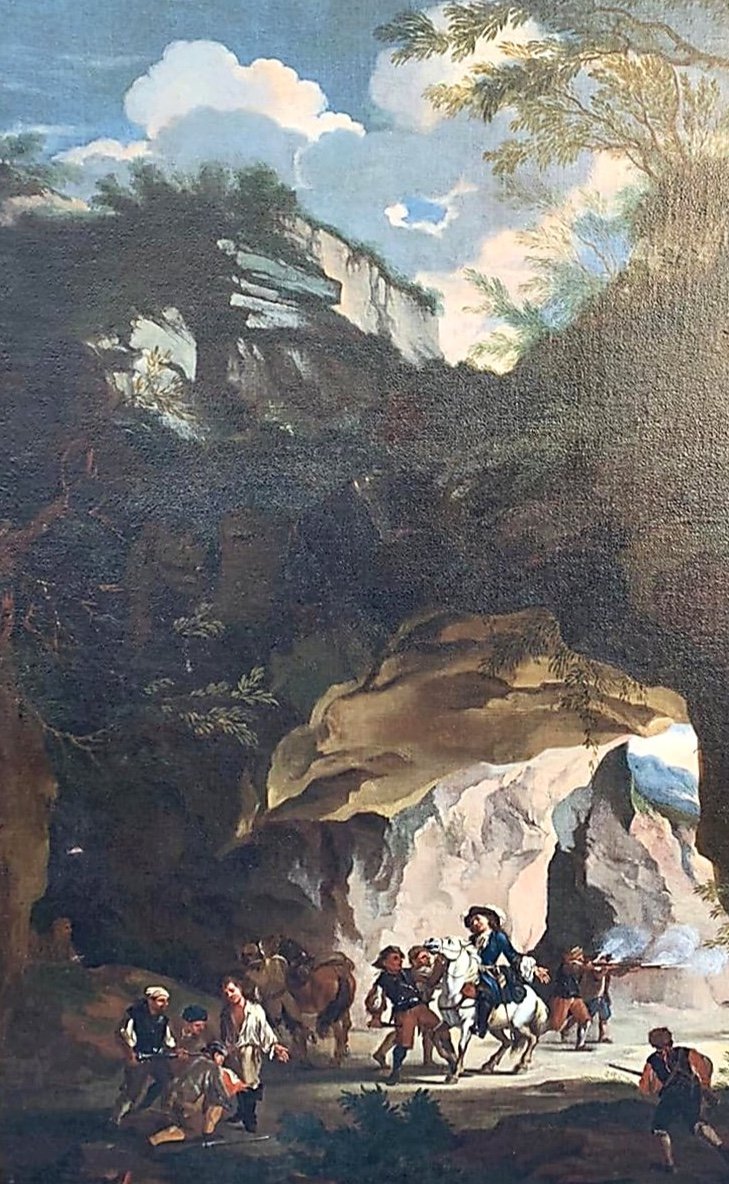
Rocky landscape with bandits' ambush. (152cm x 114cm)
Description:
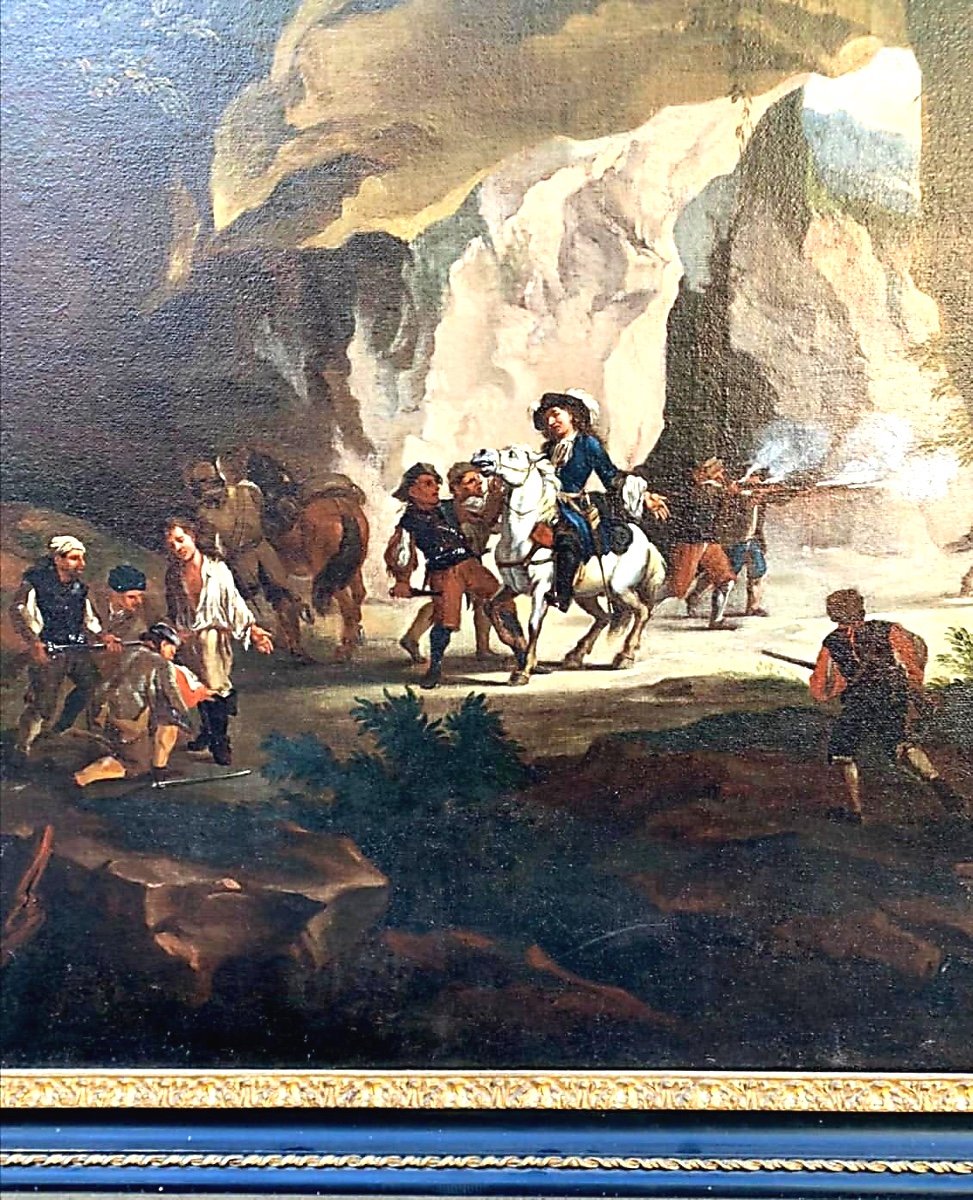
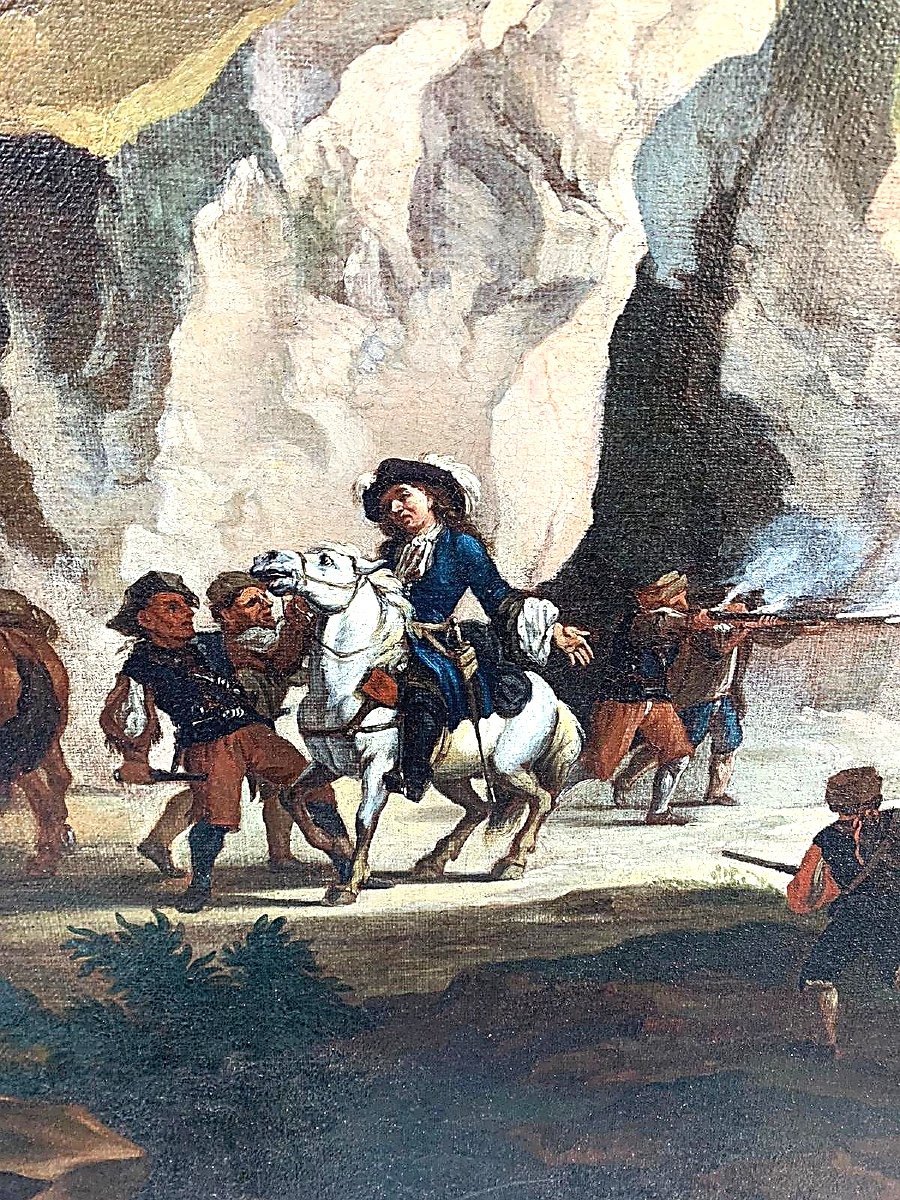
Oil on canvas painting attributed to Pandolfo Reschi (Danzig, 1643 – Florence, 1699) depicting a scene in which a character on horseback, probably a man of noble rank, is ambushed by a group of bandits hiding in the shadow of a large natural arch of rock and vegetation.
We are in the thick of the action, the general assistant has already been taken down from his horse and is being searched by three men who are blocking him. The Lord resists on horseback and seems to express, through his gestures, strong revulsion to the event, perhaps in an attempt to mediate with their tormentors; but next to him they are already firing, it is other brigands who are shooting with rifles at the rest of the terrified company fleeing with their horses.
The landscape where the convulsive scene takes place is impervious, rocky and could refer to the Apennine areas of Lazio around the Castelli Romani. The naturalistic data is rendered skillfully and seems to belong precisely to the landscape and atmospheric repertoires of this painter, both in the rendering of the rocks and in that of some plants such as the dry overhanging shrubs.
The theme is also typical of Reschi, in fact he used to depict such types of scenes as wayfarers marching in the areas of central Italy, as well as frantic battles between armies. Furthermore, the proportions of the characters depicted within the composition and the cold chromaticism are other points in favor of this attribution.
Pandolfo Reschi. – Son of a wealthy merchant, Pandolfo was born in Gdansk (Danzig) in 1640. While still young, he was sent to Germany to learn his father's trade, but, after his father's death, he enlisted in the army of Leopold I of Habsburg, until he decided to go to Italy, perhaps passing through Venice. Around the age of twenty he settled in Rome, where, from 1663, he resided in vicolo del Carciofo, in the district of S. Lorenzo in Lucina, in the same house as the Dutch landscape painter Pieter Mulier. He then embarked on a career as a painter and at the same time converted to the Catholic religion. At the end of the 1660s he arrived in Florence, where he lived, with the exception of occasional trips, for the rest of his life.
It is possible to reconstruct his events thanks to some seventeenth and eighteenth century biographies, starting from that of Francesco Saverio Baldinucci (1725-1730, 1975), the most extensive and interesting for the references to clients, for the description of the works and for the framework of Reschi in the Florentine artistic culture of the last decades of the century. To this must be added the news noted by Francesco Bonazini in the diary (Florence, Biblioteca nazionale centrale, ms. Magl. XXV, 442, II, 1672-1705) and those of Francesco Maria Niccolò Gabburri (ivi, ms. E.B.9.5., IV, circa 1730-1741).
Pandolfo Reschi was the greatest battle painter among Florentine painters. In addition to Salvator Rosa and the aforementioned Mehus, Reschi was strongly influenced by his knowledge of the works of his master Jacques Courtois called il Borgognone and those of Pieter Mulier called il Cavalier Tempesta. Like all Florentine Baroque painting, it was soon supplanted first by the Rococo and later by Neoclassicism. Reschi was thus almost forgotten (like dozens of other painters of the period). His re-evaluation is a rather recent thing. In his style it is possible to recognize the painters mentioned above, even if his style stands out for certain metallic colors, bordering on coldness. But this makes his production particularly original and sought after by collectors of his time. Many of his canvases are now in private collections.
The painting is in excellent condition and mounted on a stylish frame.
The dimensions of the canvas are 137 x 99 cm; The dimensions including frame are 152 x 114.
We attach a historical certificate of authenticity to the sale.
Discover some of our art proposals on www.antichitabompadre.com. Image shows this painting taking place in a natural arch formation with a rocky landscape in the background.