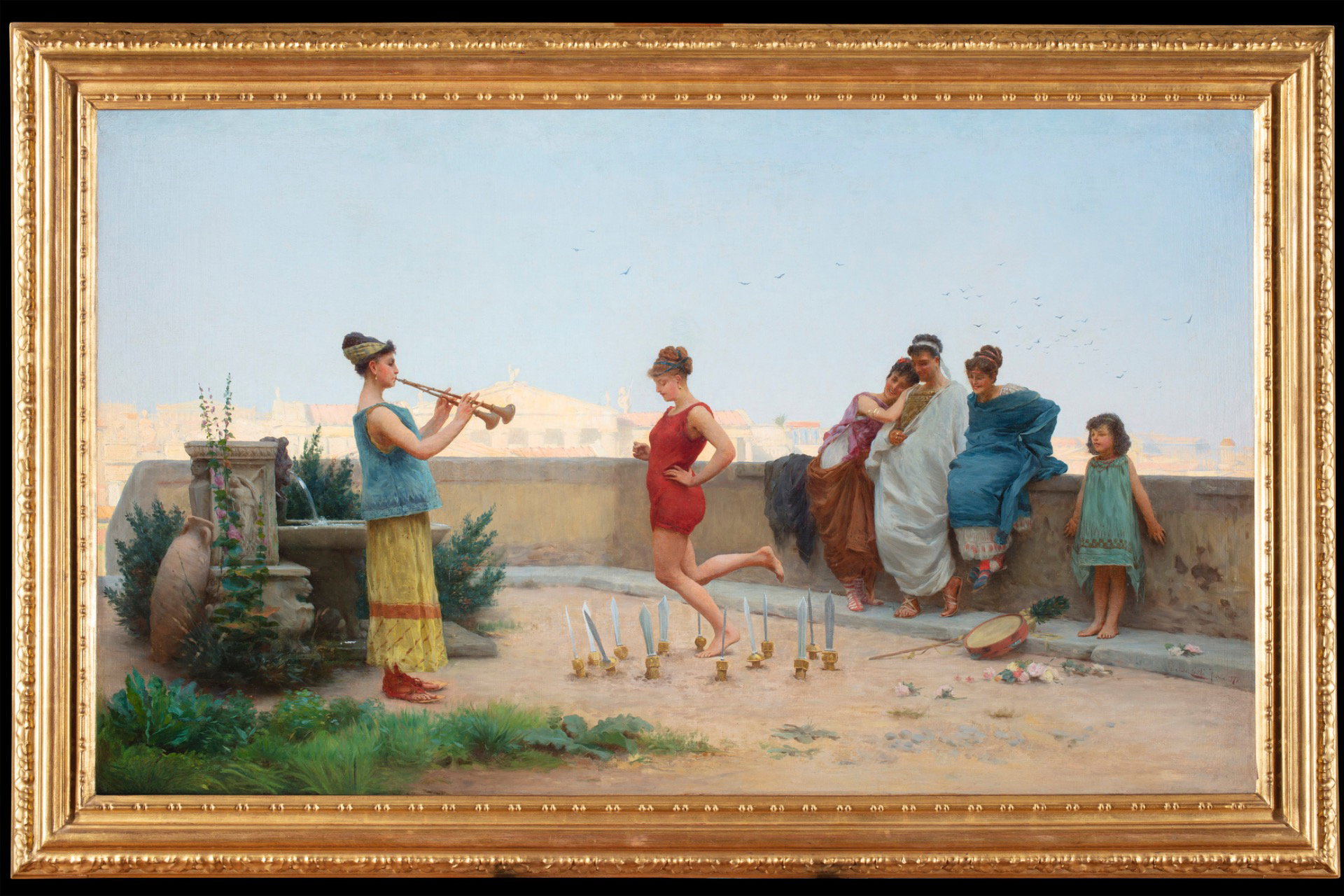
Giovanni Muzzioli (Modena, February 10, 1854 – Modena, August 5, 1894) “The Sword Dance”, second half of the 19th century.
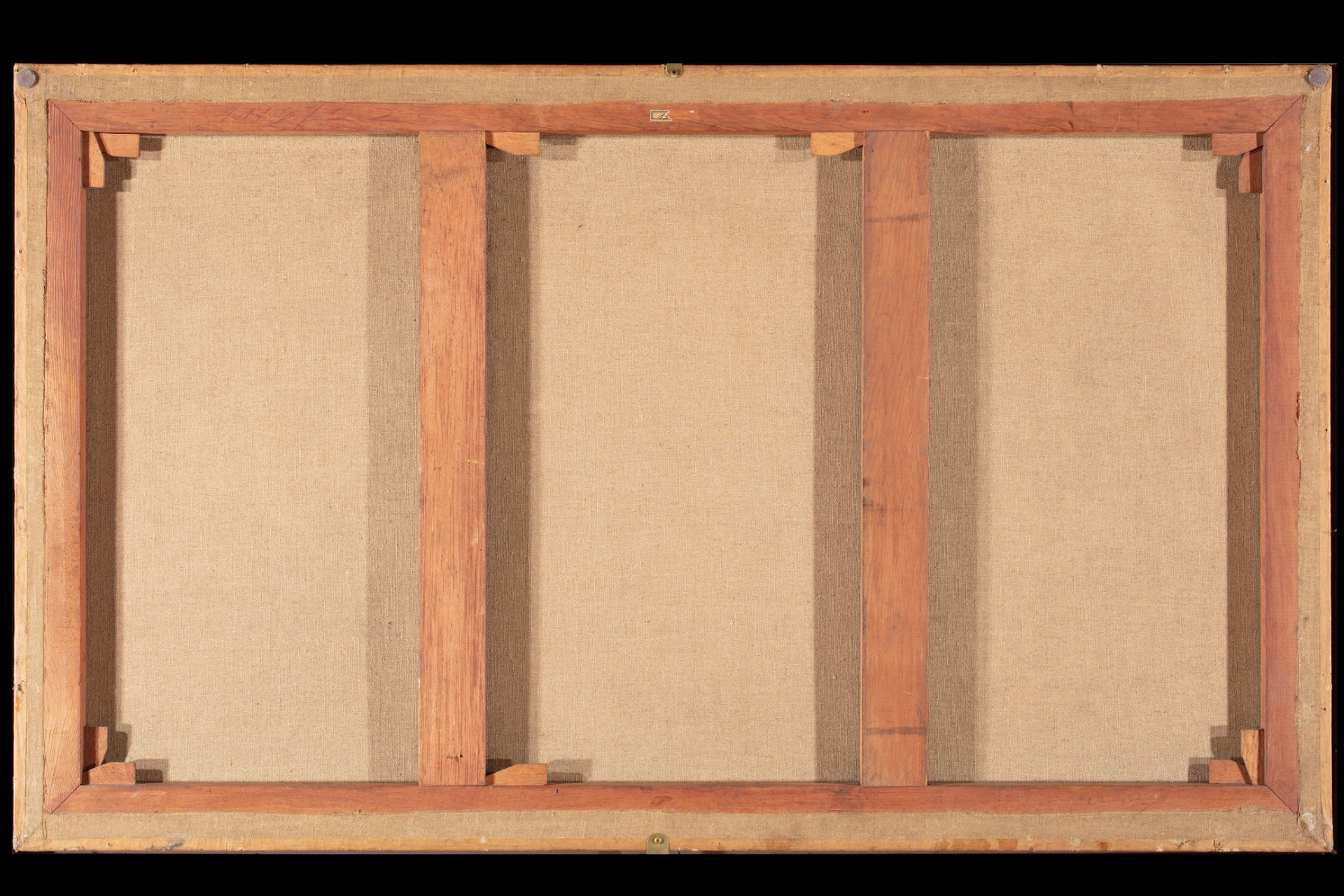
Oil on canvas, 75x 125 cm.
Signed on the right "G. Muzzioli Florence 1878"
Giovanni Muzzioli, painter from Modena, trained at the Academy of Fine Arts in Modena and completed his training in Rome and Florence. In Rome, where he was from 1873, he learned about classical antiquity and came into contact with "genre" painting with an antique feel, inspired by the wall painting brought to light by the excavations of Pompei and the surrounding areas. Furthermore, in 1878 he had the opportunity to deepen the topic and visited the Paris Exposition, where he saw the works of Lawrence Alma-Tadema, a Dutch artist who became the main exponent of a genre that was very successful in the second half of the nineteenth century: Neo-Pompeian painting. This trend favored the representation of subjects from the classical world and scenes with ancient settings.
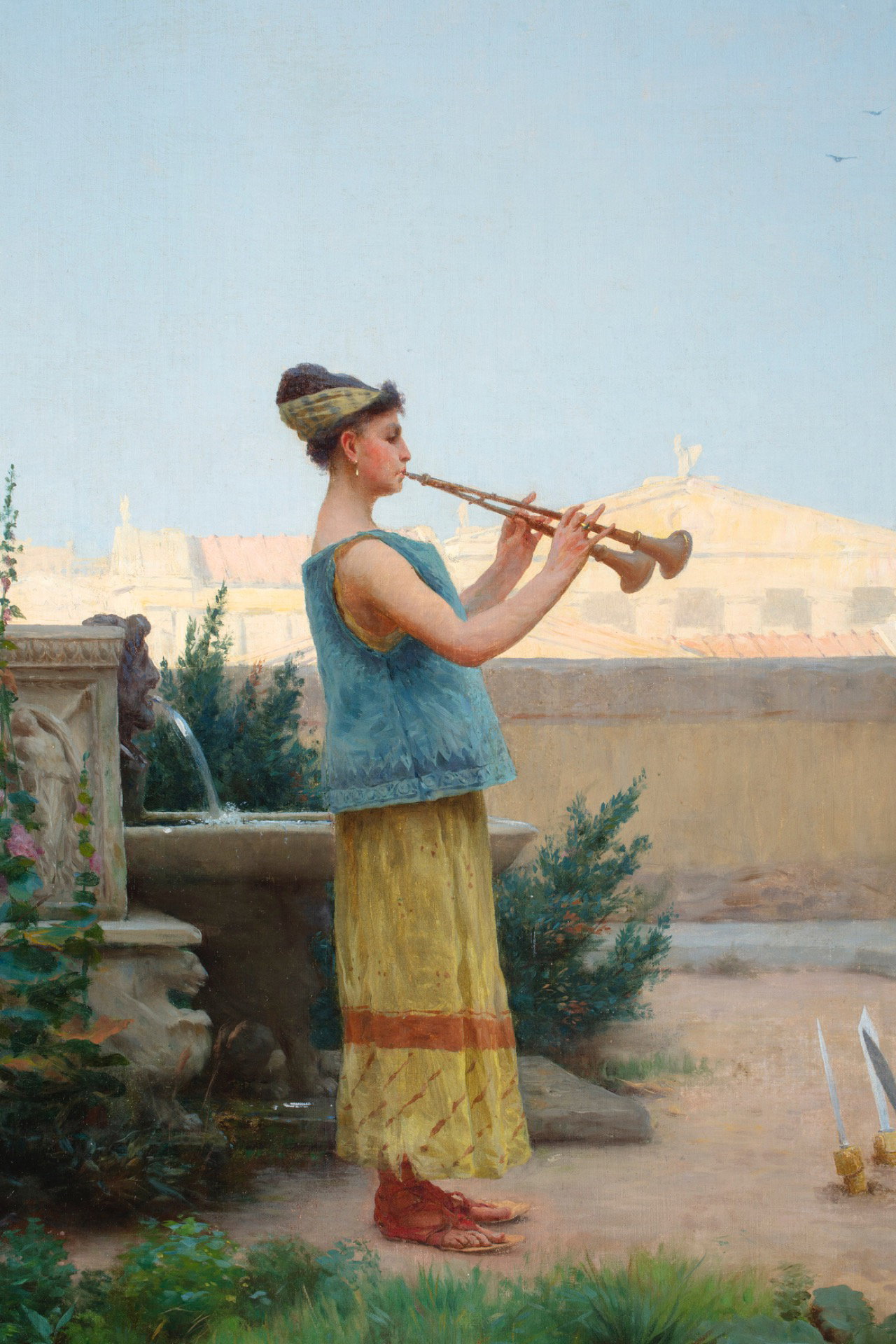
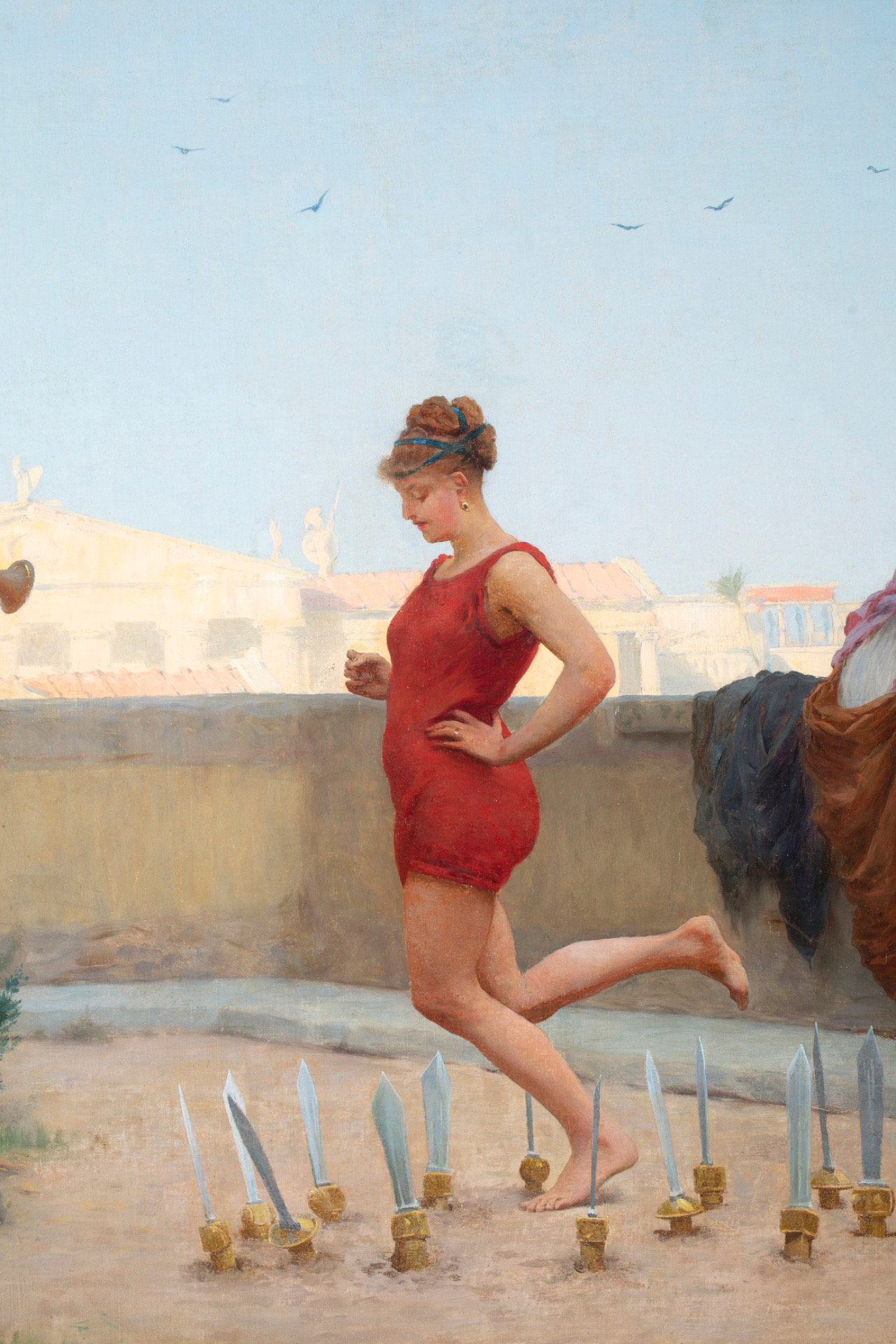
“The Sword Dance”, or “Cubistetèira”, falls into the genre of Neo-Pompeian paintings. The setting is inspired by Greek-Roman antiquity: the scene takes place on a terrace from which you can see the rest of the city. In the center there is a dance scene: the dancer, called cubistetèira, is intent on this dance among the swords stuck in the ground, while another girl in front of her plays a double flute. On the right there are spectators intent on observing the game. All the characters are portrayed in ancient Roman-style clothing. On the left, next to the girl playing the flute, there is a fountain surrounded by vegetation.
In this work, Muzzioli proposes a moment of daily life: he looks to the ancient world but not to illustrious characters, but to common figures of the people. It seeks a truer vision of the depicted reality and the portrayed subjects, so much so that the represented landscape can suggest inspiration from real places and even the figures refer to Muzzioli's observation of common people of his time.
In addition to this specific painting, there is another version kept in Modena in the collection of the Raccolta d'Arte della Provincia (exhibition catalog Il vero, la mostra e la finzione, Modena 2009-2010, p.57, tav.12). In the latter, the same characters and the same dance scene are maintained, but instead of the fountain on the left, a column covered with a climbing plant is depicted.
BIBLIOGRAPHY: exhibition catalog Giovanni Muzzioli. Il vero, la storia e la finzione, G. Martinelli Braglia, P. Nicholls, L. Rivi (edited by), Turin, 2009