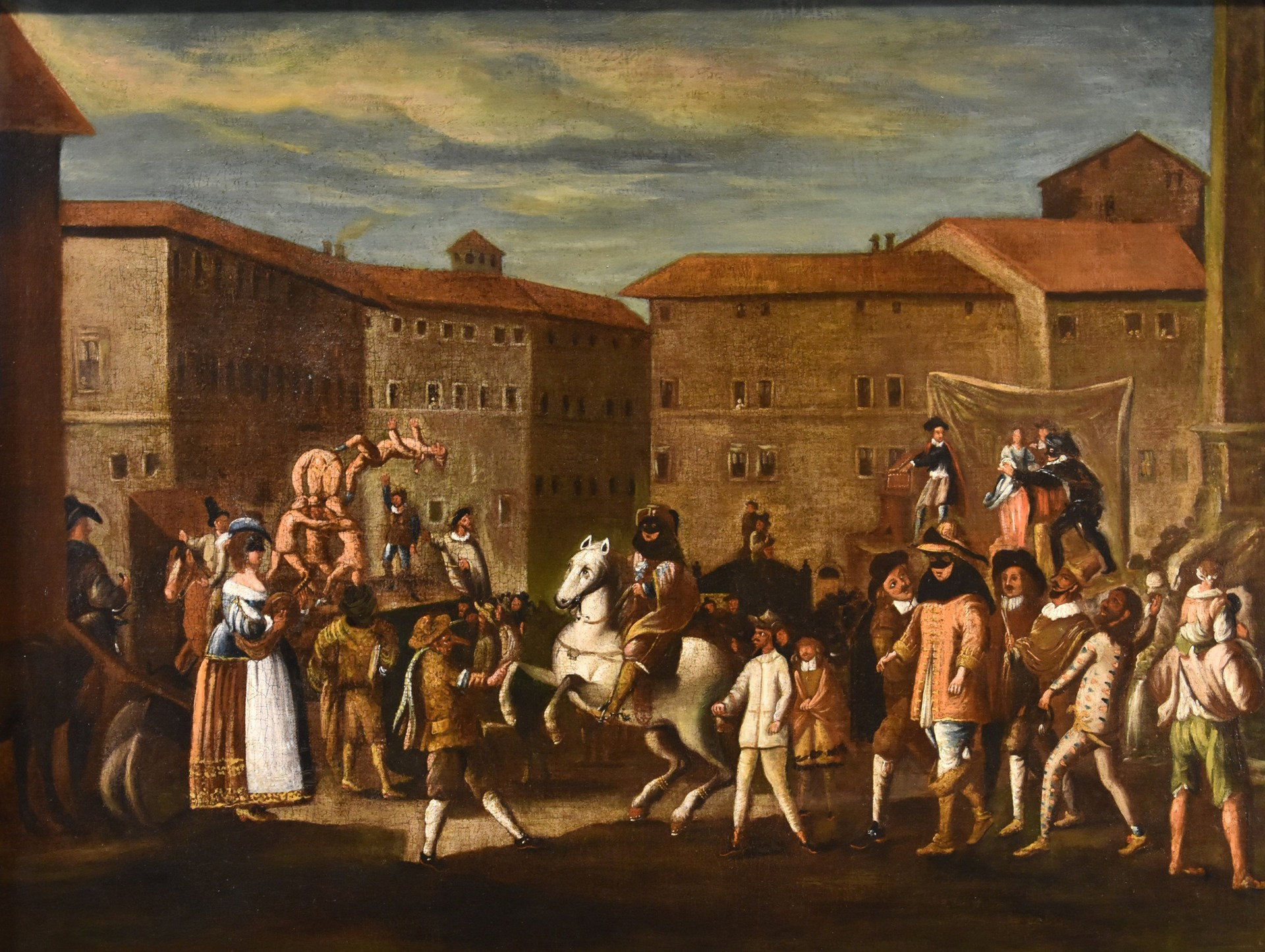
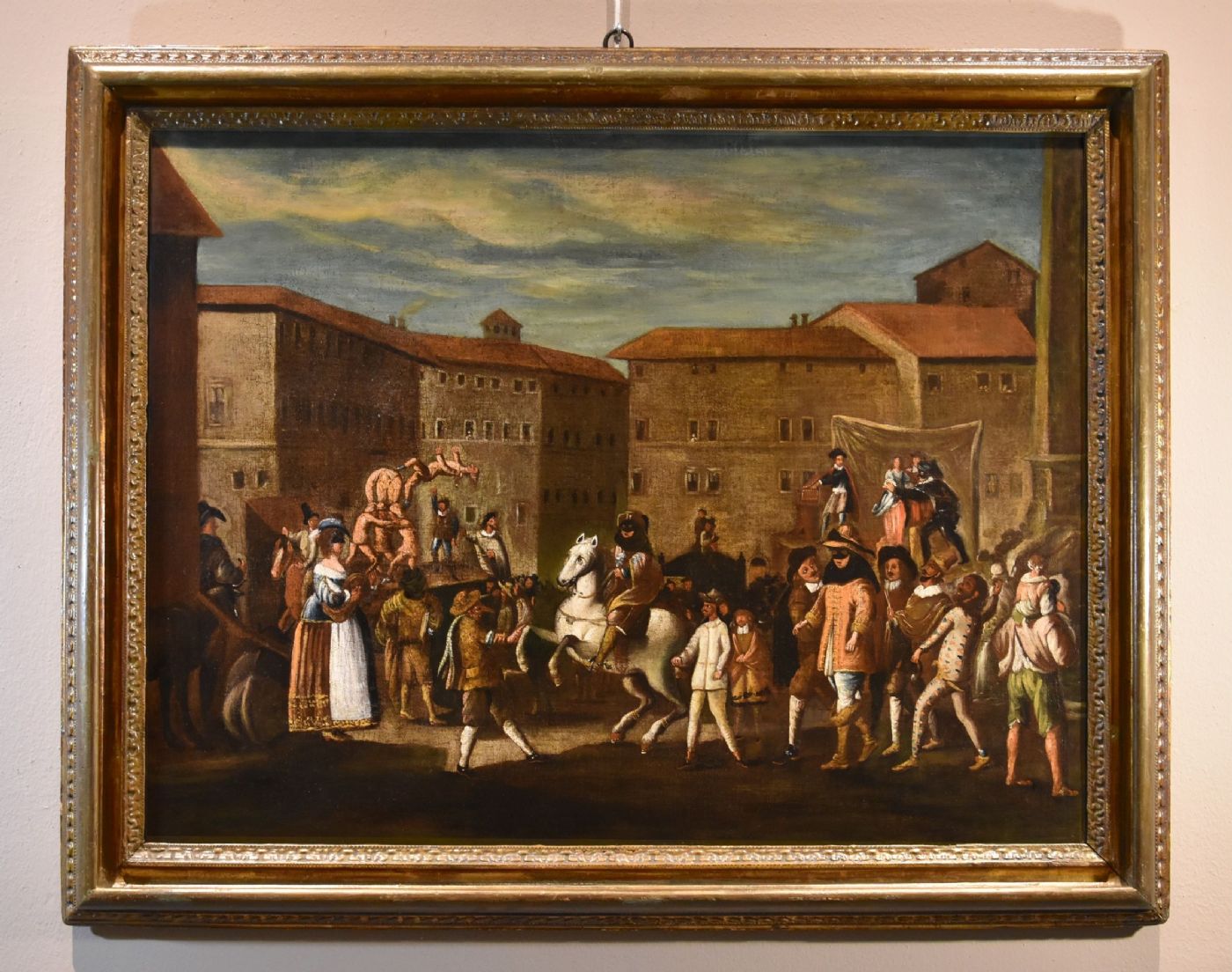
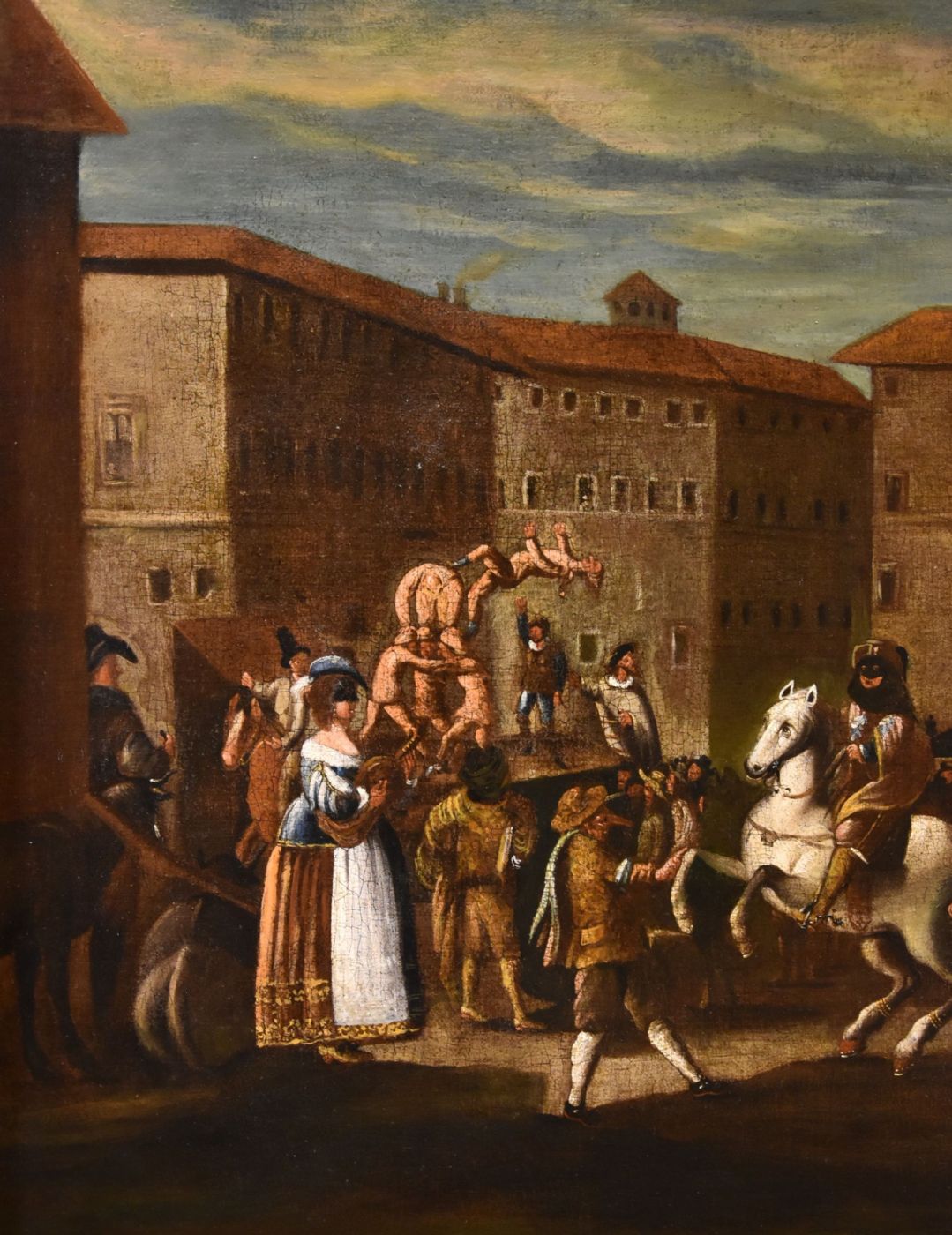
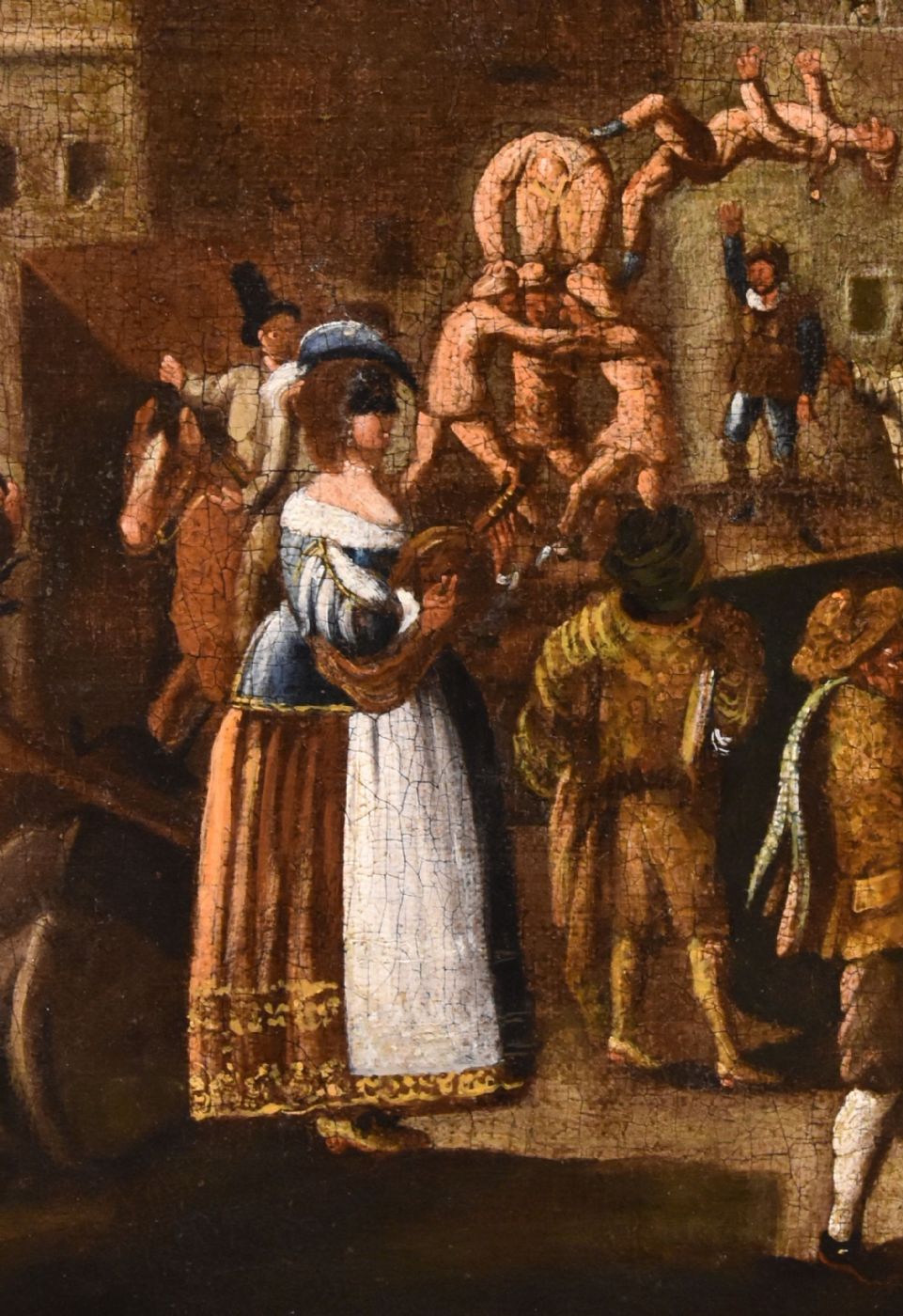
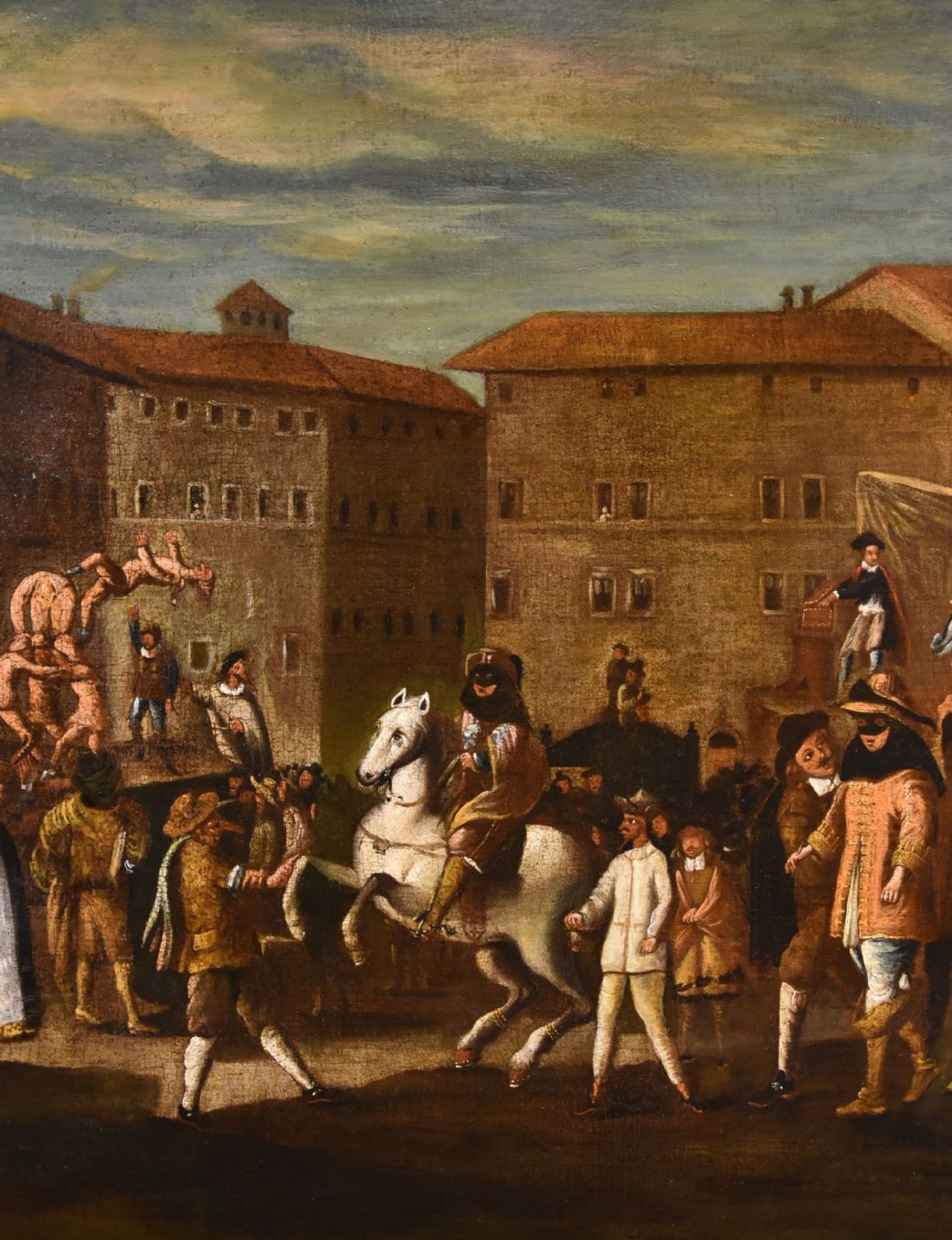
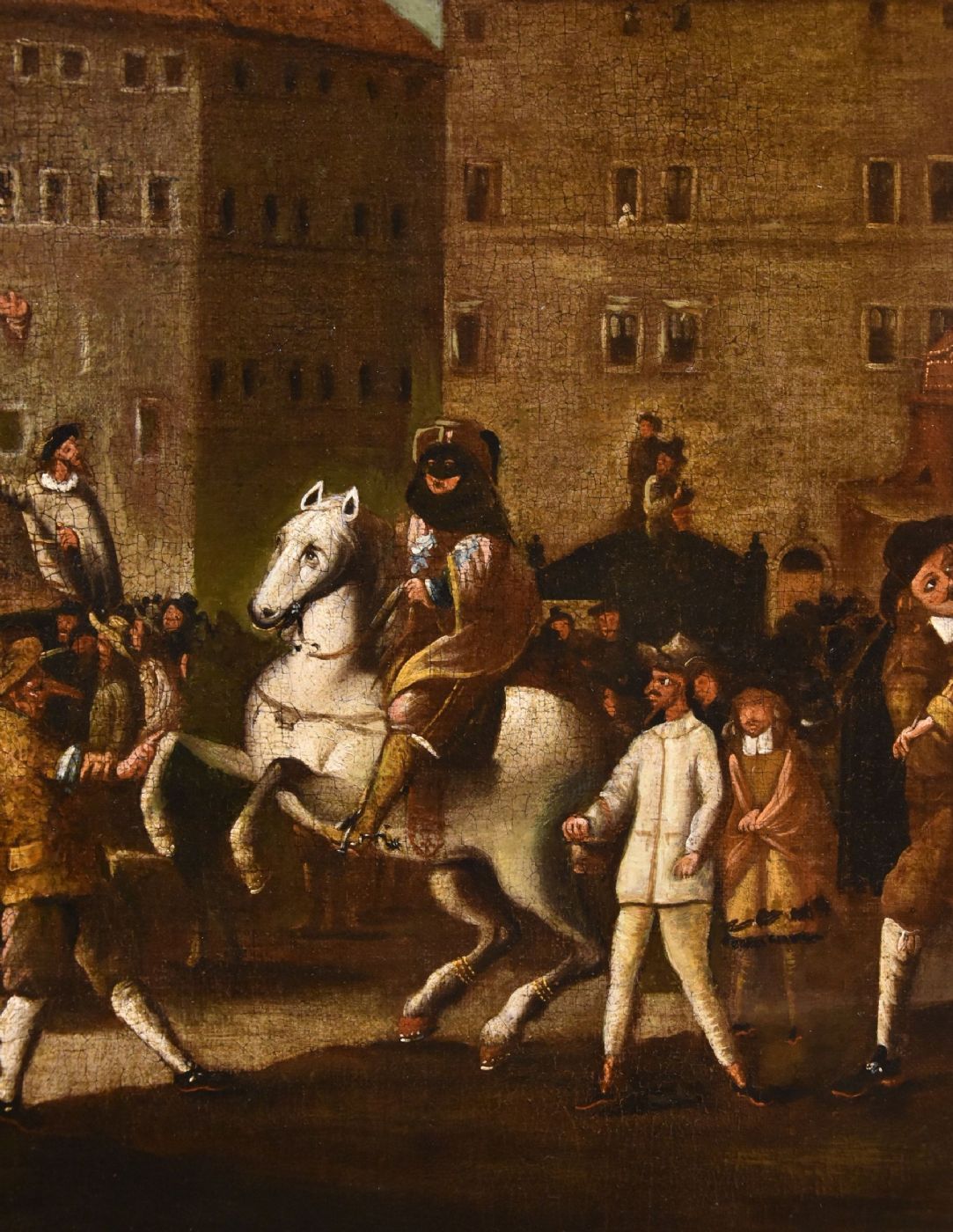
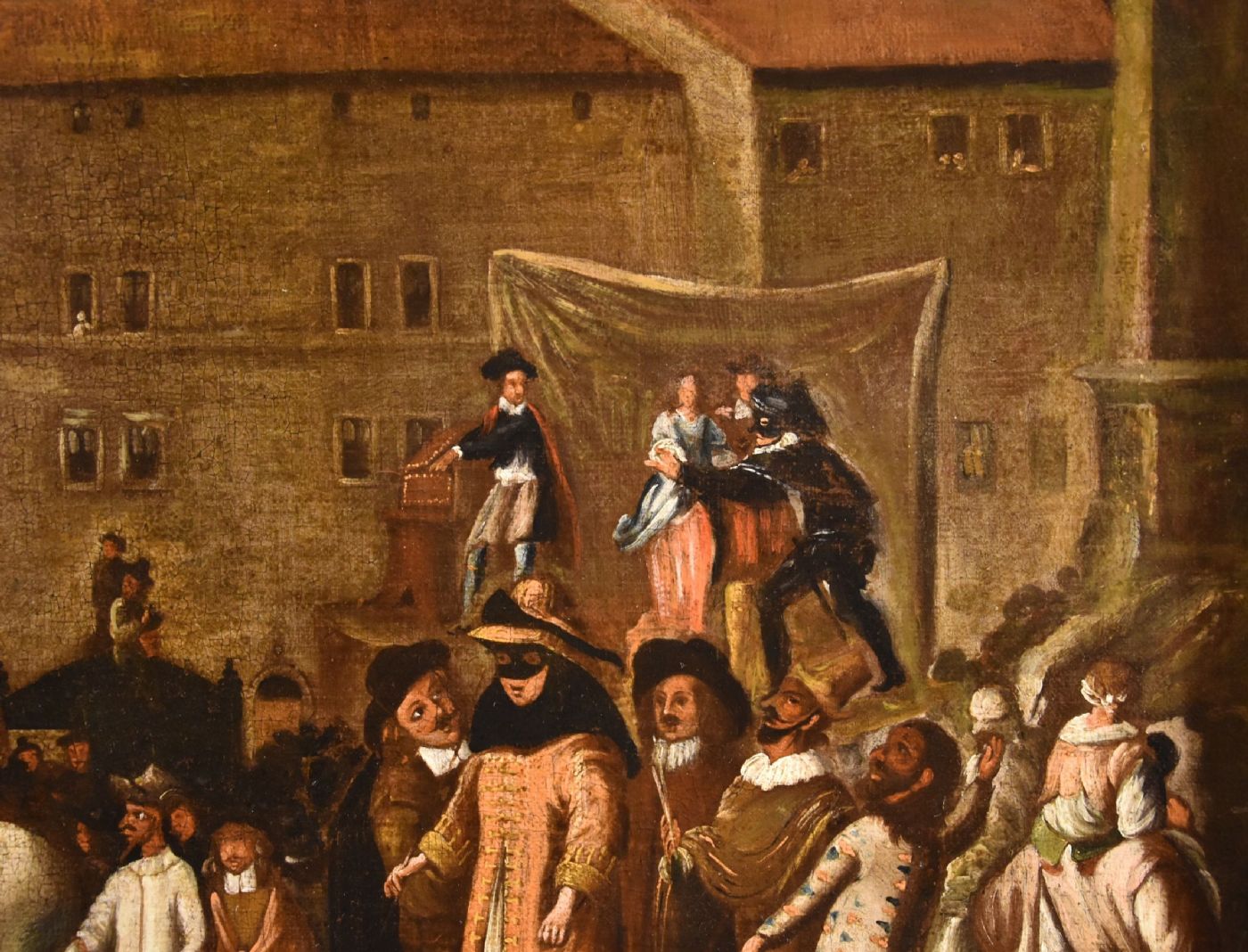
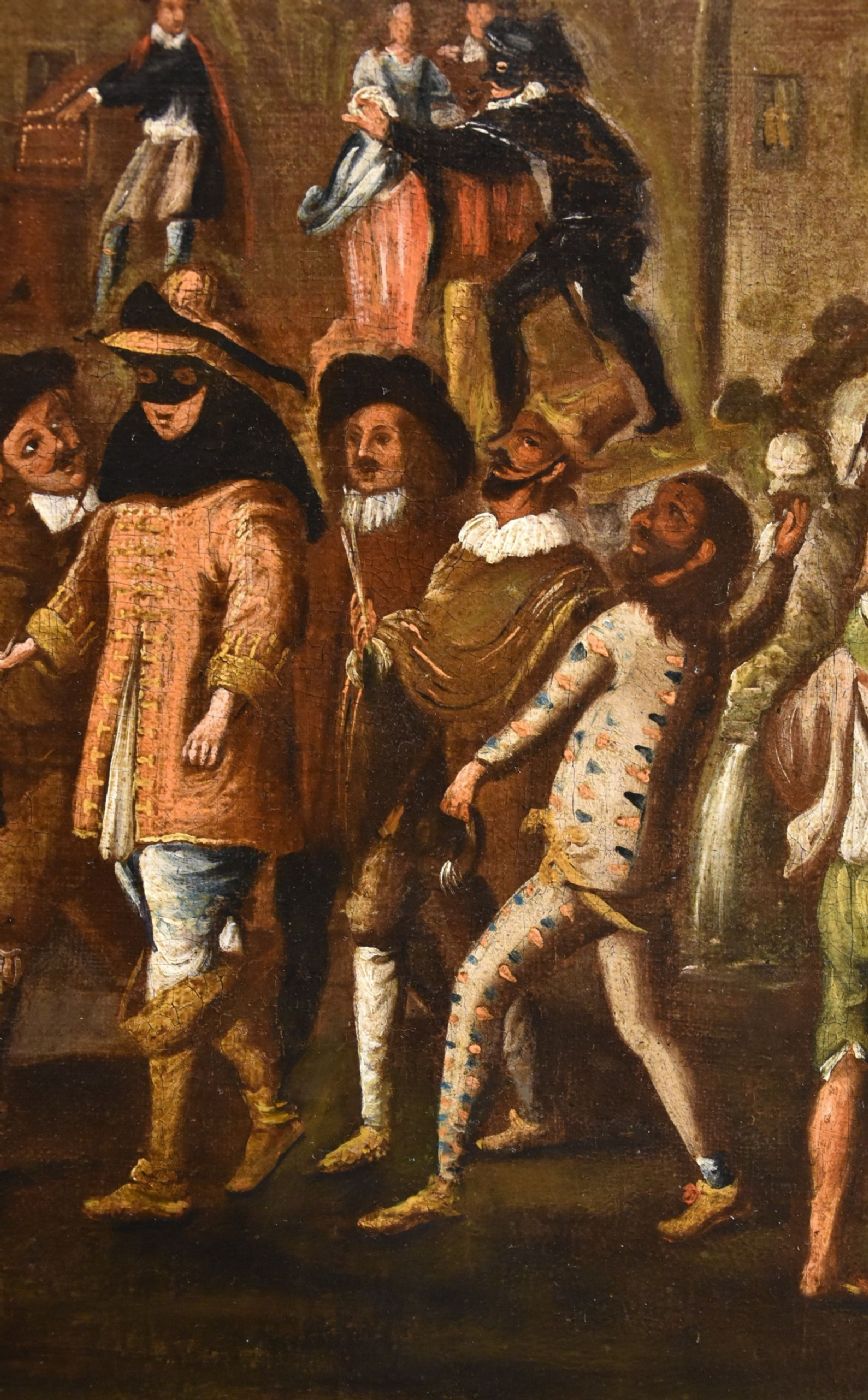
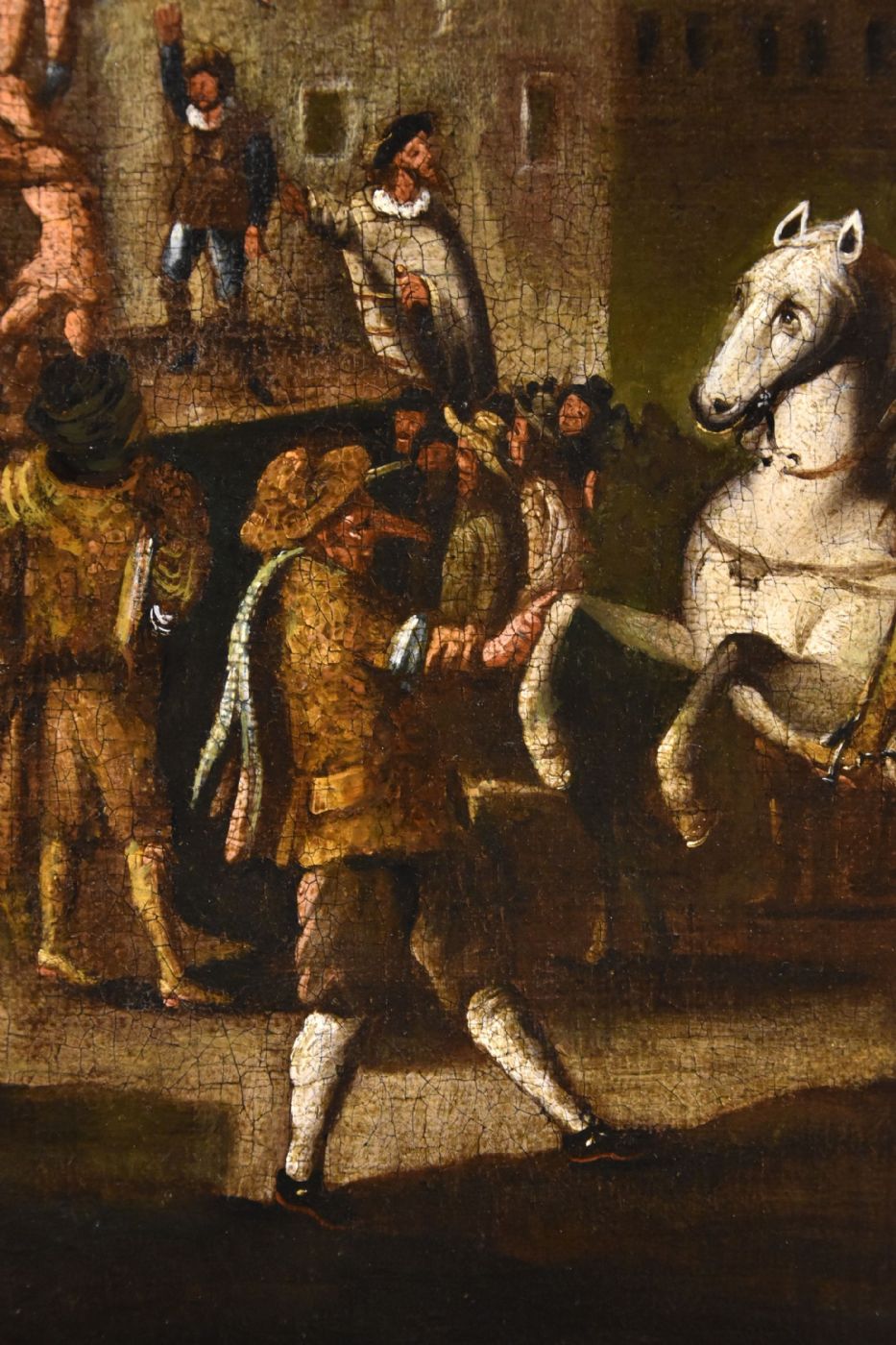
Carnival scene in 17th century Rome (in Piazza Navona)
Roman school of the Bamboccianti (mid-17th century) - workshop of Michelangelo Cerquozzi (Rome 1602 – Rome 1660)
Oil on canvas
74 x 96 cm - Framed 88 x 110 cm
Full details of the work (click HERE)
In the context of a large square crowded with masked and costumed characters, the painting depicts a joyful scene during the Carnival celebrations in 17th century Rome, and is therefore a very interesting testimony to the customs of the time.
The painting is set in Piazza Navona, with the detail, on the right, of the famous Fountain of the Four Rivers designed by Gian Lorenzo Bernini, surmounted by the sixteen-meter-high Agonal obelisk, originally placed in the circus of Maxentius on the Via Appia, being clearly recognizable.
A city event with very ancient origins - inspired by the Saturnalia of the ancient Romans, in which slaves were elevated to the rank of masters, subverting the ordinary social order - Carnival, from the 16th century onwards, became one of the main celebrations of pontifical Rome, and one of the richest and most unbridled in Europe, becoming in the Renaissance more popular and renowned than the Venetian one.
Not simply a festival, but an integral part of the city's culture: just as had already happened in antiquity, the Roman oligarchies also granted the population, especially the most humble classes, a period dedicated to entertainment. The entire citizenry participated, the lower classes mixed with the powerful, and were even able to publicly ridicule them; protected by the anonymity guaranteed by the masks, a sort of leveling of all social divisions was obtained and they were even authorized to publicly ridicule the authorities and the aristocracy.
People in masks paraded, disguised as characters from the Commedia dell'Arte, especially in the Roman style.
Thus via Lata (the current via del Corso), Piazza Colonna and Piazza Venezia became the places dedicated to the unfolding of the festival, allowing the people (and also the masked lords) to take possession of the official nature of the festival.
Among the various painters who depicted carnival scenes, a special place belongs to the Roman Michelangelo Cerquozzi (Rome 1602 – 1660), to whose workshop we can easily attribute our work.
Active mainly in Rome, Cerquozzi became known for his membership in the Caravaggesque popular Roman current - defined as the 'school of the Bamboccianti' - a pictorial movement to which Flemish, Dutch and Italian painters adhered, who preferred simple themes with popular scenes drawn from daily life in Rome at the time.
And Carnival, which lent itself perfectly to a popular narrative iconography, was therefore a typical subject of the "bambocciata": in Cerquozzi's production there are several works with a carnival subject, preserved in various museums and collections, as well as many other authors belonging to the current, for example Jan Miel (see Carnival in Rome, 1653, Madrid Museo del Prado), Johannes Lingelbach (see Carnival in Rome, 1650/1651 Kunsthistorisches Museum).
ADDITIONAL INFORMATION:
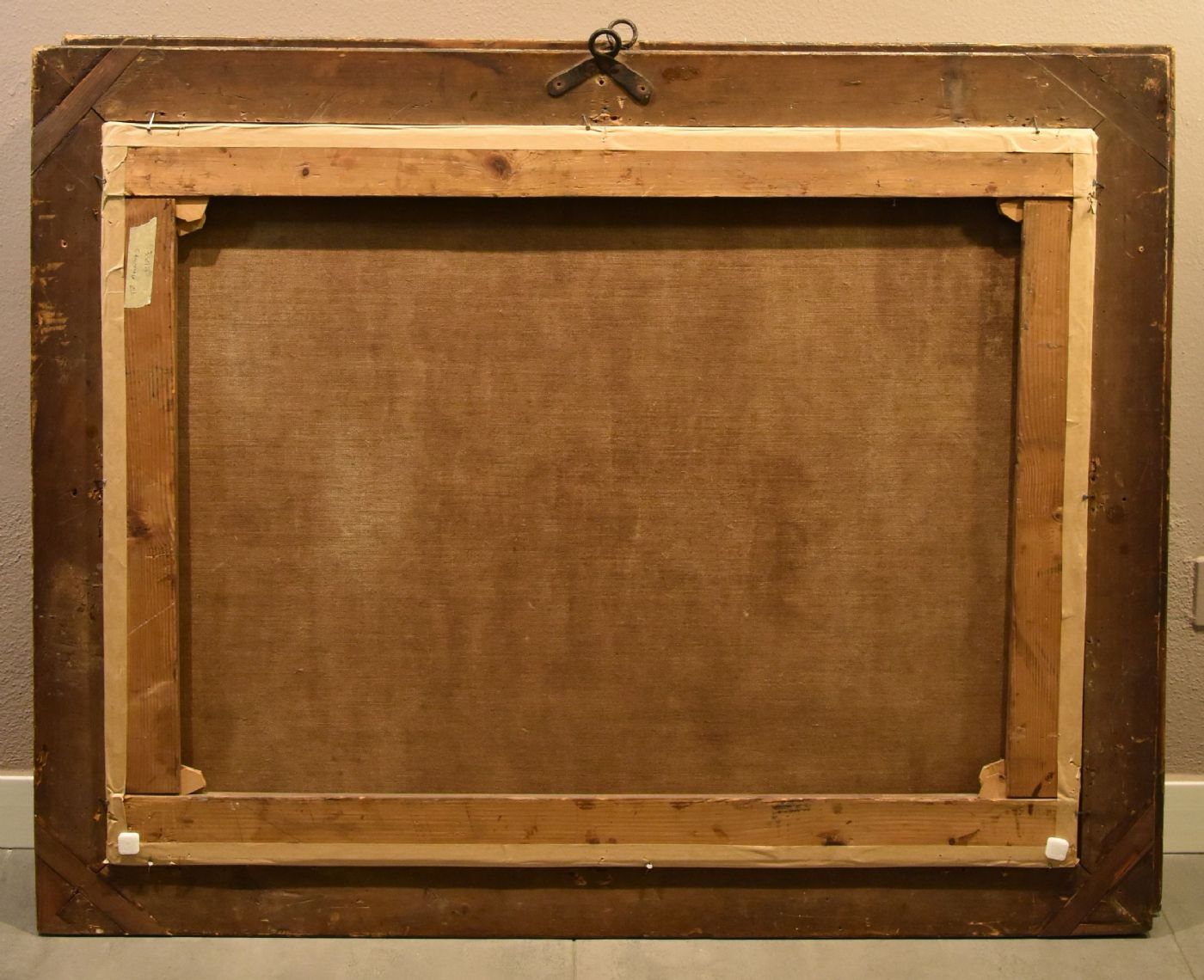
The painting is sold complete with a pleasant antique frame and is accompanied by a certificate of authenticity and a descriptive iconographic sheet.
We take care of and organize the transport of purchased works, both for Italy and abroad, through professional and insured carriers.
If you wish to see this or other works in person, we will be happy to welcome you in our new gallery in Riva del Garda, in Viale Giuseppe Canella 18. We are waiting for you!
Contact us for any information or to organize a visit, we will be happy to answer you.
Follow us also on:
https://www.instagram.com/galleriacastelbarco/?hl=it
https://www.facebook.com/galleriacastelbarco/