Small Venetian lacquered wood tray
Description:
Dimensions: 19 X 23 cm
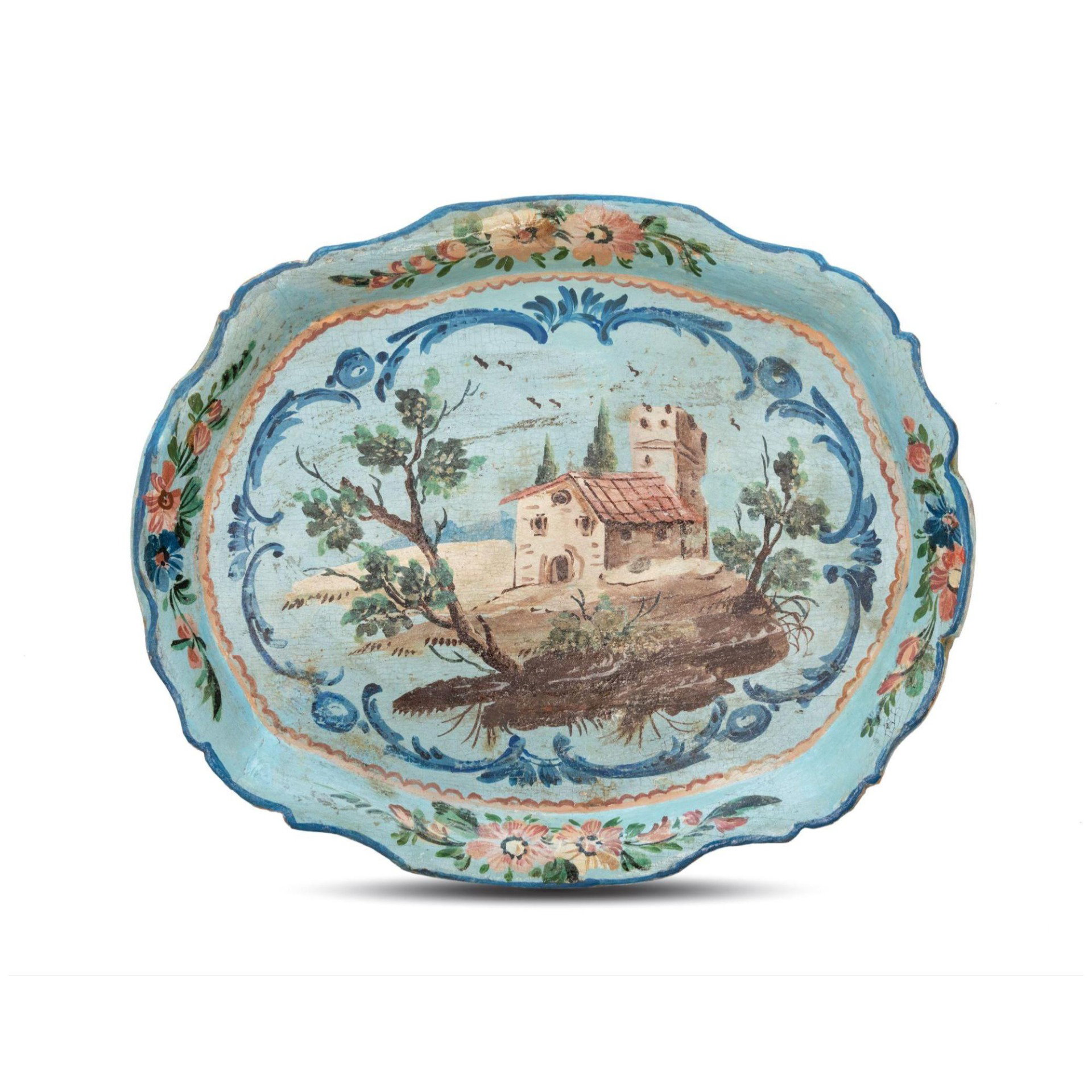
This small lacquered tray on a light blue background was made in Venice in the 18th century. More precisely around 1750, in the full Louis XV period.
It features a shaped figure all around with designs of floral sprigs on the border.
In the center, we find the figure of a country house painted with plants and birds, enclosed within a blue-painted rocaille frame.
Visible to the naked eye and against the light, its craquelure is evident. Its dense texture is a further indication of its 18th-century originality.
Similar examples can be found published in manuals of Venetian lacquers.
Period
Eighteenth century, 1750
Style
Louis XV
Material
Lacquered wood
Origin
Venice
Venetian Lacquer:
Lacquer indelibly marked the artistic epic of the Venetian eighteenth century, becoming a dazzling and almost unique symbol. Thanks to the surprising inventive fertility and extraordinary executive skill of the "depentori" (painters), it found happy application on an almost unlimited variety of objects, both luxurious and for daily use.
It is noteworthy that on this object, the images and decorations are applied by direct painting without the use of so-called "cartine" (patterns), which are thin sheets of paper already painted and then glued onto the painted wooden base. The latter practice was particularly common in Bassano (Vicenza), an artistically flourishing town in the Veneto region, and the birthplace of great artists such as Jacopo da Bassano (1510-1592). This latter technique is the so-called and famous "arte povera" (poor art).
Louis XV (1710 - 1774)
Few monarchs like Louis XV (1710 - 1774) embodied the spirit of an era so powerfully. Ascending to the throne at just 5 years old in 1715, after the impressive series of bereavements that had characterized the final years of Louis XIV's reign, his governance was hailed as the beginning of a new golden age following the long twilight of the Sun King. The early years of the young prince's reign marked a turning point, not only in the political history of France but also in its social and especially artistic history. The court's hasty abandonment of Versailles, desired by the regent, Philippe d'Orléans, brought Paris back to the center of fashion and aristocratic patronage. A new, more private and aristocratic approach by the country's elites signaled the birth of a new decorative style that would be identified with the Regency. Within a few years, what is defined as Louis XV or, more generally, Rococo, would be codified. The name derives from the use, as an ornamental element, of elements taken from nature, such as rocks. However, other characteristics identify the new taste: a remarkable asymmetry of forms, which would soon be corrected in the so-called "rocaille symétrisé" (symmetrized rocaille); an elegant and light use of curved lines accompanied by often delicate colors and magnificent gilding; and a preference for small, comfortable furniture. The interiors of the period, as they appear in paintings and engravings, are therefore supremely elegant and sophisticated, yet also comfortable and welcoming. A true translation in wood and fabrics of that "sweetness of living" that was to characterize one of the most fascinating eras in the history of European costume, even when the curves of the rocaille - the king is now old - gave way to the cold elegance of the new Greek taste.