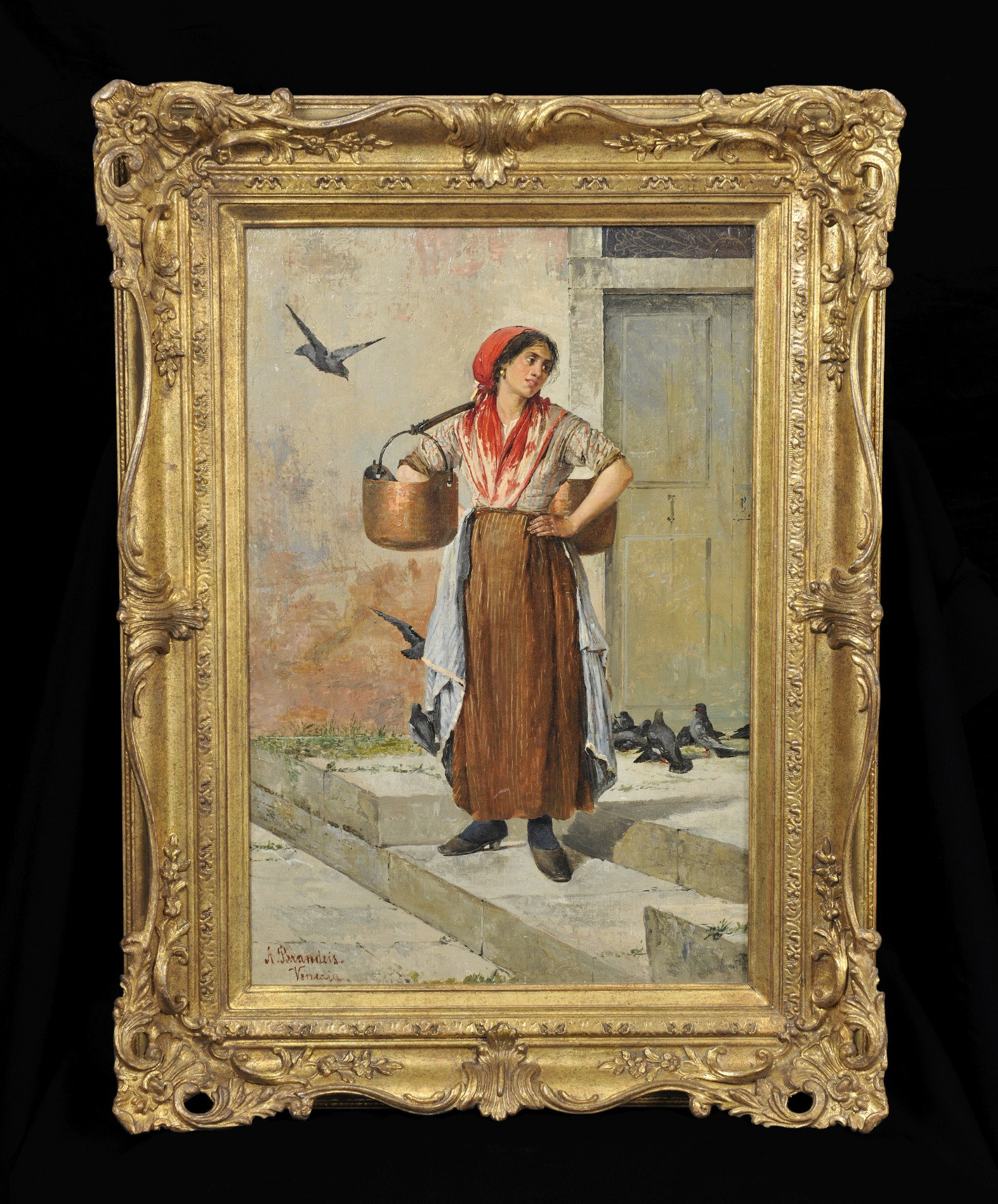
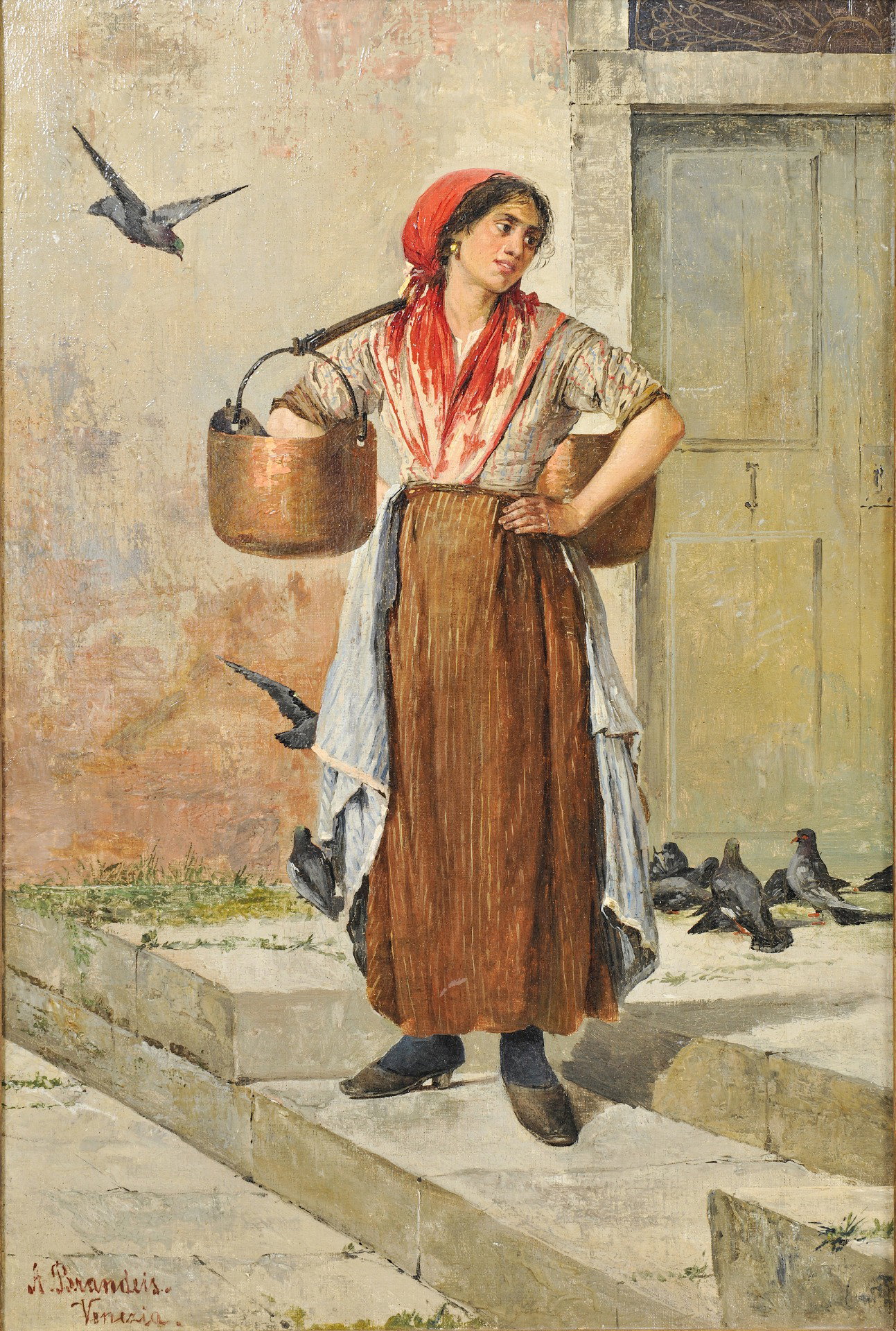
The painting depicts a young Venetian commoner standing on a stone staircase, caught in a moment of pause or just after drawing water. The full-length figure is the focus of the composition, framed by simple and bare architecture, presumably the entrance of a house or an inner Venetian courtyard.
The girl is depicted with an intense expression, almost melancholic or dreamy, with her gaze directed upwards and slightly to the right. She wears the traditional clothes of a Venetian commoner of the time: a long rust or brown skirt, a light-colored bodice, and a white apron. A touch of vibrant color is given by the red handkerchief tied around her head, which frames her face and immediately captures attention.
She carries on her shoulders, using a yoke or an invisible support, two shiny and embossed copper buckets, typical tools for transporting water, which create a strong element of light and contrast with the dark background.
A group of pigeons (or doves) is perched on the steps at the girl's feet, while at least one bird, perhaps a swallow or another dark bird, is depicted in rapid flight in the upper left corner. These flying elements contrast with the static and meditative pose of the girl, adding dynamism to the narrative.
The style is characterized by an almost photographic precision in the rendering of details (such as the buckets and face), typical of the artist's academic training, combined with a solar and natural brightness (as critics note) that illuminates the face and red details, typical of the Venetian School.
Antonietta Brandeis was one of the first women to attend the Academy of Fine Arts in Venice. She was famous for her detailed urban views of Venice, Rome, and Florence, but also for these genre scenes that affectionately and realistically portrayed the people and everyday life, often with particular attention to light and color. "La Popolana" is an excellent example of this production, where the portrait merges with the environmental view, offering an authentic and poetic insight.
Antonietta Brandeis (Miskovice 1848 – Florence 1926)