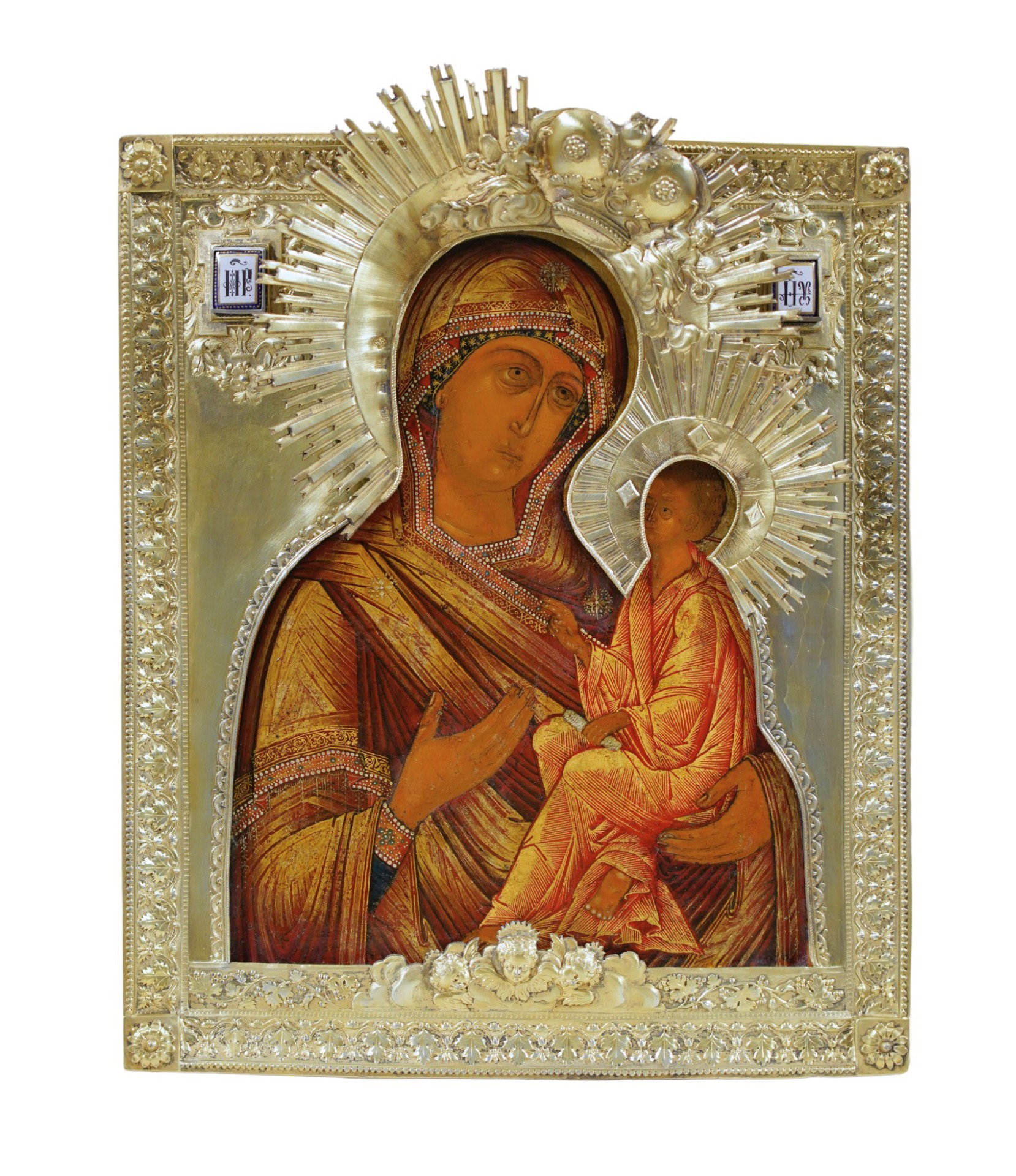
Mother of God of Tikhvin – Russian Icon 1825, Moscow
Description:
The Russian icon Mother of God of Tikhvin presented here is a refined egg tempera on panel with a silver riza, created in Moscow in 1825 by the goldsmith Dubrovin Nicolaj Lukich. The Tikhvin prototype belongs to the Hodegetria family: the Mother indicates the Child as the path to salvation, while Christ blesses. The 34.5 x 27.5 cm format and the presence of the precious riza make it a devotional work of high representation, ideal for elegant environments and qualified collections.
The history of the Mother of God of Tikhvin icon dates back to 1383, when – according to tradition – the image miraculously appeared in northwestern Russia, soon becoming one of the most beloved and protective symbols of the Russian people. From the 17th century, the cult spread widely in Moscow and Volga workshops, with high-quality replicas intended for both churches and private devotion. The typology emphasizes the tenderness of the Mother-Child dialogue and the intercessory function of the Virgin.
Artistically, the work features warm colors, fine highlights, and chrysography that softly model the folds of the garments. The embossed and chased silver riza creates bright theatricality: radiant rays, an upper crown, and a frame with floral motifs. The open composition enhances the painted faces, left visible according to practice, while the silver embraces the pictorial field without stifling it. The craftsmanship of Dubrovin Nicolaj Lukich – a goldsmith active in Moscow in the early 19th century – adds authority and identity to the ensemble.
For the discerning collector, this icon combines pictorial quality, nobility of materials, and devotional history. Convenient dimensions, excellent legibility, stage presence, a piece capable of becoming the focal point of a Marian wall or engaging with classic and contemporary furnishings, while maintaining its spiritual message and nineteenth-century elegance intact.