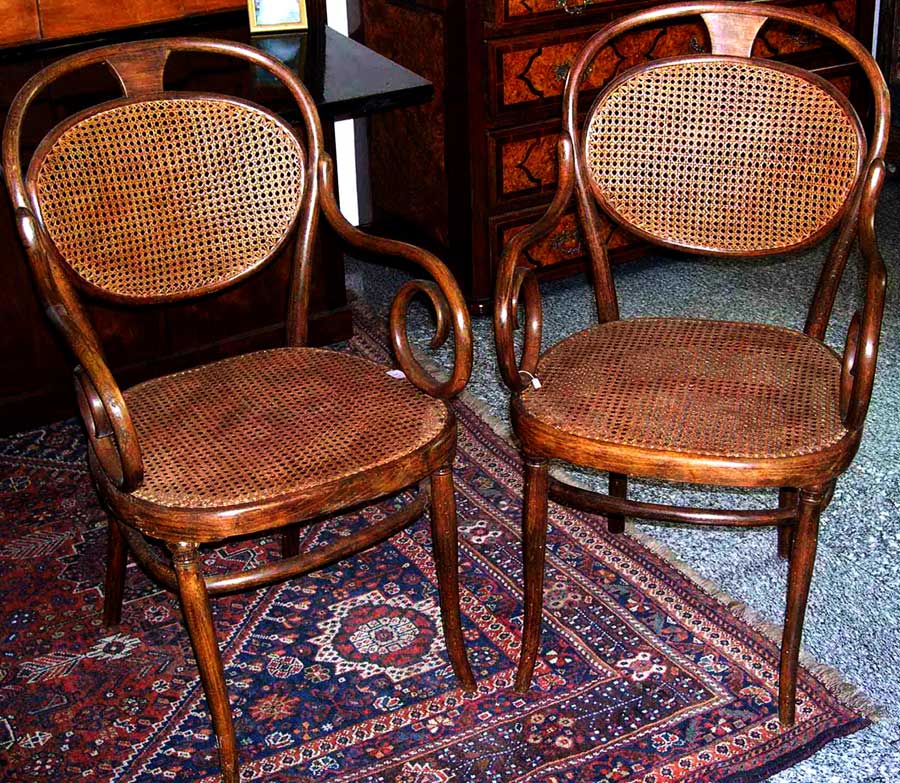
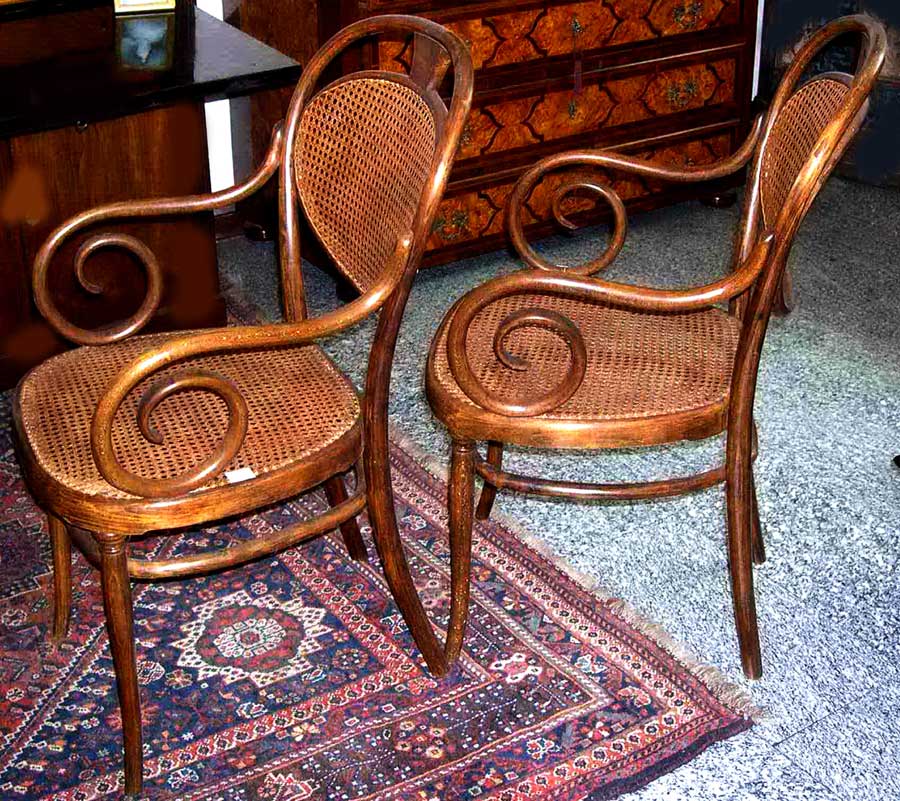
Pair of original Thonet armchairs from a limited production, not mass-produced, circa 1870/80.
Description:
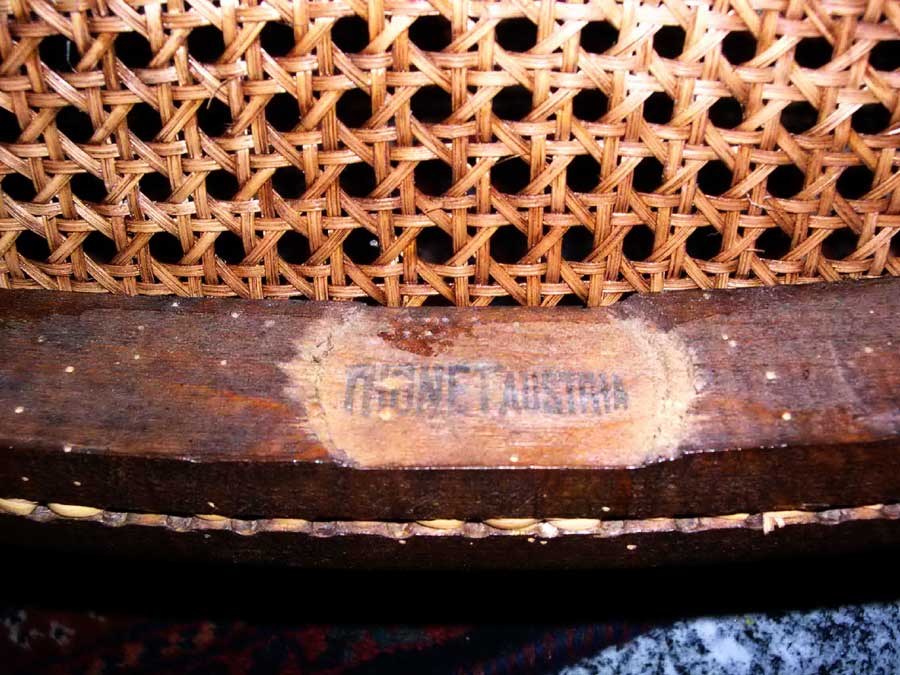
Pair of original Thonet armchairs from a limited production, not mass-produced, circa 1870-80. The most valuable original Thonet furniture comes from the "craft and design" phase of the mid-19th century. The first models made around the mid-century, first in Boppard, then in Moravia, are reference points in the history of design and furniture, and are of museum quality. The production of 1870-80 retains significant artistic and collector interest, as production was still meticulous and limited, with a technique similar to prototypes. Mass production, which spread at the end of the century and the beginning of the 20th century, is considered less interesting. Steam-bent beech, Vienna straw. Original firebrand of the manufacture. Vienna 1870/80 approx. Height cm. 98, seat only cm. 48; width 51; depth 47. In excellent condition and with patina.
History of the prestigious Thonet firm.
In the years around 1830, Thonet conducts his experiments with veneer strips softened in boiling glue before inventing "bentwood furniture". In 1842, Prince Metternich, struck by the talent of the Rhenish cabinetmaker, called him to Vienna. Here Michael Thonet dedicates himself, with his children, to making parquet flooring and furniture for the Liechtenstein Palace and the Schwarzenberg Palace. With the creation of chair No. 4 for the Daum café on Kohlmarkt in Vienna, he quickly conquered the Viennese café scene, laying the foundations for the development of the furniture sector intended for the "community", i.e. public spaces. With the revolution of 1848, many people lose their jobs and find other employment in Thonet's new factories, where steam engines are in operation. Success came in 1859, when the Gebrüder Thonet company of Michael's sons presented chair No. 14 in solid bentwood, the famous "Vienna straw chair" now considered one of the icons of design history. The Thonet brothers quickly understood the need to integrate new trends and technical developments into their work, embracing certain ideas that were still in their embryonic stages. From the outset, they presented their creations at the industrial and craft exhibitions of the time. The multilingual catalogs of the Gebrüder Thonet company helped to make the products known abroad, and they soon became bestsellers. Sales branches were established in neighboring countries as well as in more distant ones, developing a distribution network for Thonet furniture all over the world. The development of an innovative technique for bending solid wood (hot steam), first by boiling the glue, then by moistening it with steam generated by an autoclave, and then giving it the desired curvature in metal molds and making it rigid again by drying it in ovens. This latter process was then patented in 1842. Michael Thonet died in Vienna in 1871, and the business was continued by his sons. The most valuable original Thonet furniture comes from the "craft and design" phase of the mid-19th century. The first models made around the mid-century, first in Boppard, then in Moravia, are reference points in the history of design and furniture, and are of museum quality. The production of the last third of the 19th century retains significant artistic and collector interest, as production was still meticulous, limited in number, and with a technique similar to prototypes. The Austrian Museum of Applied Arts in Vienna and the Thonet GmbH museum in Frankenberg, Hesse, possess one of the largest collections of original Thonet chairs.
In accordance with the provisions of the New Code of Cultural Heritage, the selling company provides, concurrently with the sale, detailed written photographic guarantee of originality and provenance of the works sold. The data with which the works are described and then contained in the written guarantees are express determinations resulting from accurate and documented technical/historical/artistic investigations, even of expert assessment.