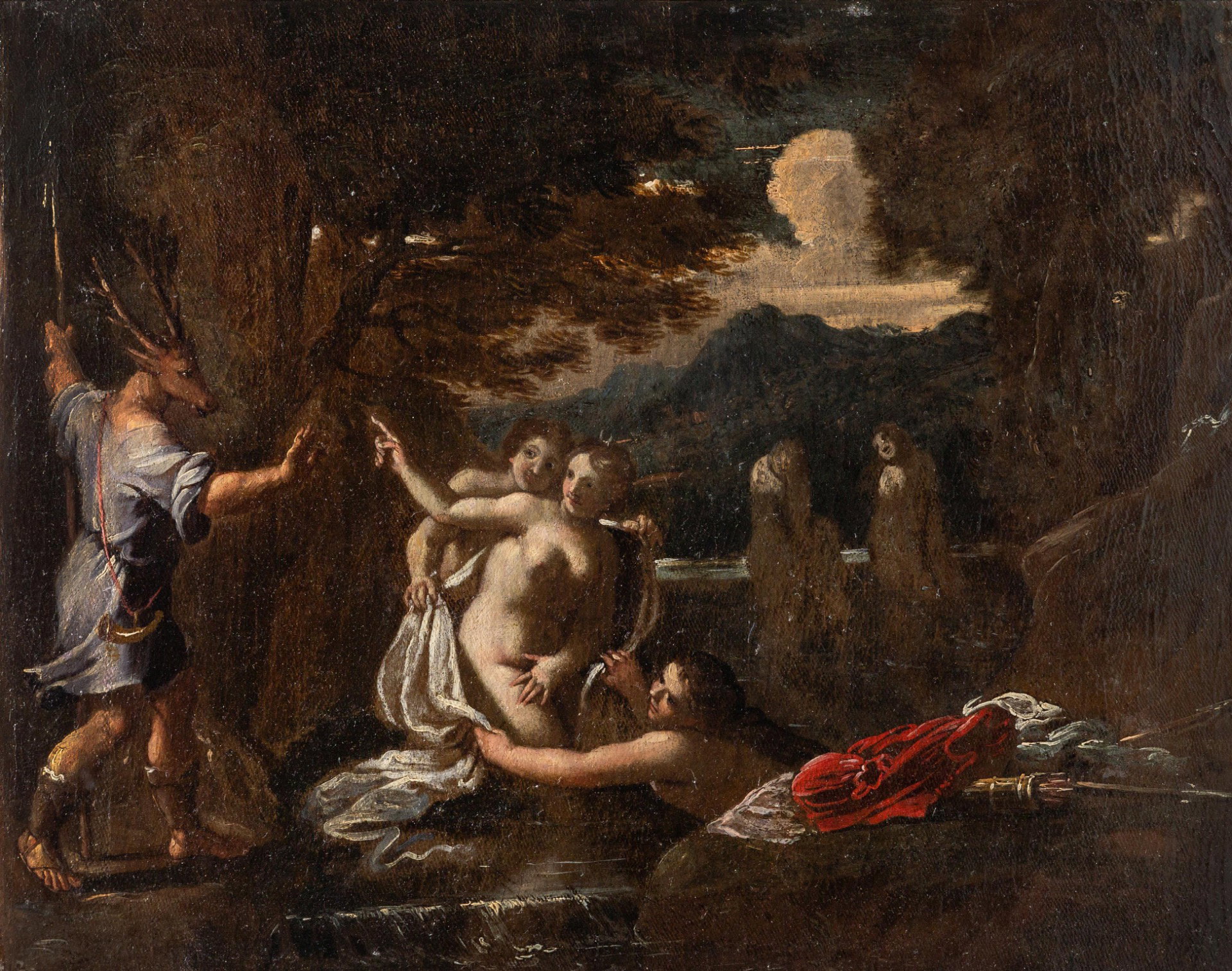
Camillo Ricci (Ferrara 1590 - 1626)
Diana Turns Actaeon into a Stag
Oil on canvas, 40 x 49.5 cm
Description by Massimo Pulini
On the bend of a stream, which creates a pool of water and a clearing between one grove and another, some young women are bathing who, at the moment the image is frozen, appear alarmed by the arrival of a young hunter. Two of them take care to cover the nakedness of the central figure who, the mark of a small crescent moon on her hair, reveals to us to be Diana, the goddess protector of springs and forests. At the same instant in which the divinity raises her hand menacingly, we see the young hunter in the middle of a metamorphosis willed by Diana herself through sorcery. A stag's head has appeared on top of the human body, which however still seems to be advancing on the bank. Tardy and useless is his gesture of apology, with open arms, and as soon as the transformation into an animal is complete, his own dogs will devour him, no longer recognizing him. The dramatic story of Actaeon is told and suspended in this small and sincere painting, which reveals both characteristics of Emilian painting, combined with elements of Venetian culture. It is no coincidence that Camillo Ricci, the artist I believe to be the author of the work, is from Ferrara and blends, within his style, the cursive brushstroke and the stain of Venetian ancestry, to the Emilian physical solidity. His own teacher, Ippolito Scarsella known as Scarsellino (Ferrara 1550 - 1620), was a cardinal figure between the two artistic schools, as well as between the two centuries. Both collaborated with each other in various works, as Barut-faldi recalls by quoting a booklet of memories of Scarsellino himself in which were noted; «the advancements and the company made to Ippolito teacher in the larger, and more laborious operations» (G. Baruffaldi, Lives of Ferrarese painters and sculptors (1697-1730), Il, Ferrara 1846, pp. 108-116.). An erotic rural scene with Mars and Venus is known (location unknown), which clearly reveals the two hands, of the master and the pupil, and that painting can be said to be a precedent to the setting of our mythological narrative. However, there are autonomous works such as a Joseph fleeing from Potiphar's wife, recently passed through the Roman Bertolami auctions (April 2023) to provide a fitting comparison of style and expression. The short-limbed and rounded physical types recur, as well as a simple theatricality of attitudes and sentiment. Paintings of this nature make us understand how similar is also the pictorial drafting which, in a good part of the shadows, exploits the reddish color of the priming, the preparation based on burnt earths, giving the work a humid intonation. The painting with Diana and Actaeon shows unfinished parts, especially in the background, where two other sketched bathing women are visible, but very rapid brushstrokes are also evident in the foreground, where the clothes and weapons of the Amazons are touched with very modern fluidity. On the same perspective plane, but placed lower, also the small waterfall is expertly touched. It could be one of the works left unfinished at the time of his premature death at the age of thirty-six. In any case, the style, which appears more autonomous from Scarsellino's lesson, should belong to the last season of the artist's life, between 1620 and 1626.