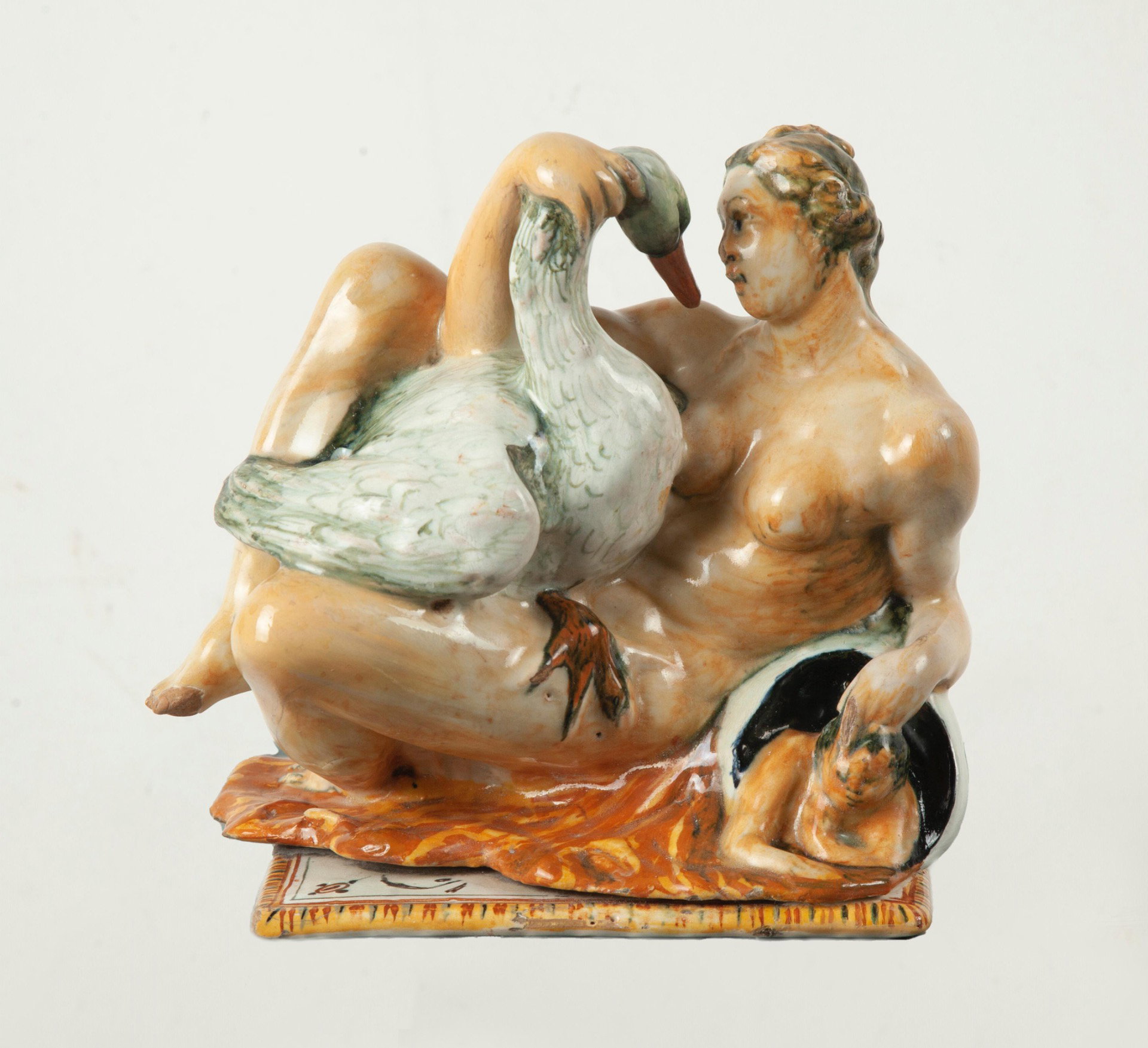
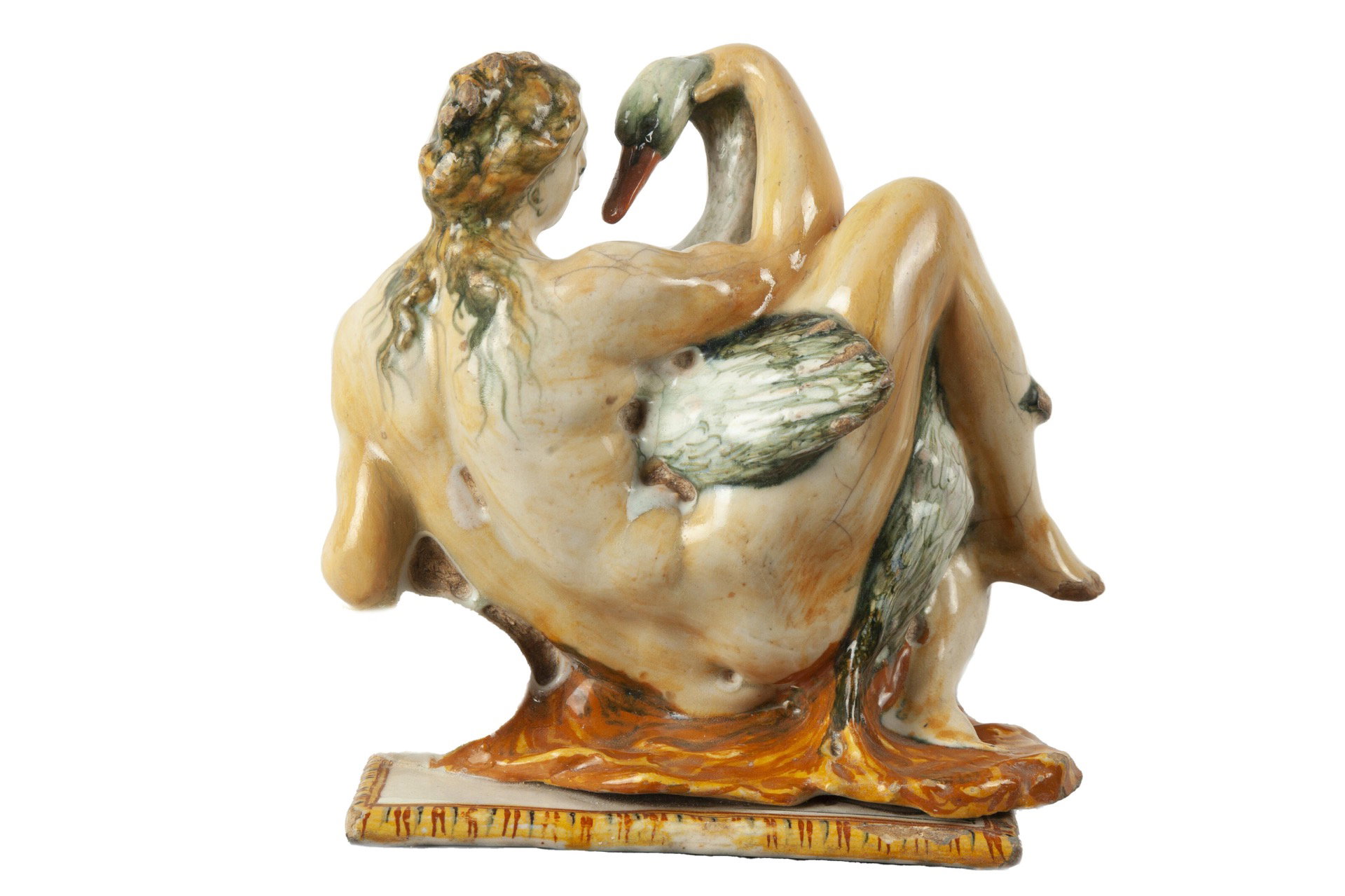
Patanazzi Workshop (16th-17th century) Leda and the Swan
Description:
Patanazzi Workshop (active in the 16th-17th centuries)
Majolica, base sides cm 12 x 16, total height cm 19
PROVENANCE: Nella Longari Gallery Milan, Barbara Johnson Collection, Christie's Auction, Sept 29, 2006, New York, lot 187, Private collection, Bologna
Entry by Carmen Ravanelli Guidotti
The fully sculpted and painted in full polychromy composition depicts the myth of Leda (Ovid, Met., VI, 108 ff.) at the moment when the young woman, wife of Tyndareus, king of Sparta, unites with Jupiter in the guise of a swan. Leda, naked and half-lying down, rests her body on a cloth and her left hand on an open egg from which the bust of a child (Castor or Pollux) protrudes, one of the children who will be born from this union. Furthermore, the composition rests on a rectangular base with a beveled edge and painted to look like a fringe. The iconography of this precious sculptural work, whose waxy quality of the enamel gives a tender softness to the modeling, especially in the body of Leda, closely recalls the graphic version of Leda and the Swan by Marcantonio Raimondi, it was so well known and widespread in the Urbino majolica environment, that it was widely transcribed on the "istoriata" painting, in particular by Francesco Xanto Avelli, throughout the third decade of the 16th century, as evidenced, for example, by a version dated 1537, from the Museo Civico in Bologna'. The same Bolognese Museum also preserves a plastic Leda very similar to this one, but with an oval base. Even more interesting is a second version, which can be admired in the Wallace Collection in London' ; it in fact not only has a base, moreover rectangular like this one under examination, but has come down to us complete with its inkstand-tool box, decorated with sphinxes and cartouches, in the typical lavish taste of the works of the Patanazzi of Urbino of the late 16th century. Its completeness clarifies that in the case in question and in the one in Bologna we are faced with the fastigium placed to crown inkstand sculptures, real writing sets, composed of a base box, sometimes even equipped with tool drawers and often enriched at the base with molded relief details taken from a vast repertoire of matrices, which simultaneously multiplied on the same object or on several plastic compositions complementary decorative elements of symbolic-decorative character both sacred and profane: putti, harpies, sphinxes, cherubs, monstrous figures,
masks. They were applied with such a casual interchangeability of the modelers of the Urbino Patanazzi workshop, from 1580 onwards, that these plastic groups became curious anthologies of minor late-Mannerist sculpture, known in bronze forms for having produced mainly basins or braziers, torch holders, salt cellars, coolers, hand warmers, inkstands indeed and table triumphs of various kinds. The mythical subject of this composition also enriches the catalog of profane themes of other sculptures produced by the same well-known Urbino workshop (Orpheus, Apollo, etc.). among these, mostly without a date, for reasons of chronology, it is always worth remembering the one destined for Cardinal Baronio, present in the collections of the Faenza Museum, whose dating can be derived from the coat of arms of the learned prelate, displayed by a child, which, being subordinate to the papal one, is to be put in relation with the election of the influential figure to the Roman purple, which took place on June 5, 1596. In addition to the Baronio inkstand, two similar Patanazzian compositions of the Metropolitan Museum in New York of 1584 and the base of an inkstand with plastic figures of poets on the sides, bearing the signature "Vrbini Patana(zzi)/fecit anno 1584", once in the D'Azeglio then Delange collection, are particularly noteworthy due to the certain date. Finally, we recall that these plastic compositions were not only conceived with a intended use, but were also born with a private character, or for the exclusive use of those who had commissioned them or received them as a gift.