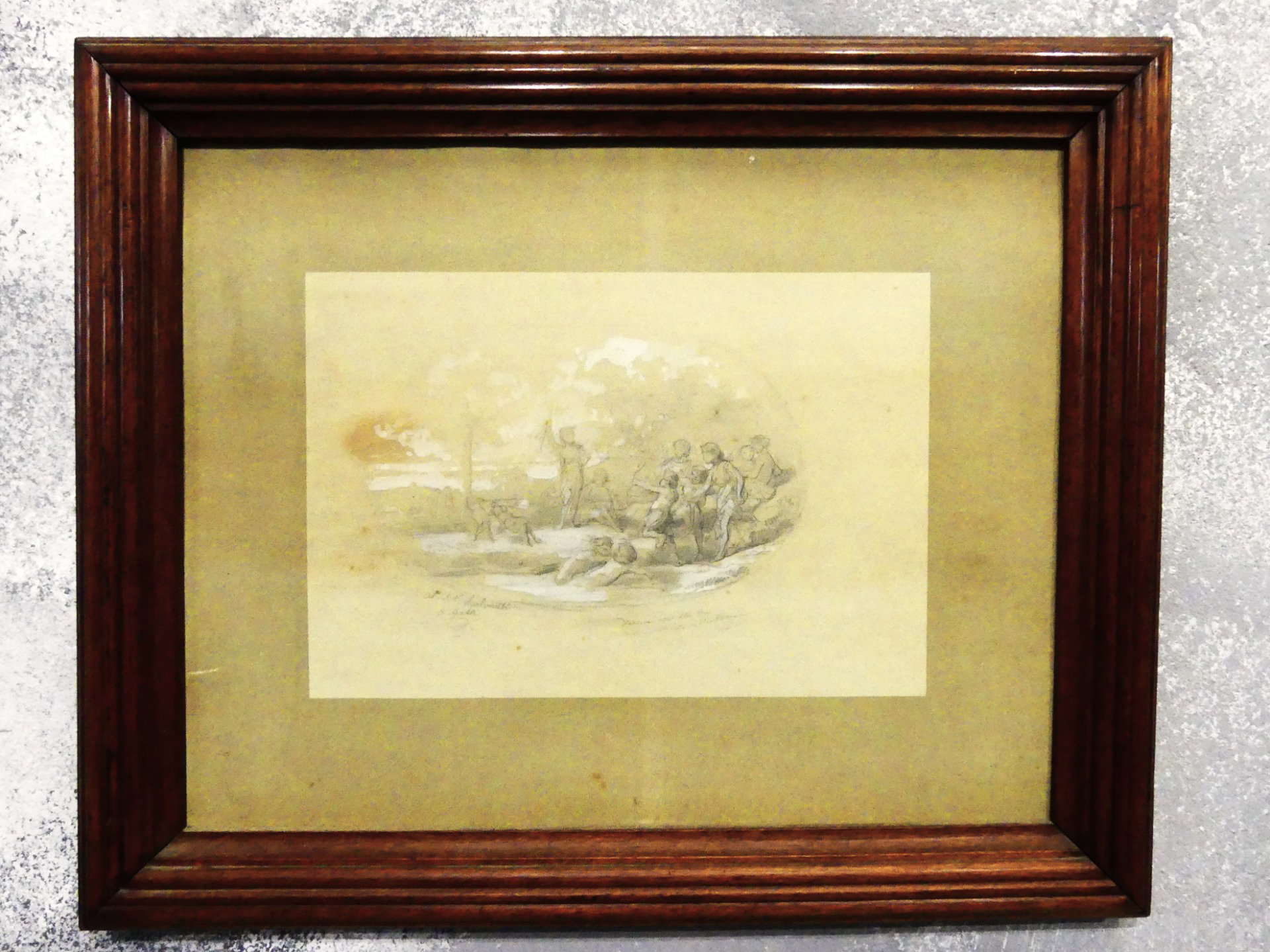
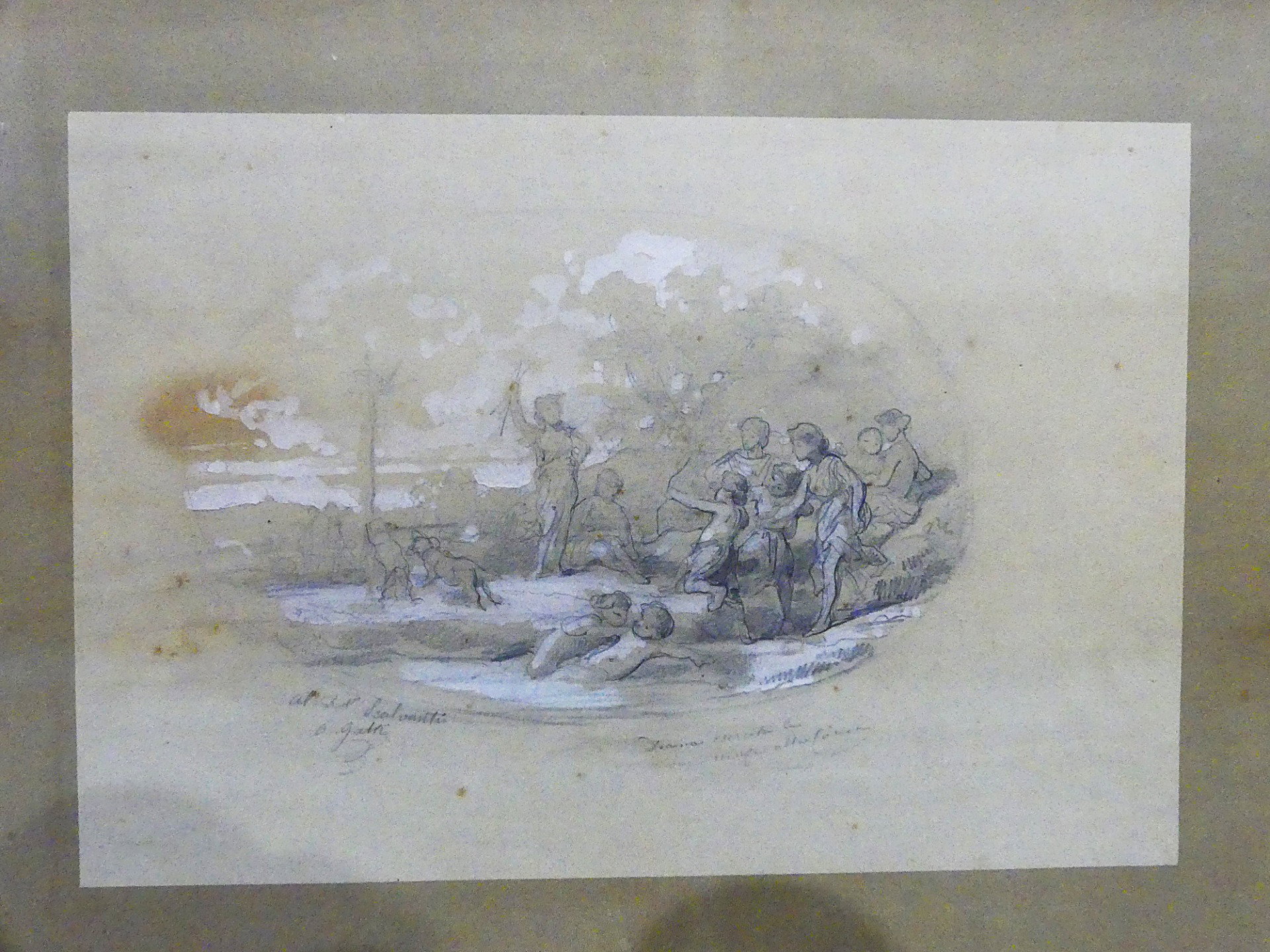
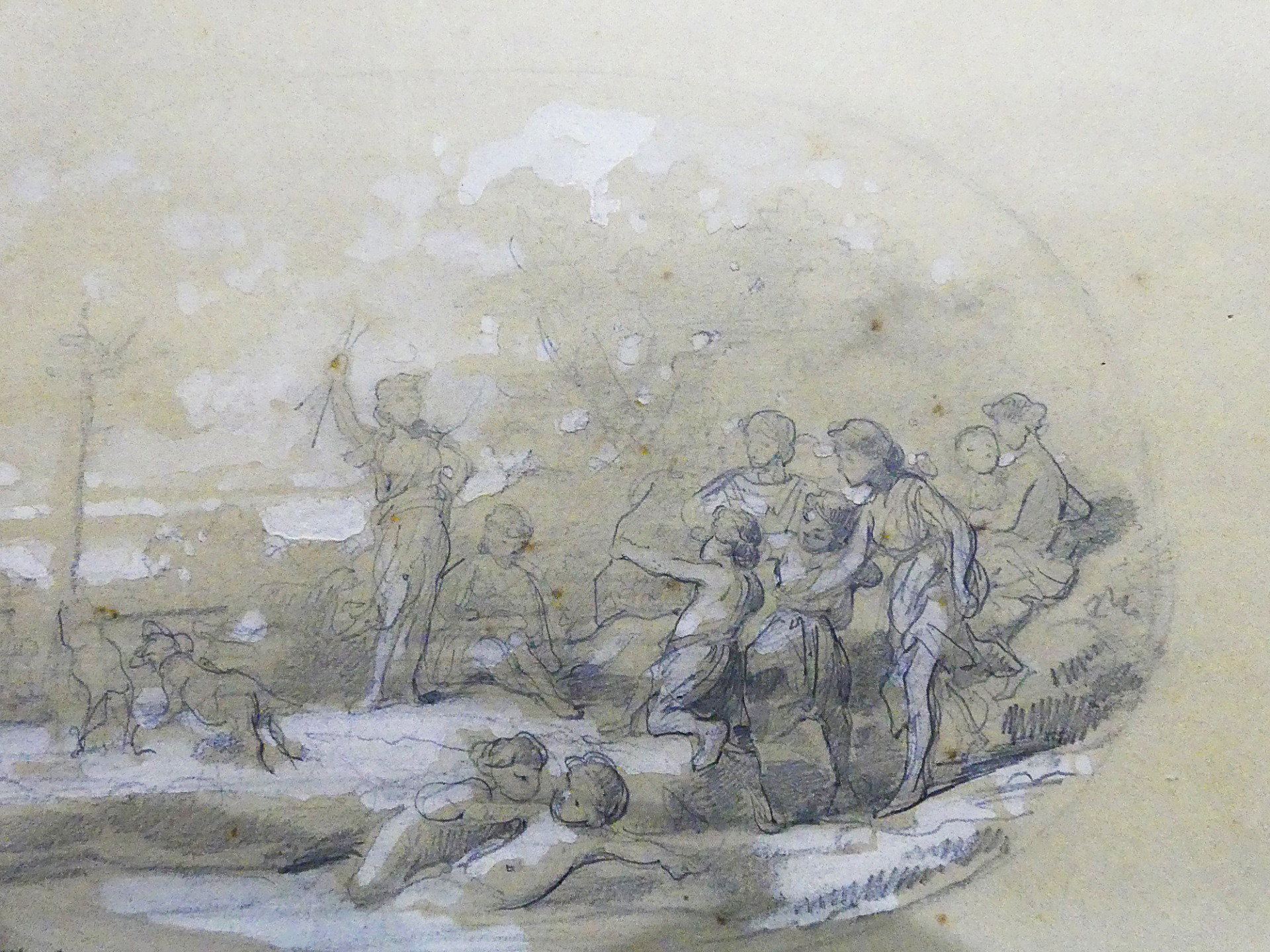
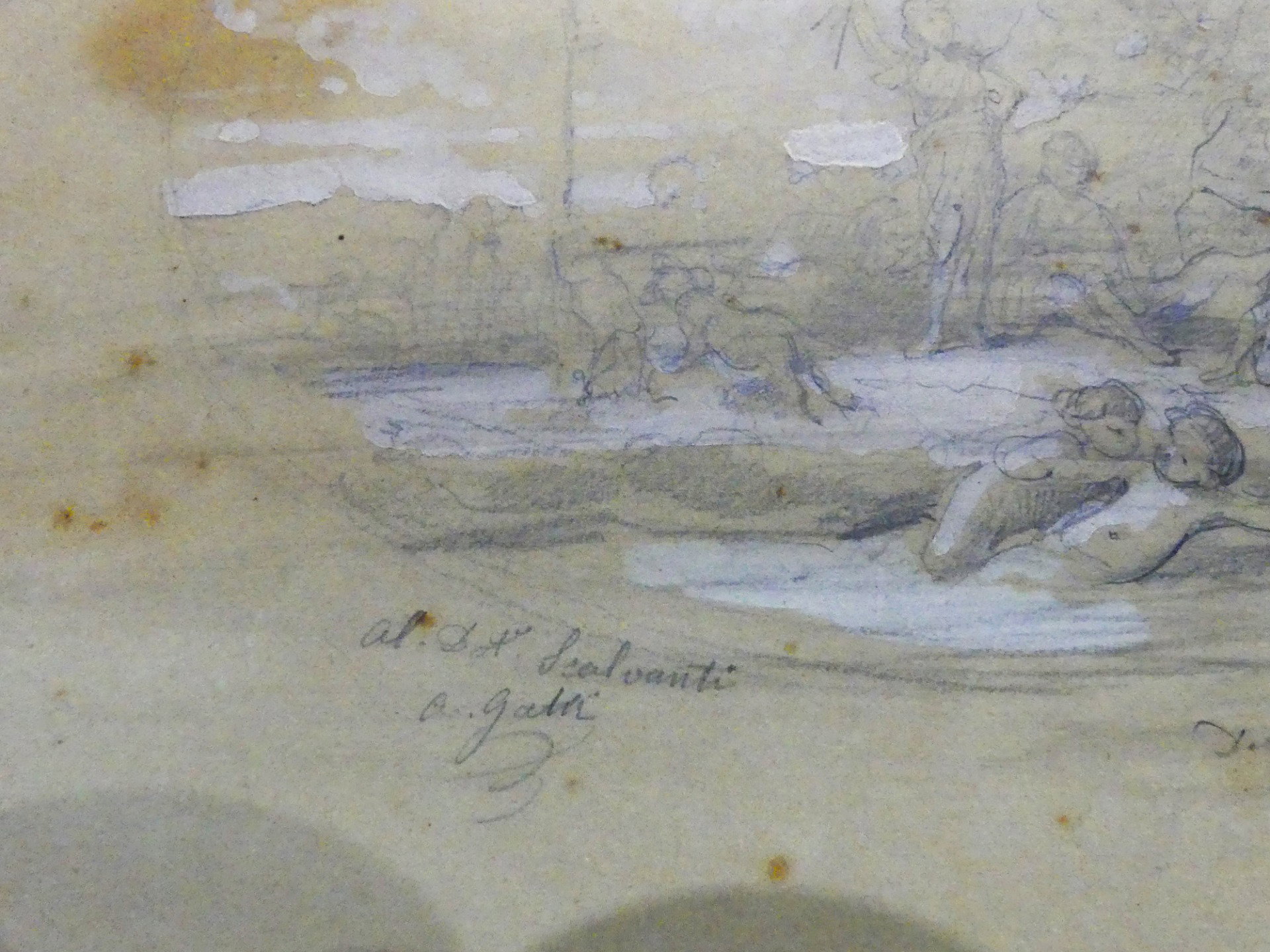
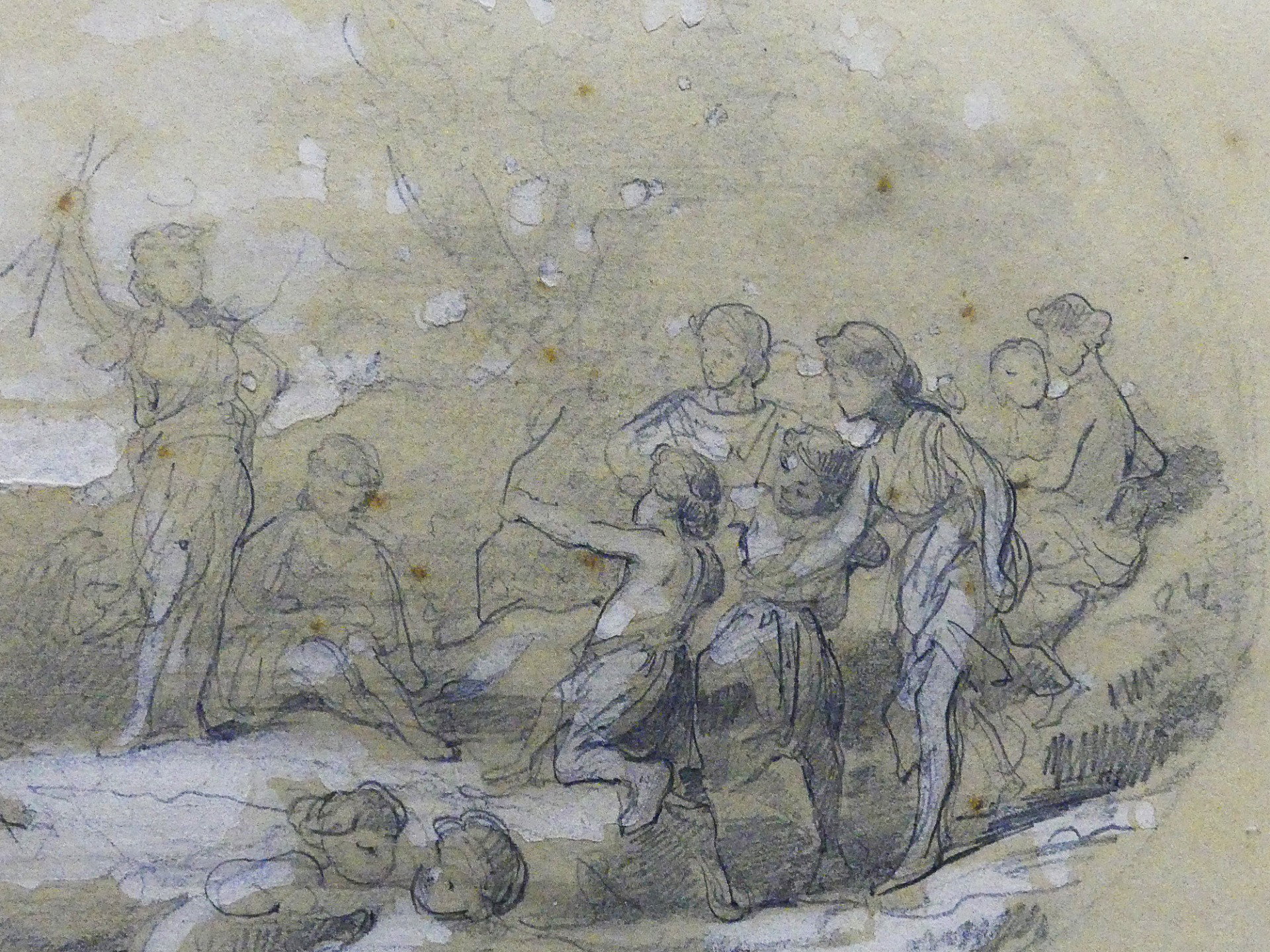
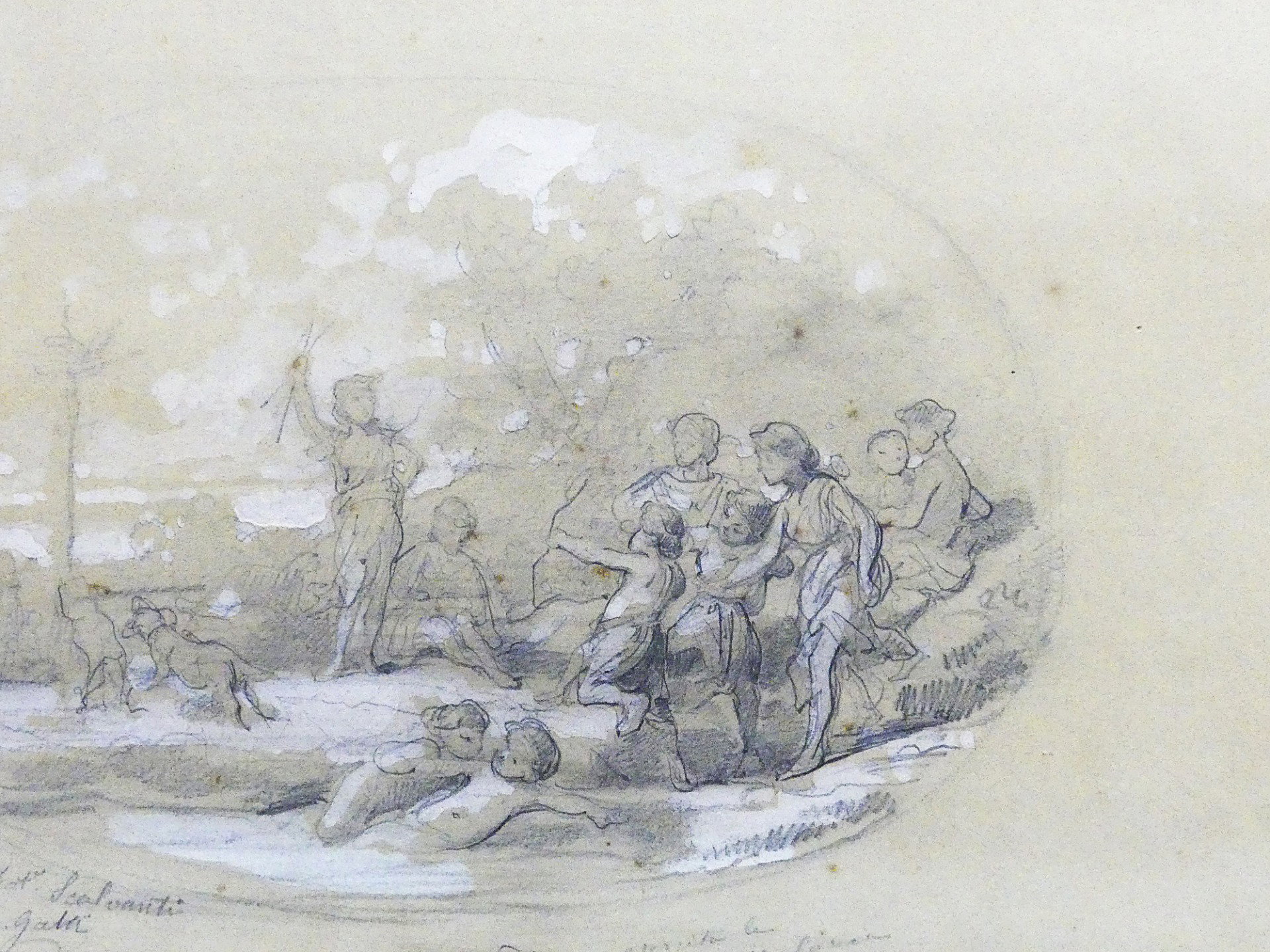
ANNIBALE GATTI Study of water lilies with dedication
Description:
LA GALLERYA PROPOSES
STUDY OF WATER LILIES BY THE MASTER ANNIBALE GATTI
PENCIL ON PAPER, SIGNED WITH DEDICATION AT THE BOTTOM LEFT
32 CM H 22 CM without frame
GATTI, Annibale
Son of Damiano, he was born in Forlì on September 16, 1827. His father, a decorator and fresco painter, moved to Florence with his family in the 1830s in the hope of receiving new commissions.
As Gatti himself recalls in his posthumously published autobiography (1928), as a child he was sent to study first with "a certain Lega" (p. 8), then at the S. Jesi school, receiving only criticism and disappointment. Alongside the difficulty of studying, he practiced in his father's busy studio "making floral decorations in fresco, lines, heads, half figures, animals and all those particles that make up the figurative decorations" (p. 10).
In 1843 he enrolled in the Academy of Fine Arts in Florence, attending drawing courses held by B. Servolini. The latter confirmed to the father the son's ineptitude, advising him to direct him to another profession. With T. Gazzarrini, head of the drawing chair at the Florentine Academy, Gatti finally found a master who, thanks to assiduous practice, was able to lead him to his first school successes. In 1847 the young man was admitted to the painting school held by G. Bezzuoli, where he had G. Bellucci, C. Conti and G. Fattori as fellow students. In 1849 he received the smaller drawing prize, in 1850 and 1851 the one for the oil sketch. In 1856 he faced the canonical study trip to Rome.
The following year saw the painting Molière Reading to the Servant, the first of a long series of versions among which it is worth remembering the replica made in 1864 for Countess Fiorella Favard: the traces of both paintings, like most of Gatti's canvases, have been lost; however, the works are known thanks to sketches or drawings preserved, mostly, in private collections mentioned in Zappia's volume (1985).
In these years Gatti created his first portraits, among which we remember that of Marquis Cesare Giovannelli (ante 1855), father of Ida who would later become the painter's wife.
In 1858 he was commissioned a painting for the church of S. Verdiana in Castelfiorentino; the painting, depicting The Glory of S. Verdiana, was finished in 1861. In these three years Gatti built his reputation by executing the frescoes, depicting a series of putti, in Palazzo degli Antinori di Brindisi in Florence (1857-60), painting the Assumption of the Virgin and four Archangels for the dome of the presbytery of the cathedral of San Miniato (1859) and the painting with Michelangelo in Glory for Palazzo Toscanelli in Pisa (1860). The decorations for Palazzo Giuntini, then Bastogi, depicting the Allegory of the Arts and the Allegory of the Seasons, and, again in Florence, the decoration of the meridian gallery of Palazzo Pitti with the Allegory of Peace, while, in the throne room, he created the Genius of the House of Savoy Presenting Italy to the Assembly of Other Nations, can be traced back to 1861. In these same years Gatti completed the decorations of Palazzo Favard on the Lungarno Vespucci, finished by the architect G. Poggi in 1858, frescoing three rooms, respectively with the Glory of Tasso, Stories of Psyche and Country Concert.
Gatti was also the author of small easel paintings, destined for merchants and galleries, which depict episodes from the lives of the ancient masters: for example, the three dedicated to Buonarroti, kept in a private collection (Zappia, 1985), with Michelangelo Presents the Moses… (1855), Luisa Strozzi in Michelangelo's Studio (1857) and Charles V Picking up the Brush for Titian (1858).
Gatti faced the seventh decade as the leading artist in the Florentine area.
With the transfer of the capital, Florence was the object of an intense building campaign. In this context G. Poggi was the most active architect and Gatti, like him, the most requested painter. His painting fully satisfied the need for décor of the new bourgeoisie and the small nobility. The persuasive and coquettish classicism (decoration of Villa Favard in Rovezzano, 1865), combined with the constant reference to the theatre, in particular to opera (decoration of Palazzo Morrocchi in Florence, 1868-70), give a neo-eighteenth-century flavour to his works (ceiling of Villa di Larione, 1870).
During the 1870s, relations with Anglo-American patrons became closer, for whom he created small historical subject paintings (Lafayette's Visit to Washington, Franklin Crowned in Paris, in addition to the Meeting of Milton and Galileo, a subject replicated in several versions). In 1872 for the palace of F. Wilson Gatti frescoed the Triumph of Love, perhaps the most successful work, while the Frieze with Putti for the villa of F. Stibbert near Florence is more than a decade later.
With the Glory of S. Verdiana, Gatti had updated nineteenth-century religious painting, still settled on "purist" canons, through the recovery of seventeenth-century Emilian painting and the teachings of his master G. Bezzuoli. Painting thus becomes sumptuous, rich in colouristic impasto and chiaroscuro effects, attentive to naturalistic affections. Gatti did not always maintain this stylistic code, but changed it according to the context for which the work was intended. He adopted a neo-fifteenth-century register in the Coronation of the Virgin, a fresco created in 1868 in the sanctuary of the Virgin in Camoscio (Città di Castello), a neo-Renaissance building just finished by E. De Fabris. In 1873 Gatti executed Paradise, a fresco for the funerary chapel of Villa Favard in Rovezzano, in full harmony with the architecture of G. Poggi and the sculpture of G. Dupré. Finally, he paid homage to the young Michelangelo with the fresco The Pietà (1891) for the funerary chapel of the Counts della Porta in the cemetery of Città di Castello.
The downward parabola of his success can be traced precisely with the paintings prepared on commission for the church of S. Verdiana. The Glory of the Saint was awarded at the National Exhibition of Florence in 1861, in 1870 The Transport of S. Verdiana won the Casamorata competition and received the gold medal from the Ministry of Public Education, while in 1883 Pope Clement VII in Prayer was presented in Rome at the Exhibition of Fine Arts, passing almost unnoticed.
Gatti died in Florence on August 13, 1909; a small obituary in La Nazione remembered him as a knight and resident professor of the academic college of fine arts in Florence.
The artist also successfully painted theatre curtains. We remember the one for the new theatre in Pisa (1867-68), with Goldoni Reciting a Sonnet, and the one for the theatre in Carrara (1882) with The Master Guglielmi Carried in Triumph; the curtains of the Opera House of Cairo (1869) and the theatre of Santa Fè de Bogotá (1885) have instead been destroyed.
Sources and Bibl.: G.E. Saltini, On a painting by A. G. in the villa of Larione near Florence, Florence 1871; Retrospective Exhibition of A. G., Florence 1928; C. Zappia, A. G. portrait painter, in Labyrinthos, 1983, nn. 3-4, pp. 70-90; Id., A. G. painter of Florence capital, Rome 1985 (with bibl.); L. Zangheri, Villas of the province of Florence, Milan 1989, pp. 172, 188, 273, 391, 441; Painting in Italy. The Nineteenth Century, Milan 1991, I, ad indicem; C. Zappia, ibid., II, p. 845; G. Trotta, The interiors of Villa Favard in Rovezzano. Architecture and décor in post-unification Florence, in Bollettino architetti, 1992, n. 44, pp. 8-16, Id., Florentine villas of the nineteenth century, Florence 1994, pp. 10, 38-40; C. Morandi, Painting of the Restoration in Florence: the frescoes of the Meridian in Palazzo Pitti, in Prospettiva, 1994, nn. 73-74, pp. 180, 186 f., 189; C. Morandi, Palazzo Pitti, the pictorial decoration of the nineteenth century, Livorno 1995, p. 28; R. Carapelli, Clarifications and additions to the catalogue of A. G., in Antichità viva, XXXV (1996), 5-6, pp. 36-49.
INFO LUCA 339 37 97 813
LA GALLERYA
WHOLESALE AND RETAIL
LARGE EXHIBITION WITH WAREHOUSE 1000 SQM
HIGH ANTIQUE FINE ART, PAINTING, SCULPTURES, MARBLES,
AND ANCIENT ART OBJECTS
VISIT
ALL OUR PROPOSALS ACCOMPANIED BY A CERTIFICATE OF AUTHENTICITY
IN VIA AUTOSTRADA 34D MAGLIANO ALPI
MOTORWAY TO/SV EXIT CARRU 500M ON THE LEFT
"ESTIMATES, APPRAISALS, SUCCESSIONS AND HEREDITARY DIVISIONS
WE PRIVATELY PURCHASE ANTIQUES, ANTIQUE FURNITURE, ENTIRE INHERITANCES'
IMMEDIATE PAYMENT MAX SERIOUSNESS
WEEKLY NEW ARRIVALS
RECEIPT BY PERSONALIZED APPOINTMENT OUTSIDE HOURS ALSO ON SUNDAYS AND HOLIDAYS
Province of vision: CN (Cuneo) Italy