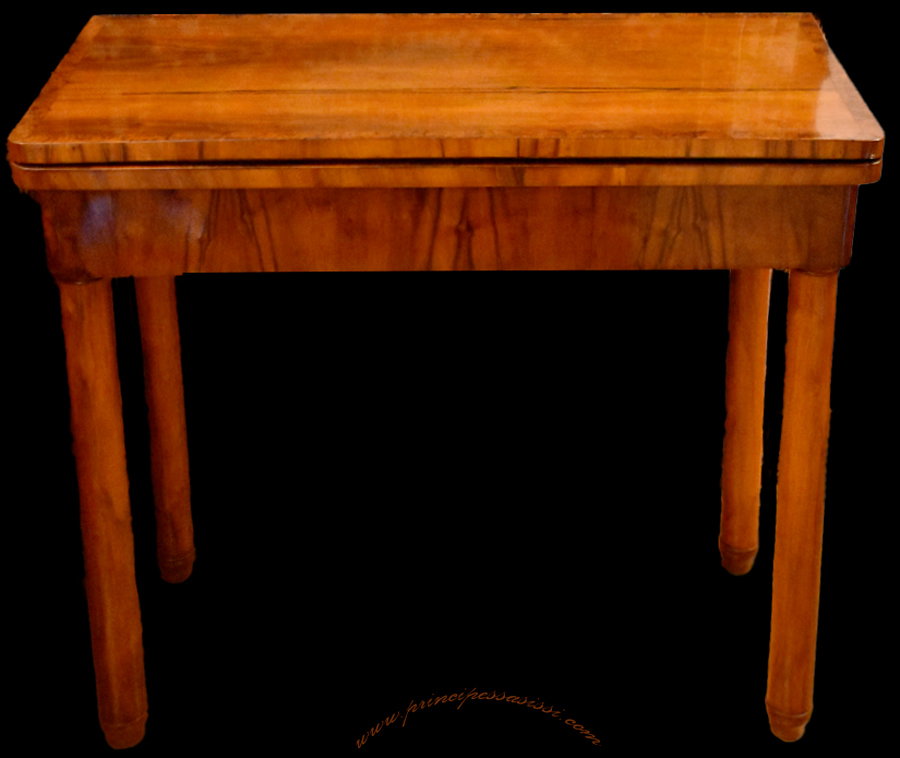
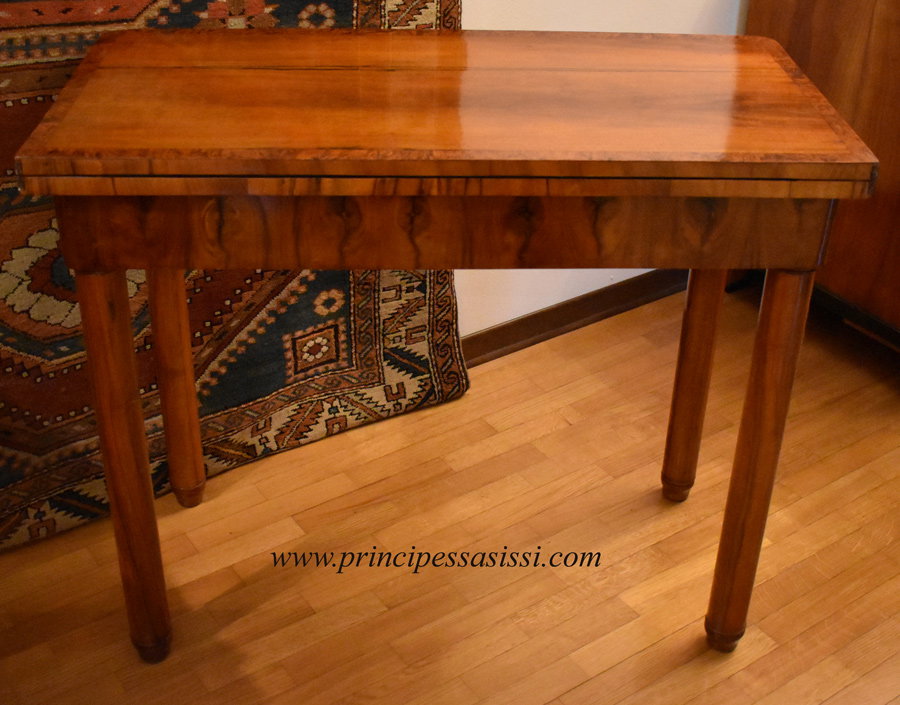
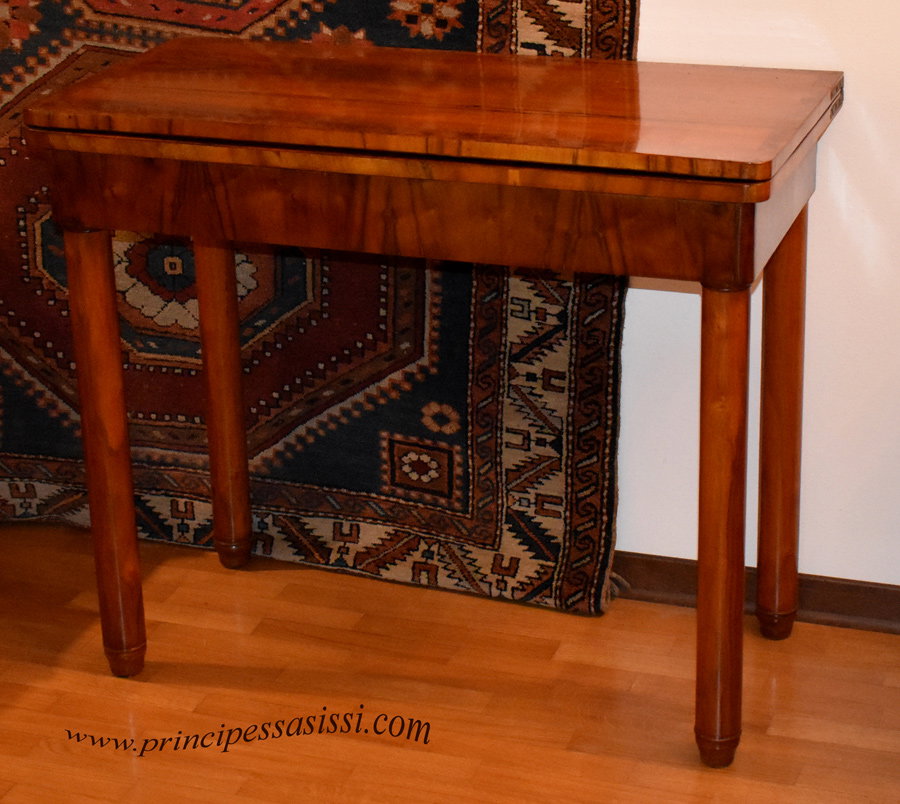
Vienna, 1820-30. Rare and interesting game/console table from the early Viennese Biedermeier period, possibly by Joseph Danhauser or his immediate circle.
Description:
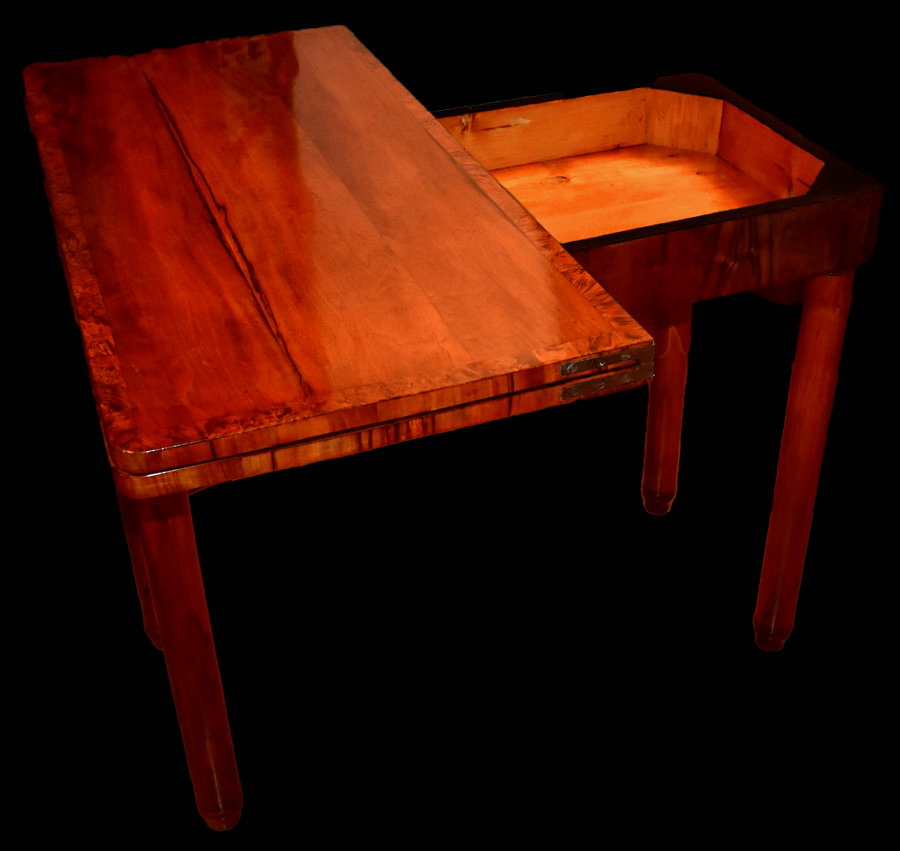
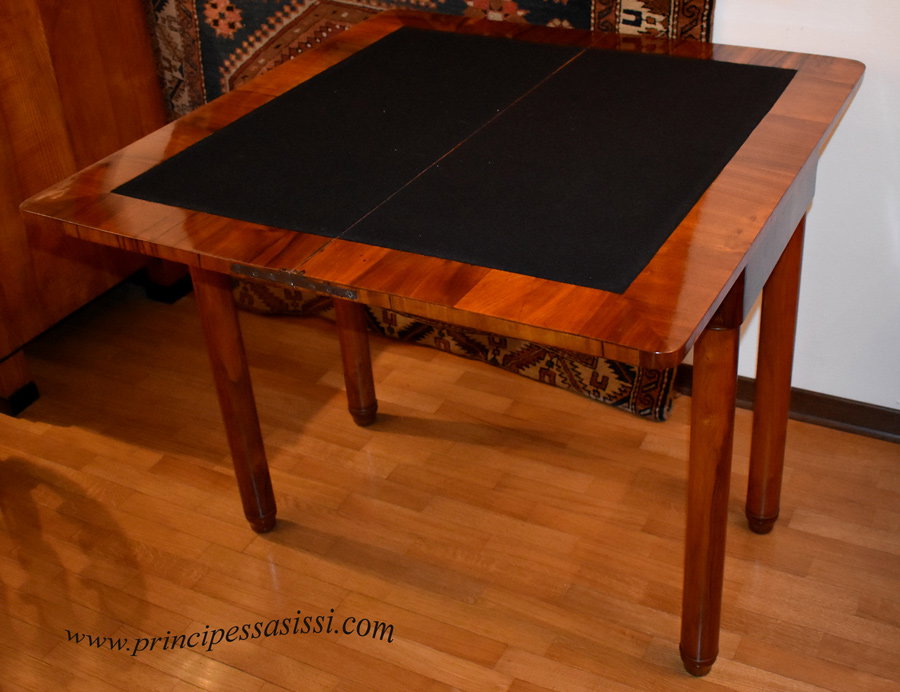
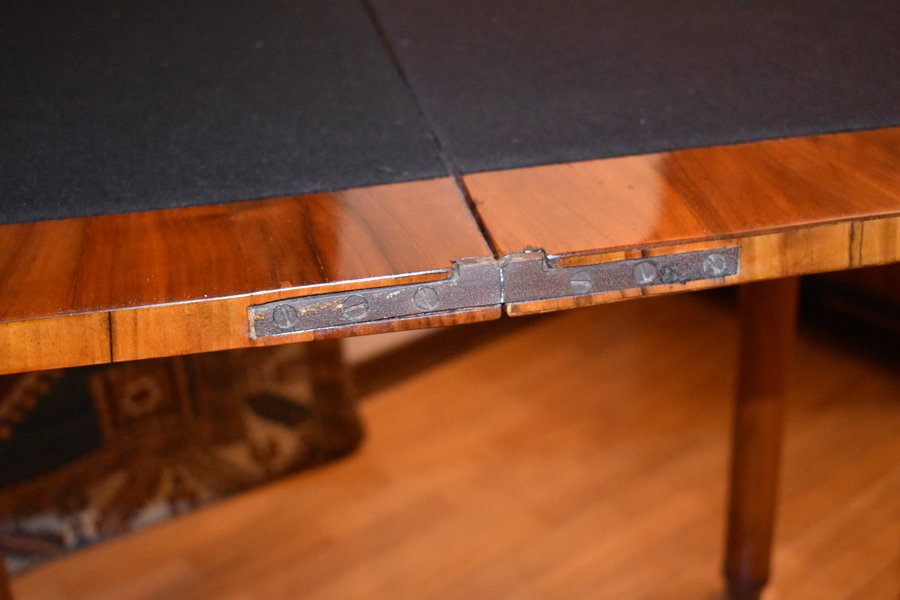
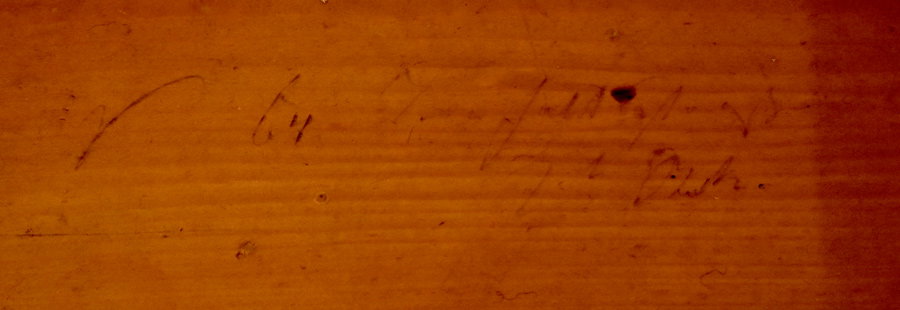
Vienna, 1820-30. Rare and interesting game table from the early Viennese Biedermeier period, possibly by Joseph Danhauser or his immediate circle. The work is in excellent condition and is finely veneered in blonde walnut feather with poplar burl details on the edges of the top. The top rotates, opening a practical compartment that was once used to hold cards and chips. In the right position, it opens like a book, revealing the game top covered in anthracite black felt. In the inner part there is, partly legible, the original numbering of the model and signature of the cabinetmaker which can also be read with the initials J and D as for Joseph Danhauser. However, it should be noted that model no. 64 by Joseph Danhauser, as per the archives of the Museum of Applied Arts in Vienna, does not correspond to ours. It is also worth remembering that, in any case, not all of Danhauser's creations are documented and only part of the original drawings have reached us, therefore the mere absence of the original drawing does not exclude that it may still be one of his works. The inscription reads "N.64 fecit .... 6 August, year not legible and then the partially legible signature with initials probably J. and D. and surname consistent with inscription possibly abbreviated Dahnauser, but it is not possible, as specified above, to be certain of this. The drawing of this table is not present in the collection of original drawings by Joseph Danhauser at the Museum of Applied Arts in Vienna. Not all of his original drawings, however, have reached us. Some of it has unfortunately been lost. In conditions of integrity, in first patina, consolidated and polished with shellac using museum standard technique. Can also be used as a practical console. Measurements cm. 96 wide, 80 high, 46 - 92 deep.
Joseph Ulrich Danhauser, a great Viennese cabinetmaker and designer, documented his product range in a vast drawn catalog, parts of which (approx. 2,500) have survived the times and are now kept in the MAK (Austrian Museum of Applied Arts in Vienna) . This catalog includes, among others, 153 models of chairs, 56 sofas, 179 types of chandeliers and 124 curtains. All these models were numbered consecutively. He boasted a clientele of rank from all over the Austrian monarchy and Germany. The most prestigious job entrusted to Danhauser was the renovation of the Palace of Archduke Charles (now Albertina, home to an important Viennese museum) around 1822. Danhauser's furniture factory holds a prominent position in the history of Viennese furniture making and interior decoration. Danhauser's drawings allow us to follow the development of the style of Viennese furniture, which was initially based on French models, such as those created by Percier and Fontaine, but soon gained its own precise and refined autonomy. Danhauser's exceptional quality and uniqueness as a furniture maker lies in the harmonious combination of concreteness and abstraction, functionality and emotion. Thus he assumed the role of mediator between individuality and anonymity and became one of the most important inspirations for the modern avant-garde movement. The Danhauser manufactory was founded in 1814 by the sculptor and cabinetmaker Joseph Ulrich Danhauser (1780-1829), the father of the painter son Joseph Danhauser. It was one of the first companies in Vienna operating in the field of interior decoration. Having been granted a special production license, it was possible for Danhauser to integrate with the relevant specializations all the trades relating to interior decoration and therefore carry out the necessary work under one roof. These included primarily the production of furniture and upholstery, the production of lighting fixtures, metalworking and the creation of elaborate draperies. It is a point of reference in the history of design and furniture. His very rare original creations that have survived the times are kept in a few museums, castles, large antique shops or prestigious private collections, mostly noble ones.
In accordance with the provisions of the New Code of Cultural Heritage, the selling company provides, at the time of sale, a detailed written photographic guarantee of the authenticity and origin of the works sold. The data with which the works are described and then contained in the written guarantees are expressed determinations, the result of accurate, in-depth and documented technical/historical/artistic investigations.