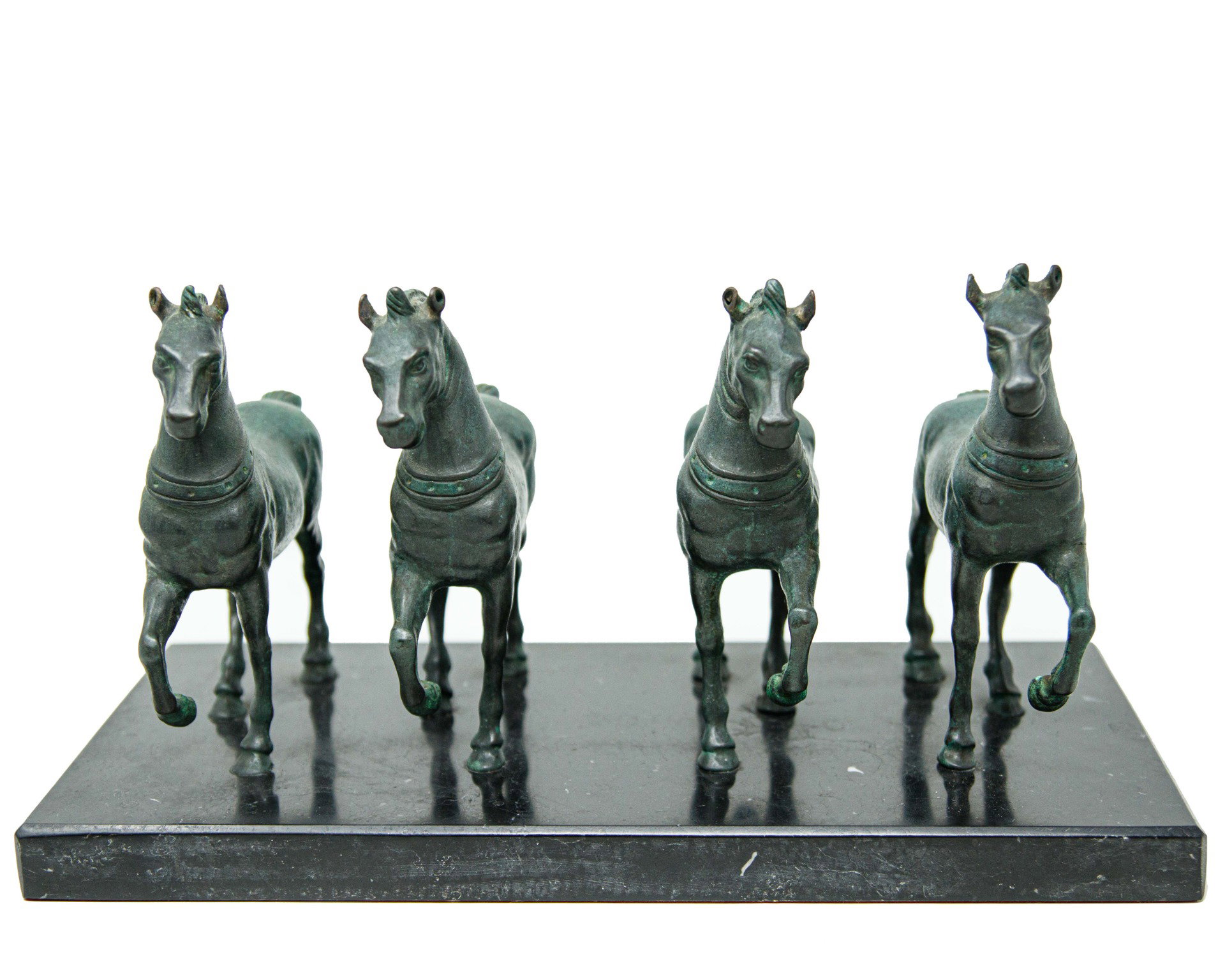
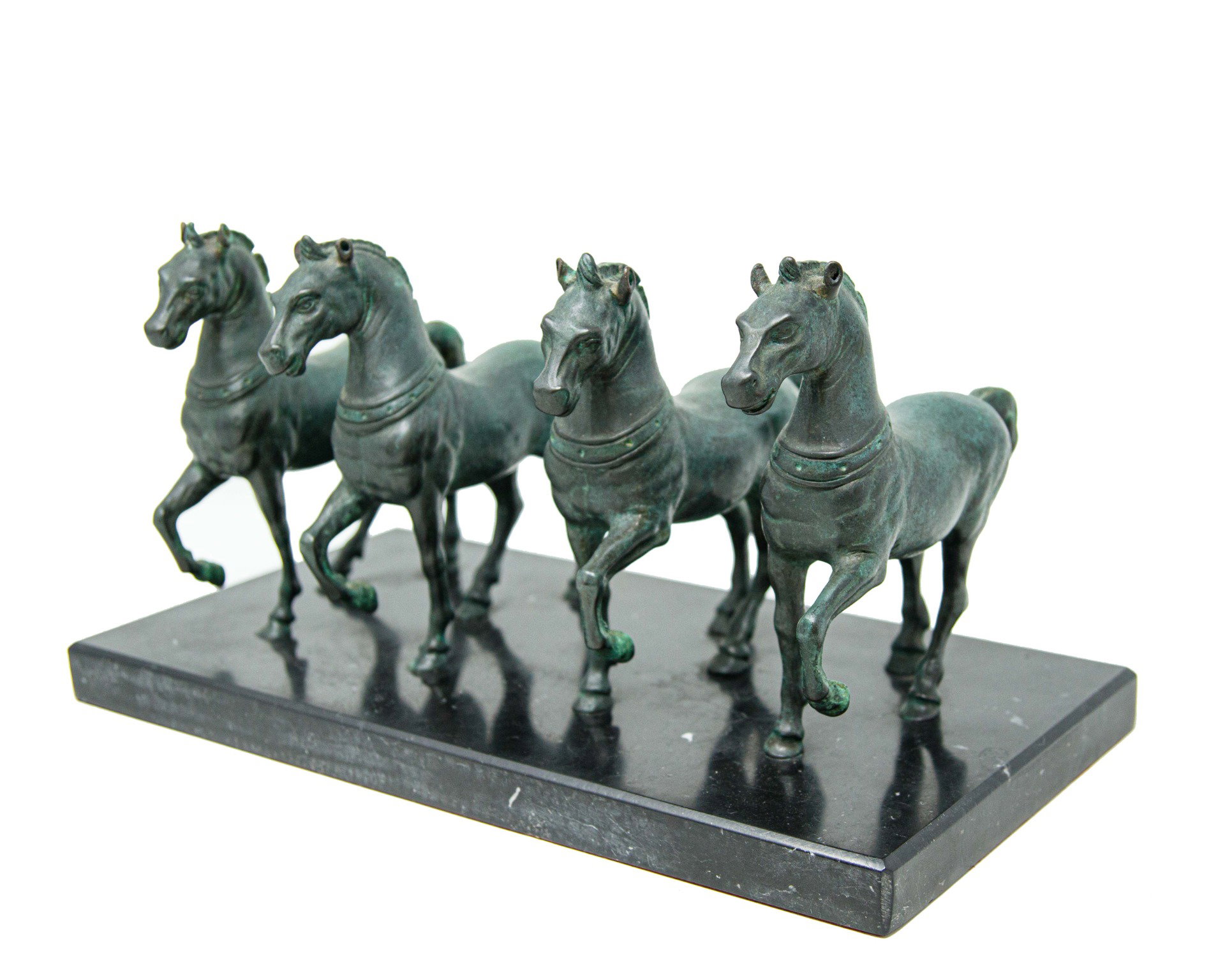
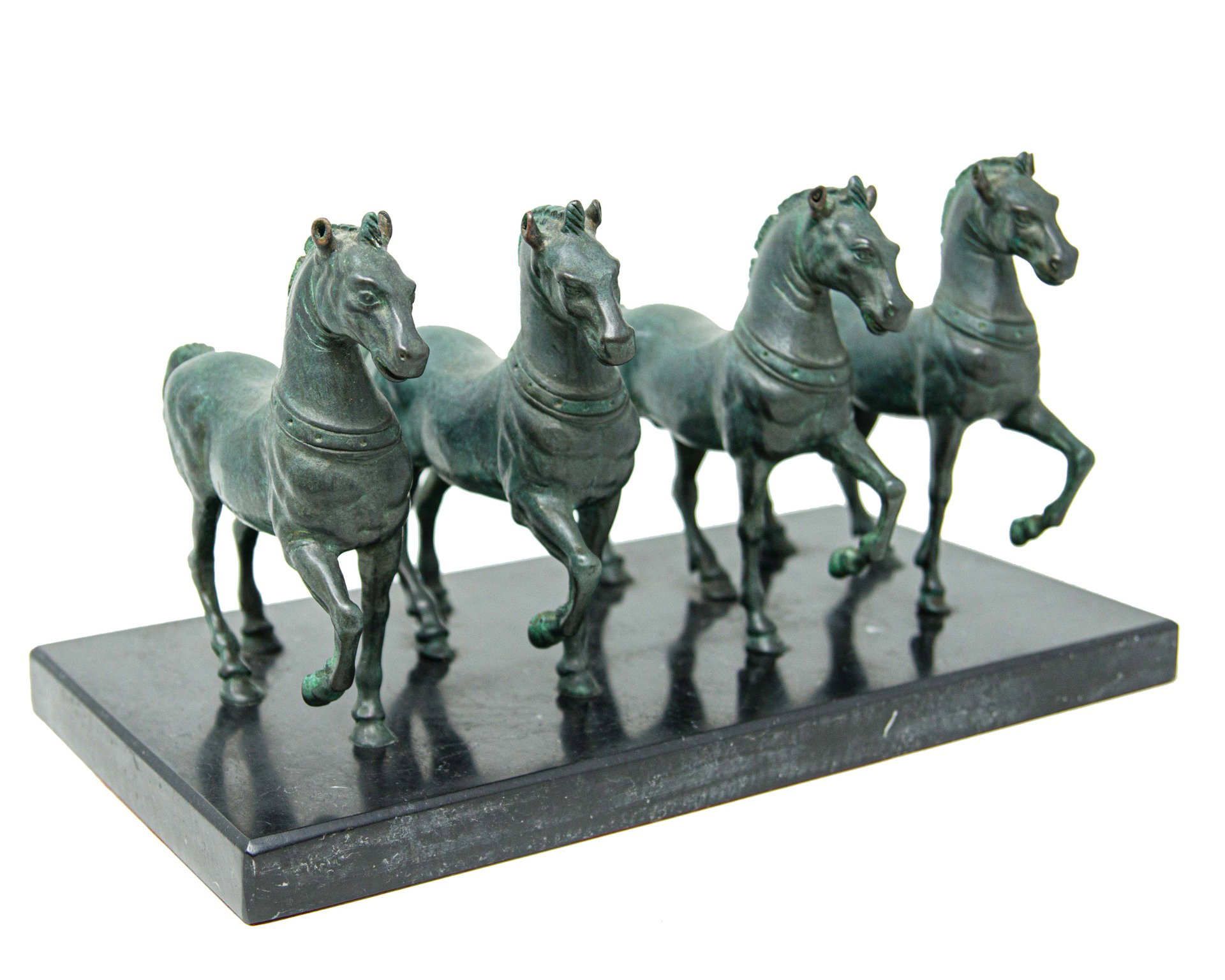
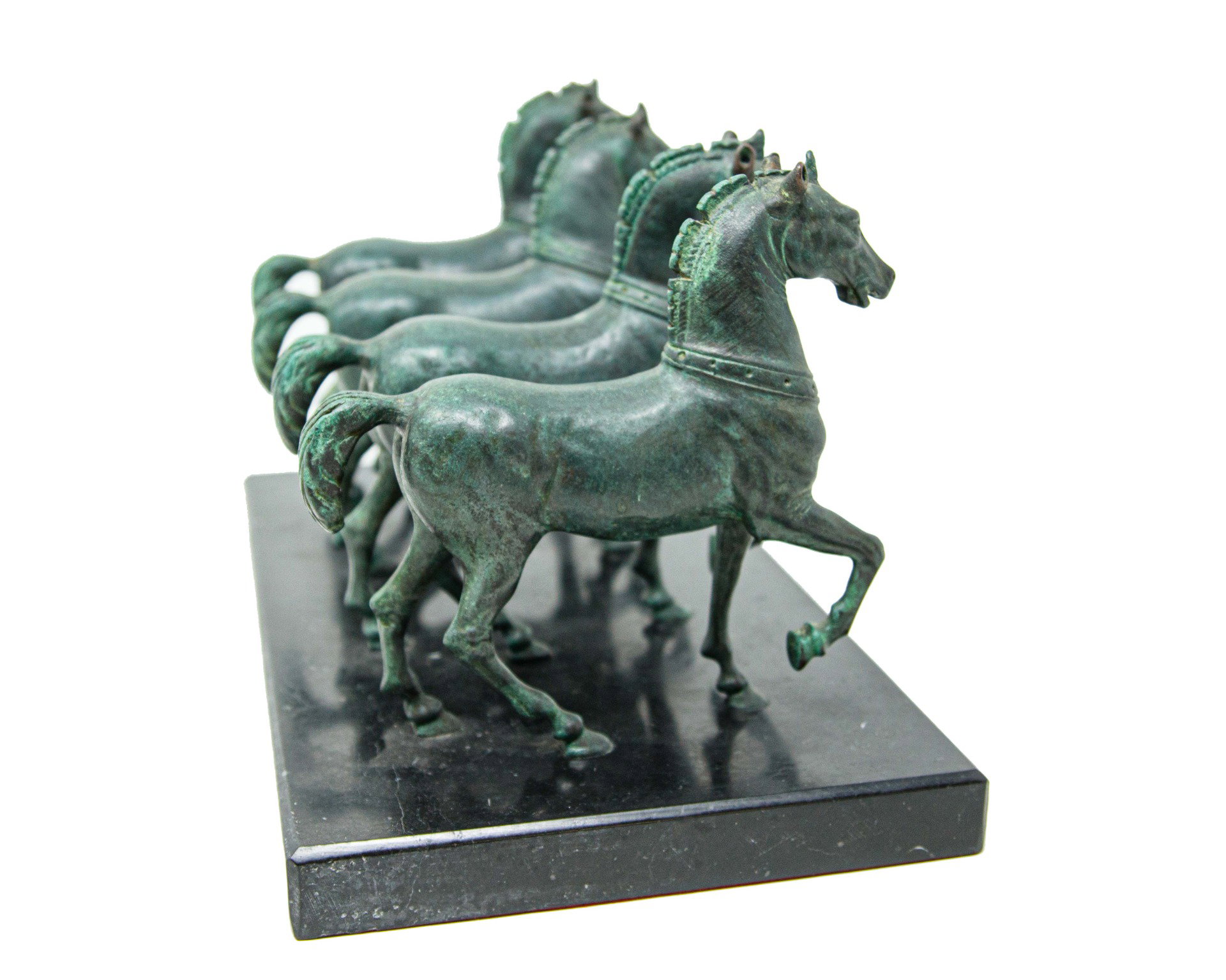
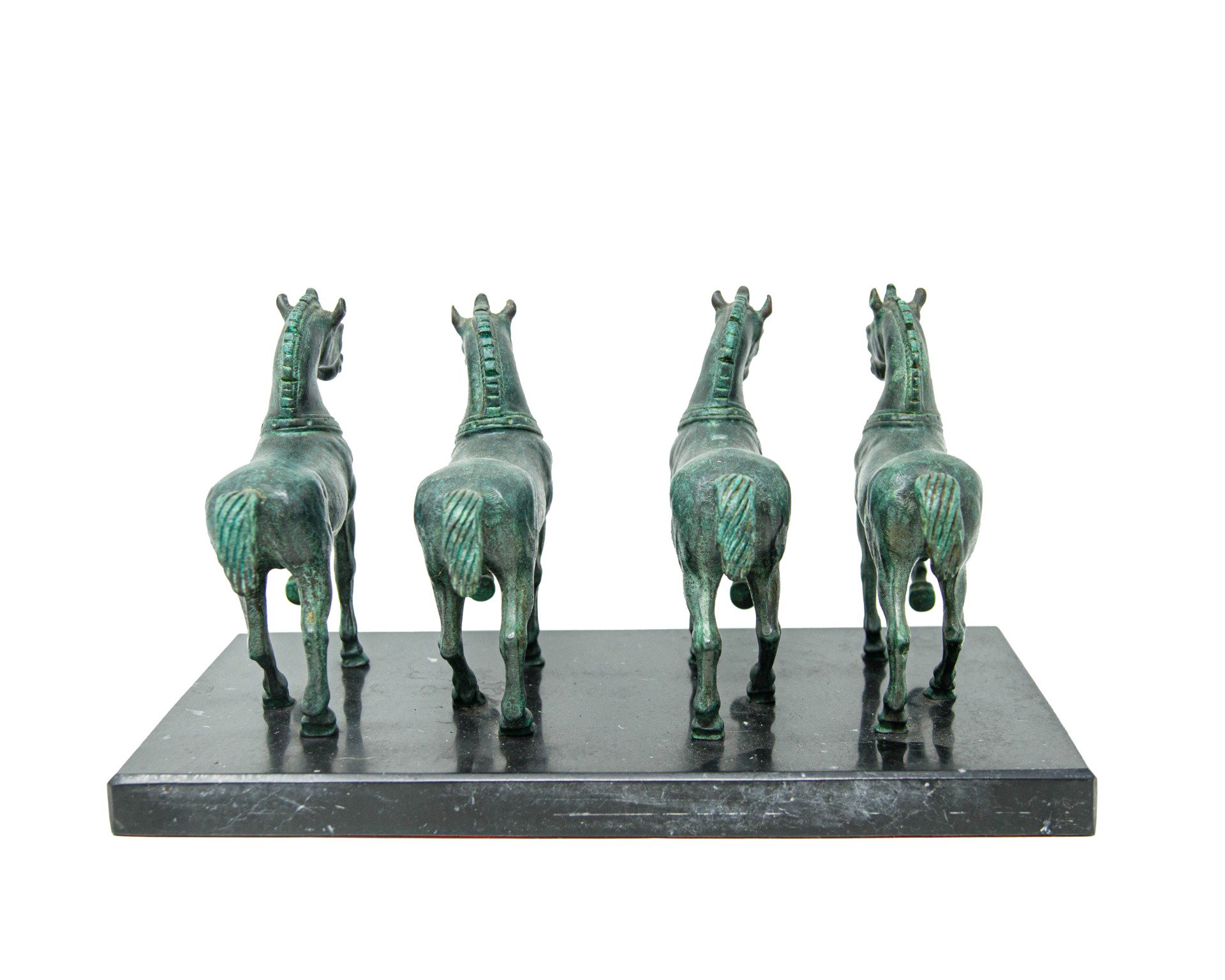
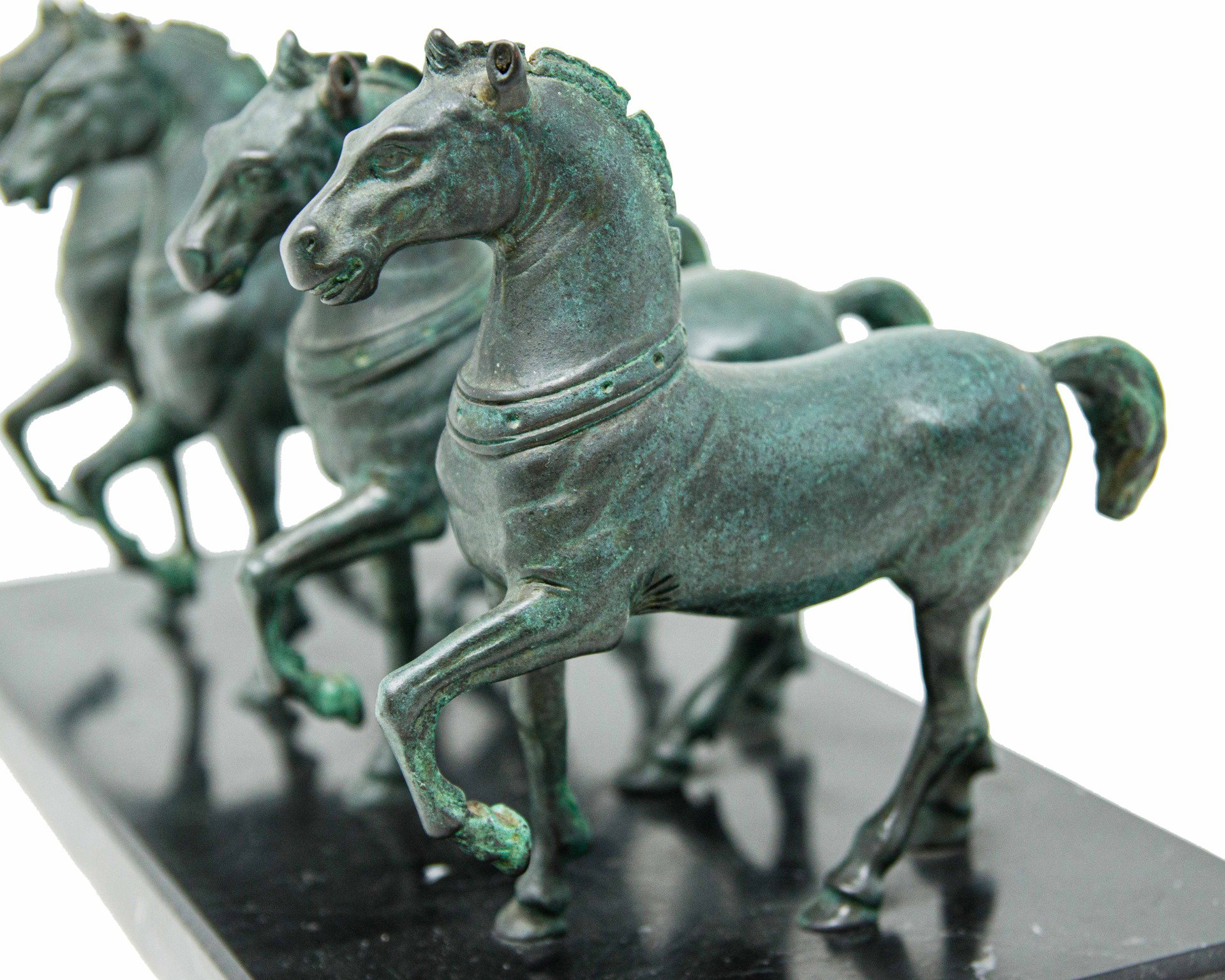
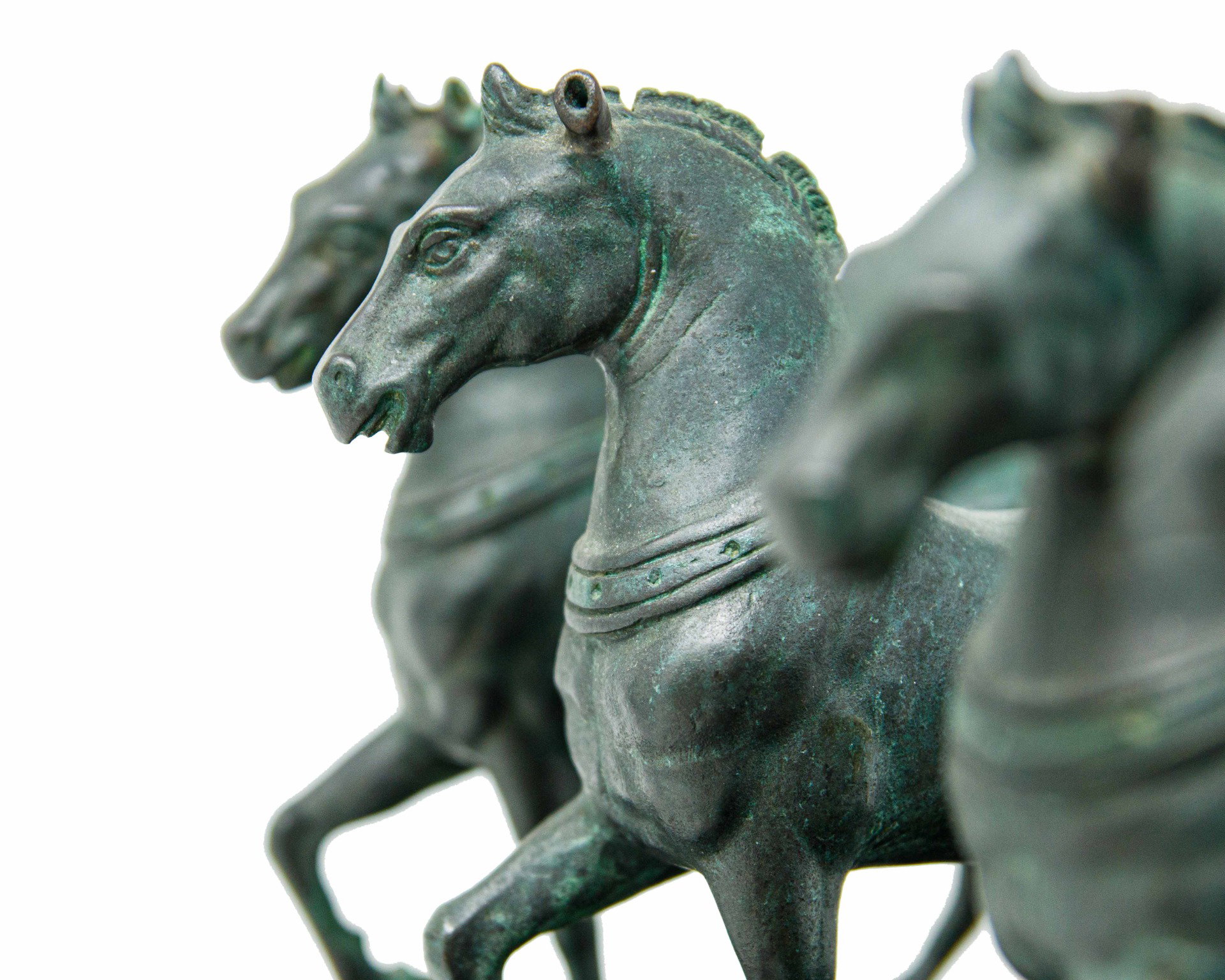
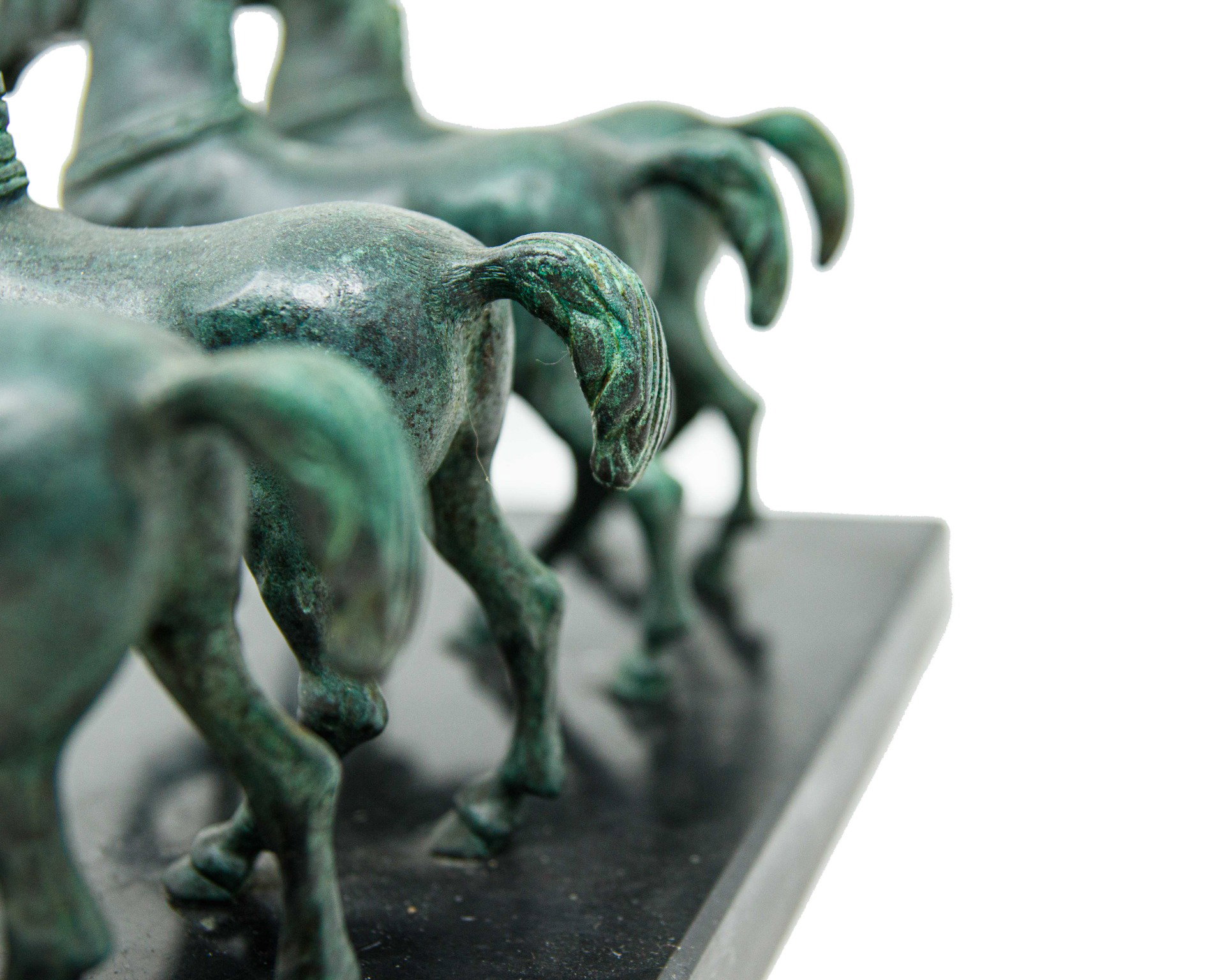
Bronze, 19th century, Quadriga with the Horses of Saint Mark
Description:
Bronze, 19th century
Quadriga with the Horses of Saint Mark
Bronze, cm 31 x 16 x 17 (height)
The sculptural group of the four horses of Saint Mark, in gilded bronze alloy, is now kept at the Museum of the Basilica of the same name in Venice and represented, ideally, by a copy on the loggia of the facade.
Hypothesized as a Roman copy of an original Greek work, the group is mentioned by most Byzantine sources. Nicetas Choniates, in his Historia, recalls an episode indirectly fundamental for the correct location of the group. During the festivities ordered by Emperor Manuel I Komnenos for the visit of the Sultan of Iconium to the capital in 1158, a juggler threw himself from near the horses, identifying himself as a new Icarus. "Four bronze horses are well fixed (...) smeared with gold, with their necks slightly curved, looking at each other in the face and showing themselves puffing in the race towards the goal", just above the carceres, the gates of the Hippodrome where the racehorses awaited the starting signal. With the sack of Constantinople perpetrated by the crusaders in 1204, the horses, already spotted by Enrico Dandolo, also reached the territory of the Serenissima. Described by Andrea Morosini in 1627, the horses abandoned the terrace of the basilica's facade for the first time with the fall of the Republic of Venice in 1797: the quadriga was lowered from the loggia on December 13 and the following year it was transferred to Paris, to the symbolic monument of the new constituted power, the arc de triomphe du Carrousel between the Tuileries gardens and the Louvre palace. With the defeat of Napoleon, the four horses finally returned to Venice thanks to the mediation of Antonio Canova, papal envoy.
With the looming monster of war, the quadriga had to face a new transfer. "War was declared on the evening of May 23, 1915. On the morning of the 24th at five o'clock, two enemy hydroplanes appeared over the city, which was completely rosy and had just freed itself from the blue veils of the night: and they dropped four bombs on it. And one fell a hundred meters from the Doge's Palace": thus Ugo Ojetti in his booklet Il martirio dei monumenti.
On May 27, 1915, with the help of the army, each horse was lowered and housed inside the Doge's Palace, placed between the Porta della Carta and the Scala dei Giganti and covered with sacks, until November 1917. With the defeat of Caporetto, it was decided to preemptively transfer a good part of the artistic heritage to Rome, with the will to save it from the war. The quadriga entered the internal courtyard of Palazzo Venezia, where it remained until the end of the war. Returned to Venice, following a restoration in 1982 it was decided to permanently store the group in the Museum of the Basilica.
The object is in good condition
With Ars Antiqua it is possible to defer all amounts up to a maximum of € 7,500 at ZERO RATE, for a total of 15 INSTALLMENTS.
Ex. Tot. € 4,500 = Monthly installment € 300 for 15 months.
Ex. Tot. € 3,600 = Monthly installment € 720 for 5 months.
For amounts exceeding € 7,500 or for a longer delay in time (over 15 installments), we can provide a personalized payment.
Contact us directly to get the best quote.
LIVE TV
– SUNDAY 7.00 PM – 11.00 PM Dig.terr. 126 + 809 SKY
- THURSDAY 9.00 PM - 12.00 AM Dig.terr. 134 + 809 SKY
– Streaming on our website www.arsantiquasrl.com and on our social networks Facebook and Youtube
All the works proposed by Ars Antiqua are sold accompanied by a certificate of authenticity in accordance with the law and an accurate in-depth sheet.
It is possible to see the works directly at the gallery showroom in Milan, in via Pisacane 55 and 57.
We personally organize transport and delivery of the works, both for Italy and abroad.