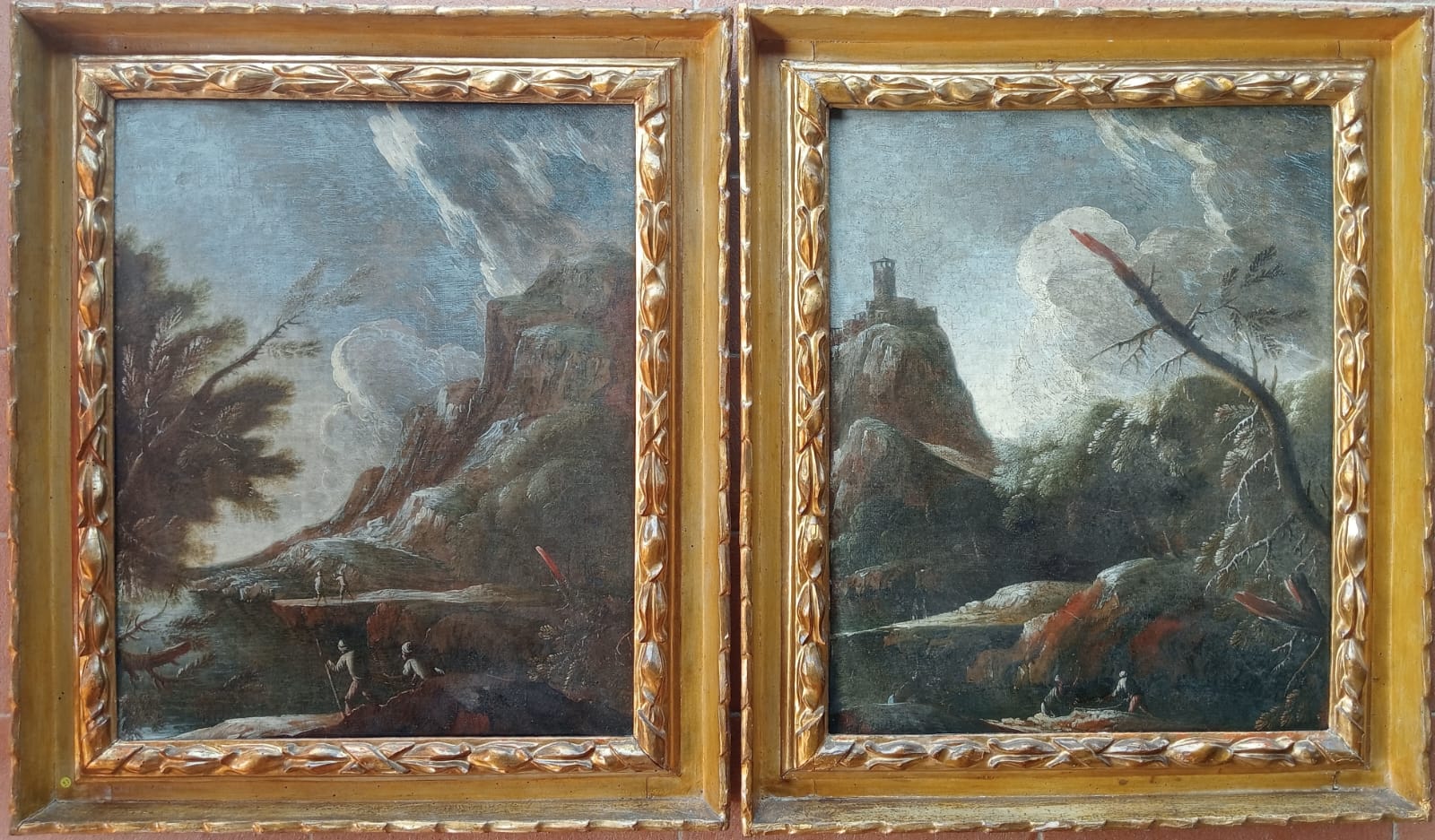
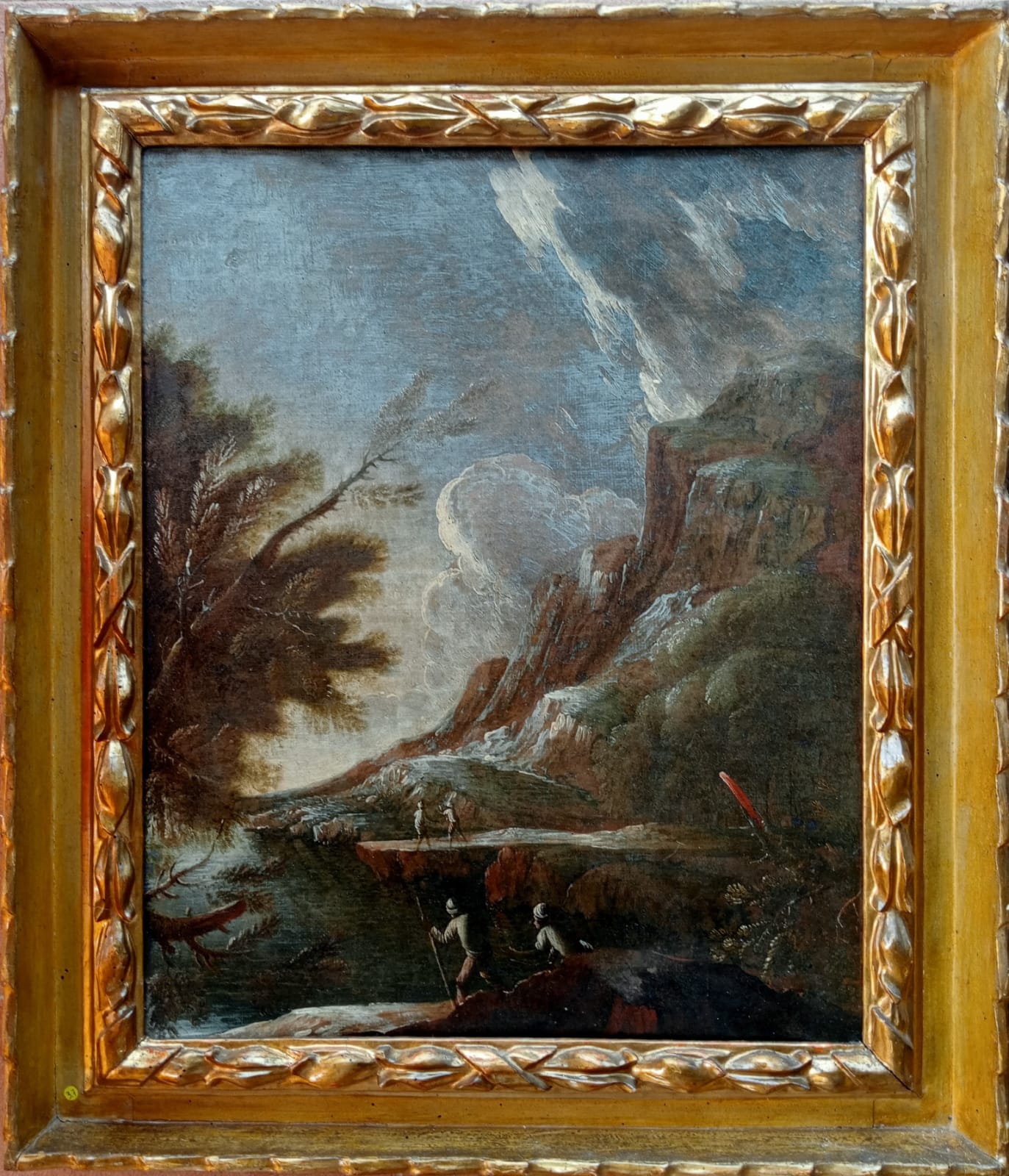
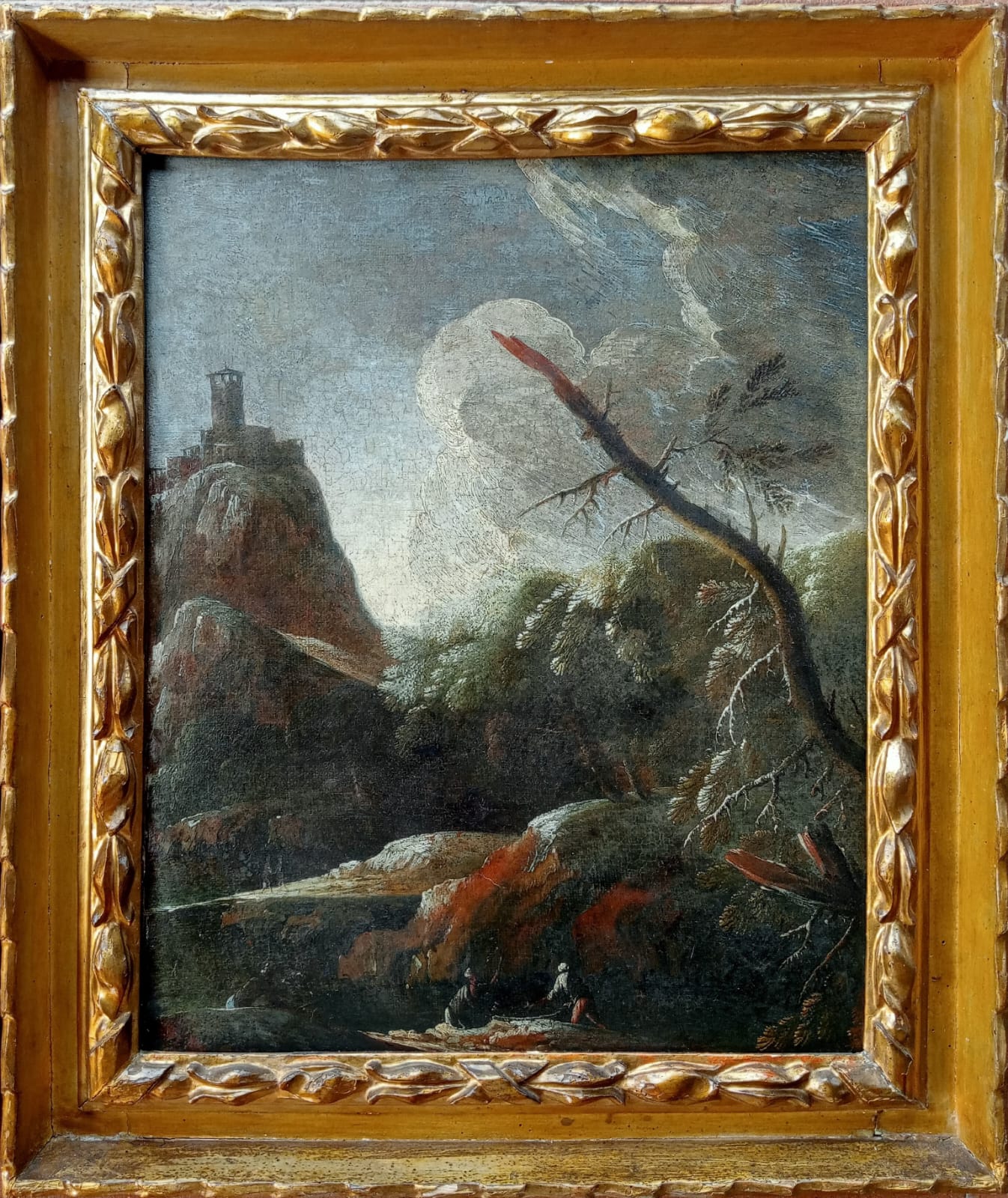
Pair of landscapes by Giulio Bucci, a painter from Faenza of the 18th century, with authentic polychrome and gilded frames from Faenza.
Giulio Bucci was born in Faenza in 1711 to Captain Domenico and Orsola Giordani. He learned the first rudiments from the Greek painter Nicola Valletta (who lived in Faenza in the second quarter of the 18th century) and, upon the death of his father, the Company of S. Gregorio, also known as the "shameful poor", granted him a subsidy to study in Bologna with a talented artist. From anonymous 18th-century handwritten papers, it appears that the young man from Faenza, after attending the school of Ercole Lelli, on his own initiative wanted to study with G. M. Crespi, known as lo Spagnolo. After finishing seven years of apprenticeship in Bologna, B. returned to Faenza around 1738, where he remained working, except for a few quick trips to Bologna, until February 7, 1750, when he returned to Bologna to marry Lucia Gloria. He remained there for six or seven years; he had five children: three boys and two girls. After a serious illness, around 1761, he went to Faenza and was induced by relatives and friends to stay in his hometown for many years, loaded with numerous commissions. In the autumn of 1768, he was again in Bologna (in March of the previous year he had been awarded the Clementine academic patent) to deliver three large canvases of "landscapes" that had been commissioned by agents of the Russian imperial court (the Strocchi papers say: court of Spain) and which had cost him more than a year of work; but they were refused. The disappointment reduced him to desperate physical and financial conditions: he was saved by his friend and patron Ignazio Benedetti, who induced him to move to Faenza as a guest in his home. There, having recovered slowly, B. went back to work executing paintings considered among his best; but the joy of being back home with his family lasted only a short time; in fact, he died on May 25, 1776. He was buried in the church, then called del Suffragio (now the parish of S. Stefano), in an earthen tomb offered by his protector, who had the tombstone engraved, which is no longer traceable.
Dimensions: 80 x 66 cm, depth 6 cm
Price: 5700 euros