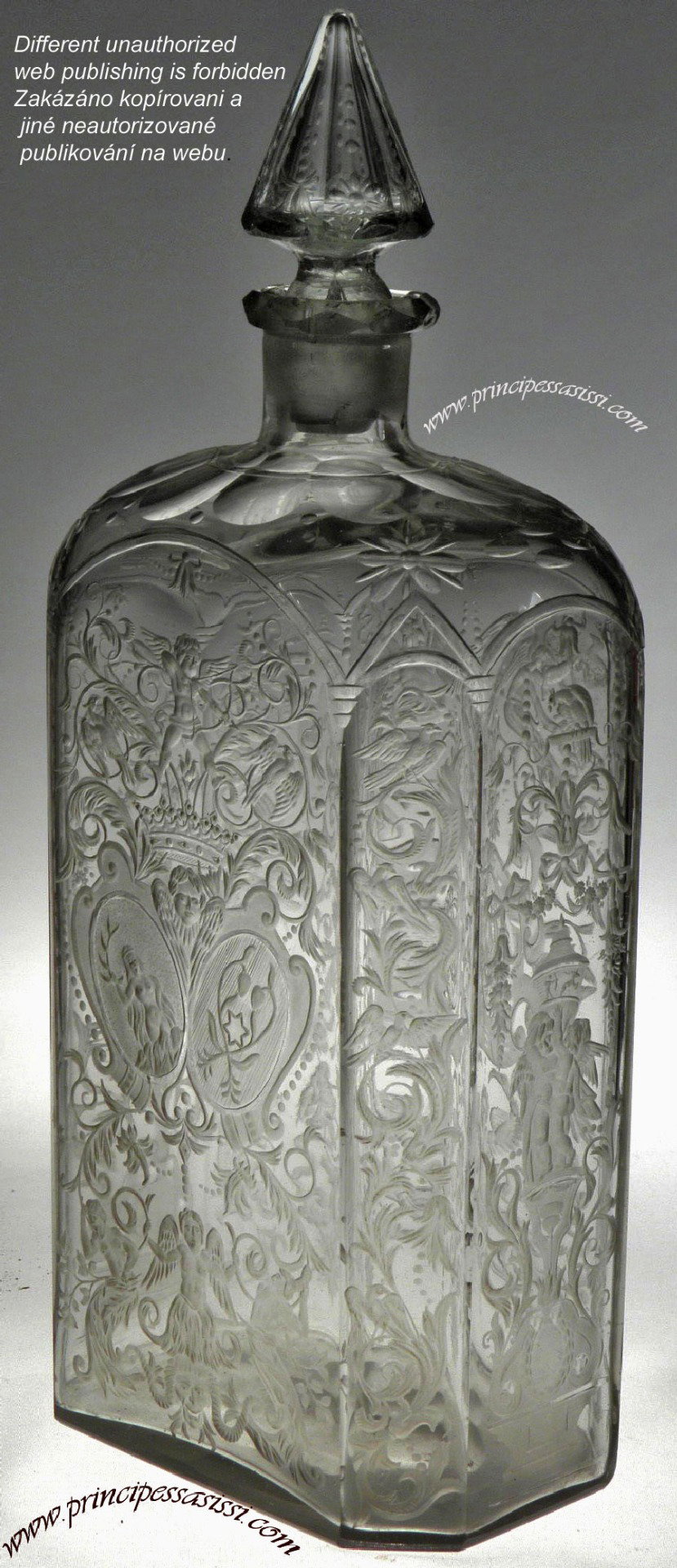
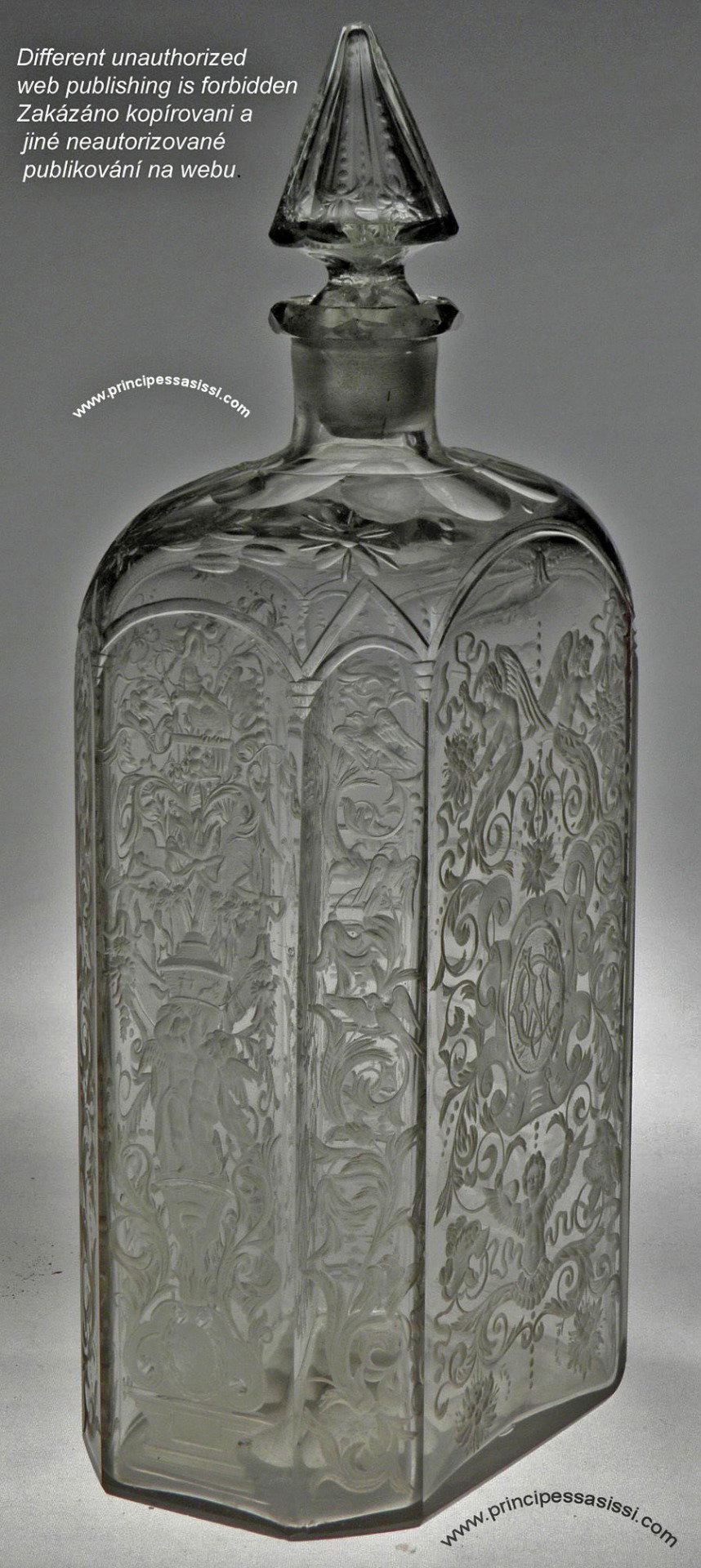
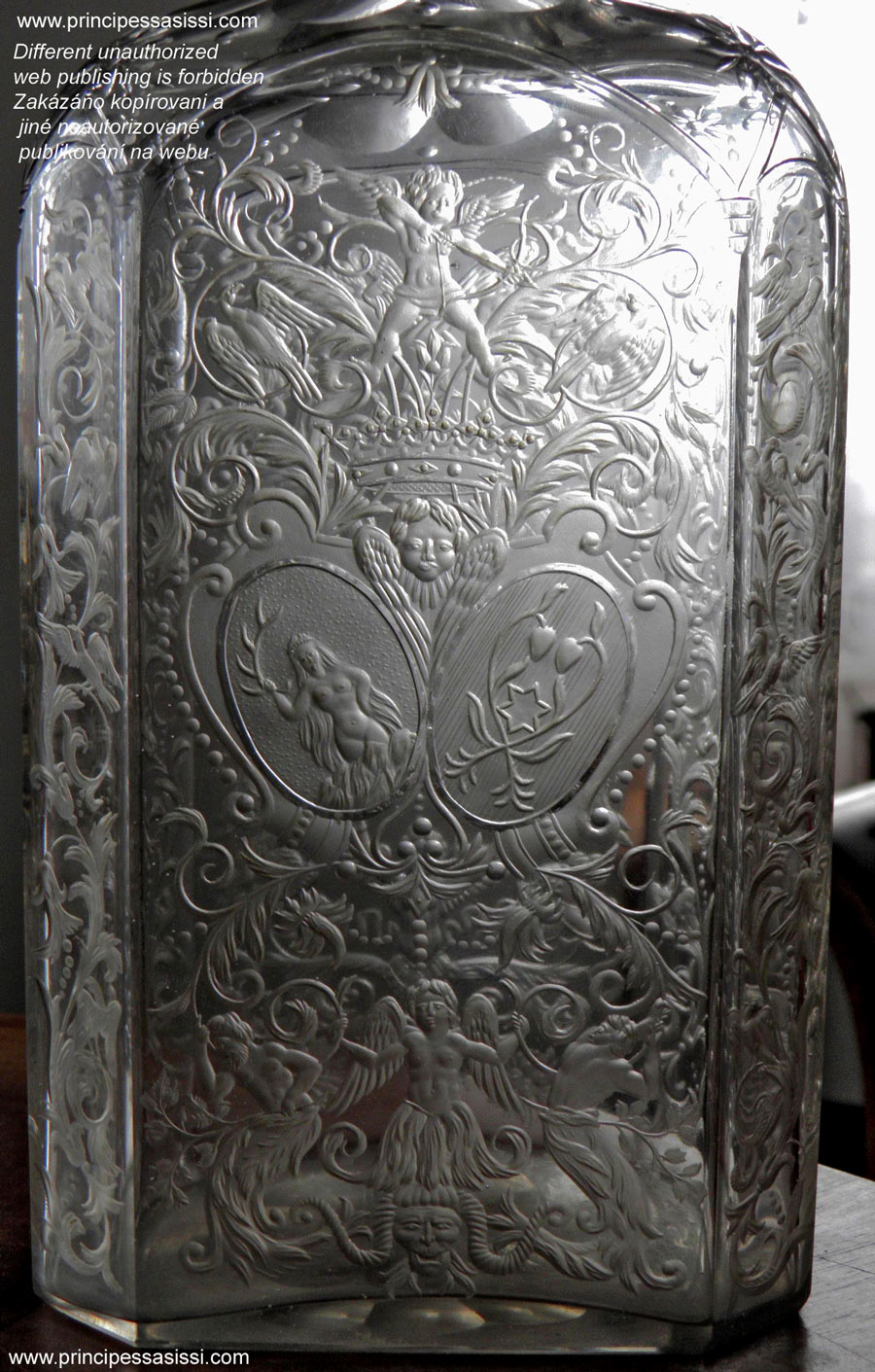
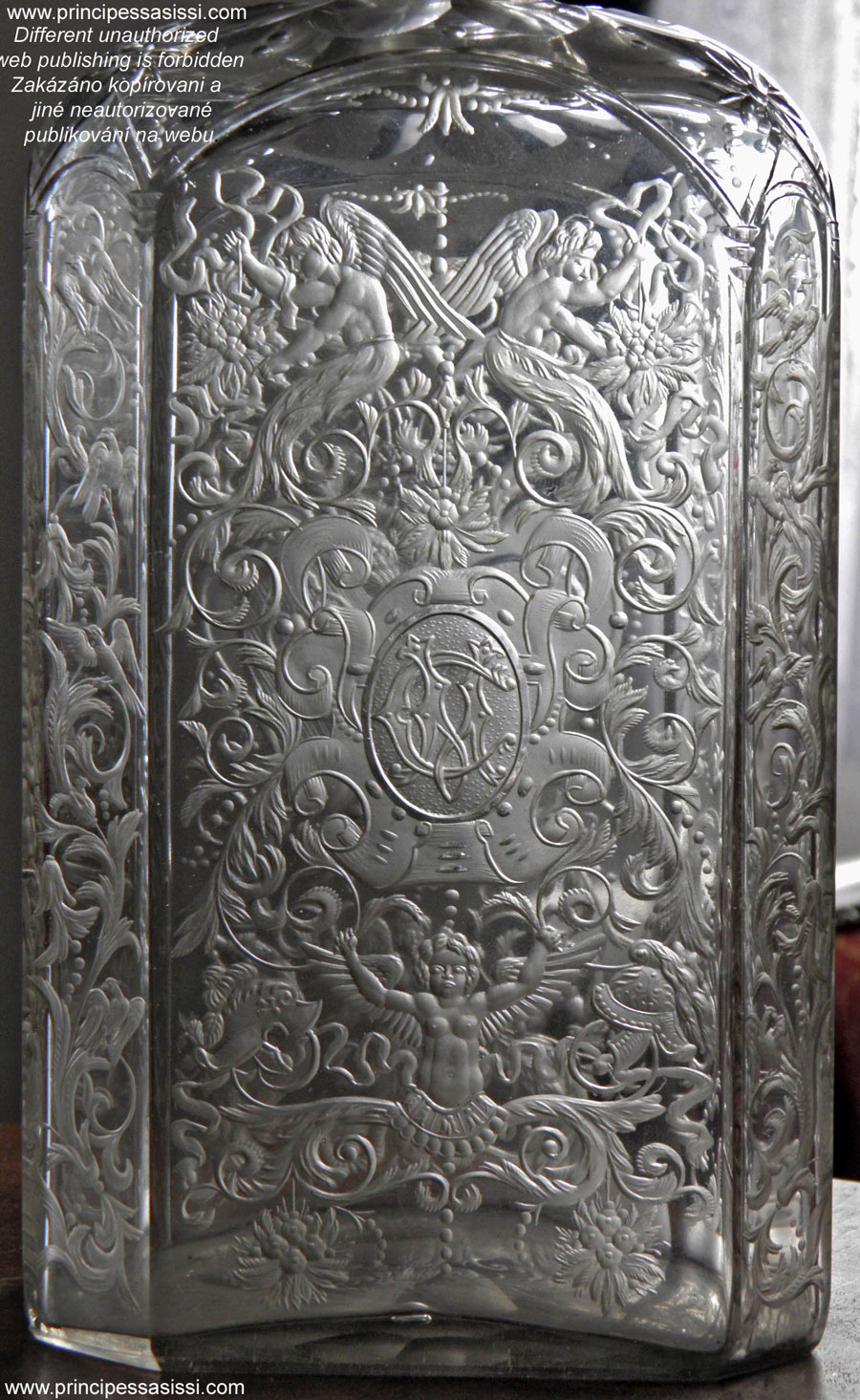
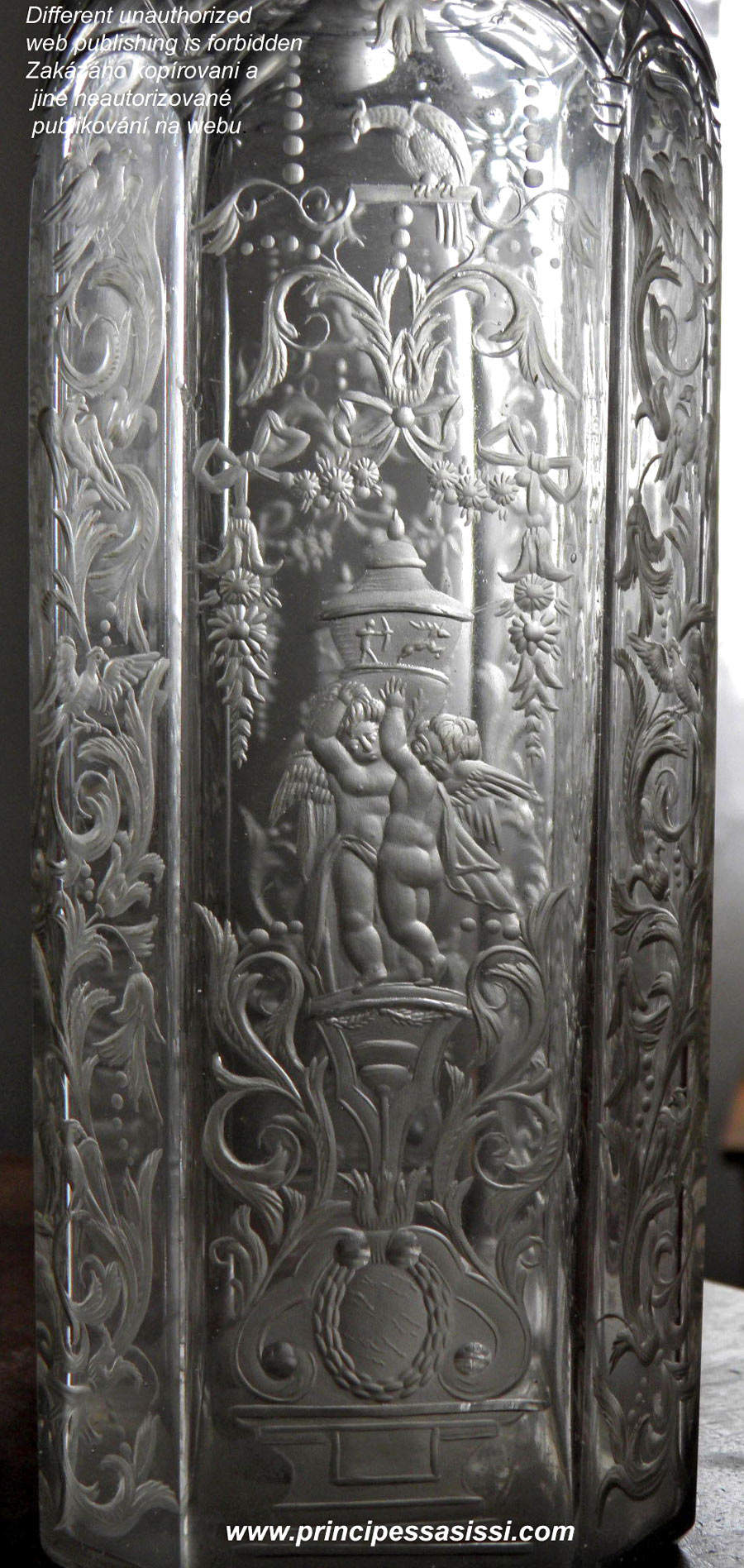
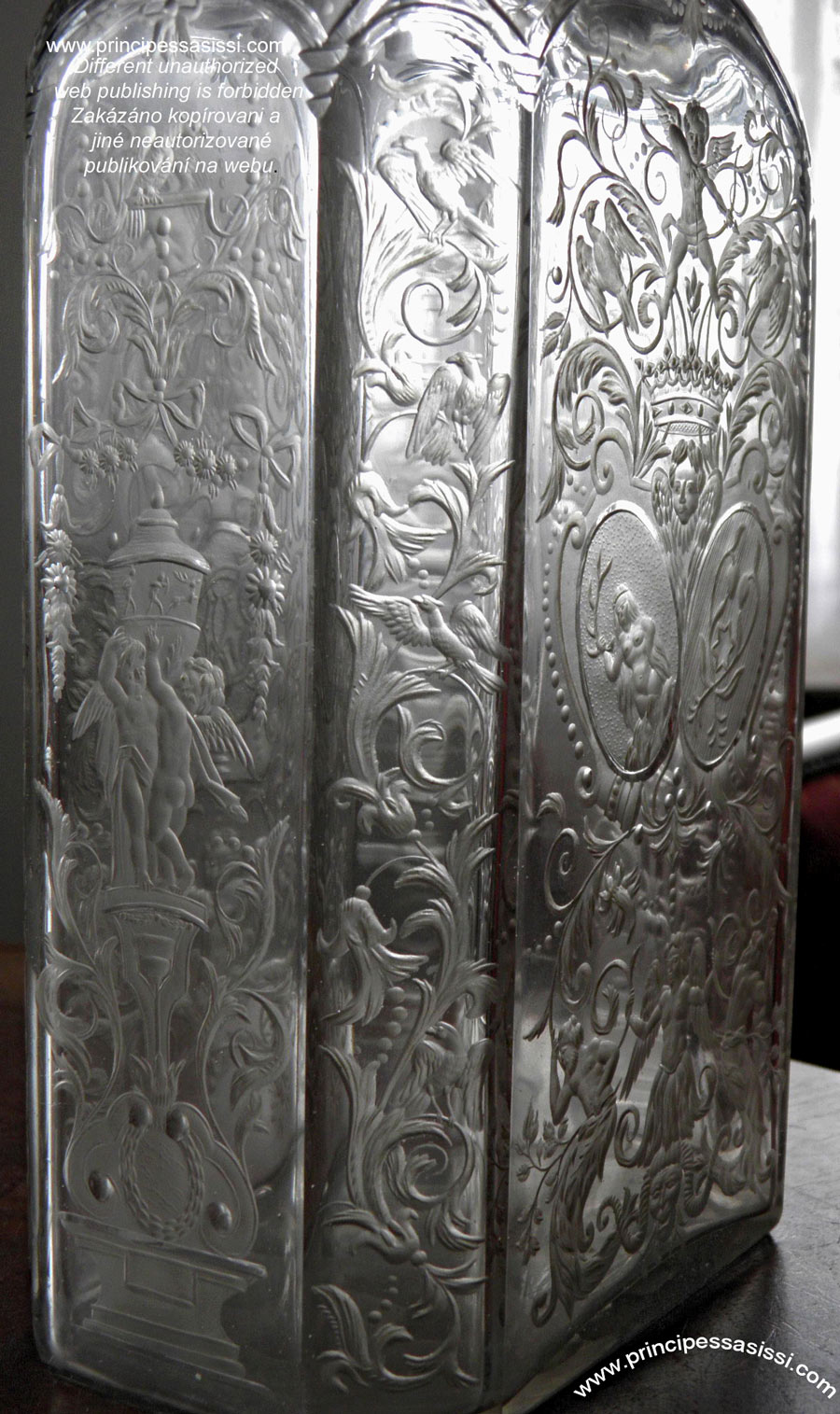
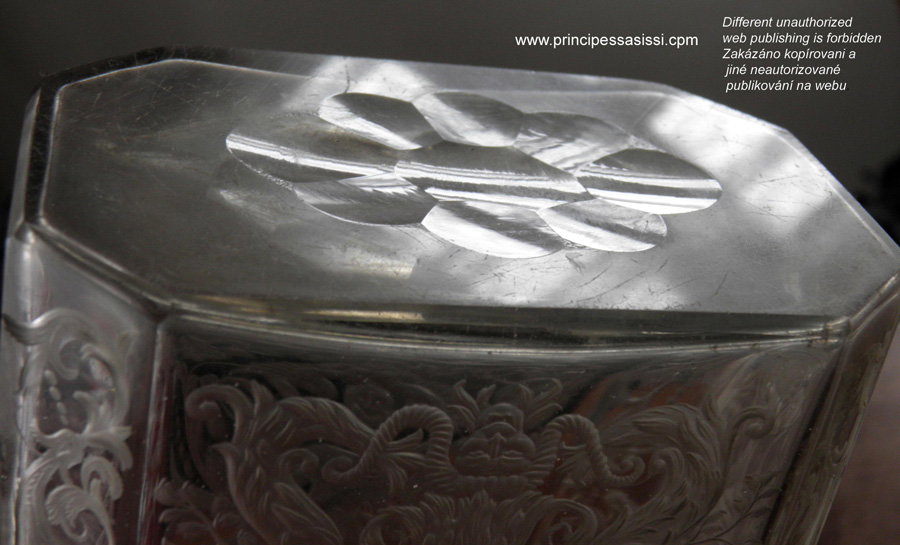
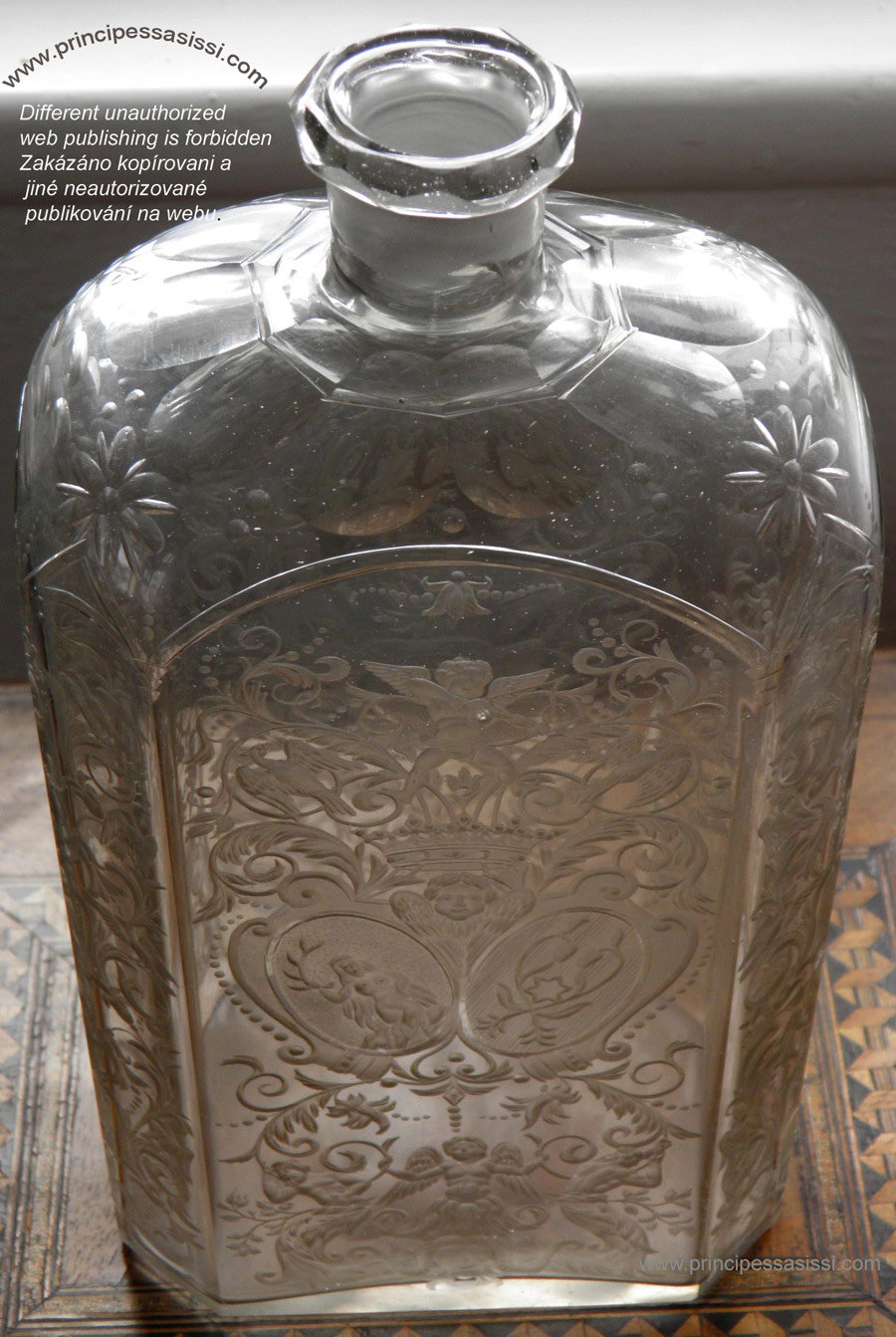
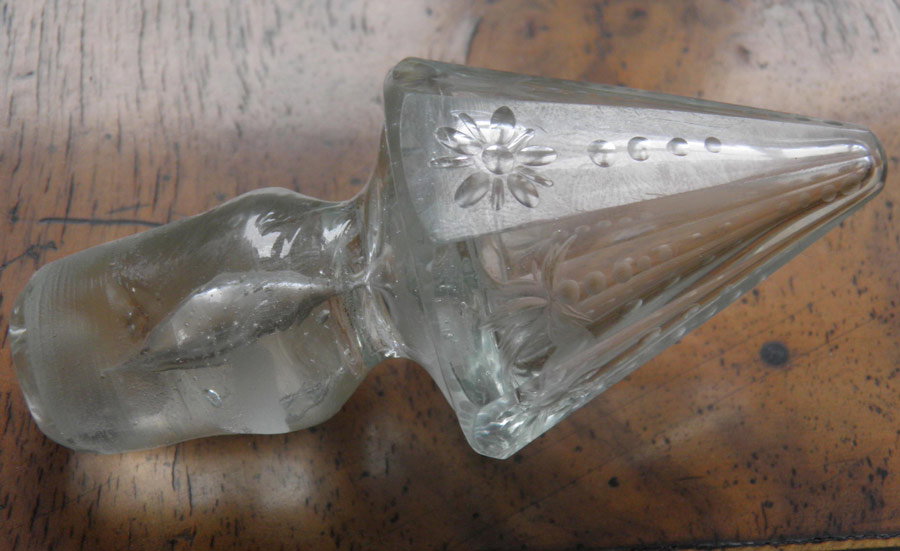
North Bohemia, Giant Mountains, third quarter of the 18th century. An important bottle, masterfully wheel-ground as a celebration of the alliance between two important families of Bohemian and Austrian nobility. Wheel-ground using the Tiefschnitt technique, i.e., carving described as deep or in bas-relief. Given the subject matter and quality of the grinding, this work is probably attributable to the workshop or circle of the Winter family, in Petersdorf, in Silesia, now the Polish side of the Giant Mountains. The mythological and zoomorphic motifs, acanthus leaves, rococo curls with hints of eighteenth-century classicism, suggest a dating to the full 1700s. The known history of these two important families of Bohemian and Austrian nobility, however, may shift the dating of the work to the third quarter of the eighteenth century. The iconography is magnificently rich. On one side, in a swirl of floral motifs and curls, a mask, two telamons support the heraldic coats of arms of the two families united by friendship. Above them, Eros, god of love and friendship, depicted with a bow and arrow to represent the protection of friendship and alliance. On the opposite side of the work, the monogram CM. Measurements: maximum height 29 cm, without stopper 23.5, wide 12 cm and deep 8. In excellent condition. Patina consistent with the period. Literature Rudolf von Strasser, Sabine Baumgaertner, Licht und Farbe, The collection of the Museum of Art History in Vienna, on page 284 we read: "The Putti of the chalice in the collection of Rudolf von Strasser attributed to Friedrich Winter boast a loving execution. The hair in locks and harmonious bodies. The putti are a symbol of the carvers of the Giant Mountains. Not only Friedrich Winter, but also his brother Martin, shone for the realization of putti carved in bas-relief". The Winter family held an honored position as a family of glass sculptors in the Court of Count Christof Leopold Schaffgotsch, in rich Silesia, straddling the border between Bohemia and modern Poland. In 1688 the Count favored the creation of a workshop with tools for engraving glass using hydraulic power; Friedrich Winter directed and assisted ten to twelve engravers, who continued the work even after his death. The great capacity of these artists was a source of pride for Count Schaffgotsch, who protected their work with a special decree. In accordance with the provisions of the New Code of Cultural Heritage, the selling company provides a detailed written photographic guarantee of the originality and provenance of the works sold at the same time as the sale. The data with which the works are described and then contained in the written guarantees are expressed determinations resulting from accurate, in-depth and documented technical/historical/artistic investigations.