Description:
Francesco Liani (Borgo San Donnino 1712 – Naples after 1783)
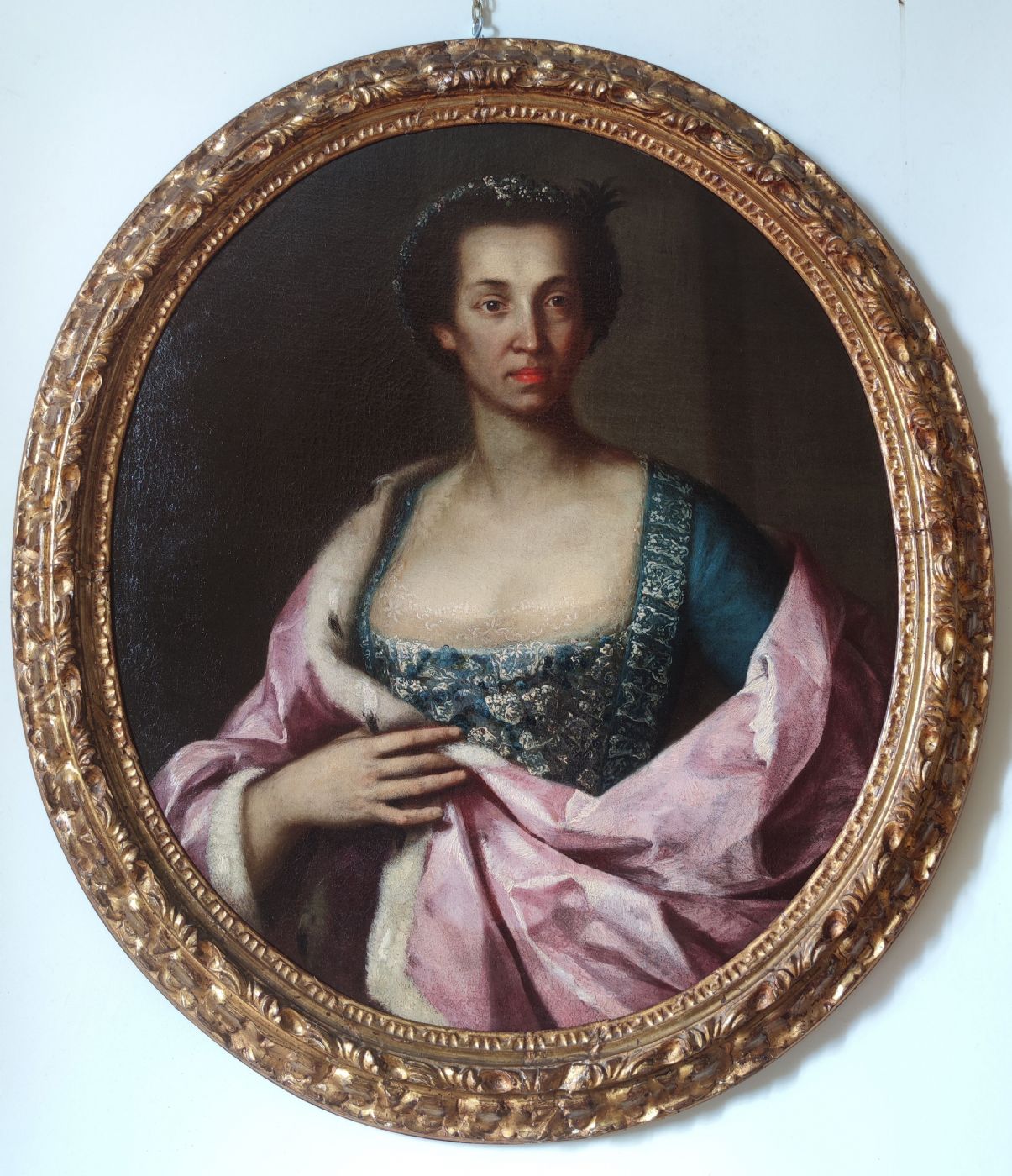
Female Portrait
Oil on canvas
cm. 81 x 69.5
Circa 1745
Private collection
State of conservation: excellent
Unpublished bibliography
A Bourbon pinnacle of Francesco Liani
Anyone familiar with the civilization of the 18th century in Naples knows well that the thread of portraits is the most promising and exhilarating aspect of painting and sculpture of the Bourbon era. But it is also one of the most difficult: not only in terms of recognition, which is always risky and slippery, of the portrayed, but evidently, for the attributions. If it is true that, even in light of the latest studies on the greatest painter of the century, Francesco Solimena (1657-1747), his skill in this sector is to be rethought and relaunched; it is necessary to better detail, immediately after, the catalogs of masters of the first and second rank orbiting in Solimena's workshop: from De Mura himself to Giuseppe Bonito, to Gaspare Traversi, up to Francesco Liani with whom we directly enter the game. This only to limit ourselves to painting.
Now, having been the object of very careful cleaning which has restored it to characteristics of exemplary vividness, this portrait, towards the mid-18th century, is an exemplary distillate, a sample, of the talent of a master like Liani: born in 1712, from Emilia by birth, precisely from Fidenza but of southern adoption and wide success. To the point that the Bourbon iconography, in its official channel as well as in the derivations of a more cordial and intimate nature, substantially precipitates into Liani's corpus, from Emilia by birth and southern by adoption.
To be placed, if the analysis of the forms does not lie, right halfway between the European-wide tradition of Solimena and the expressive increases of the Stabian painter Giuseppe Bonito (1707-1789), the painting draws attention while, in the era of social media, the thread of the portrait, notoriously among the most difficult, knows a new, unexpected revival. That the work belongs to the mature Solimena appears nonetheless to be excluded: not so much for reasons of quality as, properly, for idiom. Not to mention driving supporting actors like Carlo Amalfi (1707-1787), to whom also belongs the portrait of the Prince of San Severo in the Sansevero Chapel in Naples.
On closer inspection, here we find ourselves in front of a more dried and composed Solimena; regimented but not at all extinguished or tamed within the attention to the drawing of one who, although having taken off on the Neapolitan scene, still preserved an irrevocable Emilian matrix. We could say that the author of our painting declines a more composed and late version of Solimena. As of a Solimena (or even better a Bonito) with a clean shirt. We are, in short, rather on the side of a court portraitist like the German Anton Raphael Mengs, who disappears, after a long stay between Rome and Naples, in 1779 and of whom Liani knew well the works. Look at the Morellian detail of the hand, which would not be found similar in any of the Neapolitans, while it is even superimposable to that of Lani's portrait of Maria Amalia of Saxony (1724 - 1760), who married Charles III and queen of Naples and Sicily from 1738 to '59.
The name of Liani, in our case, is confirmed by the comparisons with the very famous portraits of Charles of Bourbon and of the consort kept in the Capodimonte art gallery in Naples; as well as, to raise our gaze beyond the Neapolitan sites, recalls the naturalistic rendering of the woman's face the pungent series of the Bourbon infants: one of the treasures of the collections of the Campano Museum of Capua, among the most important and unrecognized of southern Italy.
But the stroke of genius of the painting lies in its apparent dichotomy: if, on the one hand, the splendor of the clothes and the care with which they are painted, allude to the lineage of the portrayed; on the other hand, the whole setting of the portrait is in favor of a disarming naturalness.
Grappling with the rhetorical figure of the oxymoron Liani resolves the portrait between the incredible accuracy with which the royal garments are rendered and the sincerity of the pose. As to say: the maximum of naturalness obtained despite the maximum of artifice. A lesson that, incidentally, would not be bad to pass into the daily conventions of the forced selfie. We do not know the identity of the woman who offers herself with informal elegance; and it's a shame. Immediately the gaze encounters, on the fore of the canvas, the pink cloak trimmed with fur, which refracts to the right like a wave and is rendered with considerable virtuosity. Under the effect of the luminous gush that falls from the left, the hand, carefully drawn, directs attention to the embroidery work of the blue dress.
The comforting décolleté that unfolds in the upper part composes a tone-on-tone exercise: from the white of the powder on the flesh to the embroidery of the shirt (which conceal the breast without hiding it). Finally here is the three-quarter face: that caught almost by surprise by the photographer's lens, snaps towards a point of view that excludes but solicits our gaze. We could continue in a more sedulous analysis of the portrayed, from the bright red lips that light up, in the top page, like a sustained note. But from now on it is allowed to assert that, as in the '600 some of the major experimentations in the field of naturalistic and baroque painting, occur in still life; so, equally, in the century of Enlightenment, it must be recognized that the major formal devices occur, not only in the compartments of sacred and history painting as in that of the court portraiture and worldly tone that are, especially today, more familiar to us.
In short: the painting is not only a heavy addition to Liani's genuine catalog. But it is also a proof, if proof were needed, of how that of the portrait is an open field of experimentation. Brought back by a recent cleaning to the best degree of legibility as can be seen from the photos shown at the bottom, the work deserves to reopen, at the highest level, the dossier of Bourbon portraiture. Difficult to venture a precise chronology; but everything suggests that we are towards the mid-century as confirmed by the comparison with Solimena's supreme portrait of the Baroness of Lusciano, which now belongs to the 40s and which shares the great idea of the cloak that whirls sideways.
Attested in Naples certainly in 1755 and perhaps descended following the Parmesan Clementa Ruta, practically nothing is known of Liani's Padanian beginnings. Modernly his fortune is all to be measured in the arch of years that leads to the exhibition "Civilization of the '700 in Naples", the most important exhibition held in Italy at the end of the last century, curated by Raffaello Causa in the halls of Capodimonte in 1979; and it is a fortune this of Liani - let's not forget it - matured in the ranks of the workshop of an art historian and writer like Roberto Longhi (1890 - 1970). It is in the pages of the magazine "Paragone", the great door of the studies of art history of formalistic setting in Italy, that the consecration of the painter occurs with a monographic article by the young Nicola Spinosa.
At least a dozen autographs of the painter then appeared. In the recent rearrangement of the Pinacoteca of Capodimonte (2022), also curated by the writer, the equestrian portraits of Liani Carlo di Borbone and Maria Amalia of Saxony reaffirm themselves, not only among the masterpieces of court portraiture, but among the still living signs of the eighteenth-century palace inside which, in 1957, the maximum Neapolitan art gallery will be located.