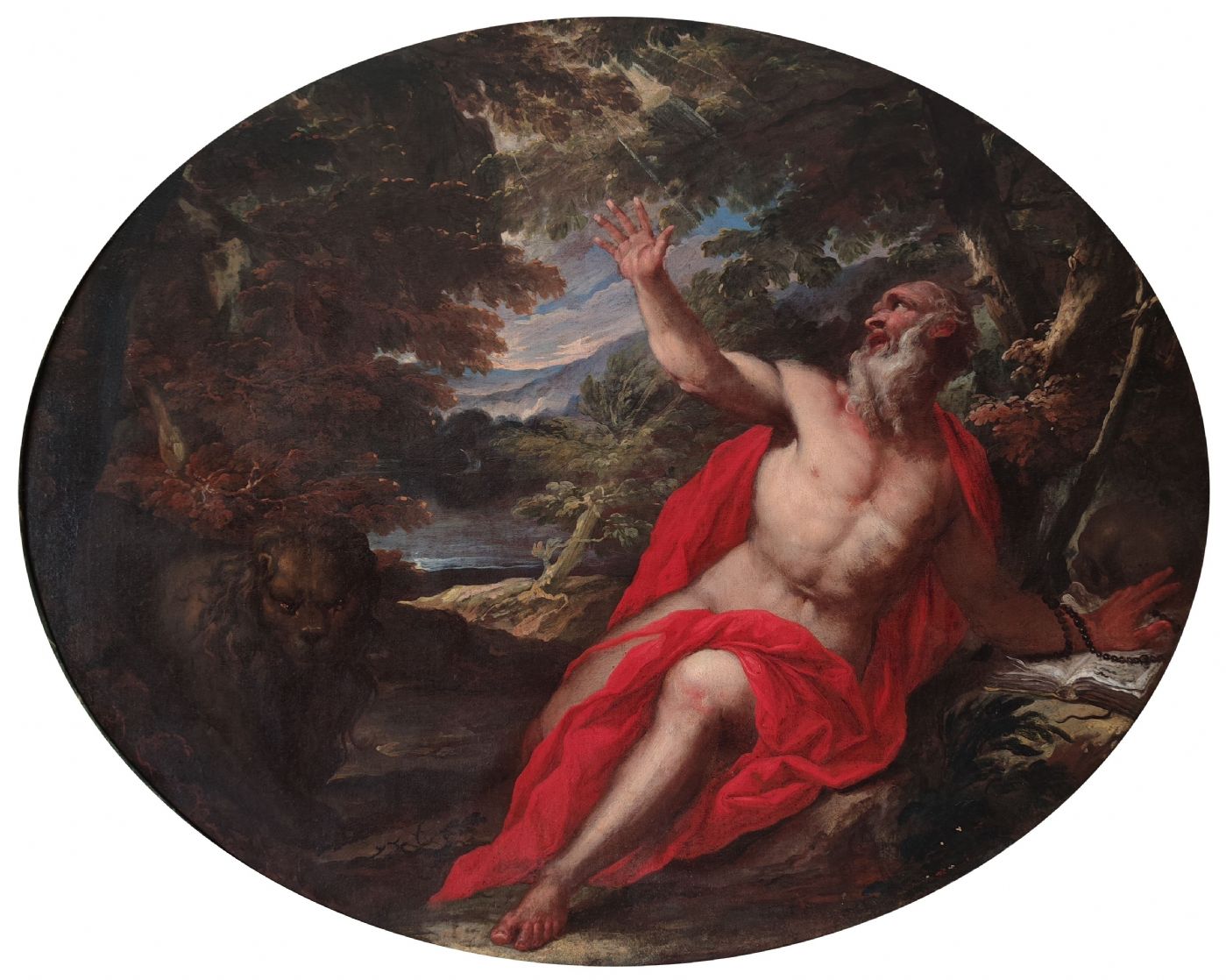
Saint Jerome has a vision of the Last Judgment
Description:
In this painting, the figure of Saint Jerome, who, according to established iconographic tradition, is represented in prayer and penance in the stony desert and in the harshest deprivation, finds a lush setting, a pretext for giving life to a highly thriving woodland landscape, soaked in light, moist fluids and lapped by a watercourse.
The author of the Vulgate is lying on the hard rocks, within a bright glade. Almost naked, girded only by the carmine red cloak, an attribute alluding to his authority and the dignity of cardinal never however accepted in order not to give in to earthly vanities, he rests the palm of his left hand on the Holy Scriptures, the wrist wrapped in the rosary crown. Beside him is a rough and improvised cross, the fulcrum of incessant prayer, composed of two knotted pieces of wood. The right arm is raised to the sky, the fingers opened to transmit the spiritual and emotional tension of the hermit. Also turned upwards is his intense, almost distorted gaze, his mouth open as in a groan, his eyes swollen with tears. Among the thick foliage of the trees he sees and hears the trumpet of the universal judgment, recalling the vision of the Angel announcing the final divine judgment. The Father of the Church meditated incessantly on the Apocalypse, the epilogue of the Truth revealed by God to man and the seal of the entire human vicissitude. Jerome wrote: "In the Apocalypse of John there are so many words, so many mysteries...Under each word lie multiple truths" (Letters 53, 9). The depiction of the transcendent experience lived by the saint is linked to this passage. The less frequent one – mostly from the sixteenth century – sees Jerome surrounded by numerous Johannine emblems, fragments of the "Truth reduced to symbols"; and the peculiar one of the Baroque era, which foresees a more synthetic and almost dramatic condensation of the supernatural event, with the hermit who perceives the ringing of the trumpet coming from above: it is exactly the interpretative cut offered by this painting.
The rhetorical and pathetic potential of the theme finds particular strength in the work commented on here thanks to the quality of the pictorial medium, the vitality of the free but wisely guided brushstroke, full-bodied and at the same time fluid. At the height of the painting corresponds a very wide spectrum of figurative culture that is expressed both in the figurative part and in that of the landscape. The first fundamental characteristic is represented by the implicit consonance with the Giordanesque taste of the image, an aspect that undoubtedly leads us to Naples. The profiling of the saint in space, the tension that animates his plethoric poses along diagonals, the foreshortening of the face are all elements of Giordanesque matrix; but the features of the leafy landscape also draw from the heritage of the great Neapolitan artist, the marked whitish highlighting on the thick foliage or the bluish crests of the mountains that stand out against a streaked but very luminous sky. Without wanting to identify too close comparisons, there are several works by the mature Giordano that lend themselves to a comparison, such as Saint Francis receiving the stigmata in Montelupo Fiorentino, a painting from 1689. Not to mention the possible references to the final phase of the Neapolitan artist, now at the dawn of the new century, marked by unusual pictorial freedom. However, it is very clear that within the perimeter of our Saint Jerome other events follow one another and that we are not at all faced with a mere epigone of the protagonist of Neapolitan painting. The interpretive vivacity, the sharpening of the expressive and emotional register, the fragmentation of the brushstroke in a vibrant and almost already rocaille ductus takes us well beyond Giordano and makes us, for example, feel the echo of Giacomo del Po, the most bizarre of the Neapolitan exponents between the end of the seventeenth and the beginning of the eighteenth century. But the succulent chromatic score and the brilliance of the color, so different from Giacomo's tremulous and opalescent trait, seem to make a history of their own and even presuppose a direct dialogue with Venetian culture, obviously to a different and updated extent compared to the neo-Venetian spirit expressed by Giordano through Cortona.
We must also admit a very interesting and eloquent relationship with the instances of Genoese painting of the late seventeenth century, which, if on the one hand justify the echo of Baciccio (the solarity of the landscape says a lot in this sense), on the other hand even manage to make us intuit the world of Gregorio De Ferrari and Domenico Piola, protagonists of Ligurian painting of the end of the century and intelligent heralds of eighteenth-century culture.
All these aspects converge on the personality of an extraordinary interpreter of Neapolitan painting of the end of the century: Domenico Antonio Vaccaro. A gifted artist, son of the sculptor Lorenzo, Vaccaro is the key figure of those tendencies that, not without implicit controversy, shook the Neapolitan panorama beyond Giordano's return from Spain (1702). The scenario of the late seventeenth century was increasingly consolidating and bifurcating into two opposing poles. On the one hand Giordano and the Giordanesques, proponents of a spirit still deeply baroque of painting but lacking new stimuli; on the other Francesco Solimena, initiator of a more tempered and classicist vision, bearer of instances marked by a rationalism that exalted the design vigor and the force of light. After the beginnings in the shadow of the sculptor father (incidentally strongly opposed by the parent who hoped for his son a future as a jurist), Domenico Antonio entered Solimena's workshop, drawing teachings that appear however much more effective and evident in his mature phase, after 1720. In fact all his youthful production, roughly between 1696 and 1705, plucks chords very different from the paused and composed language of the master. As criticism has progressively focused, starting from the acute and enlightening openings of Ferdinando Bologna (1958), Vaccaro's personality underlies a spirit as cultured as it is alien to the conformism of Solimena. Already the contemporaries, moreover, saw in him "the freedom of genius...a brain all fire and vivacity" (Roviglione 1731), while De Dominici (1743) confirmed his independence, saying that he was "carried by his great fire to paint by invention". His physiognomy is well delineated by the first works that rely on the testimony of the biographer De Dominici, such as the Vision of Saint William of Aquitaine (fig. 1) painted around 1696 for the church of Sant'Agostino degli Scalzi in Naples (on deposit at the Museum of San Lorenzo Maggiore). A painting in which light plays a very different role from Solimena's precepts, where the figures and nature are pervaded by a restless spirit, by a fanciful and emotional experimentalism that has nothing academic and rational. Vaccaro makes his own and indeed increases those alternative trends that were crossing Neapolitan culture, weaving an open dialogue with Giacomo del Po, of which he even anticipates some solutions (Spinosa 1994). Nevertheless, his horizon proves to be open outwards and in tune with the Baroque of Roman-Genoese matrix, probably breathed on the occasion of an early stay in the Urbe.
Vaccaro's "new manner" and inventive impetus were particularly appreciated in profanand history painting. De Dominici is the first to remember the Neapolitan's commitment in the execution of precious paintings on copper destined for two caskets or stipes for Charles II of Spain. The royal artifacts, presumably begun around 1698-1699, did not see the conclusion due to the death of the sovereign in 1700 and the paintings executed by Vaccaro were thus purchased by the English admiral Binks, a passionate collector of Neapolitan painting. To this group, dispersed in various collections, belong first of all the oils on copper depicting Meleager kills the boar and Apollo shoots Niobe's children in the Riechers collection in Neuilly (figs. 2-4). Already attributed to Giacomo del Po, this pair of paintings was reclaimed to Vaccaro by Nicola Spinosa who recognized its exact origin. The previous attribution error is symptomatic of Domenico Antonio's style orientation, which here abundantly overcomes the horizon of his Neapolitan colleague, building a language that proves capable of mediating the best Giordanism with Genoese instances. Difficult now not to notice the identity of hand between the branches and Saint Jerome, in which recur the same expressive deformations of the distorted faces (which reveal in backlighting the torturers of Saint Catherine refuses to worship the idols of Giacomo del Po), the tumultuous and energetic tone, the vivid chromatic agreements and that descriptive spirit of nature that proceeds without minutiae, but with an uninhibited and at the same time plastic manner.
The comparison becomes even more significant with a third copper of the unfortunate Spanish series, the Rape of Ganymede in a private collection (fig. 5), still recognized by Spinosa (see Neapolitan eighteenth century 1994). This table makes well capture the stylistic and typological affinities of succulent vegetation (fig. 10), knocked out by the light and modulated in cold ranges of fluorite green and dioptase green.
Bibliographical references:
B. de Dominici, Lives of Neapolitan painters, sculptors and architects (1742-1745), edited by F. Sricchia Santoro, A. Zezza, III, Naples 2008, pp. 884-933; F. Bologna, Francesco Solimena, Naples 1958, p. 147; N. Spinosa, in Civilization of the '700 in Naples 1734-1999, exhibition catalog (Naples, December 1979-October 1980), I, Naples 1979, pp. 162-165, cards 66-67; F. Bologna, The European dimension of Neapolitan artistic culture in the eighteenth century, in Arts and civilization of the eighteenth century in Naples, edited by C. De Seta, Rome 1982, p. 66; G. Sestieri, Some contributions to Neapolitan graphics between the seventeenth and eighteenth centuries, in Writings on the history of art in honor of Raffaello Causa, Naples 1988, pp. 311314-316; N. Spinosa, in Neapolitan eighteenth century. On the wings of the imperial eagle 1707-1734, Naples 1994, pp. 280-282, cards 70-71; N. Spinosa, Neapolitan painting of the eighteenth century, I. From the Baroque to the Rococo, Naples 1994, pp. 47-50, 76-77, 80-81, 85, 100, 147-150, cards 189-198; V.Rizzo, Lorenzo and Domenico Antonio Vaccaro. Apotheosis of a binomial, Naples 2001, passim; R.Lattuada, Domenico Antonio Vaccaro, painter, sculptor and decorator, 'ornament of his homeland',in Domenico Antonio Vaccaro. Synthesis of the arts, edited by B. Gravagnuolo, F. Adriani, Naples 2005, pp. 21-61; N. Spinosa, Painting of the seventeenth century in Naples, II. From Mattia Preti to Luca Giordano. Still life, Naples 2008, pp. 235-239, cards 218-231; D. Beccarini, A note on Domenico Antonio Vaccaro, in "Horti Esperidum", 4, 2014, 2, pp. 121-139; R. Lattuada, A painting by Domenico Antonio Vaccaro found at the Belvedere in Vienna, in "Barockberichte", 63, 2015, pp.29-33; N. Spinosa, Additions to Domenico Antonio Vaccaro painter, between Baroque and Rococo, in "Valori tattili",5-6, 2015, pp. 328-337.