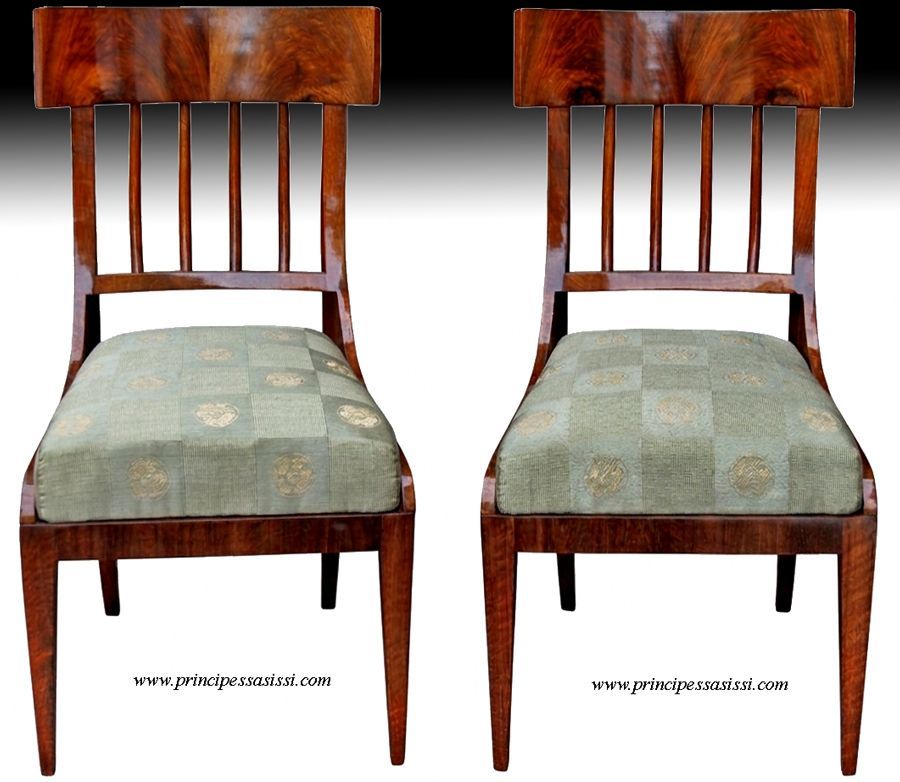
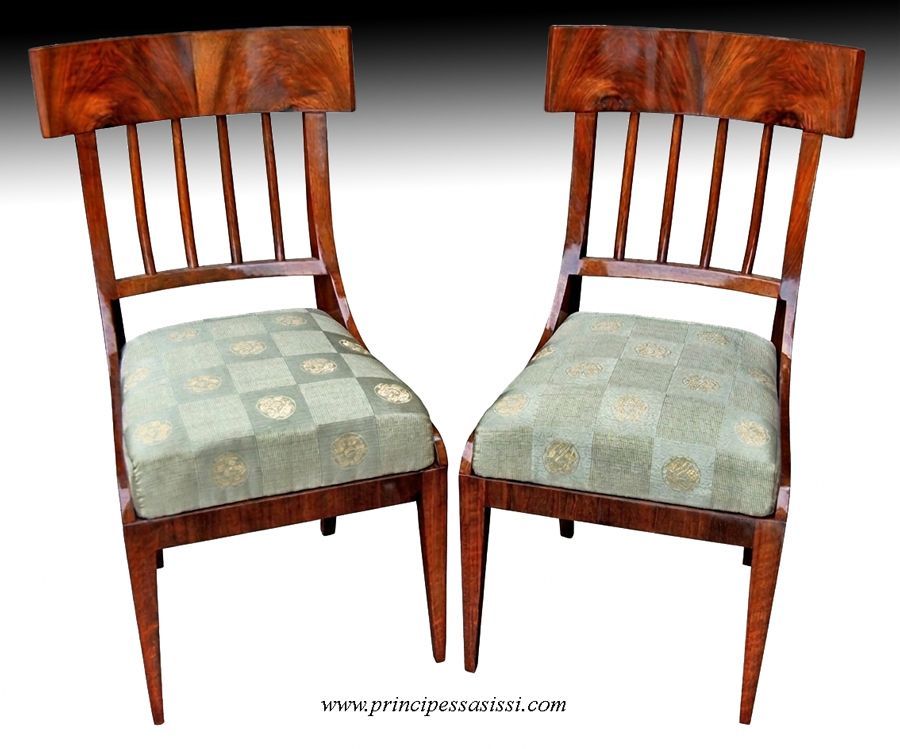
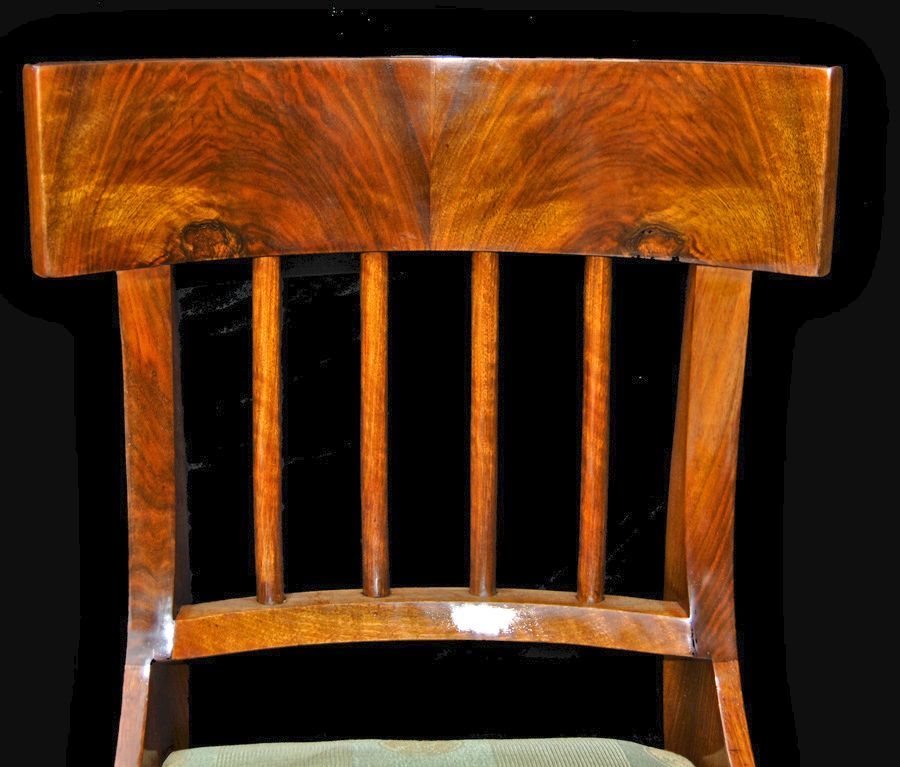
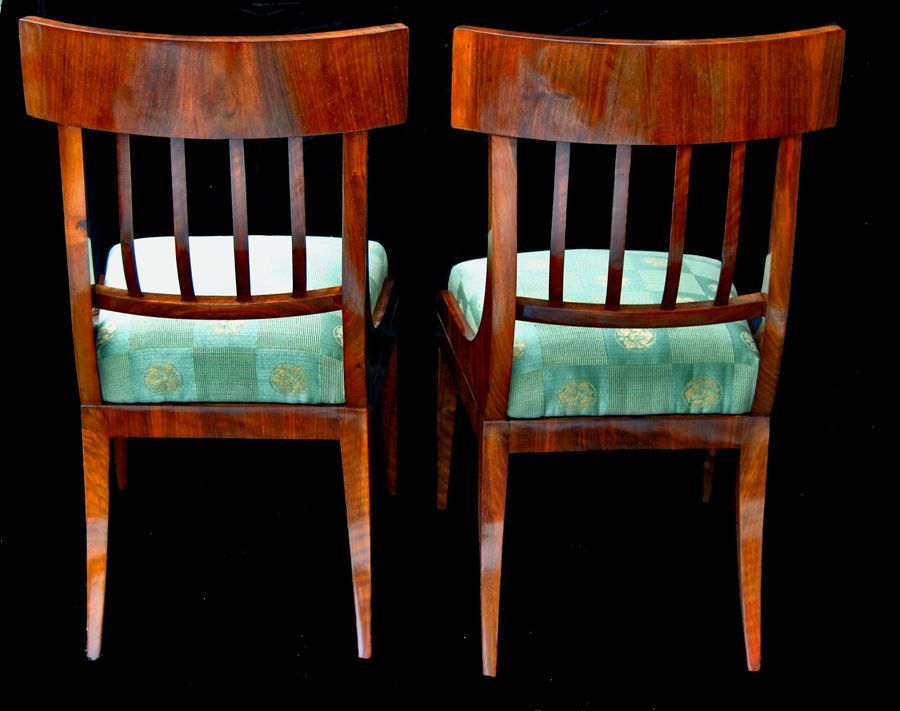
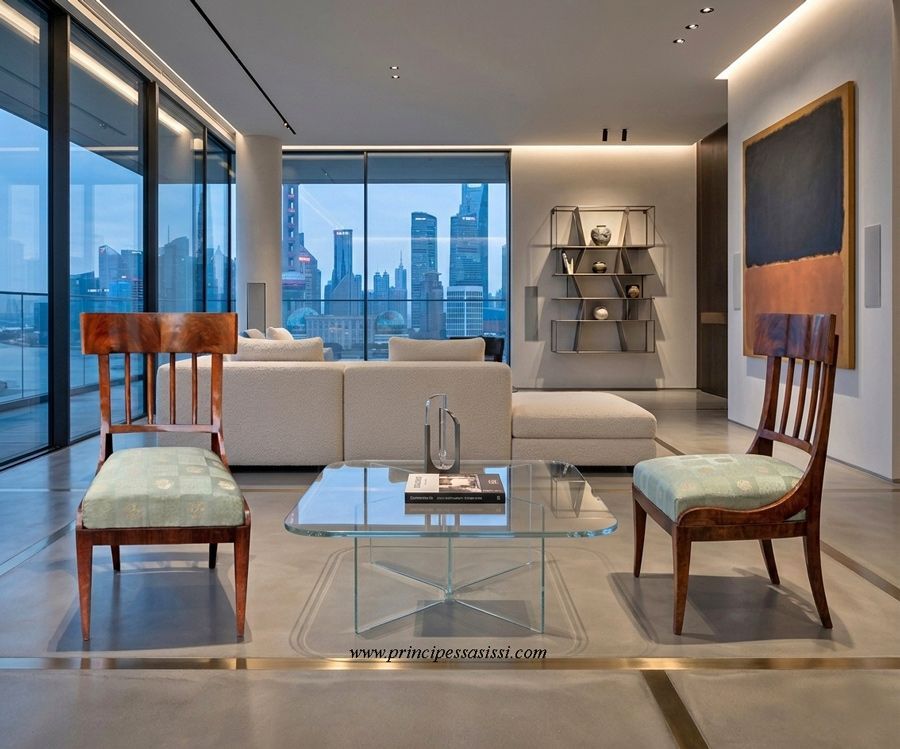
Wonderful pair of early Viennese Biedermeier armchairs. Vienna, circa 1815-20, circle of cabinet makers close to Joseph Danhauser.
Description:
Wonderful pair of early Viennese Biedermeier armchairs. Vienna, circa 1815-20, circle of cabinet makers close to Joseph Danhauser, veneered in blond walnut feather with a sober elegance and a line that "defeats time", which seems to anticipate the Bauhaus functionalism by over 100 years, as is typical of Viennese furniture of the Biedermeier period close to the great cabinet maker - designer Joseph Danhauser. Works in conditions of practical integrity, consolidated and polished with shellac applied on the original patina with museum standard technique. Original upholstery, sanitized and covered with elegant and luxurious jacquard fabric. Height 89.5 cm - seat 47, width 48, depth 51 max. seat depth 46
Joseph Ulrich Danhauser, a great Viennese cabinet maker and designer, documented his range of products in a vast drawn catalog, parts of which (approx. 2,500) have survived the times and are now preserved in the MAK (Austrian Museum of Applied Arts in Vienna). This catalog includes, among other things, 153 models of chairs, 56 sofas, 179 types of chandeliers and 124 curtains. All these models were numbered consecutively. He boasted a high-ranking clientele from all over the Austrian monarchy and Germany. The company had offices and sales agencies in Graz, Prague and Budapest. The most prestigious work entrusted to Danhauser was the renovation of the Palace of Archduke Charles (today's Albertina, home to an important Viennese museum) around 1822. Danhauser's furniture factory holds a prominent position in the history of Viennese furniture making and interior decoration. Danhauser's designs allow us to follow the development of Viennese furniture style, which was initially based on French models, such as those created by Percier and Fontaine, but soon gained its own precise and refined autonomy. Danhauser's exceptional quality and uniqueness as a furniture creator lies in the harmonious combination of concreteness and abstraction, functionality and emotion. Thus he assumed the role of mediator between individuality and anonymity and became one of the most important inspirations for the modern avant-garde movement. The Danhauser manufactory was founded in 1814 by the sculptor and cabinet maker Joseph Ulrich Danhauser (1780-1829), the father of the painter son Joseph Danhauser. It was one of the first companies in Vienna operating in the interior decoration sector. Having been granted a special production license, it was possible for Danhauser to integrate all the trades related to interior decoration with their related specializations and therefore carry out the necessary work under one roof. Among these, first of all, the production of furniture and upholstery, the production of lighting fixtures, metal processing and the creation of elaborate draperies. It is a point of reference in the history of design and furniture. His very rare original accomplishments that have survived the times are preserved in a few museums, castles, large antique shops or prestigious private collections.
In compliance with the provisions of the New Code of Cultural Heritage, the selling company provides, at the time of sale, a detailed written photographic guarantee of originality and provenance of the works sold. The data with which the works are described and then contained in the written guarantees are expressed determinations resulting from accurate, in-depth and documented technical/historical/artistic investigations.