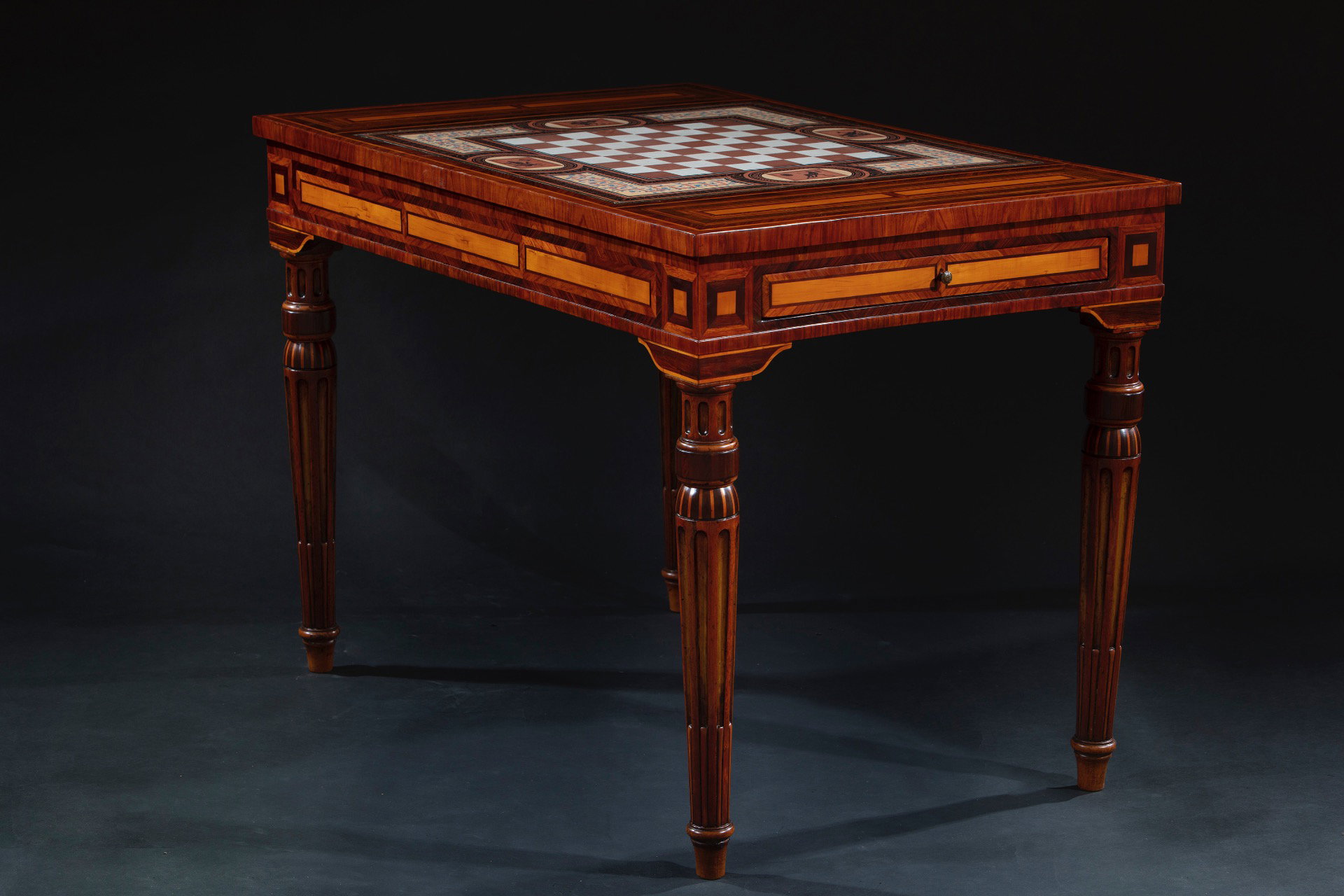
Antonio Mascarone and Roman scagliola artist, ca. 1790. Important center table threaded and inlaid in walnut and fir wood veneered in bois de violette, bois de rose, rosewood and maple, with inlaid scagliola top centered by a chessboard, Greek fret border with reserves decorated with Pompeian scenes. Lombardy, late 18th century (cm 106x77x71) The chessboard inserted in the center of the top, inspired by the repertoires of the Ancient World, is the work of a skilled Roman scagliola artist. The composite frame draws inspiration from the four volumes of the Collection of Etruscan, Greek and Roman Antiquities from the Cabinet of William Hamilton, printed by Pierre-Francois Huges d'Hancarville in 1766. The four figures in the oval reserves and the frieze on a black background of the chessboard frame are freely derived from the tables of this work, which was widely used in the decorative arts of the late eighteenth century. The decoration of the corners, with the slender Greek interwoven with delicate light blue leaves, is of exquisitely neoclassical invention. The table is of Lombard manufacture, specially built by a skilled cabinetmaker to accommodate the chessboard. We know the maker, Antonio Mascarone, a follower of Giuseppe Maggiolini, perhaps his direct pupil, a skilled inlayer as demonstrated by a table already known to scholars, very similar to the one we are writing about, and other works known to historiography. Little is known about him, but we know that he was active in Cesano Maderno, in the province of Milan, between the last decade of the eighteenth century and the first two decades of the following century. The known works show him to be an excellent cabinetmaker also versed in the art of inlay. The proximity of some inlays on his furniture to designs by Giuseppe Maggiolini, combined with the quality of the inlays themselves, suggest that he may have been a direct pupil of the master of Parabiago. Certainly, he was a cabinetmaker who must have enjoyed a solid reputation in Lombardy between the eighteenth and nineteenth centuries. He also worked for the palaces of the Napoleonic court, as demonstrated by the table mentioned, which was once part of the furnishings of the royal villa of Monza. The center table in question, finely veneered with a selection of fine woods, does not have inlays, but a refined game of bois de rose, bois de violette and rosewood veneers, arranged to create games of contrasting grains. The two lateral reserves of the top are framed by a very fine frieze that repeats that of the scagliola, quite particular because it is made with a technique similar to scagliola. Turned according to a beautiful design, veneered, fluted and rounded are the legs, illuminated by a beautiful gilding inside the flutes. A chronological placement during the last decade of the eighteenth century appears to be the most likely. Bibliography: A. Gonzàlez-Palacios, Il tempio del gusto, Milan, 1986, Volume I, p. 274, Volume II, p. 300 G. Villani, Civiltà del legno, furniture from the collections of Palazzo Bianco and the Museums of the Hospitals of San Martino, Genoa, 1985, p. 85 ff. G. Beretti, Laboratory, 2005, p. 120 ff.