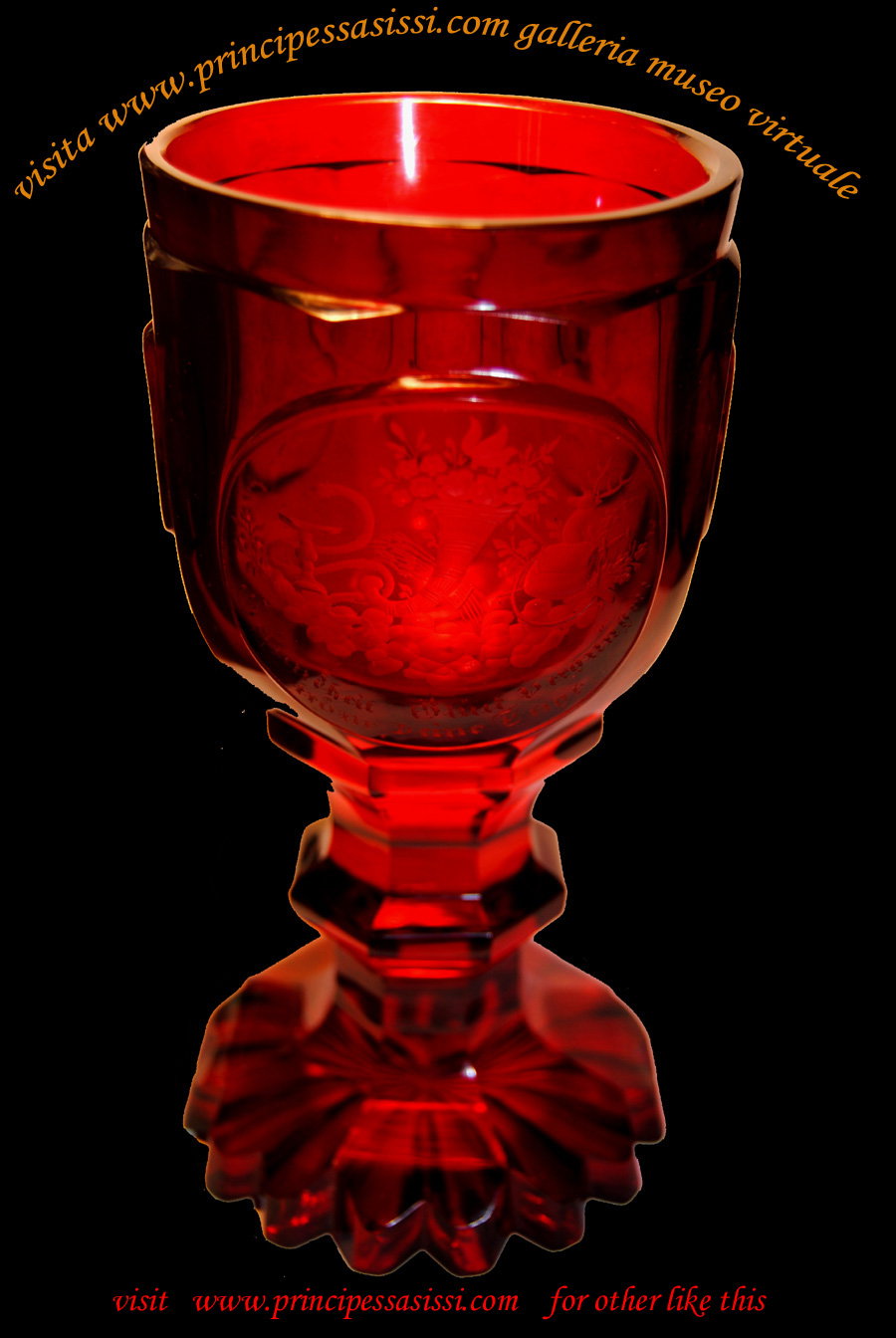
Circa 1830-35, Biedermeier period. Admirable Bohemian chalice in transparent cut crystal, colored by fusion in a vivid and bright ruby red.
Description:
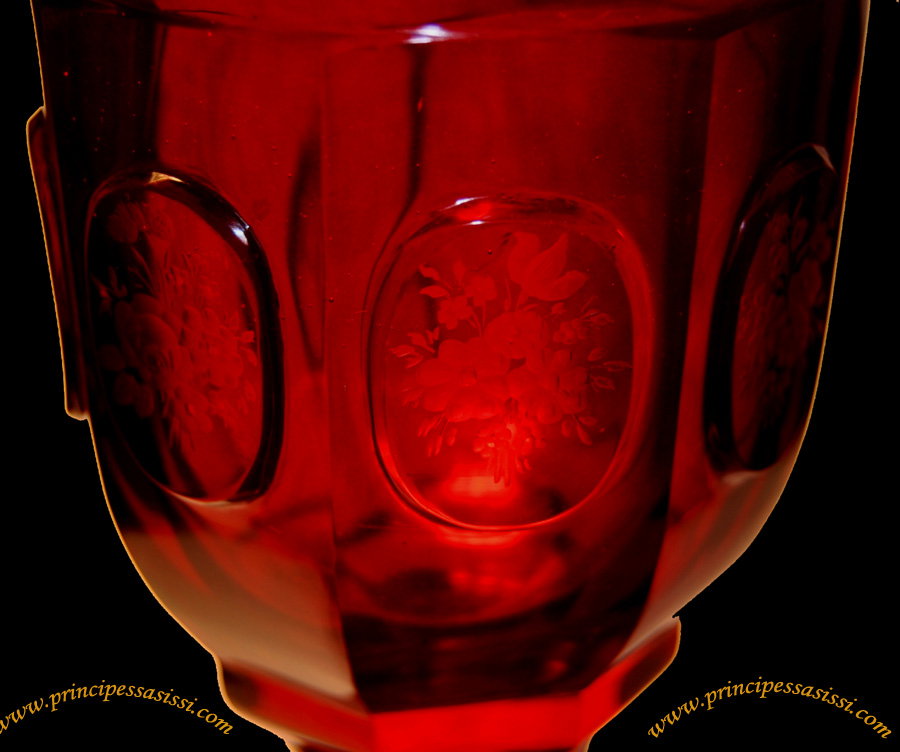
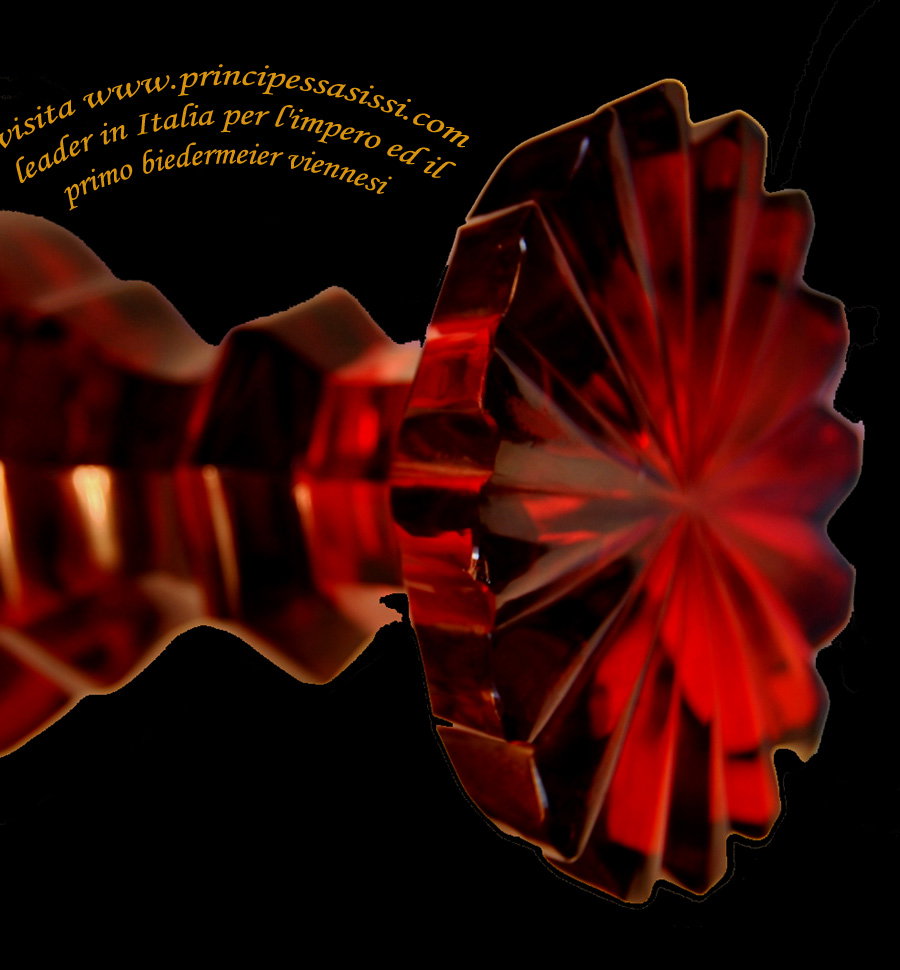
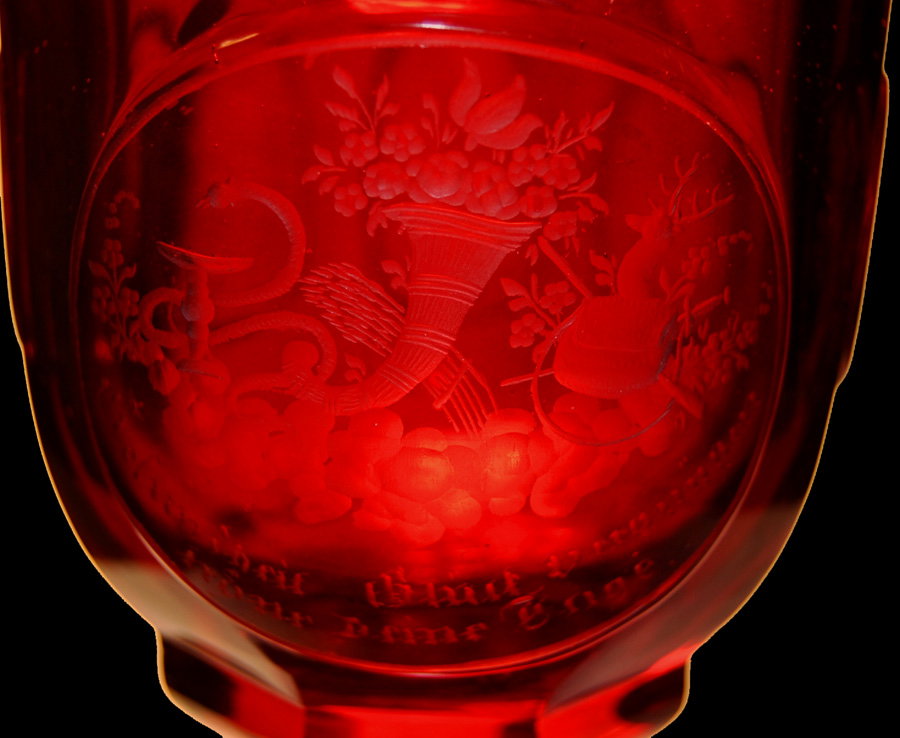
Circa 1830-35, Biedermeier period. Admirable Bohemian chalice in transparent cut crystal, colored by fusion using gold salts, in a vivid and bright ruby red (Egermann patent, circa 1830). Floral motifs and cornucopias (symbol of good luck and prosperity) masterfully wheel-cut. Cut inscription: Gesundheit, Glueck, Vergnuegen und Traene in deinen Tagen = Health, fortune, pleasure, but also tears in your days. Northern Bohemia, city of Neuwelt - Steinschonau, present-day Novy Svét, Sudeten mountain range. Circa 1835, probably Friedrich Egermann's atelier. In perfect condition. Literature: Passauer Glasmuseum - Bohmische Glas. A similar chalice on page 173 Olga Drahotova - Ceské sklo. Biedermeier, art and culture in Central Europe. Two similar chalices at the Museum of Applied Arts in Passau (Germany) inv.60\071 and 66\318. Height 17.3 cm, diameter 8.7 cm.
It should be noted that Friedrich Egermann was the only producer of ruby red Biedermeier glass 'in fusion' before 1840, for which he held the patent, which was transferred on that date. The fusion process, unlike simple 'coating', is recognizable by the fact that the crystal is colored throughout its thickness, not just superficially covered on transparent crystal. The value of objects produced in fusion is markedly higher than those simply coated, which in most cases are posterior to 1840. This 1835 jug in fusion is therefore attributable to Friedrich Egermann.
Friedrich Egermann (* March 5, 1777 in Schluckenau, Northern Bohemia, † January 1, 1864 in Haida - present-day Novi Bor) was a German-Bohemian glass decorator and painter from the Sudetenland, as well as a scientist and entrepreneur.
Born into a Bohemian glassmaking family, Egermann is one of the most important figures in the Bohemian Biedermeier glass industry, to which he dedicated his life. Starting from poor economic conditions, Egermann later achieved great success as an artist and entrepreneur. He learned from his uncle Anton Kittel Sokolov, who owned a glass factory in Kreibitz as a renowned engraver and gold painter. At the age of 29, he married the wealthy Elisabetta Schurer, the daughter of Schürer Luster, a well-known entrepreneur of the time, thus obtaining economic security. He was thus able to devote himself to revolutionary inventions, such as 'lithyalin' glass, for which he is considered one of the best artists of the Biedermeier period.
Lithyalin glass: an apparently accidental result of various experiments. Obtained by mixing minerals with already known colored glasses to obtain a product that imitates marble and precious stones. Egermann's invention obtained at the University of Technology in Vienna, Lithyalin (from the Greek λ?θος lithos = stone) allowed him to obtain the imperial privilege in 1829. Egermann's artifacts are among the most valuable creations of the Biedermeier period.