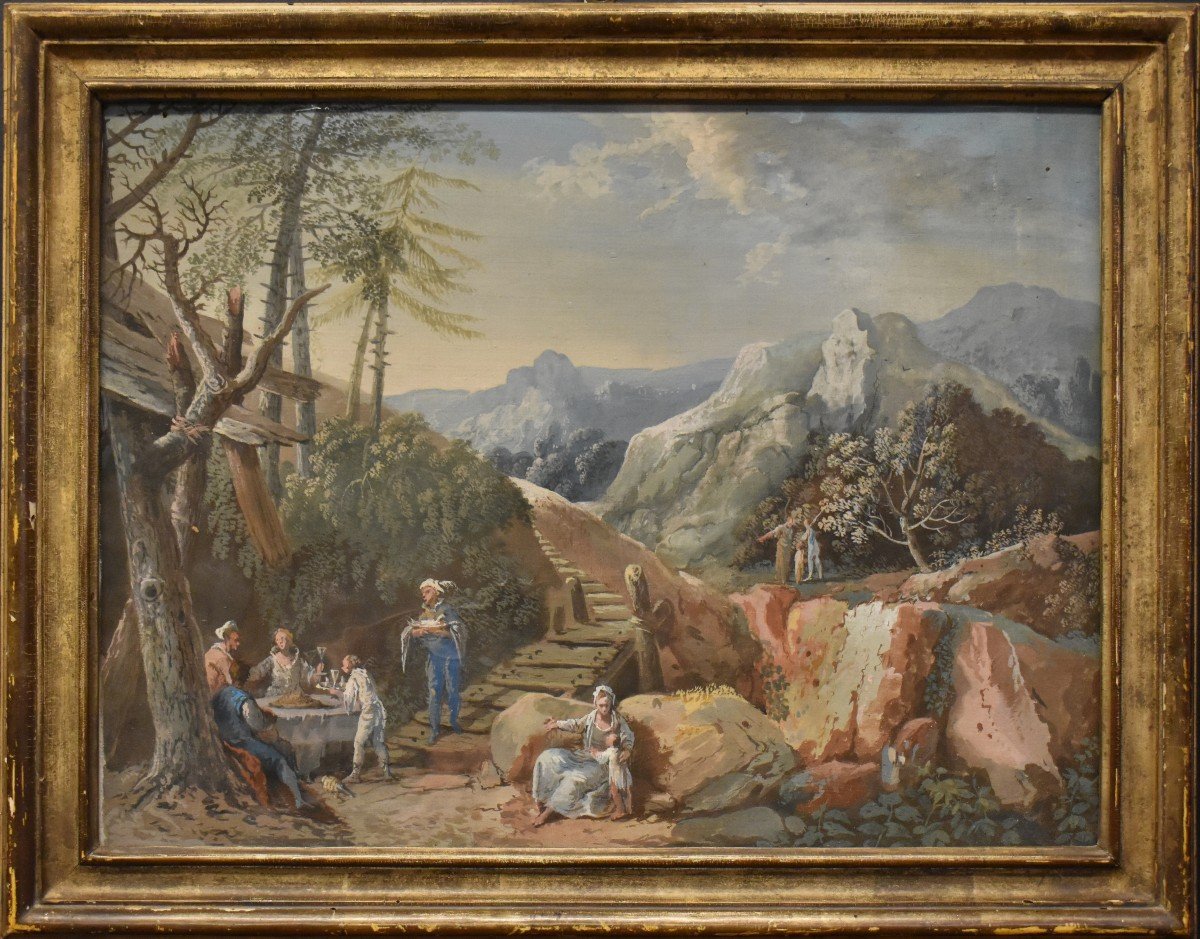
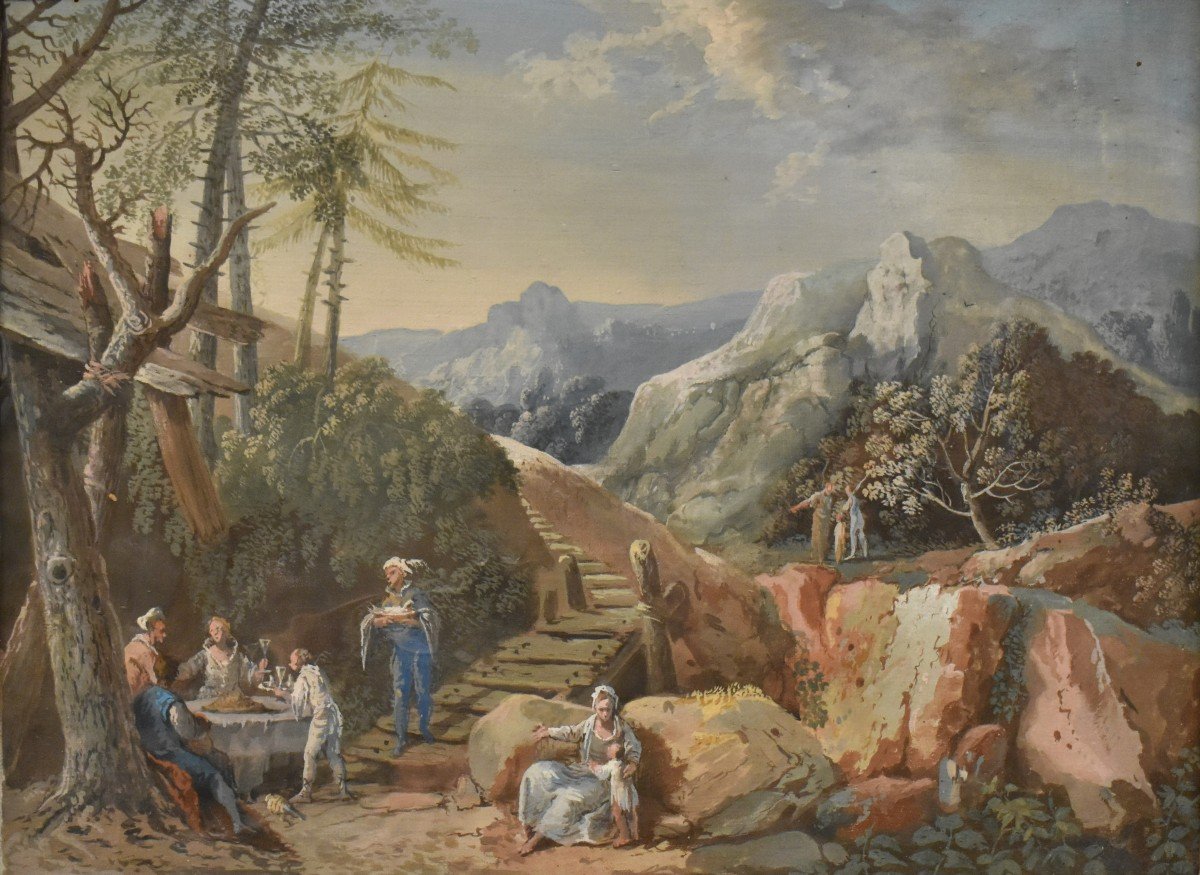
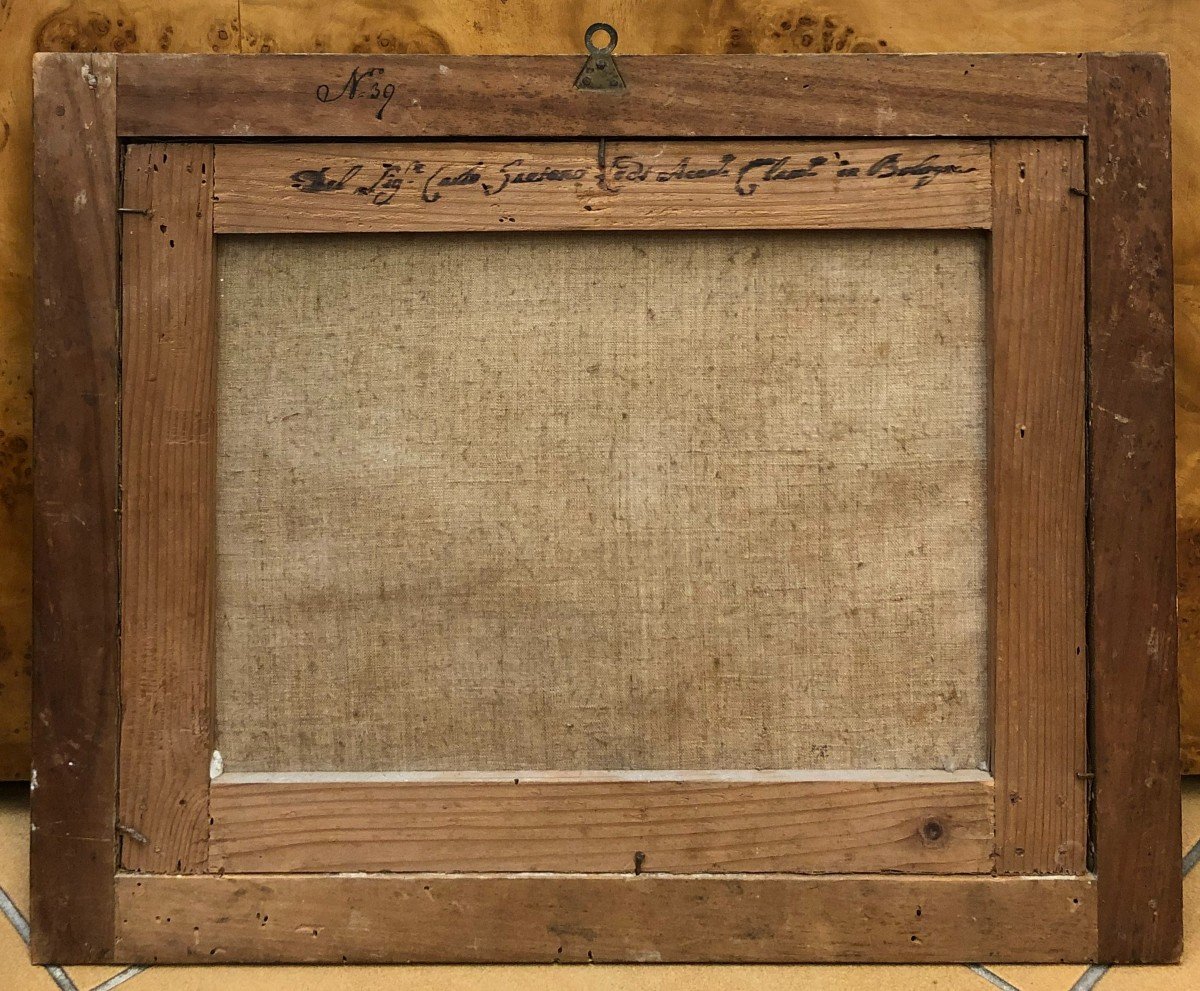
Giuseppe Bernardino Bison (Palmanova 1762 - Milan 1844) "Mountain landscape with entertainment scene" tempera on canvas.
33.5x44.5 cm
Authentication by Dr. Fabrizio Magani
More than twenty years ago (1997) I happened to intercept a group of paintings held by a direct heir of the painter Giuseppe Bernardino Bison (Milan, private collection). River views and architectures, evidently interpreted in the master's taste; an invitation, almost, to reflect on the clarity of the layout but not yet settled in the spirit of his most recognizable style.
More recently (2004) I came across two other paintings - a Marine Landscape at Sunset and a River Landscape (oil on canvas, respectively 49.5 x 37.5 cm and 49.5 x 38 cm) - certainly to be aligned with the Milanese group, which has the advantage of having passed from hand to hand among the Bisons.
In fact, the artist had settled in the Lombard capital in 1831, leaving the Venetian-Giulian environment that had guaranteed his success.
The attempt to exhibit his talent also in the genre of vedutistic and landscaping was greeted by the new public with unexpected positive feedback. Even at the end of his career he was able to wisely reiterate his vocation towards compositional virtuosity and the transparency of chromatic changes, qualities that he transmitted to his son Giuseppe, who undoubtedly was close to him in the profession.
The paintings I am talking about share the same thematic choice and show the clarity of the chromatic texture; the compositional and stylistic typology that one would like to refer to the preface, so to speak, of the catalog of Giuseppe Bernardino Bison, the famous artist of Friulian origin who knew how to merge the eighteenth-century heritage into a century, such as the nineteenth, open to the experimentation of new contents and genres.
Now this new painting is added, which I do not hesitate to unite with the volatile sensibility and the didactic clarity proper to the eighteenth-century spirit.
The flowing brushstroke condensed in the spot, with which the figures are made, represents the stylistic figure to propose the paternity of the master. It is his particular aptitude, so happy and immediate, to lead him to approach nature in the clear and quiet moments of the day, to cast a glance at the landscape, to record with originality the emotional vibrations of the moments of life.
The plausibility is such as to make those fragments of nature speak, which Bison, with extraordinary improvisation, licensed with promptness that has no comparison in the course of the first part of the 19th century.
It is almost as if it were a dream of youth and happiness that accompanies the artist during his professional career - and therefore in the repertoire - and it seems to me that such a reflection can make us understand, this time, the proposal of an early dating, as if the same eighteenth-century poetics of the landscape capriccio, from which depends the free combination of places and figures in the clear awareness of the triumph of invention, can bring us to that distant horizon of the painter, still not perfectly reconstructed.
The master already seems to be able to enclose and control the entire tradition of eighteenth-century Venetian landscape painting, to testify to its solid prestige, with the arrangements typical of a very particular genre that dilates the representation in the areas of picturesque fantasy.
Oui Bison demonstrates all the personal dexterity, with the ability to confer on the few elements of which certain paintings are made up the impalpable luminous density and the essence of truth; although being an epigone, the artist undoubtedly deserves primacy in terms of technique among genre painters of the generation active between the two centuries.
Convincing proof of this is our painting, as if the pictorial gesture had succeeded in accompanying the click of the invention: Bison quickly composes completely plausible views, and the optical fulcrum is constituted by the races towards landscapes of waters, mountains and countryside animated by eccentric appearances.
The spatial depth is composed in clear forms, solidified by a moved light that soaks the colors, as if a summer sky had perpetuated itself on the earth, an authentic testing ground in the imitation of Canaletto's, Ricci's and Zuccarelli's atmospheres.
Bison proves to be an expert in conferring on the views a sort of metaphysical suspension; however, he relies on the description of a place that lives its daily transformation, innervates it with a tender and delicate beauty, proper, one would say, of a natural melancholy.
The artist, in his characteristic paintings of landscape of small and medium size, seems to make an inimitable travel report, as if the curious taste of a tourist of the time attracted by nature and its presences took shape.
The horizon is undoubtedly humble compared to the glimmers of the lagoon landscape, yet that intimacy underlined by the complicity of the gazes between the painter and the spectator confers a very particular and domestic flavor to the scene animated by the figurines, dedicated to the occupations of the everyday: a sort of souvenir from a country outing, almost a counterpoint to the famous views of Venice.
Like a skilled director, he captures the sense of movement and light within a natural choreography that stylistically seems to refer, as we said, to the original phase of the artistic experience, which finds a precise and fortunate term of comparison in the way expressed in the Hall of Landscapes in Palazzo Manzoni in Padua, at the time of the decoration inhabited by the Venetian noblewoman Elisabetta Maffetti, which I have considered to date around 1792 on the basis of precise documentary interpretation (F. Magani, Giuseppe Bernardino Bison, Soncino 1993, pp.44-46; D. Tosato, in Frescoes in the palaces of Padua. The Sixteenth and Seventeenth Centuries, edited by V. Mancini, A. Tomezzoli, D. Ton, Verona 2018, pp.373-380). But the invention and execution could be a few years earlier, if we imagine how the first landscape interpretations were already attesting to the end of the eighties of the eighteenth century.
In fact, we must still go back to the confirmations of Aldo Rizzi, who identified the signature and the date 1787 in the Landscape with tavern and the Rural Festival.
On the formation of Giuseppe Bernardino Bison, I dedicated myself in the study prepared for the last anthological exhibition dedicated to the painter (the best research contributions, I think, have flowed into Giuseppe Bernardino Bison painter and draughtsman, exhibition catalog edited by G.
Bergamini, F. Magani, G. Pavanello, Milan 1997).
We immediately understand that the young painter dedicates himself to easel paintings in parallel to the main activity of helping in interior frescoes.
The last eighties and the first nineties are decisive for the artist's career, after the apprenticeship at the Venetian Academy: he is close to the neoclassical architect Giannantonio Selva and the scenographer decorator Antonio Mauro, working in Brescia, Ferrara and Padua, where he meets the excellent clientele of Tommaso degli Obizzi, for whom he works in the city palace and at the Catajo Castle.
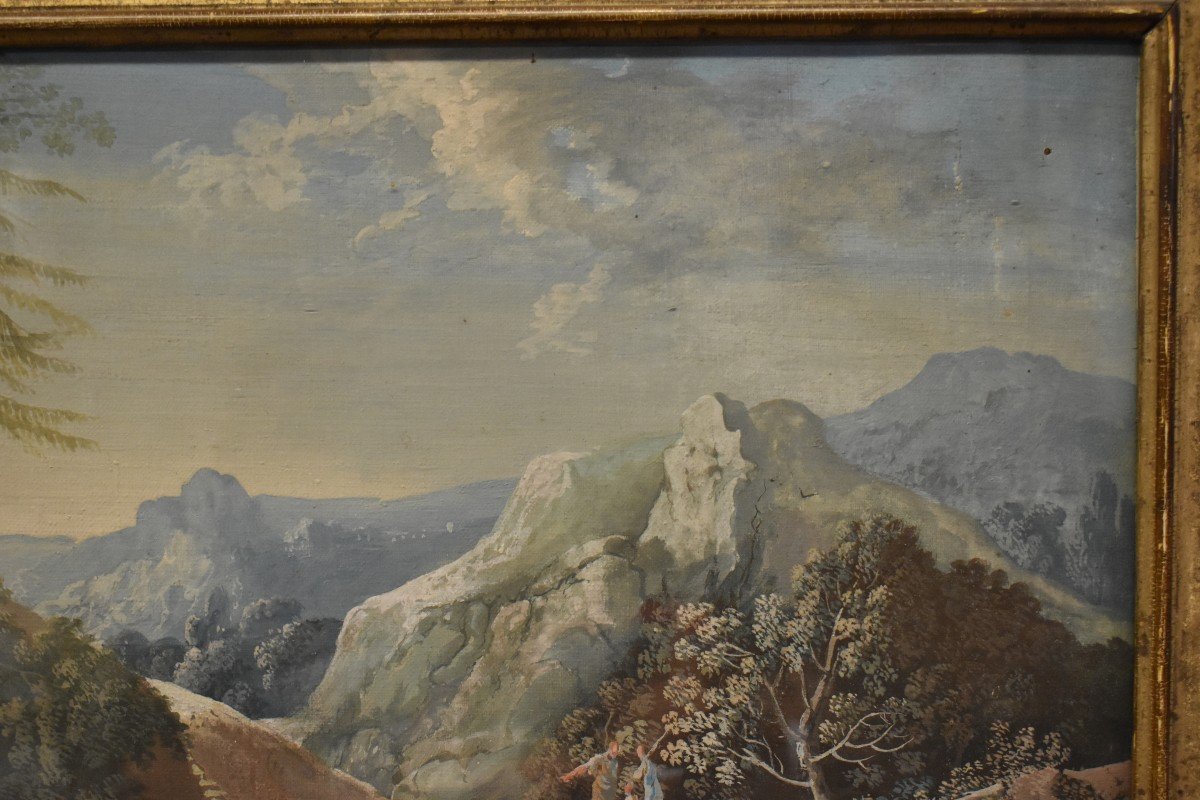
A exquisitely scenographic imprint also characterizes the painting presented here: the construction that accompanies the gaze with tight rhythm, almost following the ascent of the wooden bridge and the road to the mountains.
The work strikes indeed for its originality: it is an apparatus of great illusive evidence, because of that flow of nature that makes ambiguous the truth of the view.
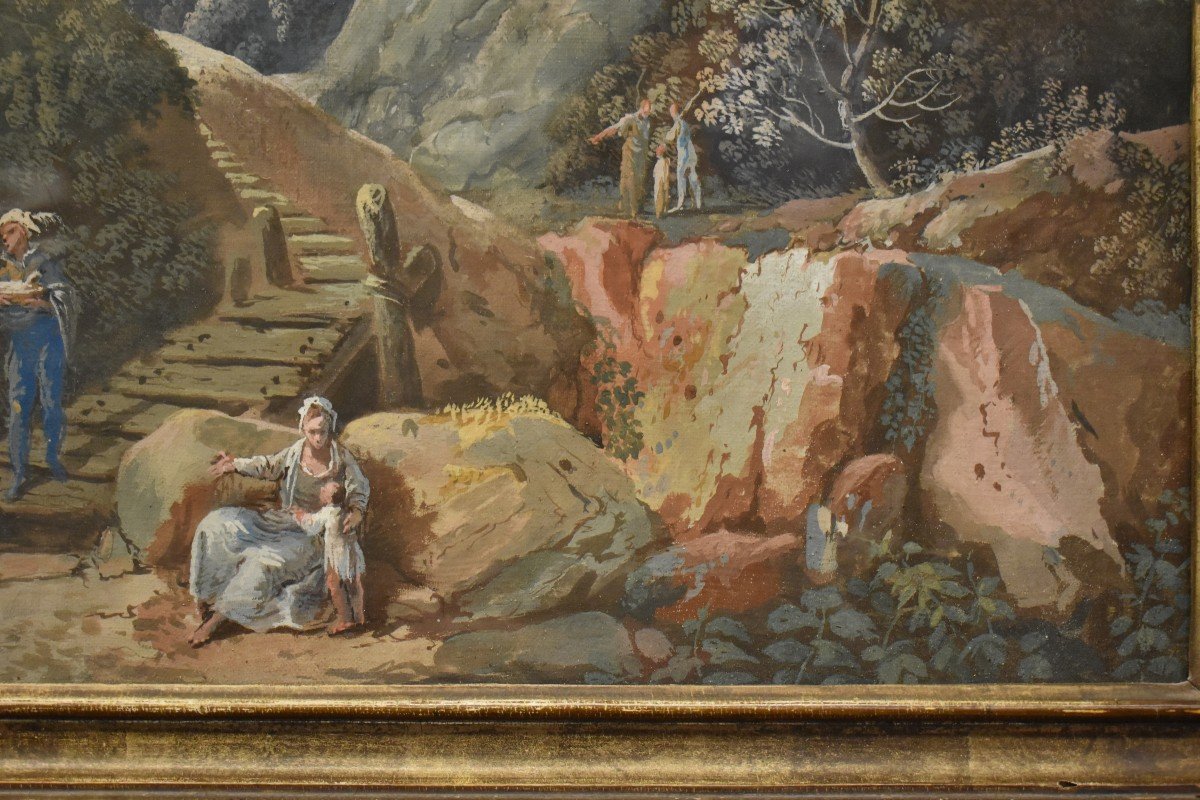
The sensibility from ephemeral apparatus that has animated the invention of the master unfolds, as we said, in an articulated scenic direction, virtuistically positioned on the register of a representation of almost sacred taste, with that woman on the right approached by her child, an idea that often appears in this first phase and that seems to allude to a classical representation of Charity.
The decorative party in fact concentrates in the rarefied atmosphere from which appears, it is the case to say, the iconic image of the landscape. It is as if the Baroque scenographic tradition had been recalled to give prominence to that apparition.
In the system, therefore, a distant experience is ritualized. Therefore we have identified the master in Giuseppe Bernardino Bison, a singular and capable artist who, in over sixty years of intense activity, has expanded his baggage of skills - trying his hand at various genres - and straddling two worlds, collecting on the one hand the late Baroque legacy and on the other hand approaching the new thoughts of the neoclassical age.
Above all, the activity carried out for about thirty years from the beginning of the 19th century in the Trieste square confirms his position as a master of the first magnitude, for having been able to touch many genres and style registers. The typical brushstroke of the artist, here scratching more than ever because of the rapid touch typical of the sketch, is accompanied by an uncommon inventiveness.
As in other cases in which Bison had demonstrated an uncommon ability in reducing to the pleasures "da camera" the illustrious genres of tradition, whether they were connected to the field of interior decoration or to the seductive side of the landscape, also in the present version the subject is enriched by moods proper to the virtuoso ornament.
The painting demonstrates how decisive the scenographic component was in Bison in the elaboration of this particular genre. Also here the composition creates an ideal relationship between hall and stage with the view "in obliquo" that, in theatrical practice, would have joined the backdrop to the proscenium, blocking the attention on a precise place of the space usable by virtual actors.
For stylistic reasons, a dating to the early years of the Bisonian experience appears very convincing, around the penultimate decade of the eighteenth century. In this way we will be able to highlight the importance of decorators such as Chiarottini in Bison's formative experience, for that invention of imaginary scenarios, of landscape places built by the vivacity of the invention rather than by calculation and design. Moreover, Chiarottini himself had been defined as an "architect" in the diplomas that welcomed him in the Academies of Florence and Bologna, between 1786 and 1787 (C. Mutinelli, Francesco Chiarottini pittore cividalese, "Atti dell'Accademia di Scienze, Lettere e Arti di Udine", XI, 1948 - 1951, pp. 291 - 292; M. Vuerich, Su Francesco
Chiarottini pittore di scenografie, "Arte Documento", 7, 1993, pp. 201 - 207; M. De Grassi, Francesco Chiarottini scenografo e decoratore, in Ottocento di frontiera. Gorizia 1780 - 1850. Arte e Cultura, exhibition catalog (Gorizia, 14 July 1995 - 31 December 1995), Milan 1995, p. 41).
Of course, the reference alludes to his specialization in perspective painting, but it is significant that contemporaries had almost detected the aspiration to planning, as can be seen in the Perspective View painted in Palazzo Brosadola in Cividale. It seems that the artist wanted to dilate on a relevant dimensional scale, proper to the fresco, the genuine and spontaneous nature of those who practice vedutism deriving it from the truth of nature and thus arouse its picturesque soul.
It can be said that Chiarottini and Bison are united in the eighteenth-century figurative heritage. Antonio Mauro had appreciated the sets painted by the Cividalese in the theater of Udine, and he had also been in Venice the master of Giuseppe Bernardino Bison, with whom he had also worked in the theater of the Obizzi of Padua (1787).
In Trieste, where the painter moved at the end of the century, began an 'escalation that led him to take part in all the most important decorative enterprises, but above all to devote himself to an unspecified number of paintings, which correspond to as many subjects that only recently has been attempted to classify by genre. Certainly in the Julian city he was able to see the works of Chiarottini in Gadola's house and in "some merchant warehouses", not to mention the decorations of the theater of Gorizia where Bison intervened to superimpose himself on the previous ornaments of Chiarottini (1782).
Fabrizio Magani