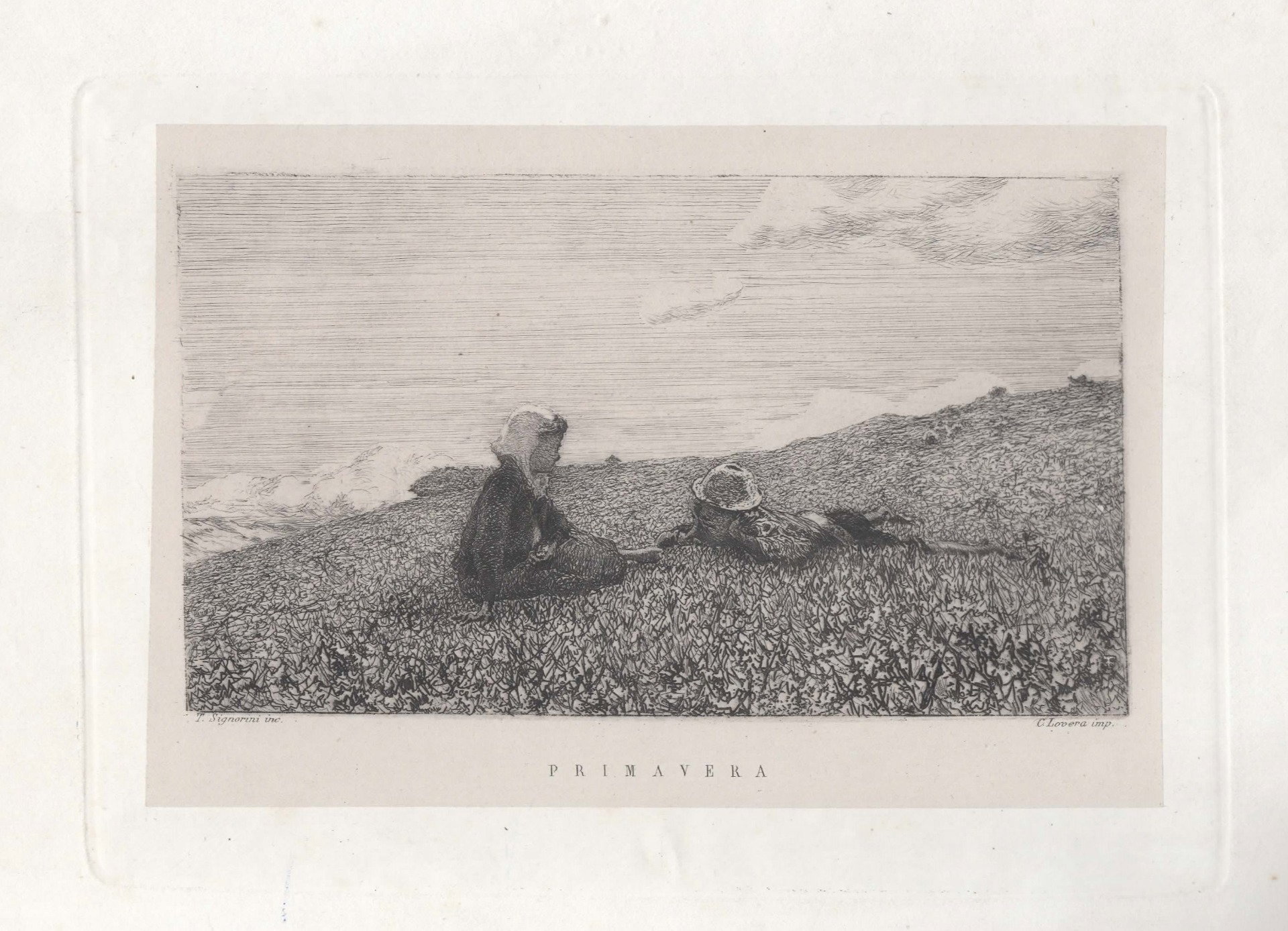
Spring. 1870-1873
Description:
Telemaco Signorini
(Florence 1835 - Florence 1901)
Spring. 1870-1873
Etching
Dimensions: mm 210 x 148
Italian painter and engraver who from a very young age worked alongside his father Giovanni Signorini, a modest but esteemed painter who worked for the Grand Duke of Tuscany Leopold II. At the age of 17, in 1852, he enrolled at the Academy of Fine Arts in Florence. From the start, academic life and the rigid climate of the masters clashed with his rebellious spirit, so in 1856 Telemaco decided to leave the Academy to devote himself to painting "en plain-air" with his friends Odoardo Borrani (Pisa 1833 - Florence 1905) and Vincenzo Cabianca (Verona 1827 - Rome 1902). He began to participate in the meetings of the Caffè Michelangiolo. In those years, Signorini traveled a lot; he visited Venice, Emilia Romagna, Lombardy and, with Cabianca, La Spezia. These Ligurian landscapes contributed to a turning point in his painting, now richer in chiaroscuro contrasts and with a conscious use of the spot as the main element of the figurative language. In 1861 he left for Paris where he became friends with the realist artists of the Barbizon School.
The subject of this etching derives in the same direction and without substantial variations from an oil on canvas painting, datable to around 1870 (cm 39.5 x 50, private collection; see Telemaco Signorini and painting in Europe, Marsilio, Venice 2009, p. 146, n. 65, p. 146, n. 65). Specimen printed on ivory-colored China paper applied to compact white paper. In the engraving below the subject: T. Signorini inc, Primavera, C. Lovera imp. Carlo Lovera was the Piedmontese printer and publisher, protagonist of the revival of original etching in Italy in the second half of the 19th century, as well as publisher of the Turin magazine L'Arte in Italia for which the best engraver artists of the period worked.
Of this work, the Migliavacca catalog describes four states in which the area of the sky is involved in a progressive chiaroscuro work. The last one includes the addition of the writings and the chiaroscuro in the meadow, published in "Arte in Italia" of October-November 1873.
Splendid well-contrasted impression, wide margins. Excellent state of conservation except for minimal thinning of the paper in correspondence with the corners of the sheet.
Bibliography: S. Migliavacca, Telemaco Signorini. First contributions to a catalog of engraved and lithographic works, "Grafica d'arte. Rivista di storia dell'incisione antica e moderna e storia del disegno", a. IX, n. 36, Milan 1998, p. 14, n. 24.