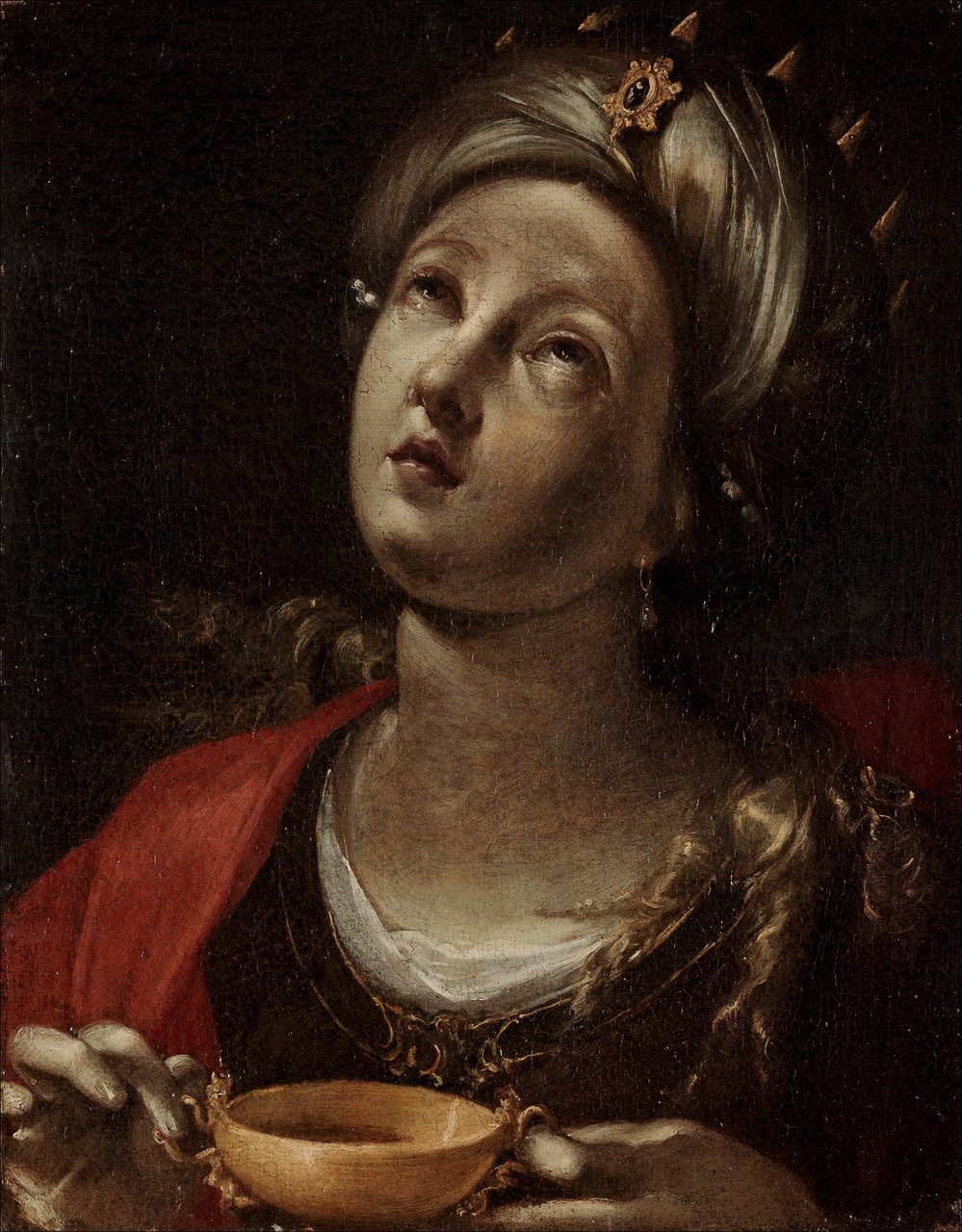
Workshop of Giangioseffo Dal Sole
Suicide of Sophonisba
Oil on canvas, 44 x 35 cm
A cold, almost unnatural light highlights in this small painting the jewels, the ripples of the fabrics and hair, the mouth and tearful eyes of a young queen. Although no spatial element is visible, it is this light that tells us of an interior, an intimate context within which the Suicide of Sophonisba is usually represented.
The queen of Numidia, an ancient North African territory corresponding to present-day Algeria, is depicted with a turban and a golden cup in her hand, as she prepares to drink the poison so as not to surrender as a prisoner to the Roman army. Sophonisba, after the defeat of her husband Syphax, became the favorite of the Berber sovereign Massinissa, but Publius Cornelius Scipio Africanus, fearing that this relationship would lead the Berber people to oppose Rome, threatened to arrest the queen, leading to the tragic outcome carried out by means of the same poison that Massinissa provided to Sophonisba.
Boccaccio extolled Sophonisba's moral virtues in his De mulieribus claris (1362), and together with Cleopatra, Lucretia, and Artemisia, the queen of Numidia is part of the iconographic repertoire of ancient heroines who, although pagan, remained examples of strength, stoicism, and courage, even in the Renaissance and Baroque periods.
The languid eyes turned to the sky, the oval face, reinforced by the volutes of the turban and constructed from ideal characters, far from any portrait, appear typical of the Bolognese pictorial tradition between the 17th and 18th centuries. Distant Reni models are stratified under at least three successive generations of artists, from Cittadini to Pasinelli, up to Giangioseffo Dal Sole, from whose workshop this version should have come, even if it is difficult to recognize a precise hand among those of his pupils. Although the two small canvases kept at the Pinacoteca Comunale of Faenza that perhaps served as examples for the execution of the work in question are attributed to Flaminio Torri, I believe they belong to Dal Sole. I am talking about another Sophonisba and an Artemisia. Our painting has a similar approach while showing less soft and apparently more archaic elements, but these components should be considered as the pledge of a personality in formation, on which distant city traditions reverberate, from Passerotti to Calvaert. I believe that the work dates back to the end of the 17th century and the beginning of the following century.
Bibliography: unpublished
Massimo Pulini