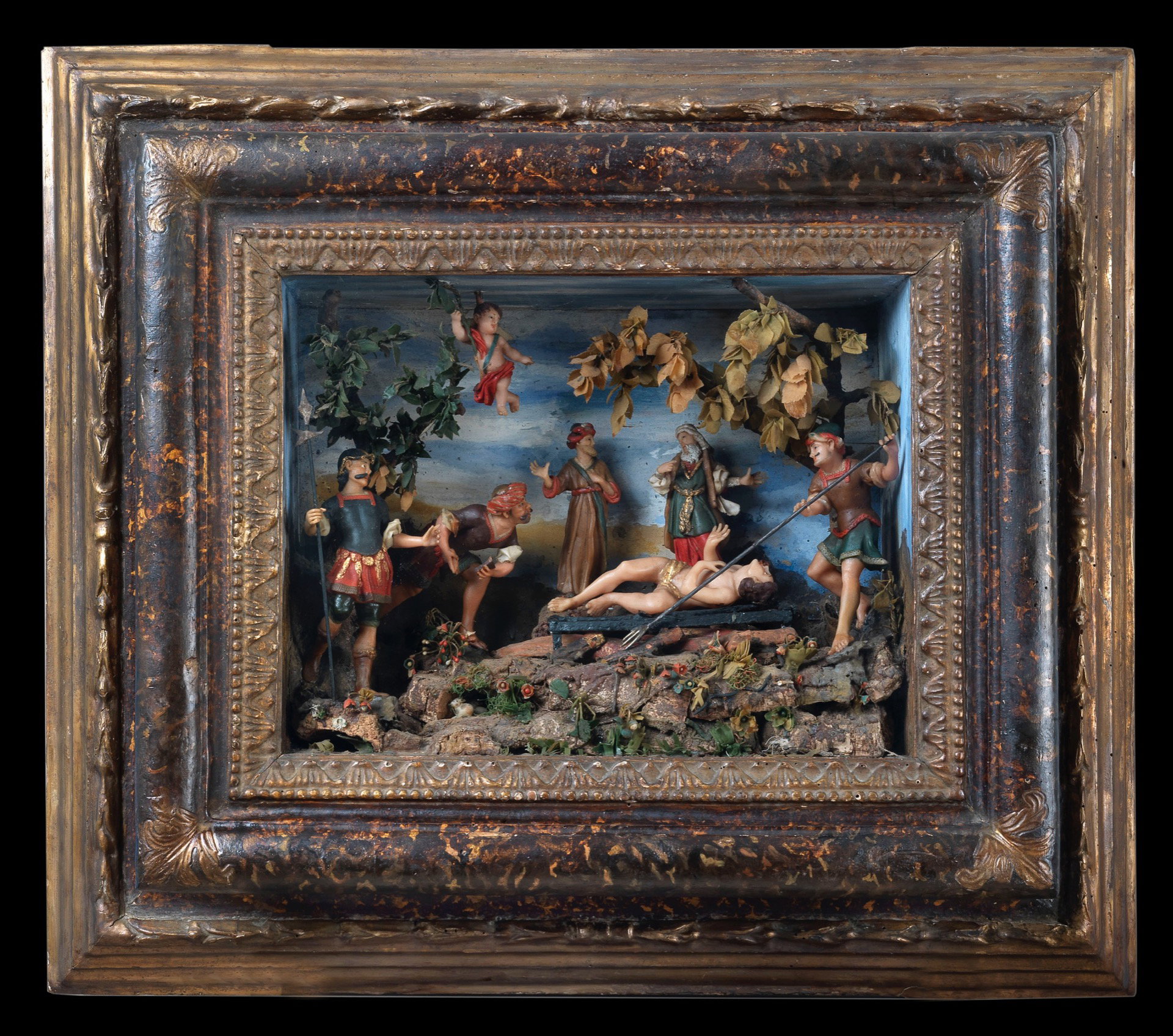
Ignazio Lo Giudice (active 17th-18th century) Martyrdom of Saint Lawrence
Description:
Ignazio Lo Giudice (active 17th-18th century)
Martyrdom of Saint Lawrence
polychrome wax, various materials, cm 70 x 79 approx. 1710
Provenance: Palermo, Alessi collection
The scene, set in a space delimited by tree "wings", depicts the martyrdom of Saint Lawrence, a frequently preferred episode among the representations of the martyr of Spanish origin, but here strongly secularized, almost completely devoid of the dramatic component required by the event. The saint is placed on the gridiron and is about to turn onto his other side, recalling his observation made during the torture: "See if I am cooked enough on this side, and turn me over and cook me on the other" (cf. J. Hall, Dictionary of Subjects and Symbols in Art, Milan 1989, pp. 181-183). Around him are his torturers, one of whom is fueling the fire, while the prefect and another witness observe the scene centrally. A fluttering winged putto surmounts the depiction. The interesting work, to be attributed to Ignazio Lo Giudice, is one of the few valuable remaining testimonies of the enormous production of wax artifacts of the 18th and 19th centuries. This dispersion, as Antonino Uccello has observed, is due both to the fragility of the material and to the little attention paid to this form of art, considered an expression of a minor craftsmanship (A. Uccello, The Popular Nativity Scene in Sicily, Palermo 1979, pp. 64-67). The skilled wax modeler is one of the members of the Lo Giudice family, active or originally from the city of Agrigento between the end of the 17th century and the first decades of the subsequent century, until just over a decade ago completely ignored and rediscovered thanks to the discovery of numerous dated and signed works in private and conventual collections and in the antique market (S. Grasso - M.C. Gulisano, Miniature Worlds: Artistic Waxes in 18th-Century Sicily, Palermo 2011, pp. 53-68; R.F. Margiotta, Lo Giudice Ignazio, in Decorative Arts in Sicily. Biographical Dictionary, edited by M.C. Di Natale, Palermo 2014, I, p. 373). As Santina Grasso and Maria Concetta Gulisano observe: "No indication comes to us from the location of the works, which we find both in the Palermo and Agrigento areas, but the absence of a documented wax modeling tradition in the city of temples" might suggest that the Lo Giudice workshop was located in Palermo, even if the artifacts received show technical and stylistic peculiarities different from the contemporary Palermo production (S. Grasso - M.C. Gulisano, Miniature Worlds..., 2011, p. 53). The artist's technical ability is evident in the work under examination in the rendering of details, especially in the definition of the clothes meticulously embellished in solid gold. These details, in addition to the pose and gestures of the characters, contribute to creating, as in other similar representations, almost the effect of a theatrical performance rather than evoking a purely sacred scene. The work, already at the Roman Galleria Carlo Virgilio & Co., attributed to Lo Giudice and dated to around 1710, but remembered as the Martyrdom of Saint Bartholomew, had been made known by Aleth Mandula (Incarner les mystères de la foi. Proto-Dioramas, une histoire religieuse, in Dioramas, exhibition catalog [Paris, Palais de Tokyo, June 14 - September 10, 2017; Frankfurt am Main, Schirn Kunsthalle Frankfurt, October 6, 2017 - January 21, 2018] edited by K. Dohm, C. Garnier, L. Le Bon, F. Ostende, Paris 2017).
The first of the artifacts attributed to the Agrigento artist is the Vision of Saint Eustace inserted inside a tableau, with a cartouche bearing the inscription: "Artis medicine D(octo)r D(on) Ignatius di lo Giudi- ce Agrigentinus / 1712" (S. Grasso - M.C. Gulisano, Miniature Worlds..., 2011, p. 53; R.F. Margiotta, An Inventory of Don Aurelio Bona Fardella, Baron of Giardinello, in Art Itineraries in Sicily, edited by G. Barbera and M.C. Di Natale, Naples 2012, pp. 202-203), a profession that had probably given him experience in wax modeling applied to anatomical studies. The valuable artifact, still kept by the Bona family of Giardinello, is to be identified with one of the five "shelves with their carved ebony and gilded with gold frames in one of which there is Santa Rosalia with its pedestal", the latter unfortunately stolen a few decades ago, listed in the post-mortem inventory of Don Aurelio Bona Fardella, Baron of Giardinello and academic of Buon Gusto, dated December 9, 1774 (R.F. Margiotta, An Inventory..., in Itineraries..., 2012, pp. 202-203). To the same series belongs Saint Jerome in the desert, also inserted in a scenic space delimited by dense vegetation, which differs from the Vision of Saint Eustace mainly for a more subdued color probably to simulate the desert setting (S. Grasso - M.C. Gulisano, Miniature Worlds..., 2011, p. 57).
For the strong affinities with the works mentioned above, four wax compositions, inserted in as many showcases, sold at the Semenzato Auction House, coming from a private collection of Sciacca in the province of Agrigento (Ibidem) and attributed until then to Anna Fortino (1673-1749), a skilled wax modeler from Palermo, have been referred to Ignazio Lo Giudice (F. Chiappisi, Wax Modeling Art, in Sciacca Worthy City, Sciacca 1984, pp. 131-137, in part. 130-131; Idem, Wax Modeling Art in Val di Mazara in the 18th and 19th Centuries, in "Trapani. Review of the province", a. XXIX, n. 261, 1985, pp. 13-24, in part. p. 21. On the artist see M. Vitella, Fortino Anna, in Decorative Arts..., 2014, I, p. 256 with prec. bibl.). The refined artifacts, remembered as the Massacre of the Innocents, Saint Martin Offering His Cloak to the Poor (?), the Martyrdom of Saint Sebastian and Saint Rosalia (Semenzato Auction House, Painted Furniture and Objects from Neapolitan and Kingdom of the Two Sicilies Collections, Ercolano June 16, 2000, lot n. 244), in reality Santa Maria Maddalena in prayer, the latter dated 1705, could draw inspiration, as has already been observed, from the famous small theaters of Giacomo Serpotta or from "those forms of theatrical representations - literary comedies and sacred representations up to the commedia dell'arte - that at that time were very successful" (cf. S. Grasso - M.C. Gulisano, Miniature Worlds..., 2011, pp. 57-58). The memory of "that unreal and fantastic world described in chivalrous poems" that was so successful in past centuries emerges, "not only in the literary field, but also in the musical and visual arts, a repertoire spread at the level of images also in Sicily through a vast circulation of prints illustrating the poems of Ariosto and Tasso" (Ibidem).
Among the works attributed to Ignazio Lo Giudice is the Stigmatization of Saint Francis, made in the first decades of the 18th century and kept in the convent of the Capuchin Fathers of Caccamo, which due unfortunately to recent tampering no longer preserves the original cartouche with the references to its author, visible, however, in an archive photo of 1981, but referable to him for the strong affinities with other artifacts of certain attribution (S. Grasso - M.C. Gulisano, Miniature Worlds..., 2011, p. 65).
Nicola and Vincenzo Antonio Lo Giudice, members of the same family, respectively signed in 1702 two wax compositions inserted in rich
3. Ignazio Lo Giudice, Massacre of the Innocents, 1705, antique market
4. Ignazio Lo Giudice, Saint Martin shows the cross to the enemies, 1705, antique market
landscape representations of the Benedictine monastery of San Martino delle Scale near Monreale. The two showcases bearing the signatures hosting the Rest during the Flight into Egypt and the the Stigmatization of Saint Francis, to these should be added two other tableaux without the indication of the artists, San Sebastiano and a Santo martire, but that for the affinity of language can be ascribed to the same prolific workshop (S. Gras so - M.C. Gulisano, Miniature Worlds..., 2011, pp. 62-64).
The stylistic assonances with some works by Caterina De Jiulianis make us hypothesize contacts of the Sicilian wax modelers with the Neapolitan environment if not even a direct knowledge of this artist (S. Grasso - M.C. Gulisano, Miniature Worlds..., 2011, pp. 67-68).
Rosalia Francesca