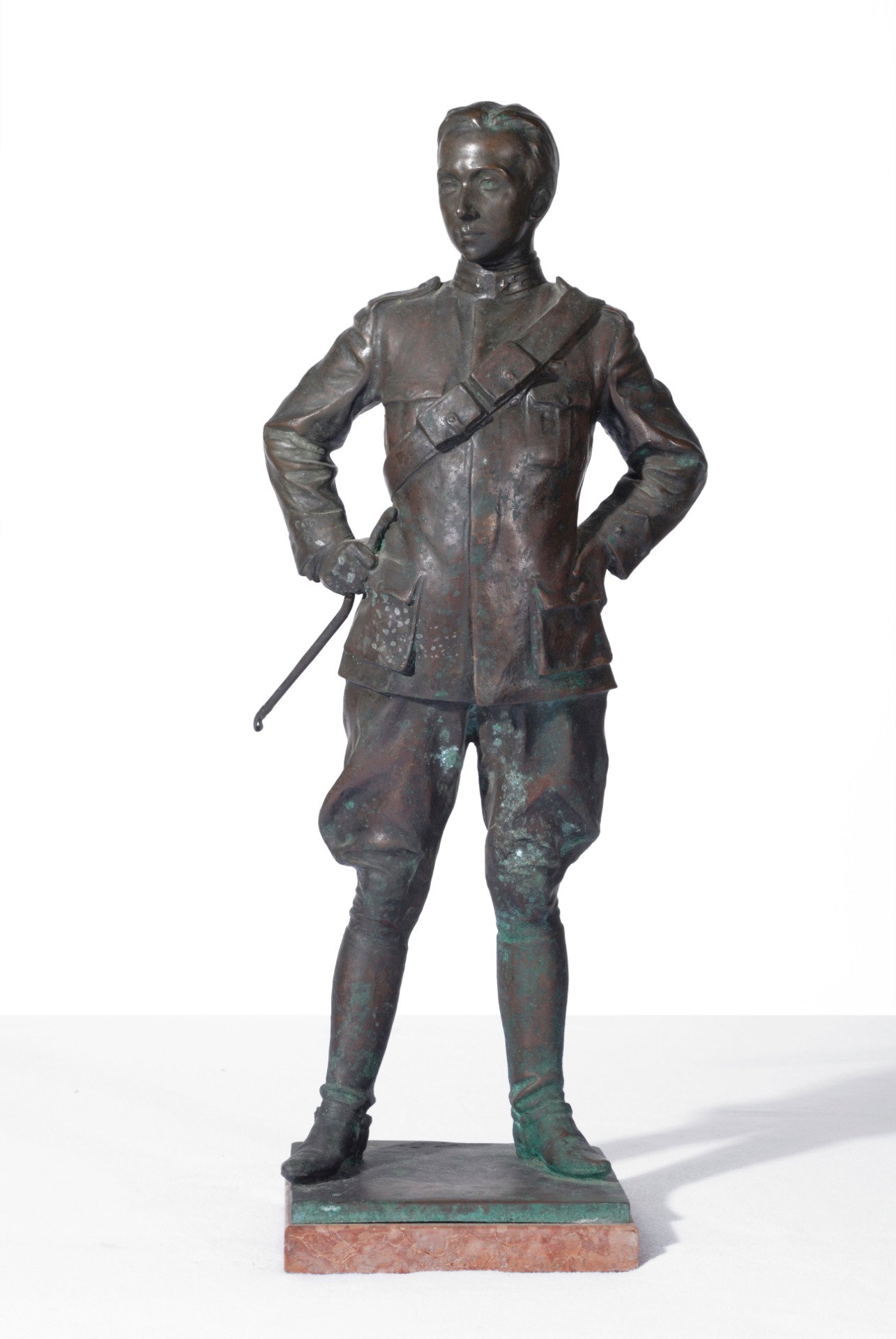
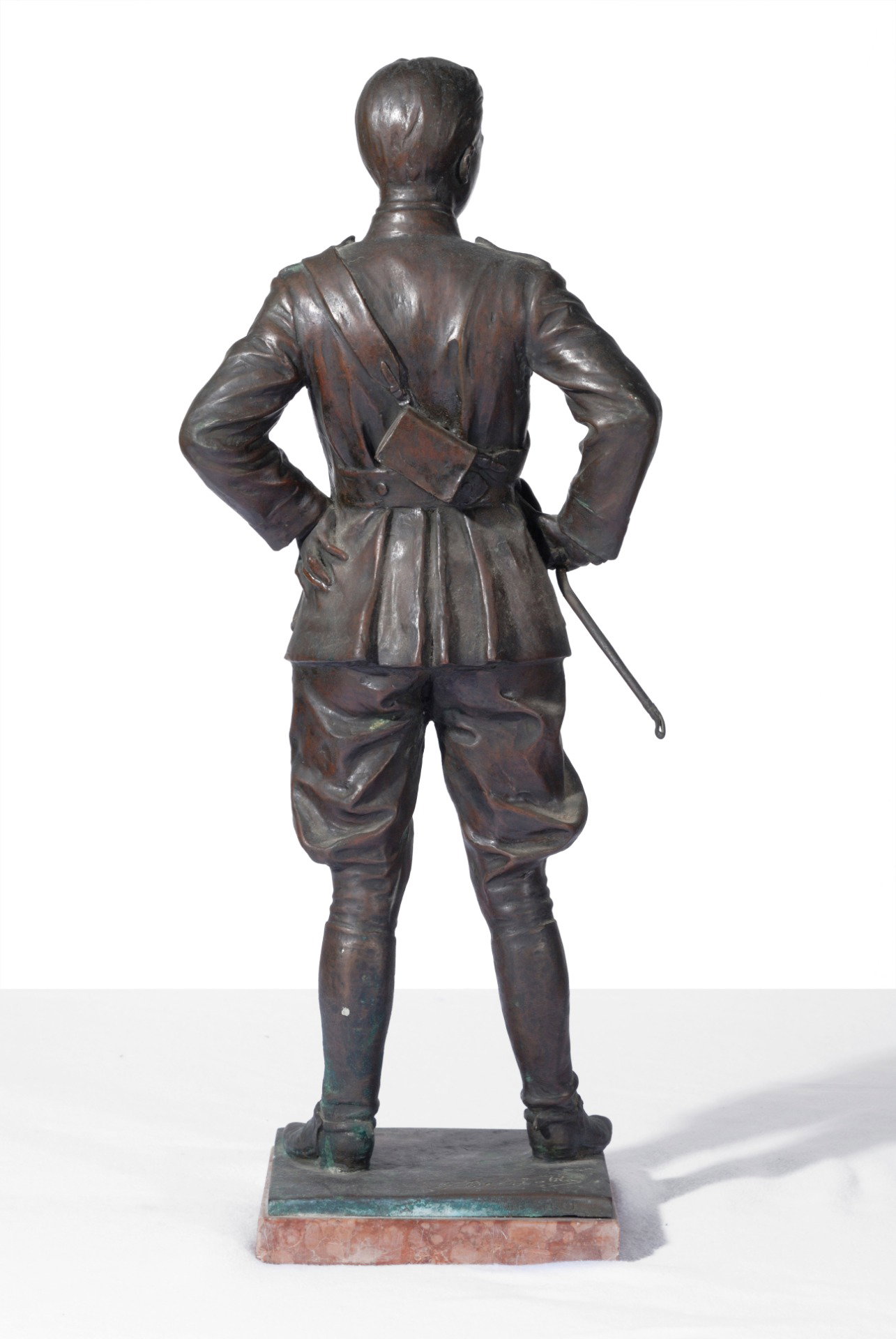
Annibale De Lotto, Soldier of the First World War, bronze, circa 1923.
Description:
Annibale De Lotto
(San Vito di Cadore, 1887 - Venice, 1932)
Soldier of the First World War
Circa 1923
Bronze
Dimensions: h. cm. 54.3 x 17.2 x 14
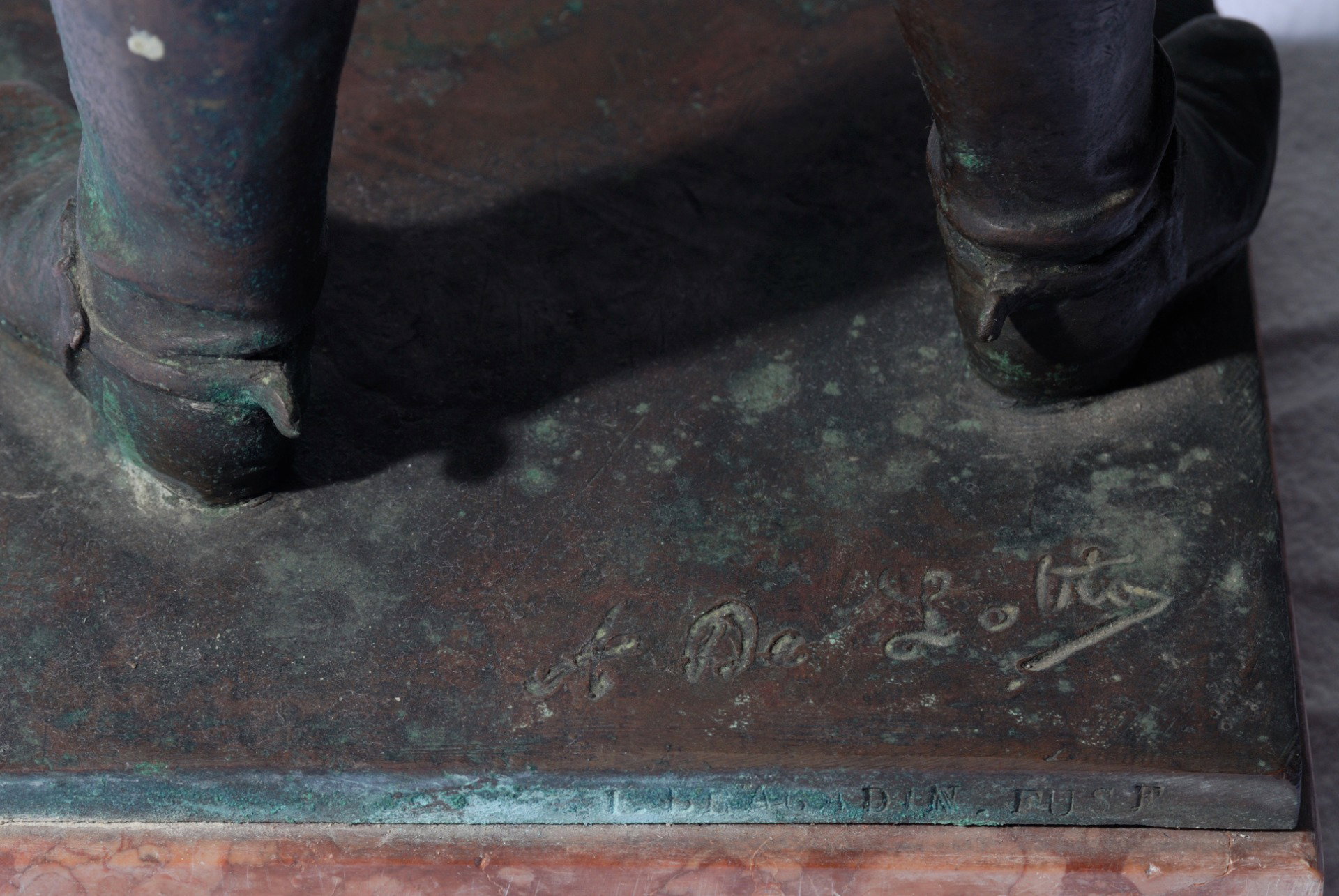
Inscriptions on the base: "Annibale De Lotto" and "I. BRAGADIN. FUSF".
De Lotto enrolled in 1891 at the academy of fine arts, attending a preparatory year, three common years and two years of sculpture, during which he had Antonio Dal Zotto as his teacher, of whom he became the favorite student. After an interruption due to two years of military life, he modeled the bust of Mestizia for the Rome exhibition of 1900, a figure of a boy entitled In flagrante and a Didone.
Also in 1904 he reappeared at the Milan Triennale with the Damned (Cassa di Risparmio di Belluno) and created an Eve. In those years, D. was making a name for himself for his celebratory and monumental statuary production and for portraiture: he won the competition for a monument to Umberto I for the Municipality of Belluno, created the bronze busts of Vittorio Emanuele III, for the council chamber in the palace of the prefecture of Venice and for the military club of the same city, and the portraits of Luigi Sugana for the Goldoni theater in Venice, for the headquarters of the "Tarvisium Venetiae" and for the Teatro Sociale of Treviso.
In 1903 he participated for the first time in the Venice Biennale, now in its fifth edition, exhibiting the statue of a boy entitled Pure Linfe, which was purchased by the government for the National Gallery of Modern Art in Rome, where it is currently located. For the same exhibition, at the invitation of the committee, he modeled the two figures of Justice and Liberty for the press room. Subsequently, the sculptor was invited to all editions of the important Venetian event until 1924. In 1905 he sent a group of three figures entitled Ilvortice and a bronze nude, Incidente, which was donated by the Association of Industrialists and Traders of Venice to the Gallery of Modern Art recently inaugurated in the Ca' Pesaro headquarters.
In the following years he created a series of celebratory sculptures: the monuments to Carducci (1912) and Oberdan (1921) in the public gardens of Venice, the Monument to the Alpini of Belluno (1914), the bronze medallion with the portrait of the musician G. B. Zorzato in the Accademia theater of Conegliano (1914), the portrait of the prelate G. Previtali (1919) in the church of S. Salvador in Venice. During the First World War, after Caporetto, he was transferred to Chieti and in this city he left a relief with the Lion of Saint Mark (1918) in the atrium of the Municipality.
His post-war production, in which our bronze depicting a soldier is included, consists mainly of numerous monuments to the fallen of the war, requested by various municipalities of the Veneto and private individuals.
Among the other numerous works of the sculptor, named academician of the academy of fine arts of Venice and honorary academician of the academy of Carrara, we remember: the Bottacin and Mazzariol funeral monuments in the cemetery of Venice, Carlotti Canossa in Verona, Pospisil in Padua; the statue of Dolore in the cemetery of Lugo di Romagna; the Redentore in the cemetery of Feltre; the Lion on the door of the Santi Quaranta in Treviso; the portrait of Senator Luigi Pastro for the Municipalities of Treviso and Venice; the portrait of Mons. Arcangelo Busicchia in the cathedral of Conegliano and the Pietà in San Vito and Santo Stefano di Cadore.
(Taken from M.T. De Lotto, s.v. De Lotto, Annibale, in Dizionario Biografico degli Italiani, Rome, 38, 1990)
Literature and Bibliography:
E. Marini, Venice ancient and modern, Venice 1905, p. 291; G. G. Villanis, Profiles of artists. A. D., in Venetian Almanac, 1914, pp. 258-66; Catalog of the extraordinary exhibition in the palace of the Exhibition at the Public Gardens, Venice 1921, p. 24; P. A. Corna, Dictionary of the history of art in Italy, I, Piacenza 1930, p. 320. G. Bigaglia, Among the disappeared artists: the sculptor A. D., in Pro familia, 20 August 1933, p. 551; A. Riccoboni, Rome in art. Sculpture in the modern age, Rome 1942, p. 581; F. Scarpabolla, Twenty years after the death of A. D., in Il Gazzettino [Venice], 21 Nov. 1952; E. Lavagnino, Modern art from the neoclassicists to the contemporaries, II, Turin 1956, p. 693; A. Tocchio-V. Chiesura, Conegliano and its activities, Conegliano 1962, pp. 34, 61, 64; G. Fabbiani, Churches of Cadore, Belluno 1964, pp. 20, 65, 131, 163 ff., 184 ff., 221; M. F. Belli, San Vito di Cadore with the diary of the Austro-German invasion, Belluno 1976, p. 127; G. Fabbiani, Brief history of Cadore, Belluno 1977, pp. 173; M.T. De Lotto, s.v. De Lotto, Annibale, in Dizionario Biografico degli Italiani, Rome, 38, 1990; M. De Grassi, Annibale De Lotto (1877-1932), Edizioni della Laguna, Mariano del Friuli, 2003; M. De Grassi, The heroes are all young and beautiful. The image of the soldier between rhetoric and reality. 1870-1935, EUT-Edizioni Università di Trieste, 2016, pp. 259, 288, fig. 37.
Visit our gallery's website