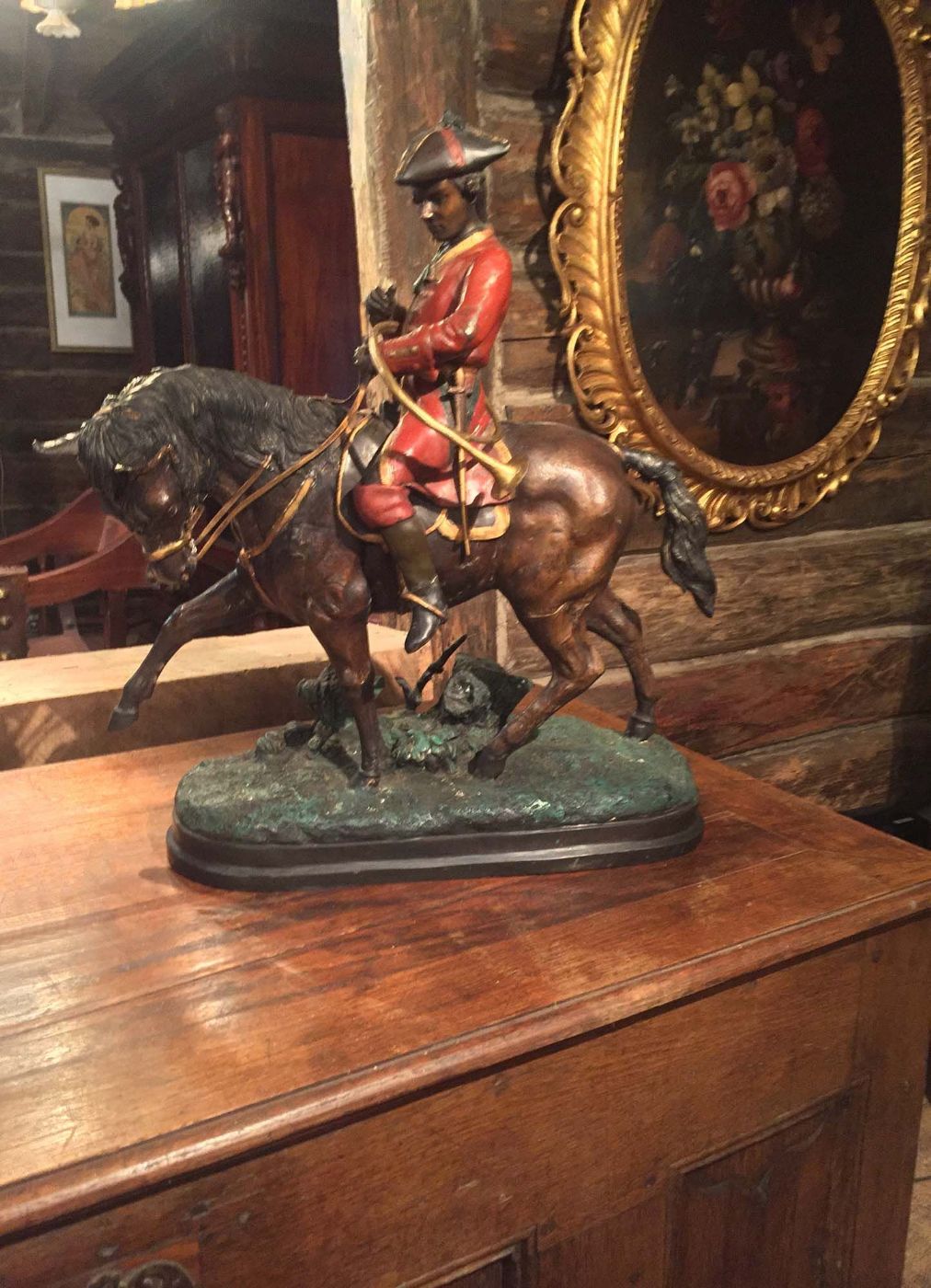
Beautiful cast bronze sculpture, made using the sand casting method, depicting a piqueur or "dog handler" in Louis XV hunting attire with a horn.
The horse is very well made, plastic and elegant, with an interesting anatomical study, "photographed" in its current pose, with its right front leg elegantly raised. Note the highlights, a specialty of the artist and his father, of the tense and contracted muscles in action.
The exquisite sculpture of his rider (piqueur) is no less impressive. Note the accuracy in the depiction of the face, the movement of the body on the horse, and the hunting attire of the Louis XV period; red coat with gold borders and large cuffs, dark leather boots, and the typical tricorne hat on the hair tied in a "ponytail". The hunting horn rests on the left shoulder.
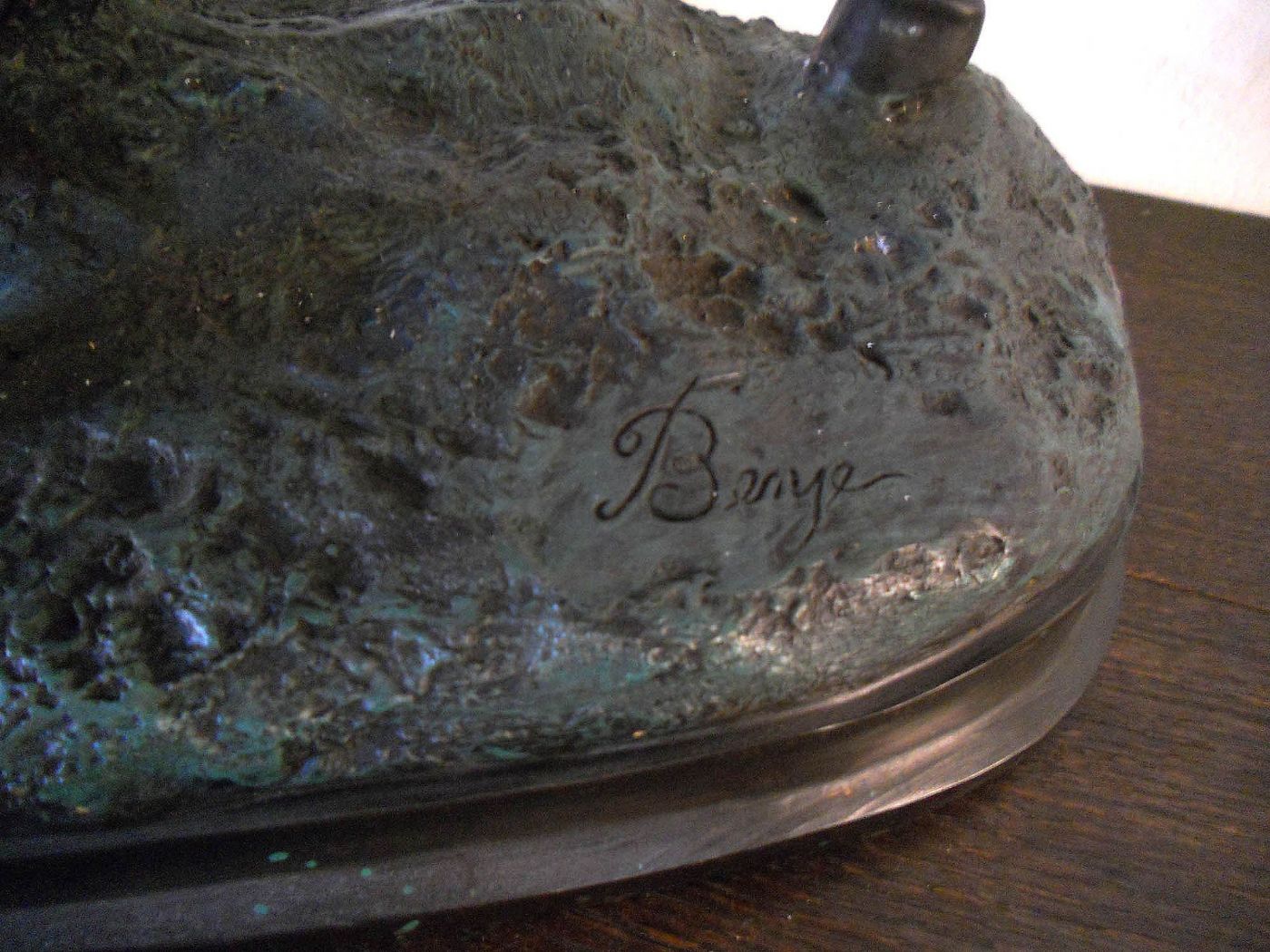
The horse and rider rest on a pedestal representing a meadow with small shrubs painted green. The signature "BARYE" is placed on its back.
France – Second half of the 19th century
Measurements: Height cm. 60 - Width cm. 60 - Depth cm. 21
Notes: from the <Treccani> Encyclopedia
Piqueur (bracchière s. m. [der. of bracco]. – One who guides and has custody of the dogs on hunting trips, also having the task of driving game towards the stands by means of sounds, shots and other noises. who during the hunt has the task of flushing out game by scaring it with noises] ≈ beater,)
Critical essay and biographical notes on the author:
Alfred Barye was born in Paris on January 21, 1839, and died in Paris in 1882. He was the son of the famous sculptor Antoine-Louis Barye (Paris, 1796 - ivi, 1875), famous for his realistic representations of animals made in bronze. Alfred learned the trade of animal sculptor under the watchful eye of his father, becoming an internationally renowned sculptor during the Belle Epoque period.
The two Baryes did not always get along; there were times when father and son did not speak to each other because the younger Barye sometimes signed some of his bronzes as "A. Barye". A habit that Barye senior opposed because it obviously created confusion as to which of the two Baryes had created the sculpture. Despite being an artist in his own right, he struggled to create his own identity while living in the shadow of his more famous father. The vast majority of his pieces are signed "A. Barye, fils" while some are marked only with "Barye" (like our work) or "A. Barye". Most of the sculptures that came out of Barye Jr.'s foundry were cast using the "sand casting" method rather than "lost wax" castings. Alfred typically used patinas with medium brown color tones (as in our case) but sometimes added green (a color for which his father was famous) with copper tones in the patination process. Any Barye bronze - from father to son - generally features a refined patina. Antoine-Louis was particularly accurate with the patination of his pieces and would never allow other foundries to perform it, preferring to do it himself. Alfred also never allowed a sculpture to leave his workshop without a perfectly applied and visually pleasing patina.
Alfred Barye created a collection of bronze sculptures and focused his attention on racehorses or horses in motion. He was known for the great attention to detail that characterized his bronzes. One of the best known is "The Arab Warrior Knight on Horseback" (1890-1910, made in Paris, height 87 cm, width 61 cm, depth 30 cm) which he executed in collaboration with Émile-Coriolan Guillemin
Barye also made a series of sculptures of birds and genre figures. He received many awards and the "honorable mention" in the 1897 Salon for the work "Aide Fauconnier Indien, Retour de Chasse à la Gazelle". Alfred Barye's final admission to the Salon de Louvre took place in 1882.
His bronzes are present in many private collections and museums:
Louvre Museum, Paris. Musée d'Orsay, Paris.
Brooklyn Museum, New York City.
Fogg Museum, Harvard Art Museums, Cambridge, Massachusetts.
Busch – Reisinger Museum, Harvard Art Museums, Cambridge, Massachusetts.
Arthur M. Sackler Museum, Harvard Art Museums, Cambridge, Massachusetts.
Museum of Modern Art of São Paulo, Brazil.
The Israel Museum, Jerusalem, Israel.
https://www.romagnavirtualtour.it/virtual-tour-palazzo-del-buon-signore/
In a time when it is not possible to move much, we thought of having our Palazzo del Buon Signore antique art gallery (www.palazzodelbuonsignore.com) visited by those who love antiques. The idea is precisely that of a real Virtual Tour. Enter our gallery, stroll through our rooms, linger over the objects you like best, looking up to "enter" with your gaze inside our chandeliers! Resume the visit letting yourself be seduced by curiosity! At the end of the visit you will have a surprise that has to do with .... dreams!