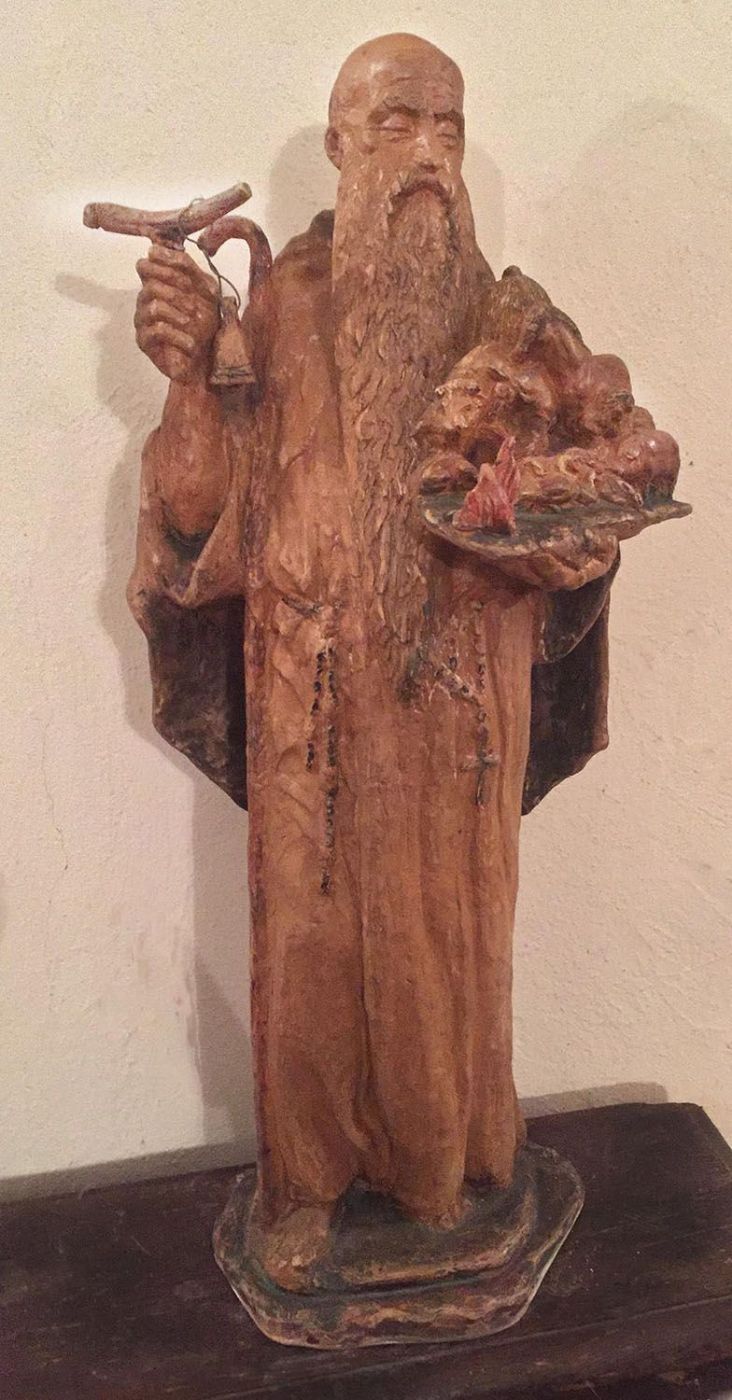
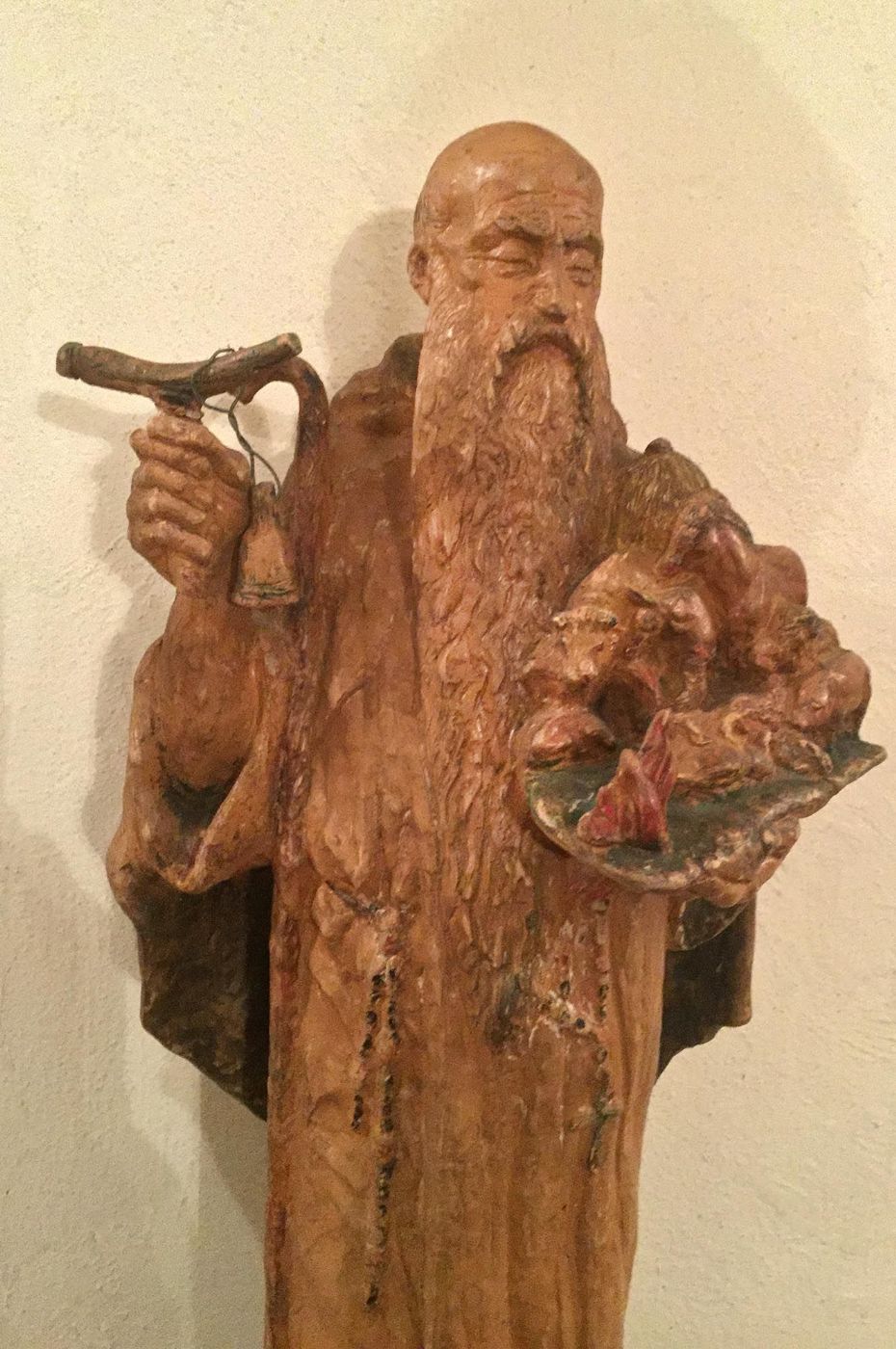
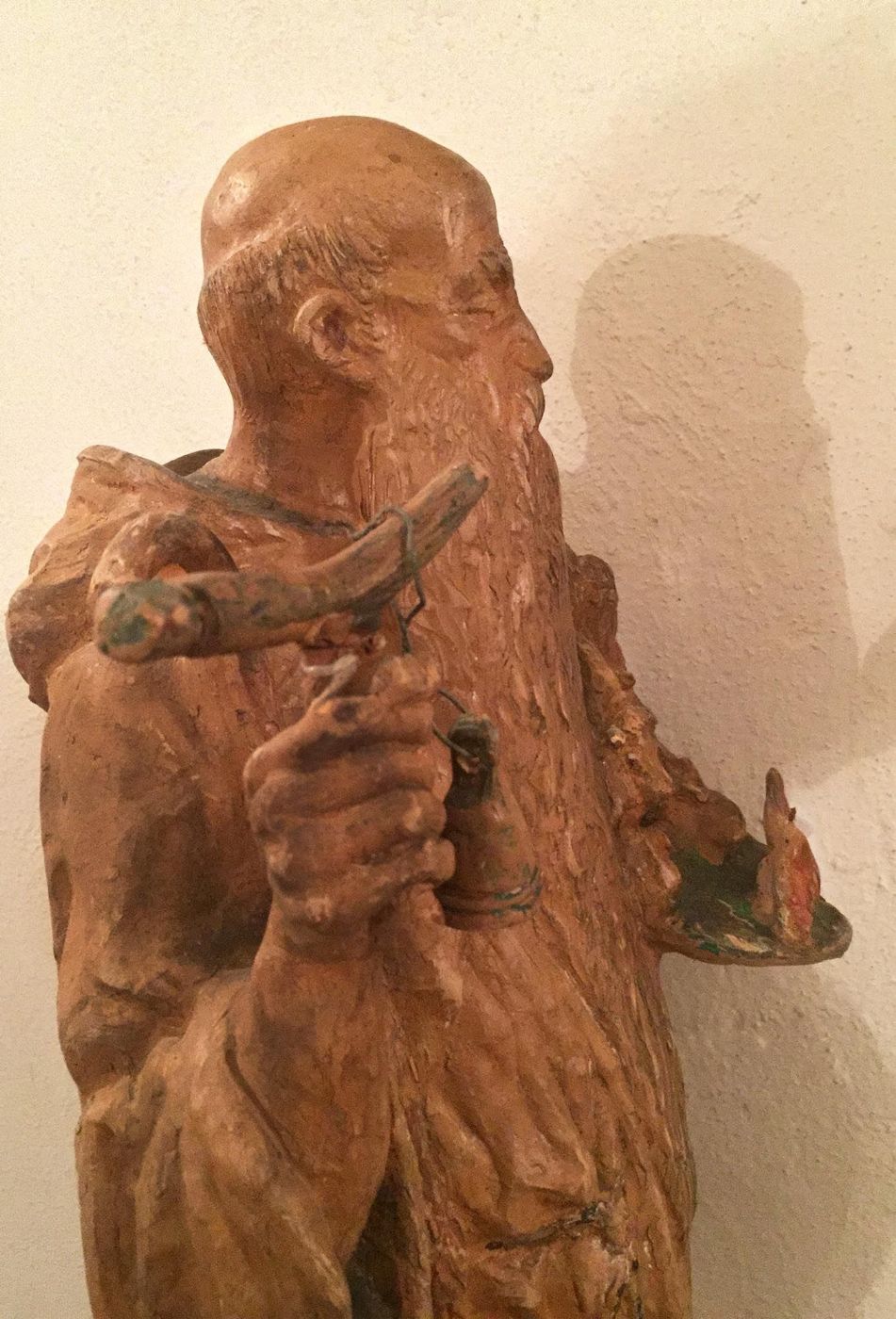
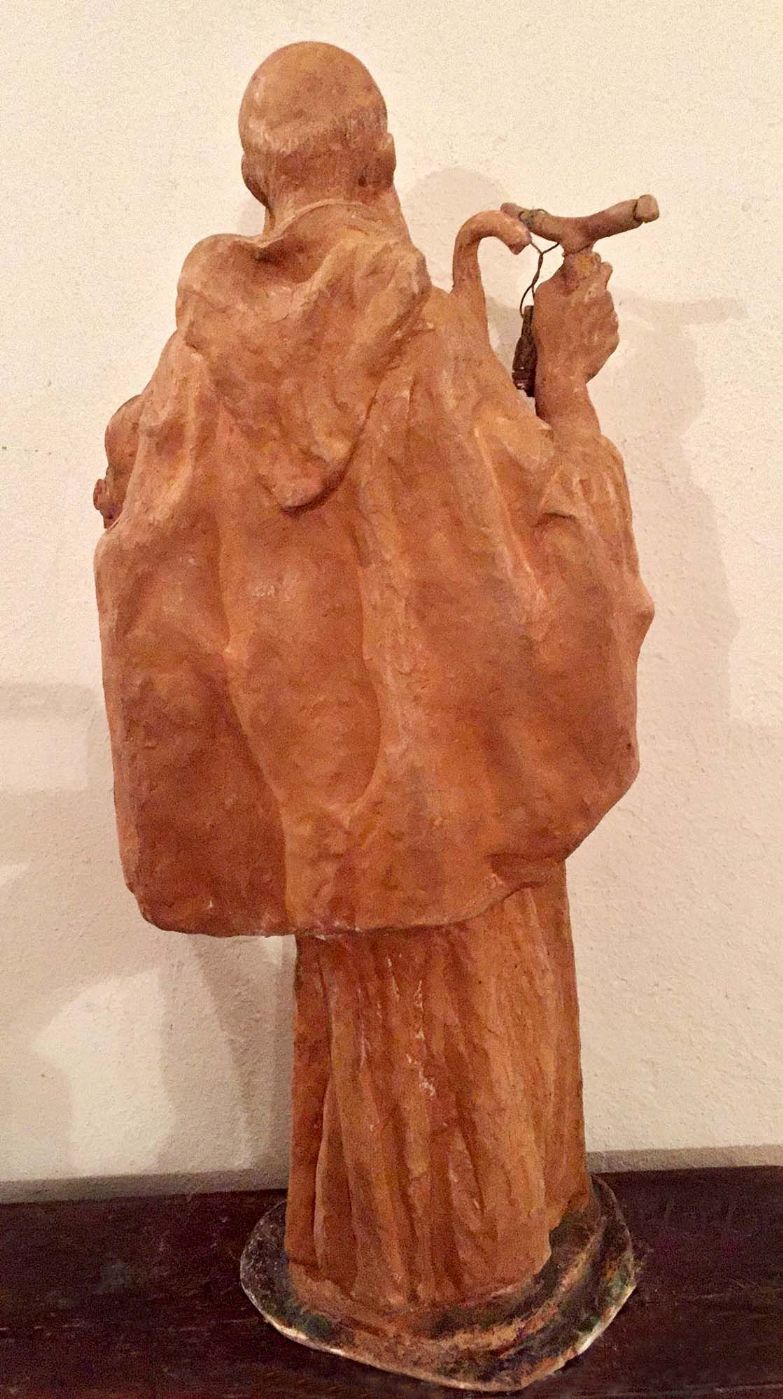
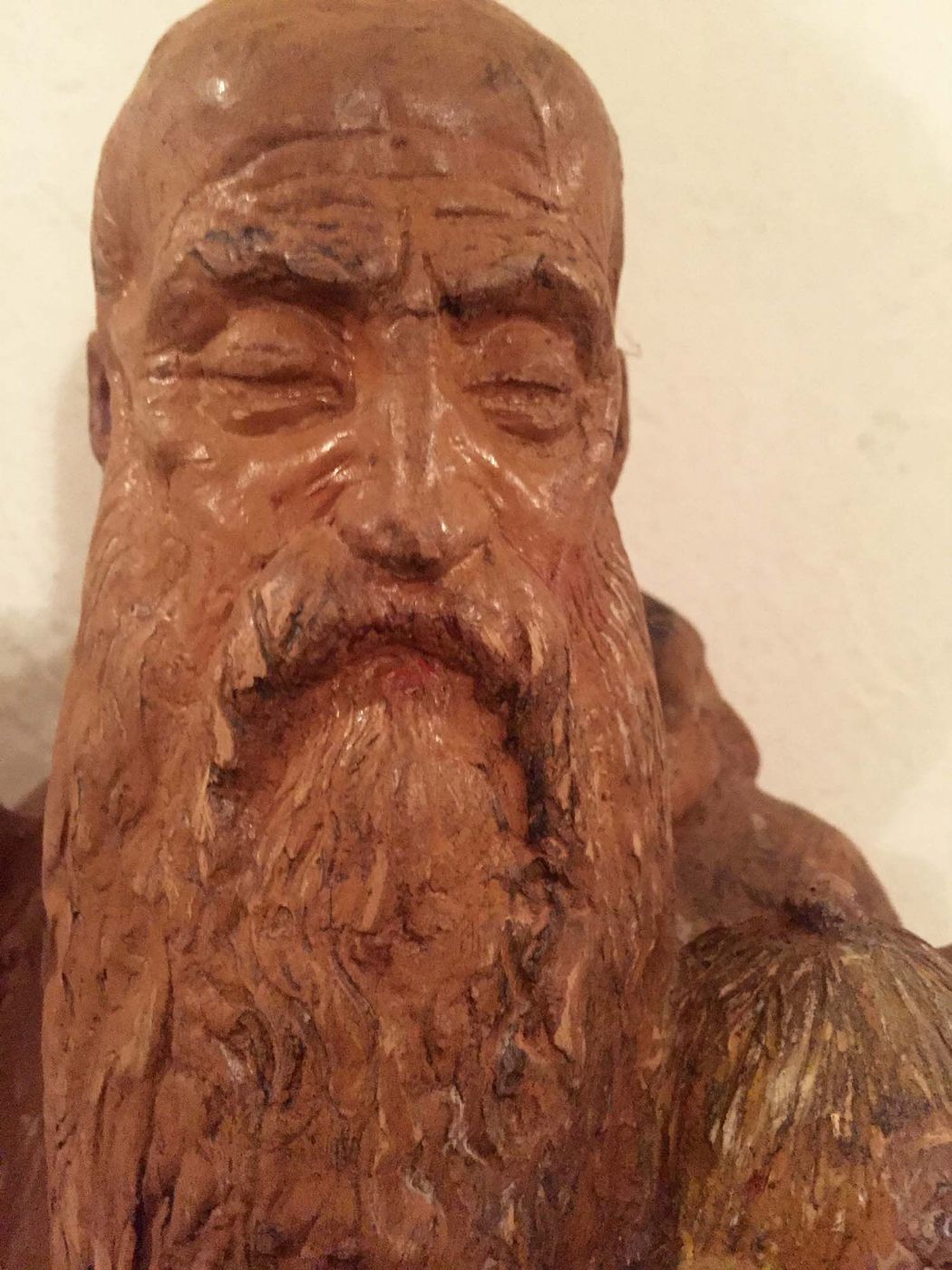
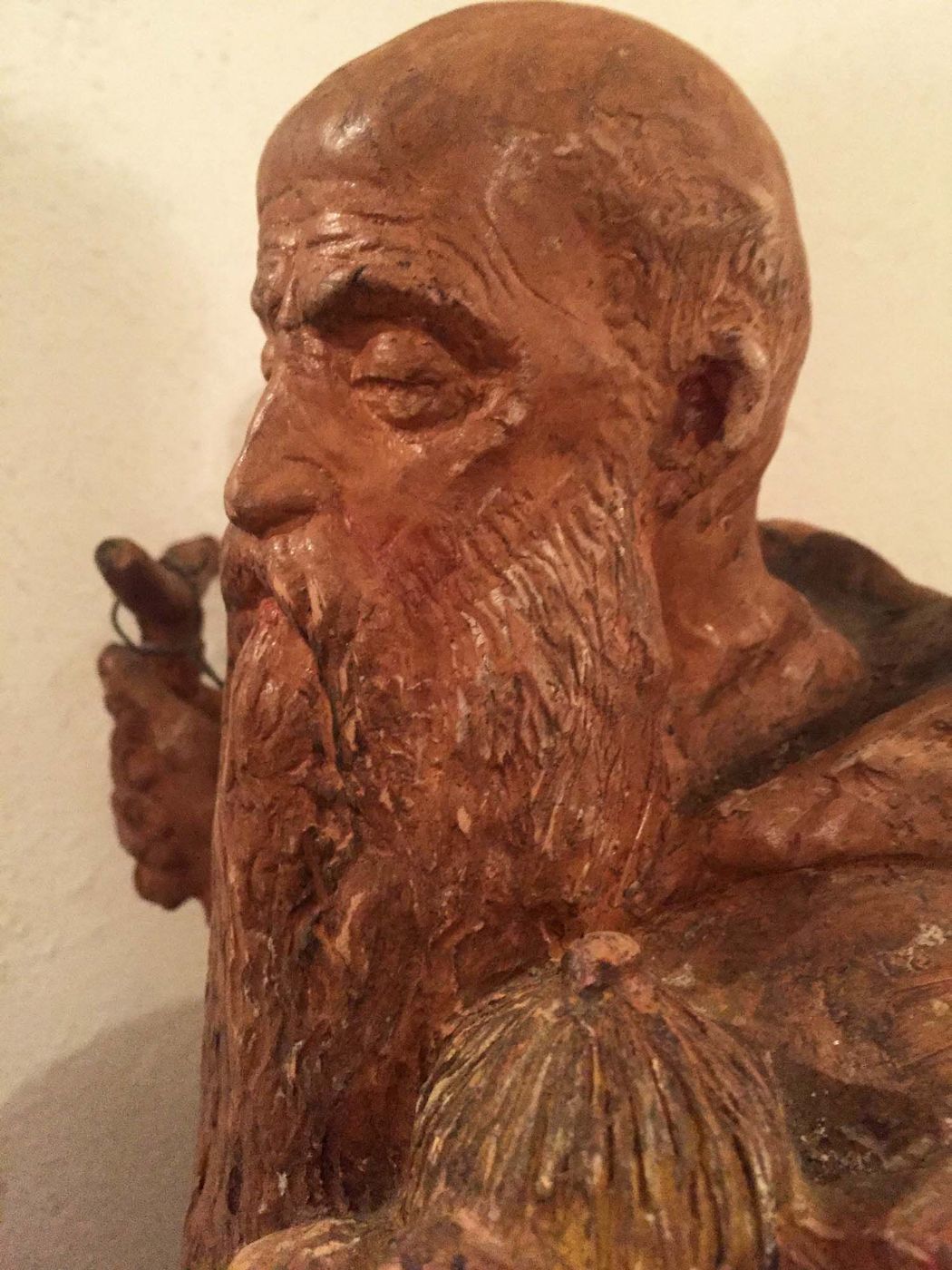
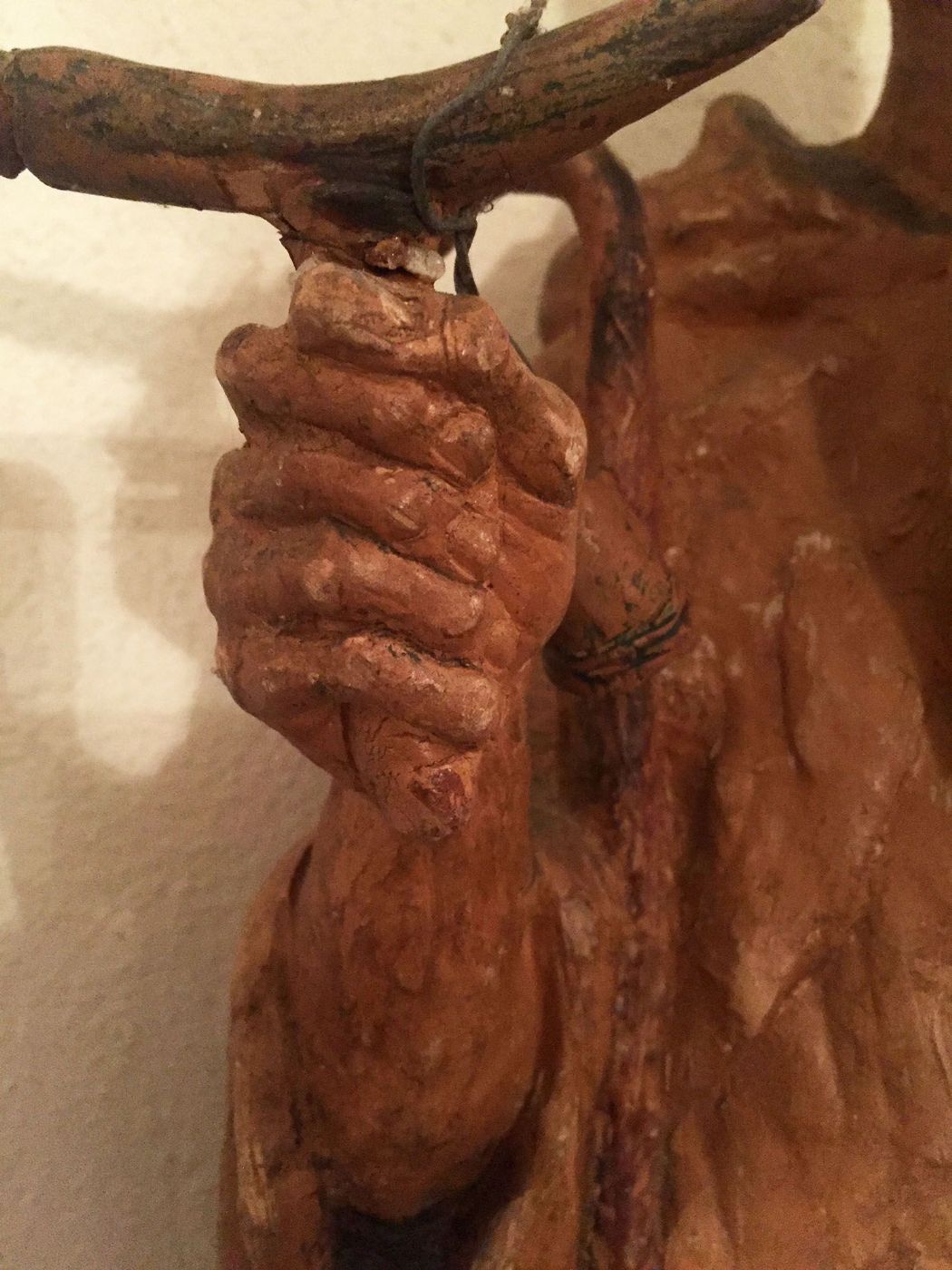
Beautiful Faenza terracotta sculpture representing Saint Anthony Abbot.
The Faenza sculptor has made the figure of the Saint truly realistic, managing to shape his face in a wonderful way and giving the right proportions to the entire figure. He has represented him in his classic iconography, an elderly monk with a long (white) beard dressed in the friar's habit with a hood, the Rosary hanging from the rope with which the monks gird their robes. In this image, the staff is not held in the Saint's hand but rests against his body at the height of his right shoulder, while in his right hand, exceptionally sculpted by the sculptor, he holds the Tau tightly, a symbol that recalls the Cross of Christ or the Egyptian cross, an ancient symbol of immortality, or of ancient Greek derivation "thauma," meaning "prodigy" (this symbol is also found in the Franciscan order). Another symbol is the bell, hung on the Tau, with which the monks announced their arrival or during their collections.
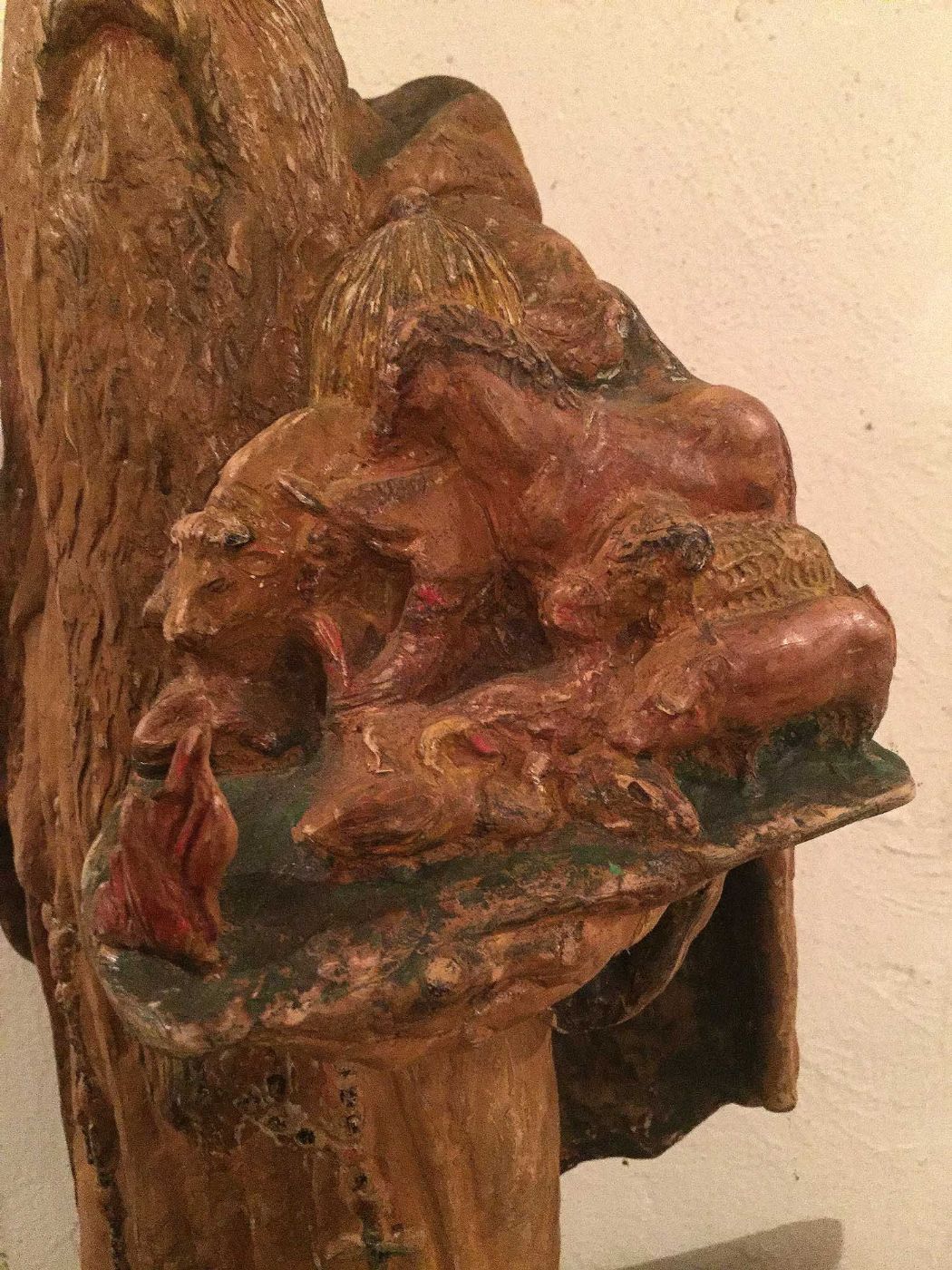
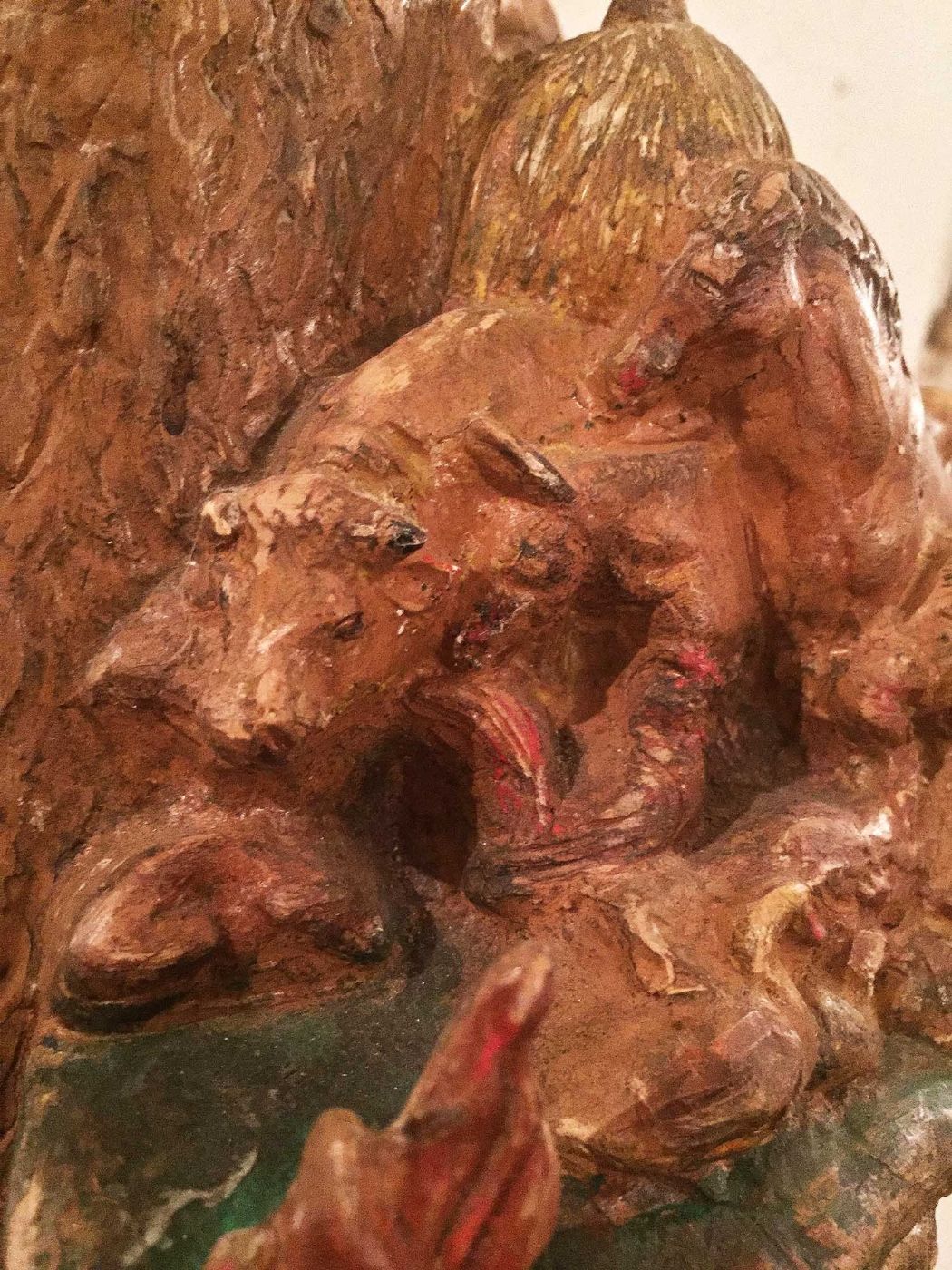
Saint Anthony Abbot is also known as the protector of domestic animals. The Faenza artist did not want to follow the classic iconographic representation of the Saint but has brought together on a "support" held on the Saint's open left hand, the animals of the farmyard, stable, and countryside, represented by the sheaf of wheat placed behind. One can recognize a ram, a horse, a donkey, a bull (perhaps a tribute to the land of Romagna, known for the Romagnola breed of cattle), a dog crouching at his feet, a rooster with its beautiful red crest (another reference to Romagna), and other birds. But the animal that stands in front of everyone is the pig, always present in the classic iconography of Saint Anthony Abbot along with the fire, placed here in the foreground and painted.
In the history of the Saint (below) the origins of the Saint and his symbols that accompany him in the various representations over the centuries are explained exhaustively. On January 17, the day of his death, it is tradition to bless domestic animals and those housed in stables, placing them under the protection of the Saint.
Faenza - 20th century.
Measures: Height 63.0 cm. Width 27.0 cm. Depth 23.0 cm (at the level of the "support").
€ 1,800.00
History of Saint Anthony Abbot
Anthony was born in Coma in Egypt (modern-day Qumans) around 251 to a family of wealthy Christian farmers. Orphaned at the age of twenty, with a sister to care for and a substantial estate to manage, he felt the vocation to dedicate his life to the Lord.
After entrusting his sister to a female community, he donated his possessions to the poor and became a hermit, retreating into the desert around the city. One night, in a dream, a hermit like him, weaving a rope, appeared to him. Anthony interpreted it as a message not to be just a hermit dedicated to prayer alone but to be useful in work to help the poor materially as well. But this holy life did not defend him from the very strong temptations of demons, so much so that doubts arose about his solitary life. Other hermits whom Anthony consulted encouraged him to persevere and advised him to detach himself even more radically from the world.
Then, covered by a rough cloth, he locked himself in a tomb carved in the rock near his village to pray. Here his struggles against the temptations of the devil began again, who attacked him even physically (in the guise of monsters, ferocious beasts that tore at his flesh) so much so that they left him unconscious for a long time. Found in those conditions by the people who brought him food, he was taken to the village church where he was cared for. Over time, he gathered around him anchorite disciples while he wanted to dedicate himself even more to the suffering, performing "healings" and "liberations from the devil." The life of Anthony Abbot is known above all through the "Vita Antonii" published in 357, an hagiographic work attributed to his disciple Athanasius, bishop of Alexandria.
Saint Anthony is considered the initiator of monasticism; he is credited with the permanent establishment of families of monks who, under the guidance of a spiritual father, abbà (Abbot), consecrated themselves to the service of God in solitary places. He died, over a hundred years old, on January 17, 357, and was buried by his disciples in a secret place. Around 1070, the relics of Saint Anthony were transferred from the tumultuous Constantinople to the Rhone valley, where the Archbishop of Vienne had an abbey erected to preserve the precious relic: Saint-Antoine-en-Viennois.
Since the 13th century, Saint Anthony Abbot has been represented in the history of art as an elderly monk with a white beard, dressed in the friar's habit with a hood. The staff on which he leans is often in the shape of a crutch, as it is a traditional symbol of the medieval monk whose duty was to help the sick. Often the handle of the staff is in the shape of a T, or alternatively the letter tau may appear on his habit, at shoulder height. This symbol recalls the Egyptian cross, a reference to the saint's Egyptian origin, but also an ancient symbol of immortality, adopted as an emblem also by Alexandrian Christians. According to another interpretation, the letter tau alludes to the word "thauma," which in ancient Greek has the meaning of "prodigy."
The pig is the inseparable companion of the Saint. In the Middle Ages, the pig (in some works, it is represented by the wild boar) was, in fact, the animals raised by the Antonian monks, domesticated, left free to go through the streets of the village with a collar and bell so that they would not be stolen. According to tradition, the fat produced by the pig was used by the monks as an antidote against herpes zoster, also known as "Saint Anthony's fire."
The burning fire associated with the Saint is also explained by a legend according to which he descended to hell to "steal" fire from the devils and then bring it into the world as a gift to men, helped by a pig that was to create havoc among the devils while the Saint carried away the fire.
Another typical attribute of the Saint is the bell, now held in hand or tied to the staff, now hung around the pig's neck. With the bell, in fact, the Antonian monks announced their arrival during their travels and collections, and with it, evil spirits were also driven away.
To the "primitive" pig were added other animals, and by extension, Saint Anthony Abbot became the protector of all domestic and stable animals. The feast of Saint Anthony Abbot (January 17) was, until a few decades ago, very deeply felt in the countryside. The day before, the peasants cleaned the stable well and gave a double ration of food to all the farm animals because, according to tradition, the saint would come, during the night, to visit the animals and, if these had told him that they were not being treated well, he would not have done anything during the year to preserve their masters from adversity.
* The famous temptations of Saint Anthony were much represented in the art of the 15th and 16th centuries.
The devils that disturb the ascetic life of the hermit can have the appearance of monsters and ferocious beasts.
Among the most famous interpretations is the engraving "The Temptations of Saint Anthony" by Martin Schongauer (ca. 1490). Among the best-known works in this regard is also the famous panel (ca. 1515-20) by Matthias Grünewald that is part of the Issenheim altarpiece kept at the Musée d'Unterlinden in Colmar. Jan Brueghel the Elder with the depiction of landscapes populated by demonic presences that conspire against the saint, while in the background mysterious fires burn (an evident reference to Saint Anthony's fire).